
The Scientific Method Methods of Biology Scientific Method

The Scientific Method
Methods of Biology • Scientific Method – All scientists have a certain way of investigating the world – Specific steps to answer a question – IGHEAD
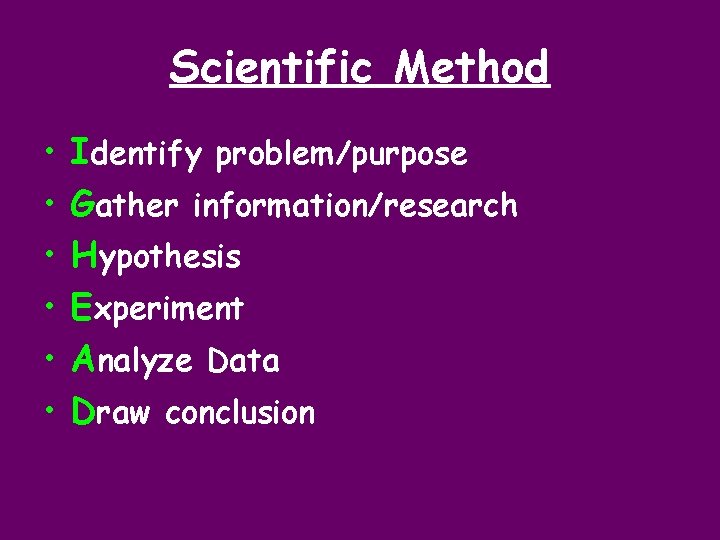
Scientific Method • • • Identify problem/purpose Gather information/research Hypothesis Experiment Analyze Data Draw conclusion
Scientific Method • Most investigations begin with an observation – Observation • The act of noting or perceiving objects or events by using the senses – Observations typically lead to the identification of a question or problem. This is the first step of the scientific method
Scientific Method • Step 2: Gather information – What do you know about the problem? – What do you need to find out about the problem? – What materials do I need to solve my problem.

Scientific Method • Step 3: Formulate a Hypothesis – Hypothesis: a testable idea or explanation that leads to scientific investigation – Educated guess • an explanation that can be tested through specific and reproducible observations

Scientific Method • Step 4: Experiment – procedure that is carried out under controlled conditions to test a hypothesis • Most experiments have two groups: control & experimental • In the control group, all conditions are kept the same • In the experimental group, testable factors or variables are introduced
Scientific Method • Designing an experiment – Independent variable • variable that affects the outcome of the experiment – EX: Changing the water temperature of a fish tank. – Dependent variable • depends on changes made to independent variables – EX: By changing the water temp (independent variable), the fish movement changes (dependent variable). – The dependent variable DEPENDS on the independent variable.
Scientific Method • Step 5: Analyze the data – Data are the results of your experiment. – They will help you answer the question. • Final step: Drawing conclusions! – Conclusions explain the results and data of the experiment
Theory vs. Law – Theory • an explanation of a natural phenomenon that is supported by a large body of scientific evidence obtained from many different investigations and observations. • Repeated testing of hypothesis • Ex: Theory of Evolution – Law • Fact of nature • Ex: Laws of Gravity and Motion
Kinds of Research • Qualitative – descriptive data, observations, etc. – investigates the why and how; not just what, where, and when • Quantitative – Theories and hypotheses are refined, technical advances are made, and so on. – Physics, taxonomy, and anatomy – numerical data (SI Units) • System based on series of 10’s
- Slides: 11