
The Scientific Method Learning Goal Recognize and apply

- Slides: 13
The Scientific Method Learning Goal: Recognize and apply the steps of the scientific method
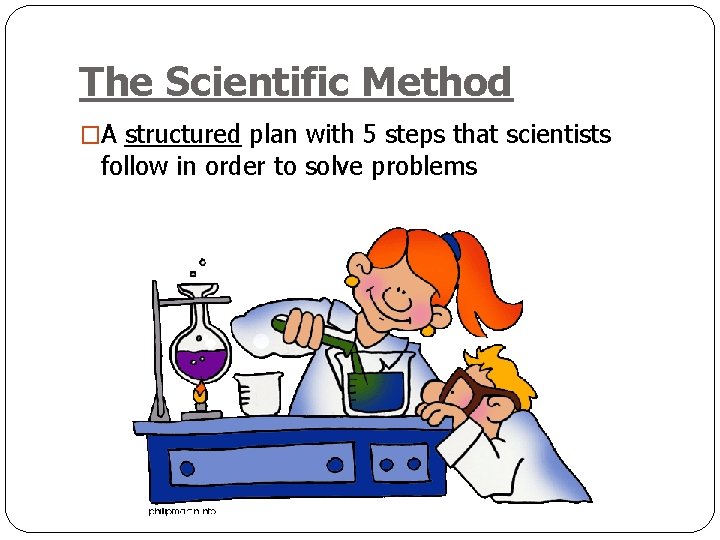
The Scientific Method �A structured plan with 5 steps that scientists follow in order to solve problems
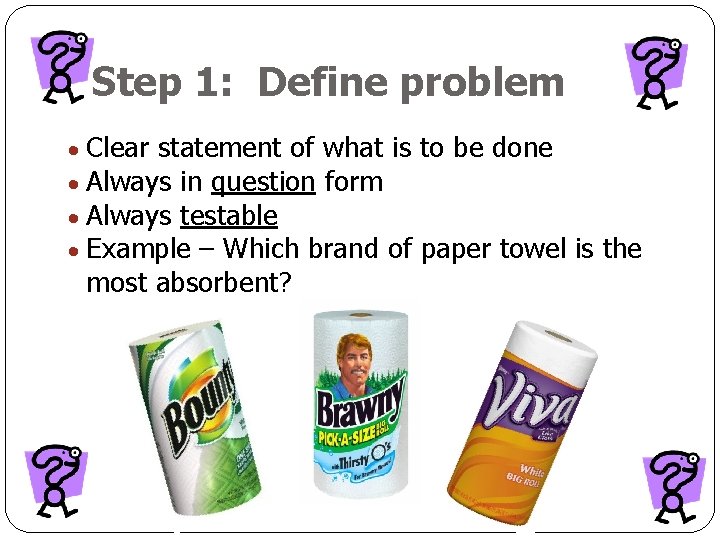
Step 1: Define problem Clear statement of what is to be done Always in question form Always testable Example – Which brand of paper towel is the most absorbent?
Step 2: Collect information • Research on topic using a variety of sources (books, magazines, internet)
Step 3: Form a hypothesis An educated guess about the solution to a problem based on collected information Always in statement form “IF – THEN” (BECAUSE) Example – IF Bounty, Sparkle, and Brawny paper towels are tested, THEN Bounty will be the most absorbent.
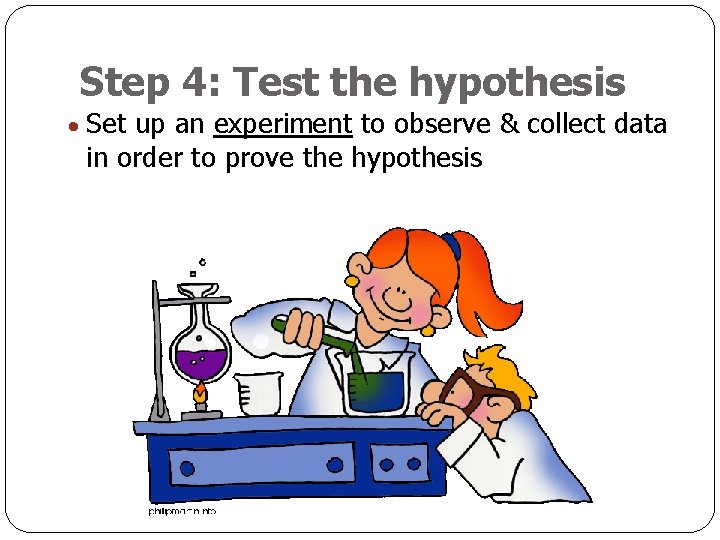
Step 4: Test the hypothesis Set up an experiment to observe & collect data in order to prove the hypothesis
Step 5: Communicate the results Scientists present the results of the experiment Write paper for a journal, present results at conference, conventions, create website, video/TV
Let’s Practice!!! Smithers thinks that a special juice will increase the productivity of workers. He creates two groups of 50 workers each and assigns each group the same task (in this case, they're supposed to staple a set of papers). Group A is given the special juice to drink while they work. Group B is not given the special juice. After an hour, Smithers counts how many stacks of papers each group has made. Group A made 1, 587 stacks, Group B made 2, 113 stacks.
Smithers thinks that a special juice will increase the productivity of workers. He creates two groups of 50 workers each and assigns each group the same task (in this case, they're supposed to staple a set of papers). Group A is given the special juice to drink while they work. Group B is not given the special juice. After an hour, Smithers counts how many stacks of papers each group has made. Group A made 1, 587 stacks, Group B made 2, 113 stacks. Problem – What will increase the productivity of the workers? If workers drink the special juice, then their Hypothesis – productivity will increase. Independent Variable – Dependent Variable – Control – Conclusion –
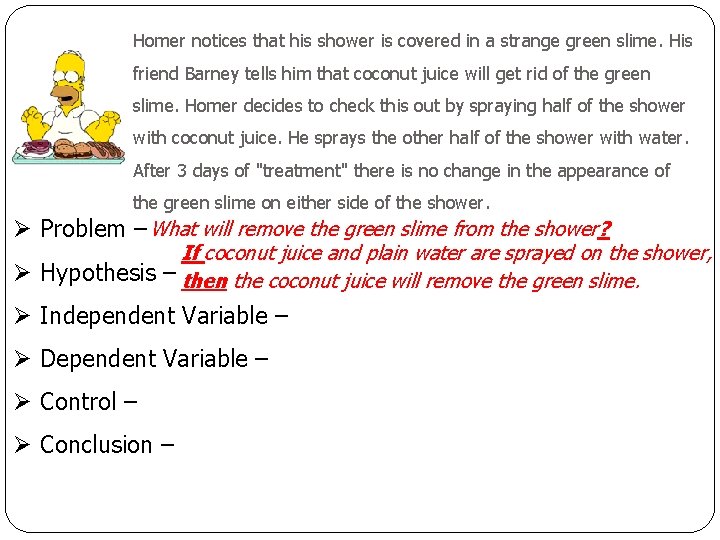
Homer notices that his shower is covered in a strange green slime. His friend Barney tells him that coconut juice will get rid of the green slime. Homer decides to check this out by spraying half of the shower with coconut juice. He sprays the other half of the shower with water. After 3 days of "treatment" there is no change in the appearance of the green slime on either side of the shower. Problem – What will remove the green slime from the shower? If coconut juice and plain water are sprayed on the shower, Hypothesis – then the coconut juice will remove the green slime. Independent Variable – Dependent Variable – Control – Conclusion –
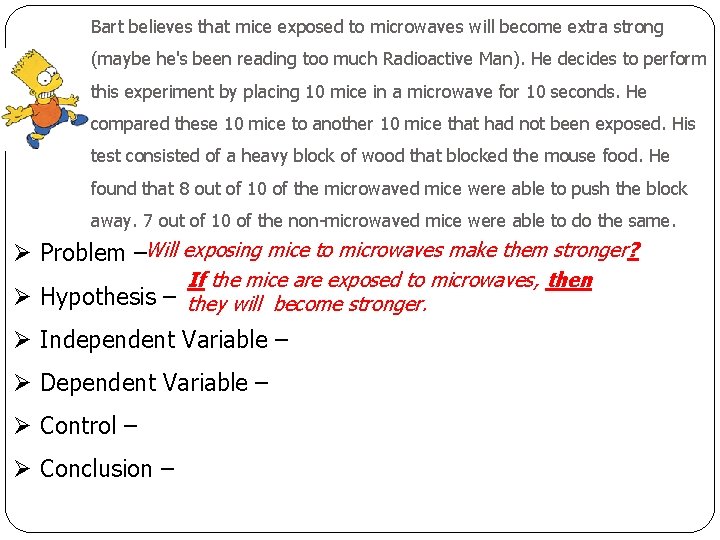
Bart believes that mice exposed to microwaves will become extra strong (maybe he's been reading too much Radioactive Man). He decides to perform this experiment by placing 10 mice in a microwave for 10 seconds. He compared these 10 mice to another 10 mice that had not been exposed. His test consisted of a heavy block of wood that blocked the mouse food. He found that 8 out of 10 of the microwaved mice were able to push the block away. 7 out of 10 of the non-microwaved mice were able to do the same. Problem –Will exposing mice to microwaves make them stronger? If the mice are exposed to microwaves, then Hypothesis – they will become stronger. Independent Variable – Dependent Variable – Control – Conclusion –
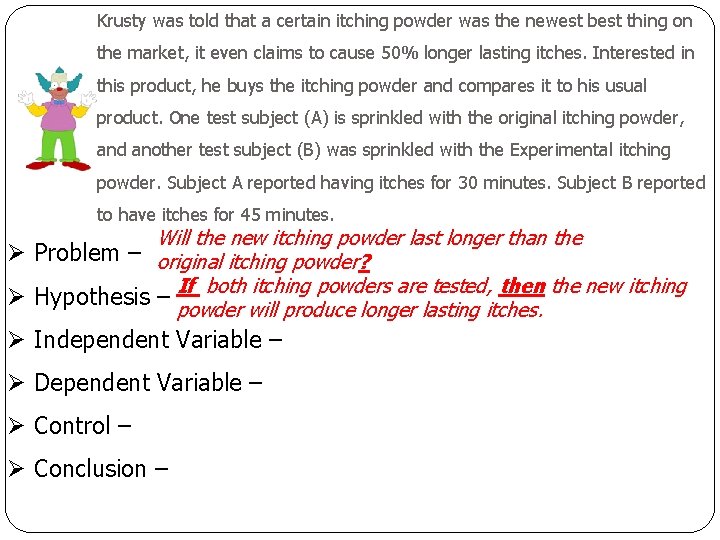
Krusty was told that a certain itching powder was the newest best thing on the market, it even claims to cause 50% longer lasting itches. Interested in this product, he buys the itching powder and compares it to his usual product. One test subject (A) is sprinkled with the original itching powder, and another test subject (B) was sprinkled with the Experimental itching powder. Subject A reported having itches for 30 minutes. Subject B reported to have itches for 45 minutes. Will the new itching powder last longer than the Problem – original itching powder? Hypothesis – If both itching powders are tested, then the new itching powder will produce longer lasting itches. Independent Variable – Dependent Variable – Control – Conclusion –
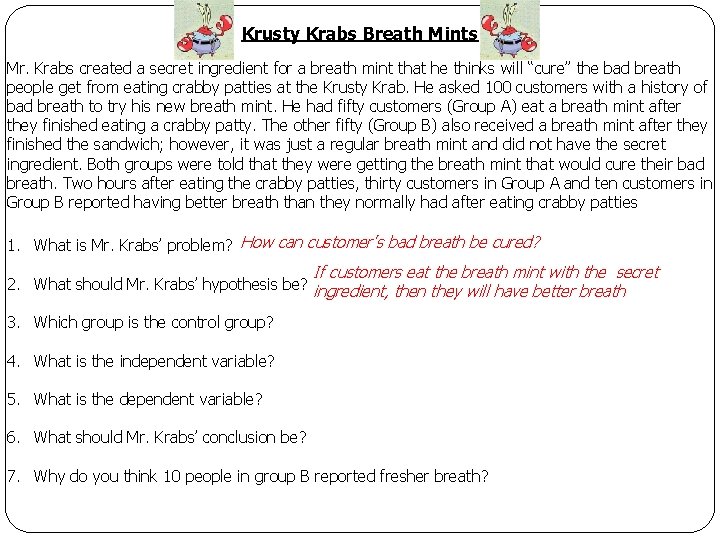
Krusty Krabs Breath Mints Mr. Krabs created a secret ingredient for a breath mint that he thinks will “cure” the bad breath people get from eating crabby patties at the Krusty Krab. He asked 100 customers with a history of bad breath to try his new breath mint. He had fifty customers (Group A) eat a breath mint after they finished eating a crabby patty. The other fifty (Group B) also received a breath mint after they finished the sandwich; however, it was just a regular breath mint and did not have the secret ingredient. Both groups were told that they were getting the breath mint that would cure their bad breath. Two hours after eating the crabby patties, thirty customers in Group A and ten customers in Group B reported having better breath than they normally had after eating crabby patties 1. What is Mr. Krabs’ problem? How can customer’s bad breath be cured? If customers eat the breath mint with the secret 2. What should Mr. Krabs’ hypothesis be? ingredient, then they will have better breath 3. Which group is the control group? 4. What is the independent variable? 5. What is the dependent variable? 6. What should Mr. Krabs’ conclusion be? 7. Why do you think 10 people in group B reported fresher breath?