
THE SCIENTIFIC METHOD How do scientists perform GOOD


- Slides: 63
THE SCIENTIFIC METHOD How do scientists perform GOOD experiments?
The Scientific Method A universal approach to scientific problem solving through a series of well-defined steps
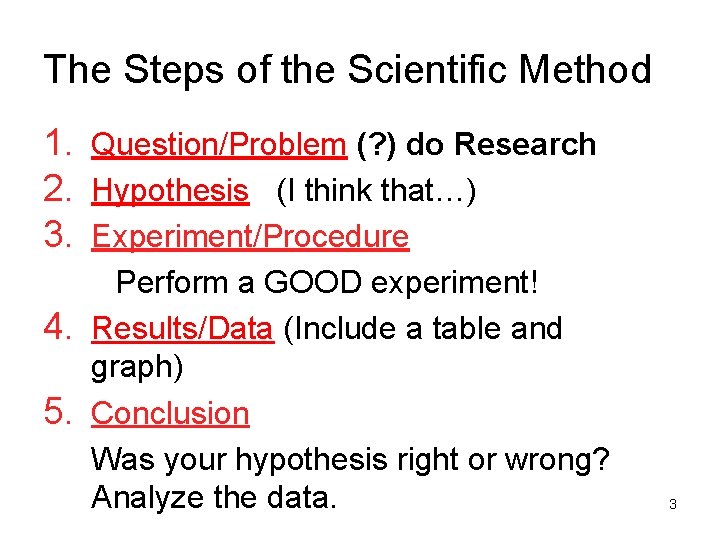
The Steps of the Scientific Method 1. Question/Problem (? ) do Research 2. Hypothesis (I think that…) 3. Experiment/Procedure Perform a GOOD experiment! 4. Results/Data (Include a table and graph) 5. Conclusion Was your hypothesis right or wrong? Analyze the data. 3
PROBLEM 1 - Defining the Problem -Stated in the form of a question that defines a specific problem for investigation Ex- Do plants need water to grow?
RESEARCH 2 - Research the Problem - Library, internet, periodicals, textbooks, encyclopedias, newspaper, scientists, teachers, TV
HYPOTHESIS 3 - Develop a Hypothesis (educated guess) - A possible explanation for an observed set of facts - Reasoning, guesswork, and inspiration Ex- Plants need water to grow
PROCEDURE 4 - Procedure (Design an experiment to test the hypothesis) - list of materials - detailed and easy to follow step by step set of instructions for carrying out experiment.
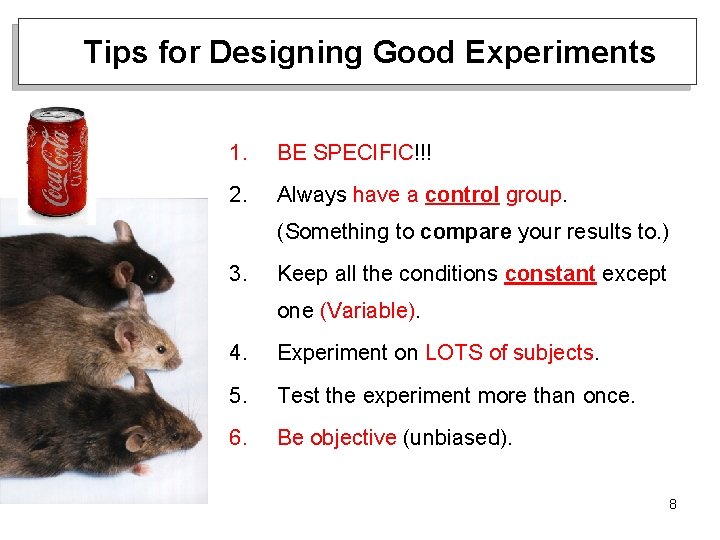
Tips for Designing Good Experiments 1. BE SPECIFIC!!! 2. Always have a control group. (Something to compare your results to. ) 3. Keep all the conditions constant except one (Variable). 4. Experiment on LOTS of subjects. 5. Test the experiment more than once. 6. Be objective (unbiased). 8
What is the control group for? • The purpose of the CONTROL group is to have something to COMPARE your experimental results to.
• Constants- Factors that are not changed (Ex- plants, soil, sunlight, location) – Control- No factors are changed, a reference setup, standard for comparison
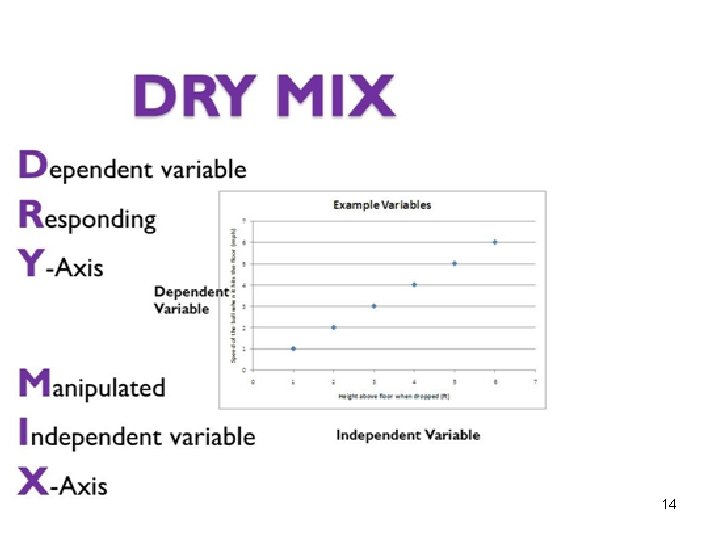
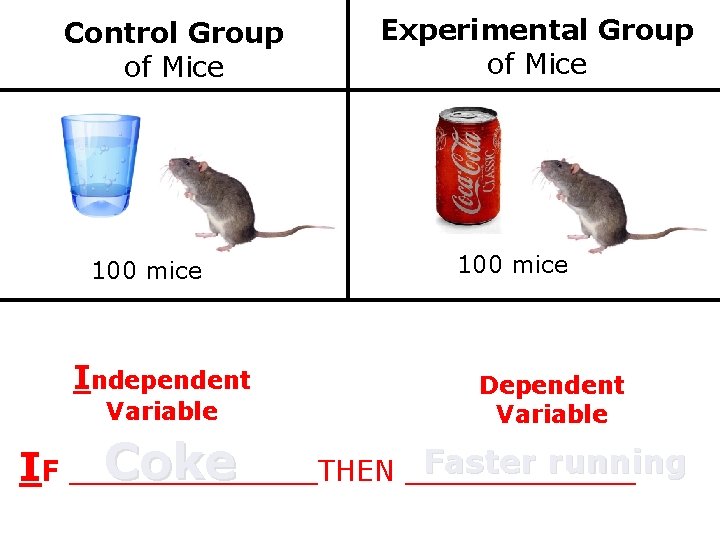
PROCEDURE • Variable- A factor that changes in an experiment • Independent variable- factor which is changed as part of the procedure (what is being tested) Ex- amount of water for plants • Dependent variable- factor that changes as a result of the independent variable. – (example: plant growth (data)
Your 2 groups of test subjects: • Control Group= Normal Group, gets nothing. • Experimental /independent group Gets the Ind. Variable The 2 things that are allowed to be different: • Independent Variable = What you varied on purpose. • Dependent Variable = What varied as a result of your experiment. • Constants: Things that can NOT vary. 12
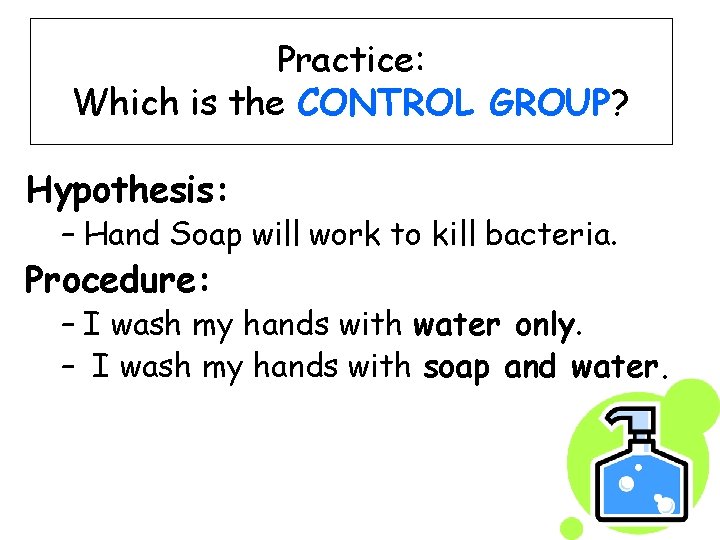
Practice: Which is the CONTROL GROUP? Hypothesis: – Hand Soap will work to kill bacteria. Procedure: – I wash my hands with water only. – I wash my hands with soap and water. 13
14
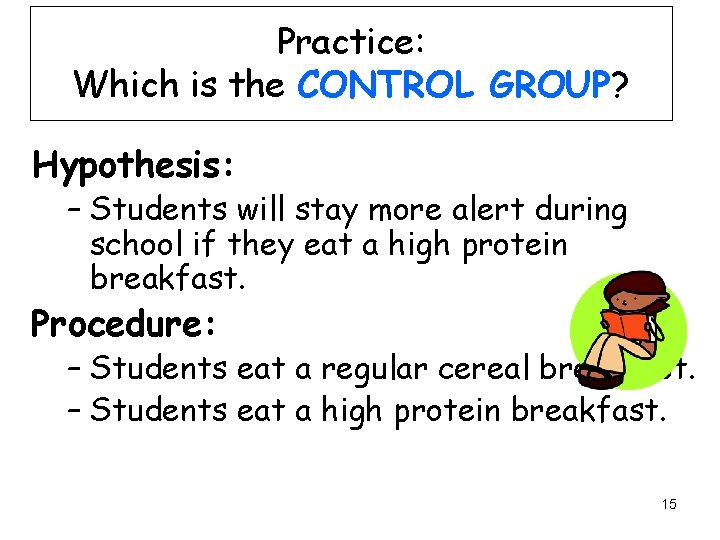
Practice: Which is the CONTROL GROUP? Hypothesis: – Students will stay more alert during school if they eat a high protein breakfast. Procedure: – Students eat a regular cereal breakfast. – Students eat a high protein breakfast. 15
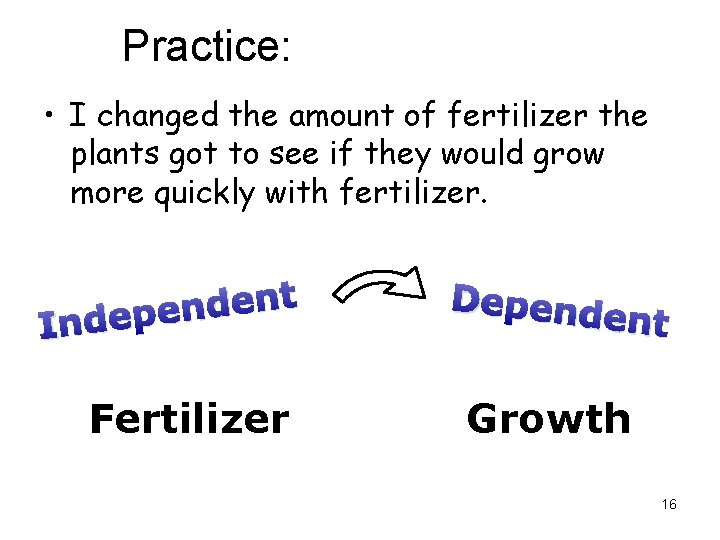
Practice: • I changed the amount of fertilizer the plants got to see if they would grow more quickly with fertilizer. I t n e d n ndepe Fertilizer Depend ent Growth 16
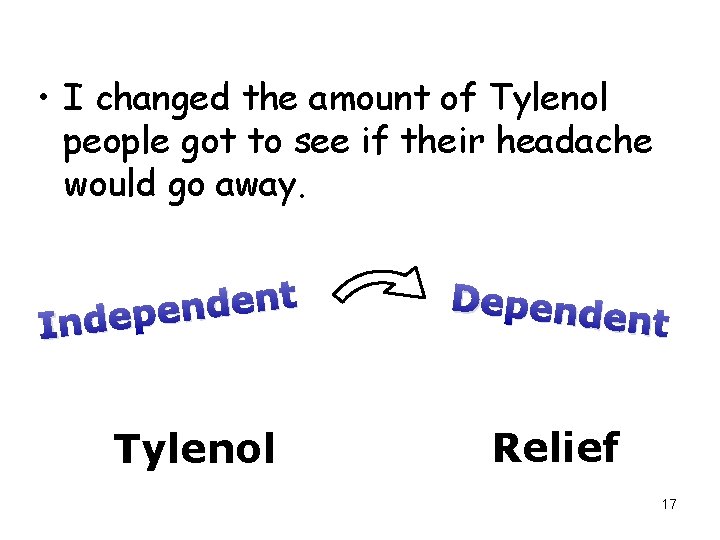
• I changed the amount of Tylenol people got to see if their headache would go away. I t n e d n ndepe Tylenol Depend ent Relief 17
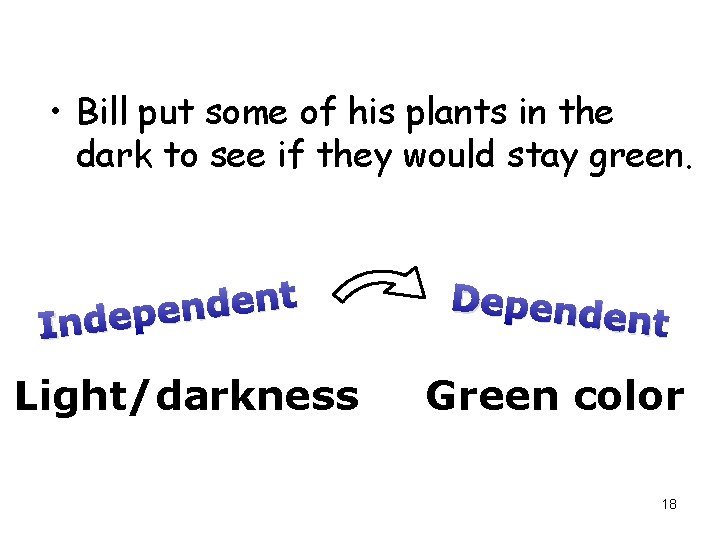
• Bill put some of his plants in the dark to see if they would stay green. I t n e d n ndepe Light/darkness Depend ent Green color 18
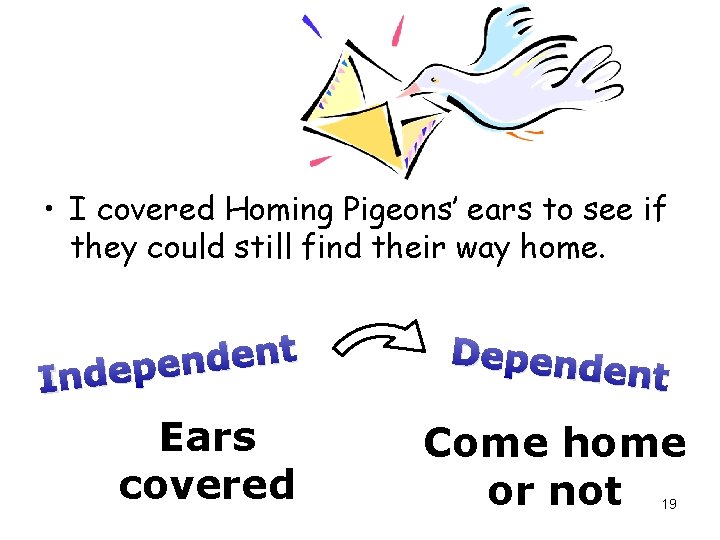
• I covered Homing Pigeons’ ears to see if they could still find their way home. t n e d depen In Ears covered Depend ent Come home or not 19
Test/experiment 5 - Test the Hypothesis - experiment and results must be repeatable to be valid Ex- Plants that are not watered do not grow
DATA 6 - Record and Organize Data Observations – What happened during experiment. Qualitative Observations- descriptions based on observer’s senses (Ex- Watered plants are taller) Quantitative Observations- accurate measurements and numerical results obtained using tools and instruments (Ex- The watered plants grew 3 inches more than those that were not watered)
DATA • Record Data- Charts, graphs, Tables, Diagrams, Photographs • Analyze Data- Look for patterns or relationships Interpret- try to make sense of the data
CONCLUSIONS 7 - Interpret results and draw conclusions • Does data support, modify or disprove hypothesis? • The conclusion is the answer to the original problem and should prove or disprove the hypothesis. • Ex- Plants need water to grow
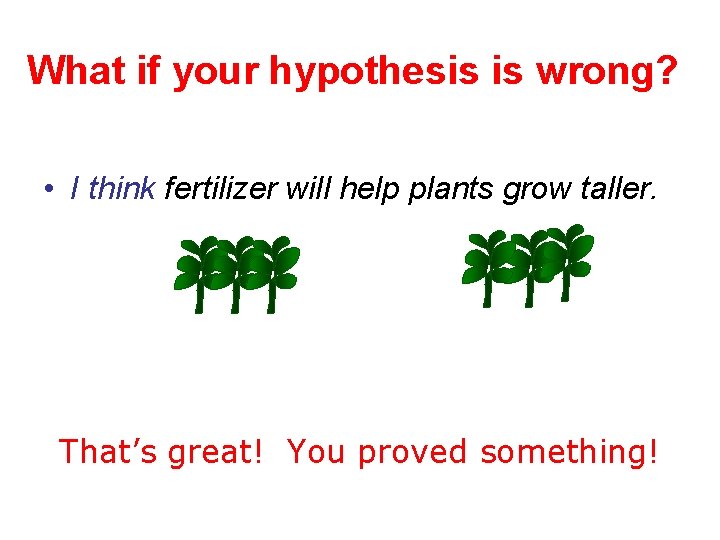
What if your hypothesis is wrong? • I think fertilizer will help plants grow taller. That’s great! You proved something!
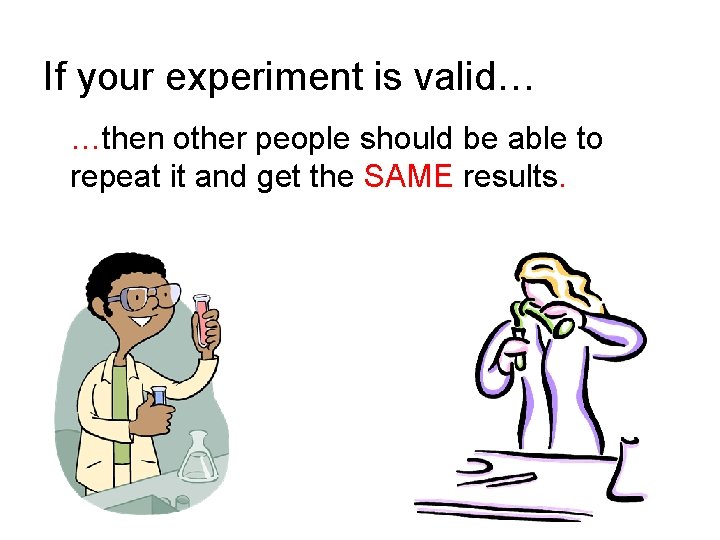
If your experiment is valid… …then other people should be able to repeat it and get the SAME results.
REPORT • All aspects of an experiment must be recorded accurately and reported in detail so that it can be repeated by other investigators • If good enough then it is published in scientific journals.
THEORIES • Explanations that apply to a broad range of phenomena and are supported by experimental evidence, attempts to explain the cause of the phenomena • Ex- Theory of Evolution
SCIENTIFIC LAW • Describe an aspect of a phenomena that is always true, a particular event or relationship always exists under certain conditions • Does not explain how or why • Ex- Law of Gravity
Practice problems Which Step is It? 29
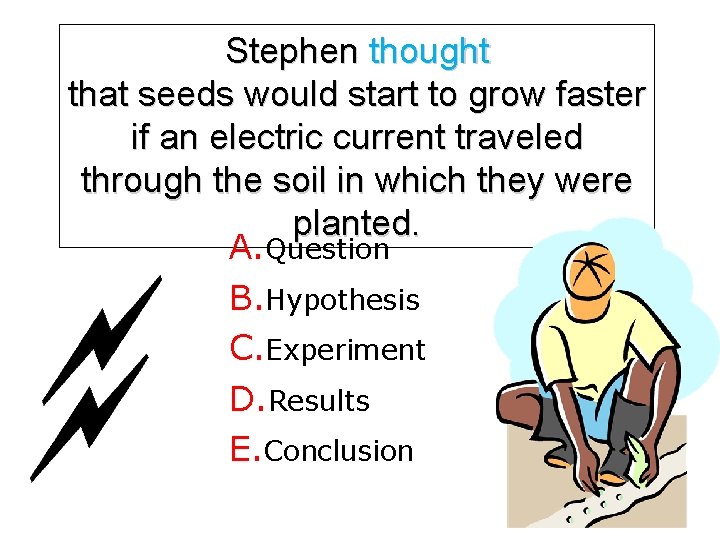
Stephen thought that seeds would start to grow faster if an electric current traveled through the soil in which they were planted. A. Question B. Hypothesis C. Experiment D. Results E. Conclusion 30
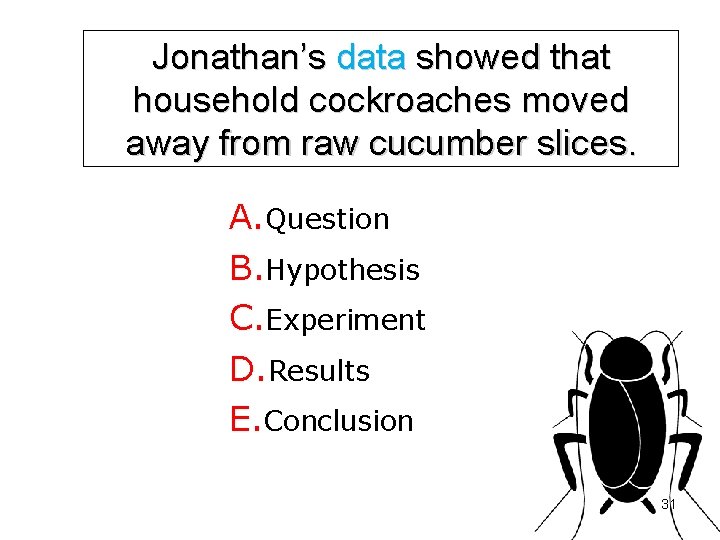
Jonathan’s data showed that household cockroaches moved away from raw cucumber slices. A. Question B. Hypothesis C. Experiment D. Results E. Conclusion 31
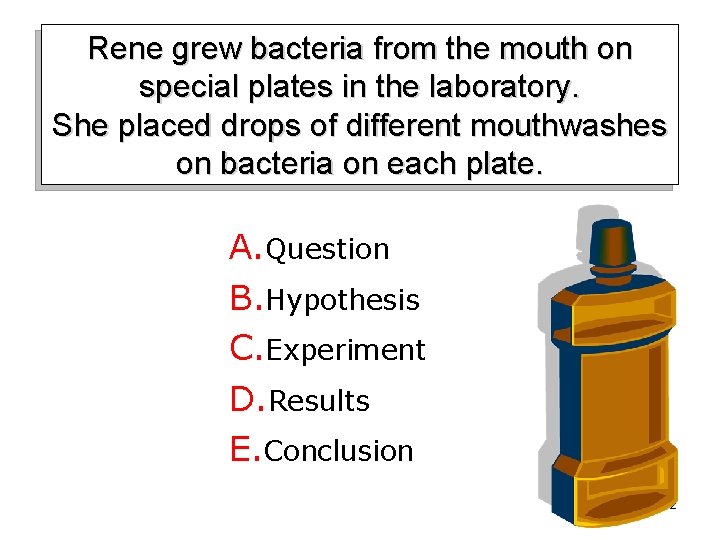
Rene grew bacteria from the mouth on special plates in the laboratory. She placed drops of different mouthwashes on bacteria on each plate. A. Question B. Hypothesis C. Experiment D. Results E. Conclusion 32
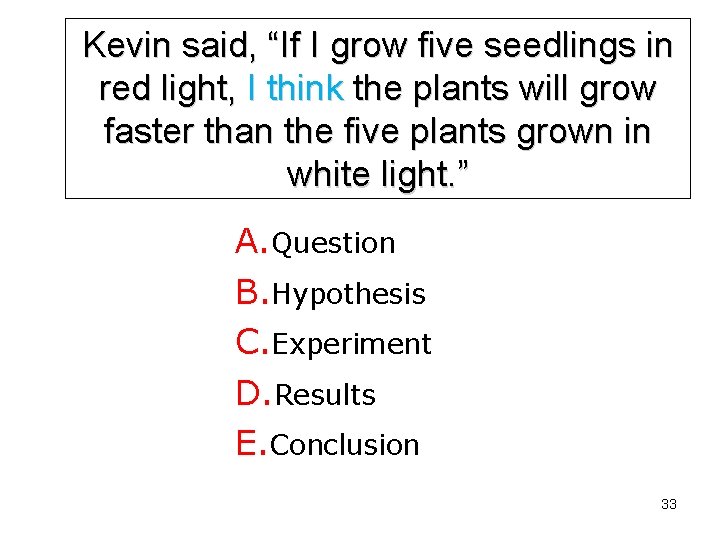
Kevin said, “If I grow five seedlings in red light, I think the plants will grow faster than the five plants grown in white light. ” A. Question B. Hypothesis C. Experiment D. Results E. Conclusion 33
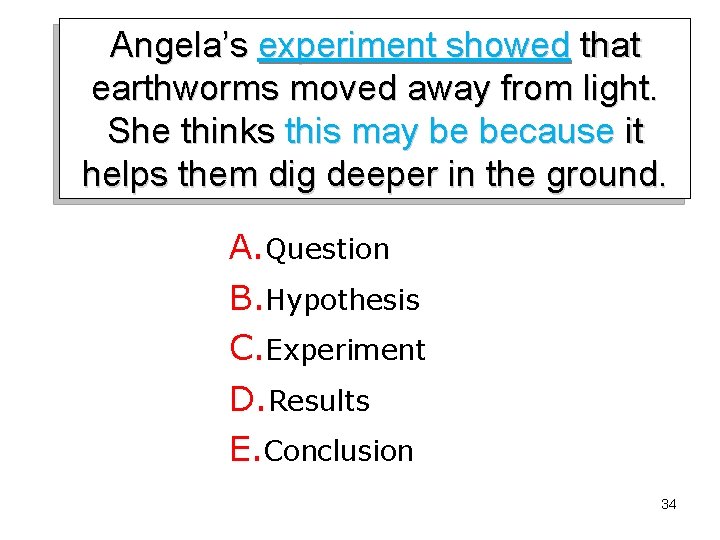
Angela’s experiment showed that earthworms moved away from light. She thinks this may be because it helps them dig deeper in the ground. A. Question B. Hypothesis C. Experiment D. Results E. Conclusion 34
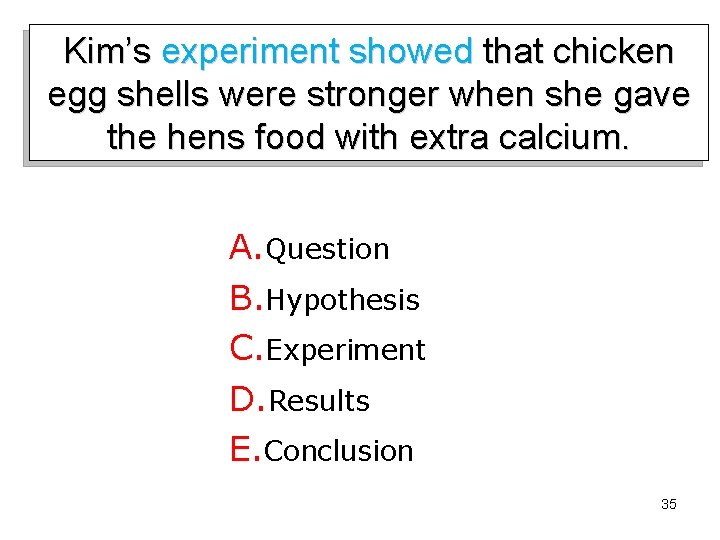
Kim’s experiment showed that chicken egg shells were stronger when she gave the hens food with extra calcium. A. Question B. Hypothesis C. Experiment D. Results E. Conclusion 35
Practice experiments • Do plants grow better with fertilizer? 36
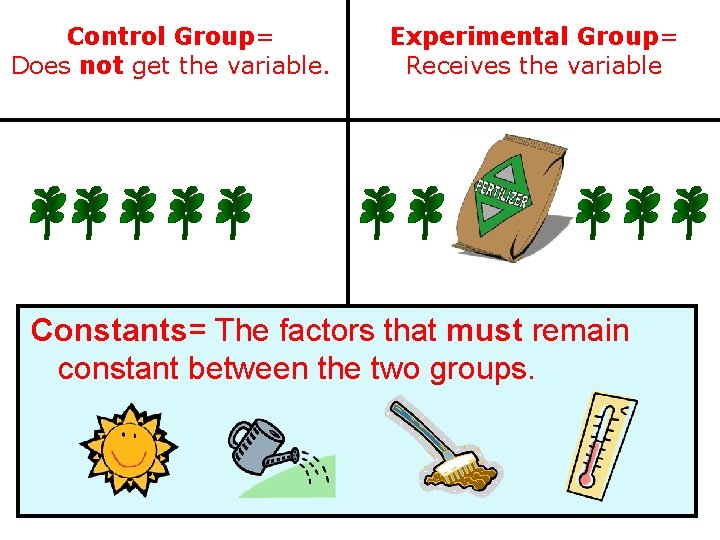
Control Group= Does not get the variable. Experimental Group= Receives the variable Constants= The factors that must remain constant between the two groups.
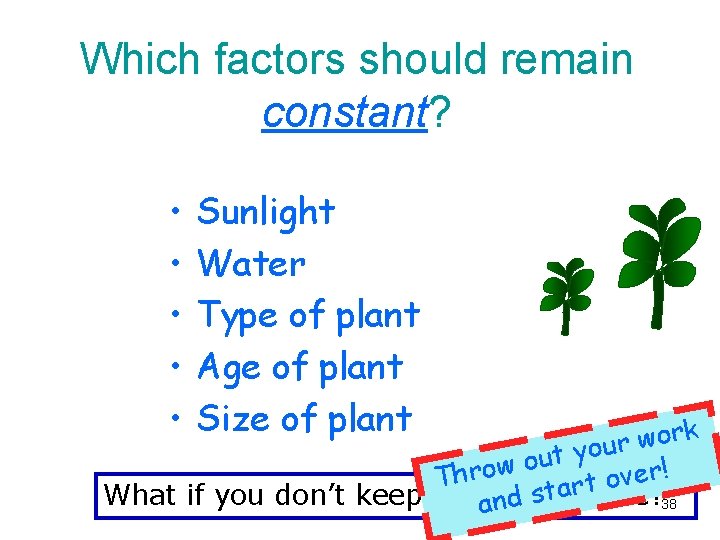
Which factors should remain constant? • • • Sunlight Water Type of plant Age of plant Size of plant k r o w ur o y t u o w ! o r r e v Th o t r a t s What if you don’t keep these the same? 38 and
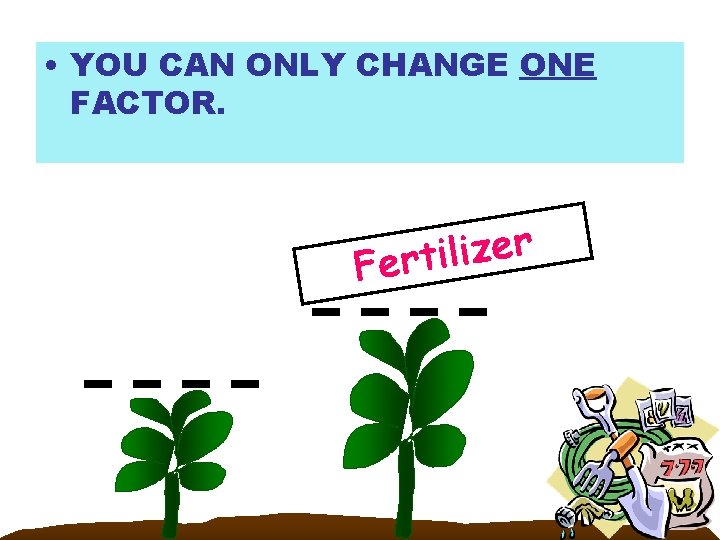
• YOU CAN ONLY CHANGE ONE FACTOR. r e z i l Ferti 39
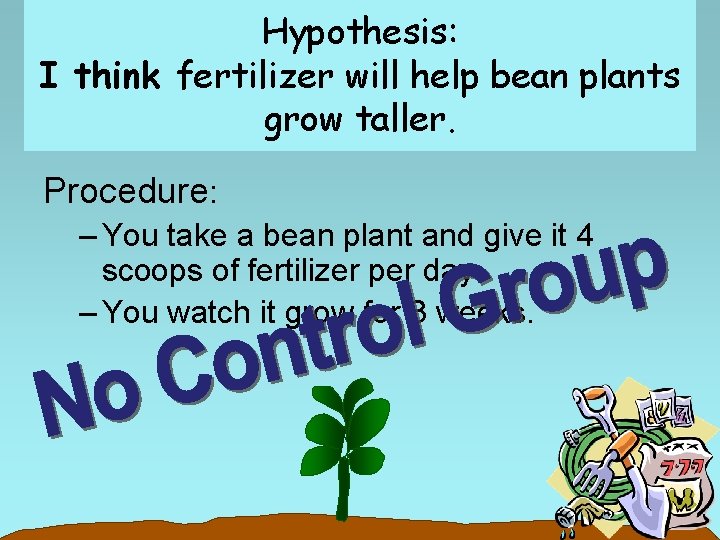
Hypothesis: I think fertilizer will help bean plants grow taller. Procedure: – You take a bean plant and give it 4 scoops of fertilizer per day. – You watch it grow for 3 weeks. 40
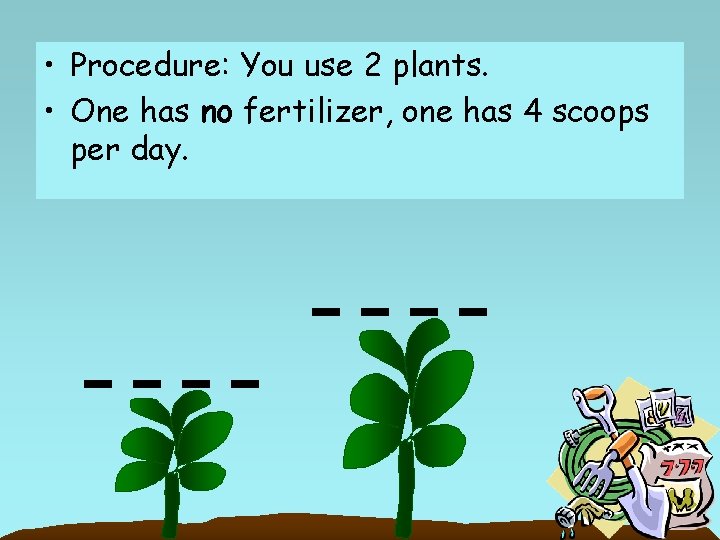
• Procedure: You use 2 plants. • One has no fertilizer, one has 4 scoops per day. 41
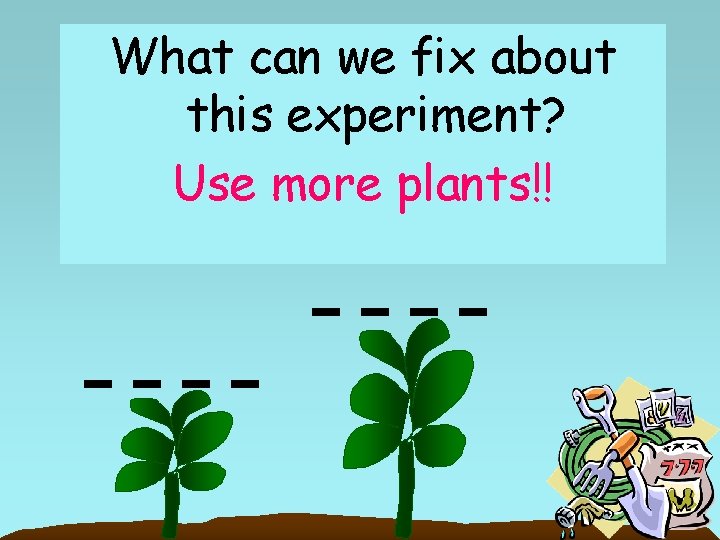
What can we fix about this experiment? Use more plants!! 42
Practice experiments • Tylenol experiment 43
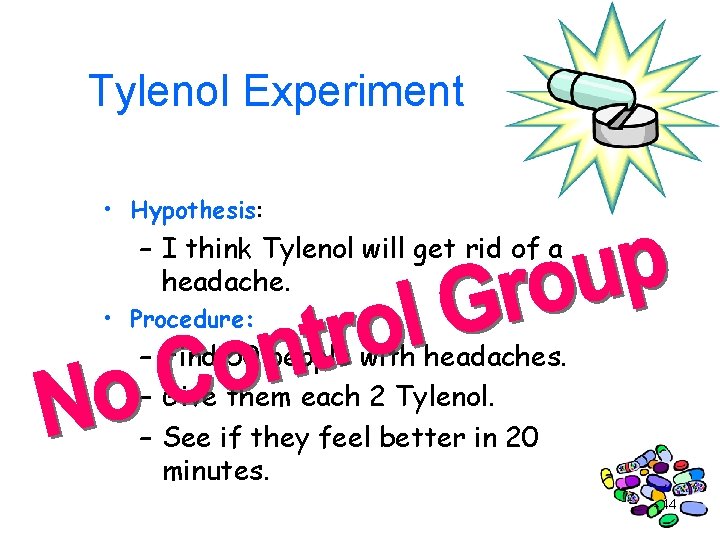
Tylenol Experiment • Hypothesis: – I think Tylenol will get rid of a headache. • Procedure: – Find 50 people with headaches. – Give them each 2 Tylenol. – See if they feel better in 20 minutes. 44
Tylenol Experiment • Hypothesis: – I think Tylenol will get rid of a headache. • Procedure: – – Find 100 people with headaches. Give 50 of them 2 Tylenol. Give 50 of them NOTHING. See if they feel better in 20 minutes. 45
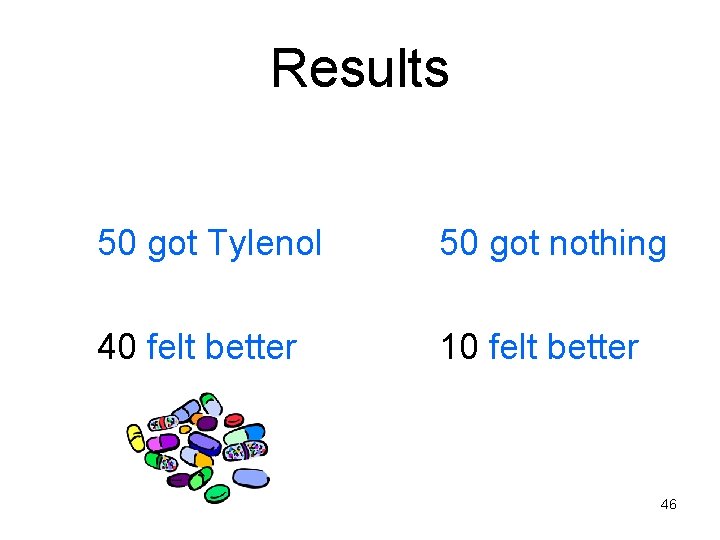
Results 50 got Tylenol 50 got nothing 40 felt better 10 felt better 46
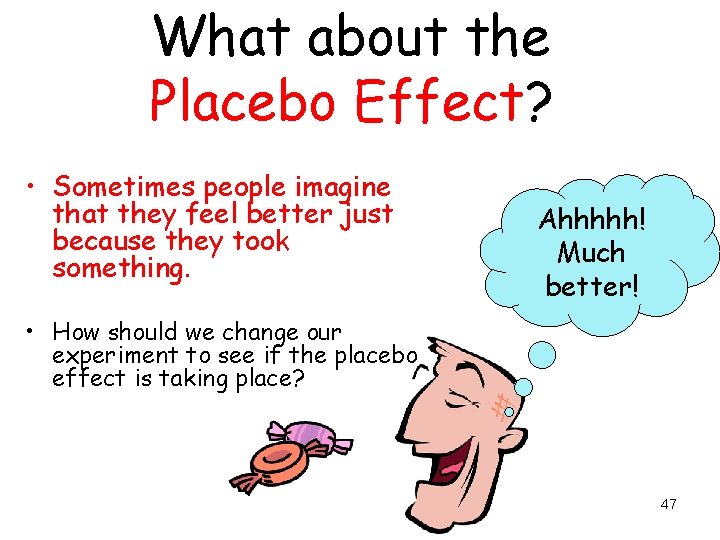
What about the Placebo Effect? • Sometimes people imagine that they feel better just because they took something. Ahhhhh! Much better! • How should we change our experiment to see if the placebo effect is taking place? 47
Tylenol Experiment • Procedure: – Find 100 people with headaches. – Give 50 of them 2 Tylenol. – Give 50 of them a Placebo (2 sugar pills). – See if they feel better in 20 minutes. 48
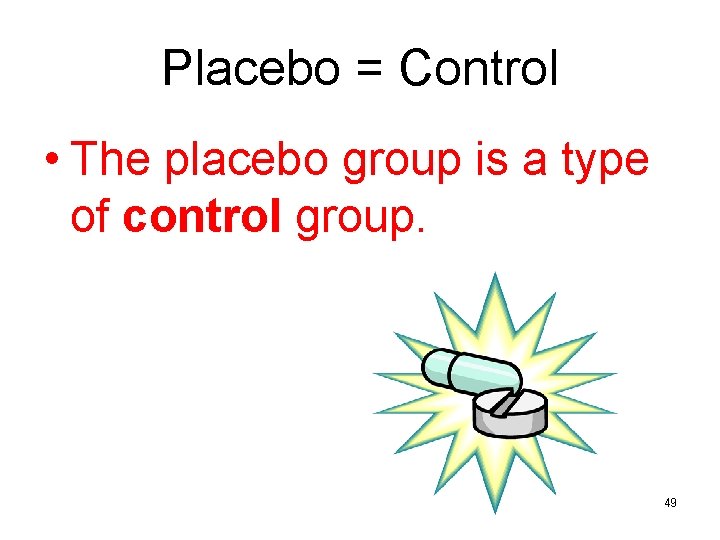
Placebo = Control • The placebo group is a type of control group. 49
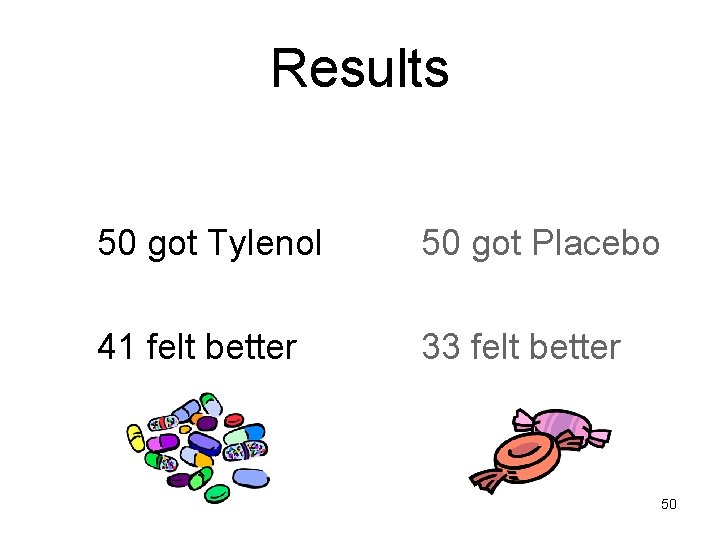
Results 50 got Tylenol 50 got Placebo 41 felt better 33 felt better 50
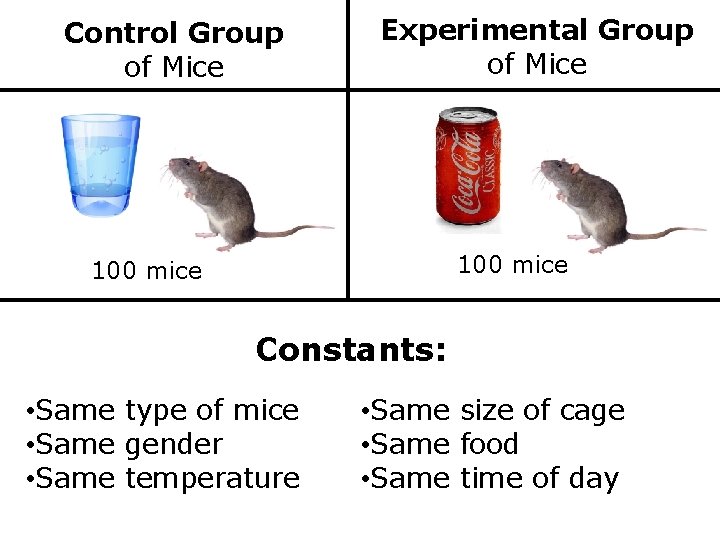
Practice experiments • Will mice who receive coca cola run faster on the wheel? 51
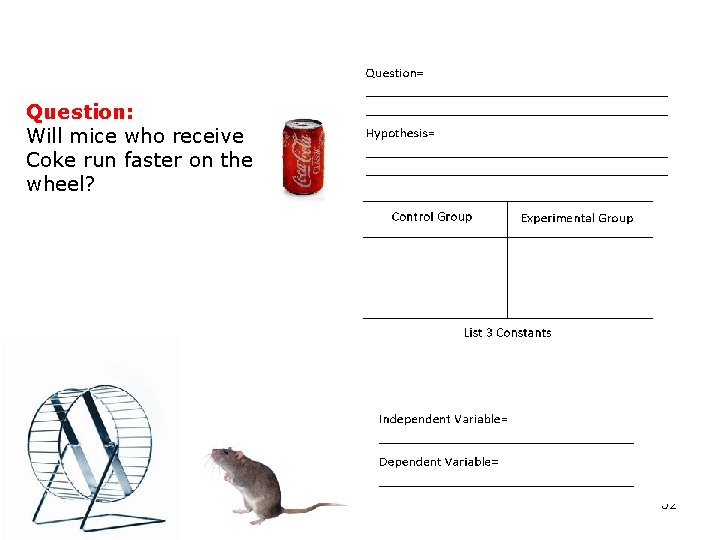
Question: Will mice who receive Coke run faster on the wheel? 52
Control Group of Mice Experimental Group of Mice 100 mice Constants: • Same type of mice • Same gender • Same temperature • Same size of cage • Same food • Same time of day
Control Group of Mice 100 mice Independent Variable Experimental Group of Mice 100 mice Dependent Variable Faster running Coke IF _______THEN _______
55
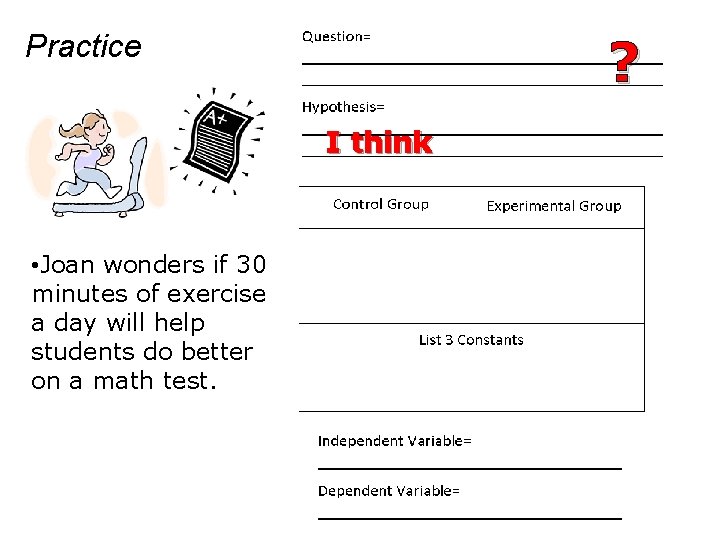
? Practice I think • Joan wonders if 30 minutes of exercise a day will help students do better on a math test. 56
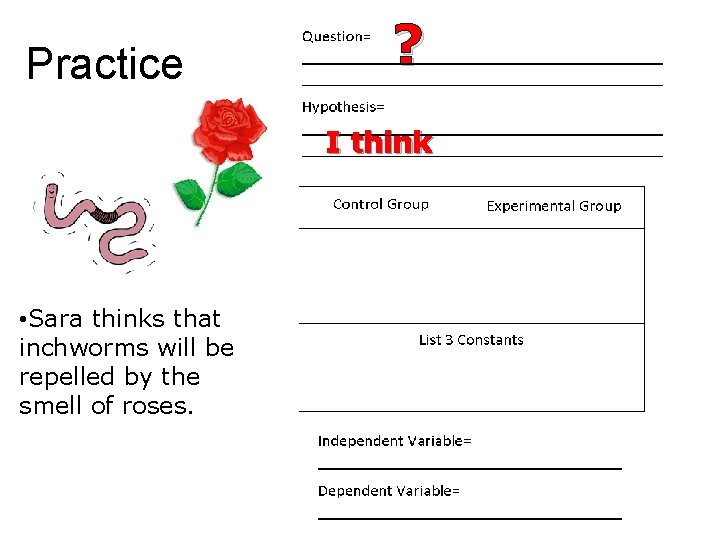
Practice ? I think • Sara thinks that inchworms will be repelled by the smell of roses. 57
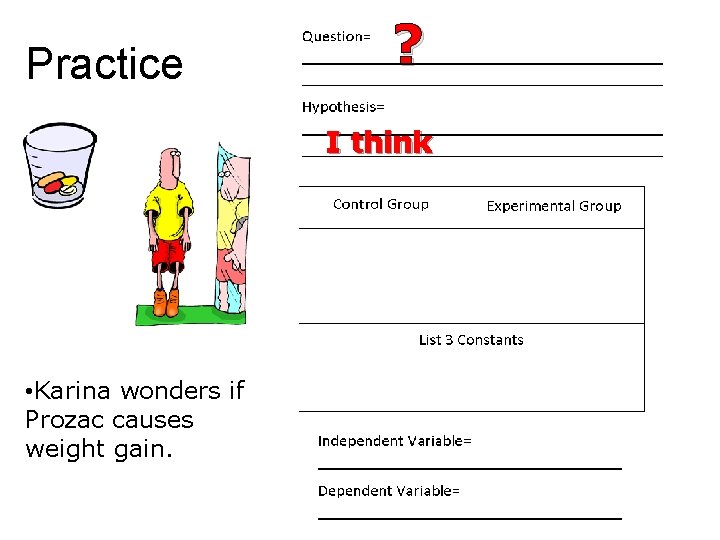
Practice ? I think • Karina wonders if Prozac causes weight gain. 58
59
Contest: Design the best experiment! Winning group will get: • 10/10 on the assignment. • And Homework Passes! “Non-winning” group will get an appropriate grade out of 10. 60
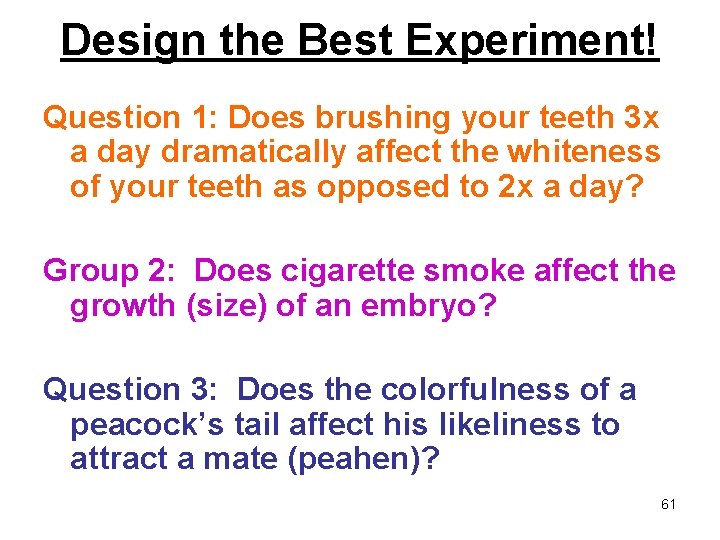
Design the Best Experiment! Question 1: Does brushing your teeth 3 x a day dramatically affect the whiteness of your teeth as opposed to 2 x a day? Group 2: Does cigarette smoke affect the growth (size) of an embryo? Question 3: Does the colorfulness of a peacock’s tail affect his likeliness to attract a mate (peahen)? 61
Remember: • • Control Group vs Experimental Group Constants Test a large number of subjects Ethics (no human subjects can be harmed by your actions) 62
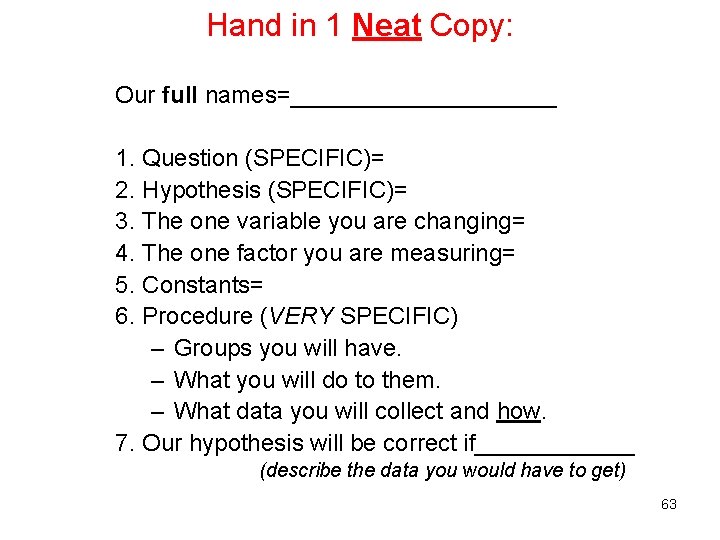
Hand in 1 Neat Copy: Our full names=__________ 1. Question (SPECIFIC)= 2. Hypothesis (SPECIFIC)= 3. The one variable you are changing= 4. The one factor you are measuring= 5. Constants= 6. Procedure (VERY SPECIFIC) – Groups you will have. – What you will do to them. – What data you will collect and how. 7. Our hypothesis will be correct if______ (describe the data you would have to get) 63