
The Scientific Method and the Nature of Science

- Slides: 21
The Scientific Method …and the Nature of Science th 7 Grade Science
What is science? l Science is the total collection of knowledge gained by observation of the physical universe. l It tries to answer the questions "how" and "why. " l It is a logical way of problem solving. l It is basically common sense.
Why Should I Care About Science? First, a Good Brain. A workable knowledge of science means you can think, decide, and judge the reality around you, whatever or wherever that may be. l Second, Money. Scientists make more money than any other common profession, on a reliable basis. In essence, if you have a college degree in a science, you’re gonna have a good job. l Third, Power. Knowledge is power. l
The Scientific World View l The world is understandable - truth exists, we just have to find it! l Scientific theories are subject to change, and that’s totally cool. l Science cannot provide answers to all questions. Why not?
Characteristics of Science l Science is a process l Scientific predict theories must be able to l Scientific experiments must be repeatable l Confidence in theories is not absolute
The Limitations of Science l Cannot make value judgments. l Cannot prove something doesn't exist (universal negative, or, the god question). l Scientific investigation is as limited as the instruments we use.
Inductive and Deductive Approaches l Inductive Approach l Collect information, then create a theory to explain it (a theory about what’s going on) l Use experiments or observations to make predictions about the future l Induction comes from “induce”, which means to cause to be, or to create l Used by scientists trying to discover or explain phenomena that are occurring now, or may occur in the future
Inductive and Deductive Approaches l Deductive Approach l Use observations to create an explanation about past events or observed phenomena (stuff that already happened) l Take your information and make a Postdiction that can be tested with experiments l Used by Police, CSI specialists, archaeologists, geologists, astronomers…
Scientific Vocabulary l Facts - things that are observable and indisputable. l Data - any piece of information; usually gained through experimentation. l Theories - explanations usually based on evidence (may be wrong). l Laws - statements that describe patterns in nature with no known exceptions. l Models - man-made ideas to help us visualize scientific concepts.
Theory vs. Law? l The difference between a theory and a law is not one of "truth" or how confident we feel about an idea. Theories don't become Laws by being proven. l A Law is a kind of Fact, it's an observation that appears to be universally true everywhere we look. A Law is usually a single statement, often an equation. l A Theory is an explanation of Facts. A Theory can include a large set of statements, which grow as the Theory is expanded and improved, often by making more observations and conducting more experiments. It explains a Fact, but it cannot become a Fact.
Hypothesis In science, a hypothesis is an idea or explanation that you then test through study and experimentation. l A hypothesis is NOT an educated guess. It’s an explanation offered in an attempt to understand a phenomenon. l There is no guessing in science! l By the way, there is no crying in science either! (this is not related to anything we’re talking about, I just like l saying that)
Steps of the Scientific Process or Method
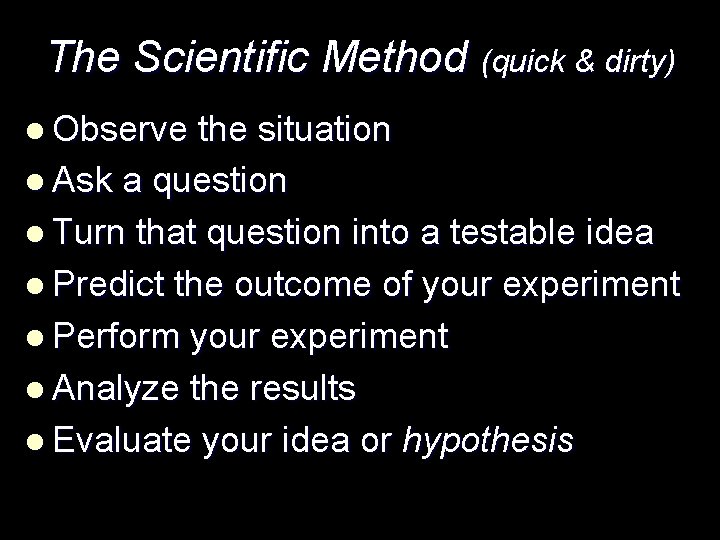
The Scientific Method (quick & dirty) l Observe the situation l Ask a question l Turn that question into a testable idea l Predict the outcome of your experiment l Perform your experiment l Analyze the results l Evaluate your idea or hypothesis
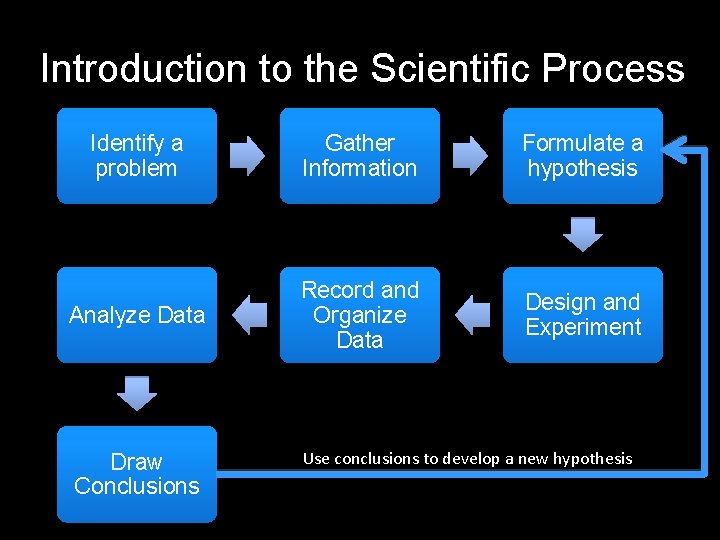
Introduction to the Scientific Process Identify a problem Gather Information Formulate a hypothesis Analyze Data Record and Organize Data Design and Experiment Draw Conclusions Use conclusions to develop a new hypothesis
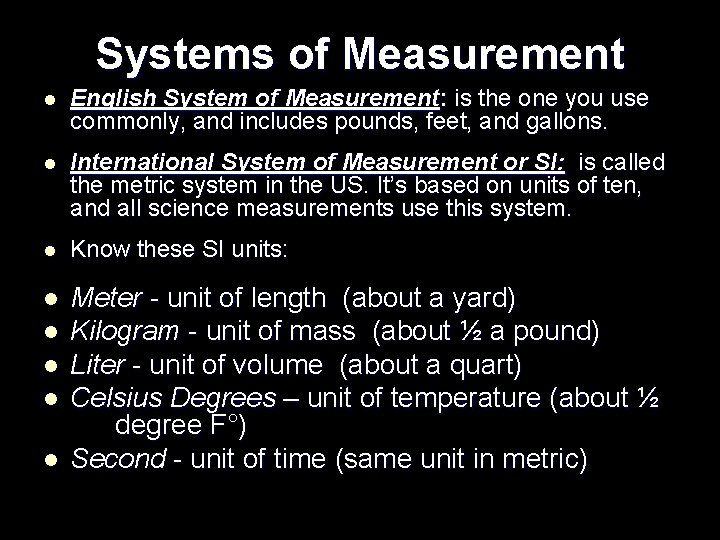
Systems of Measurement l English System of Measurement: is the one you use commonly, and includes pounds, feet, and gallons. l International System of Measurement or SI: is called the metric system in the US. It’s based on units of ten, and all science measurements use this system. l Know these SI units: l Meter - unit of length (about a yard) Kilogram - unit of mass (about ½ a pound) Liter - unit of volume (about a quart) Celsius Degrees – unit of temperature (about ½ degree F°) Second - unit of time (same unit in metric) l l
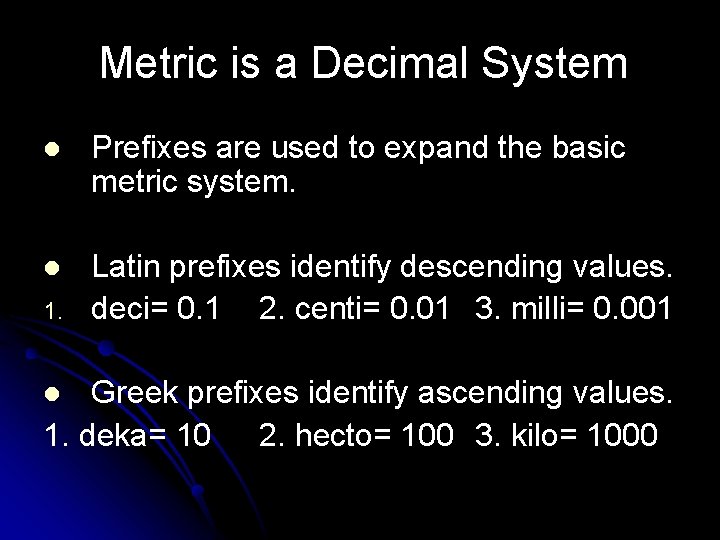
Metric is a Decimal System l Prefixes are used to expand the basic metric system. l Latin prefixes identify descending values. deci= 0. 1 2. centi= 0. 01 3. milli= 0. 001 1. Greek prefixes identify ascending values. 1. deka= 10 2. hecto= 100 3. kilo= 1000 l
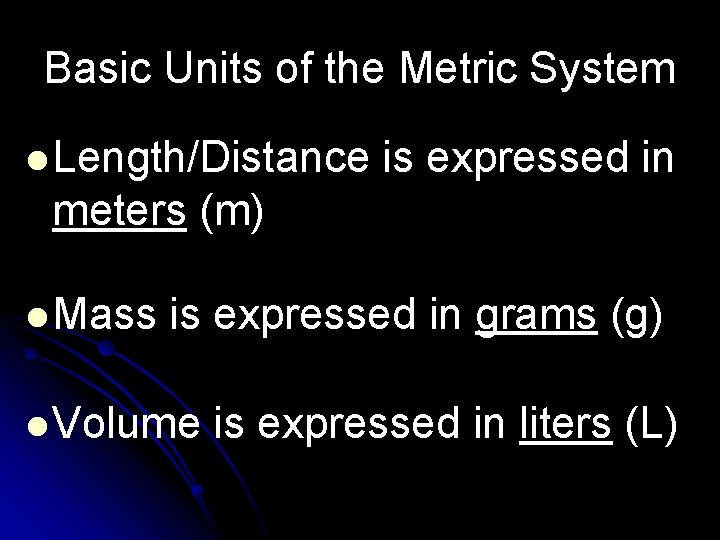
Basic Units of the Metric System l Length/Distance is expressed in meters (m) l Mass is expressed in grams (g) l Volume is expressed in liters (L)
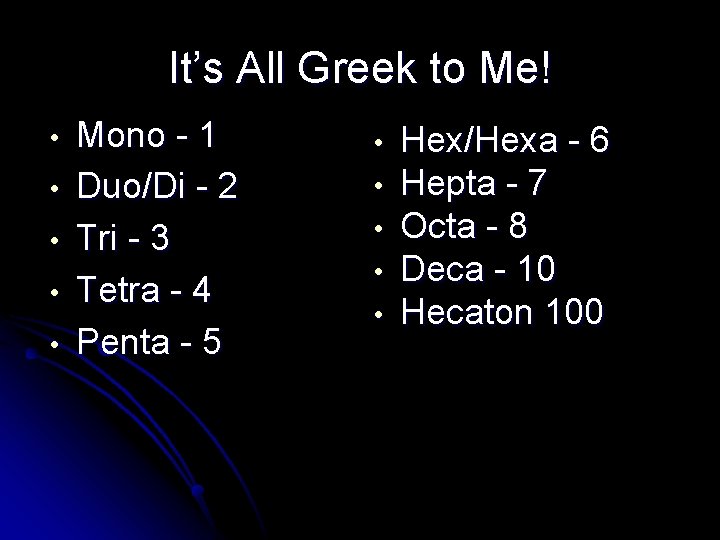
It’s All Greek to Me! • • • Mono - 1 Duo/Di - 2 Tri - 3 Tetra - 4 Penta - 5 • • • Hex/Hexa - 6 Hepta - 7 Octa - 8 Deca - 10 Hecaton 100
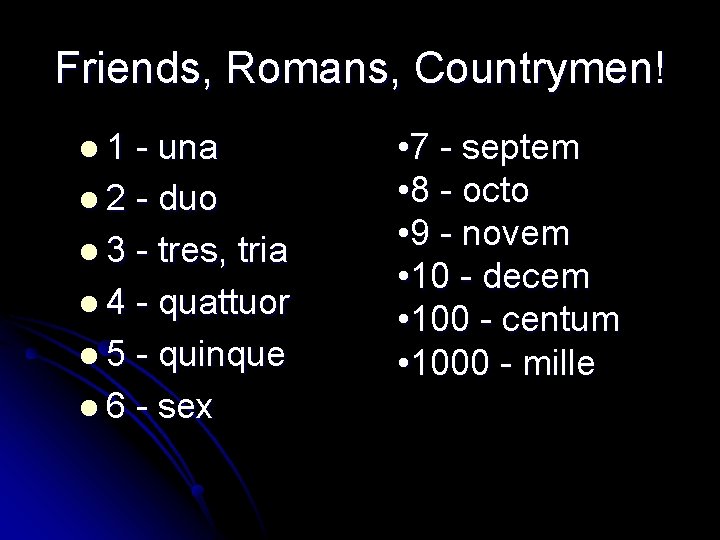
Friends, Romans, Countrymen! l 1 - una l 2 - duo l 3 - tres, tria l 4 - quattuor l 5 - quinque l 6 - sex • 7 - septem • 8 - octo • 9 - novem • 10 - decem • 100 - centum • 1000 - mille
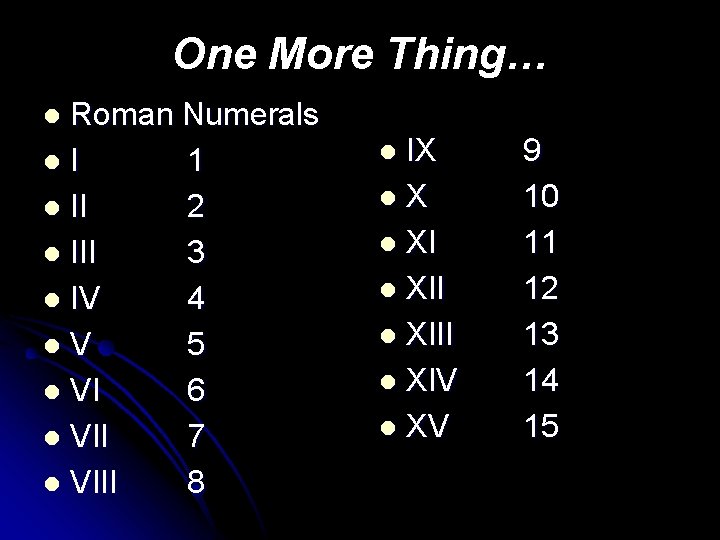
One More Thing… Roman Numerals l. I 1 l II 2 l III 3 l IV 4 l. V 5 l VI 6 l VII 7 l VIII 8 l IX l. X l XIII l XIV l XV l 9 10 11 12 13 14 15