
The Scientific Method and Taxonomic Classification BI 103
The Scientific Method and Taxonomic Classification BI 103 Marine Biology Lab 01
I. The Scientific Method n What is science? Science is special knowledge derived by a prescribed set of activities known as the scientific method. n Therefore, the scientific method is the procedure of science. n The method insures that all scientists follow the same fundamental steps in reaching their results. n
n Procedures in the scientific method n Observation all science begins with observation; anything that cannot be observed cannot be investigated by science n to be valid, scientific observations must be repeatable, actually or potentially n correct observation is a most difficult task, acquired only after long experience and many errors n
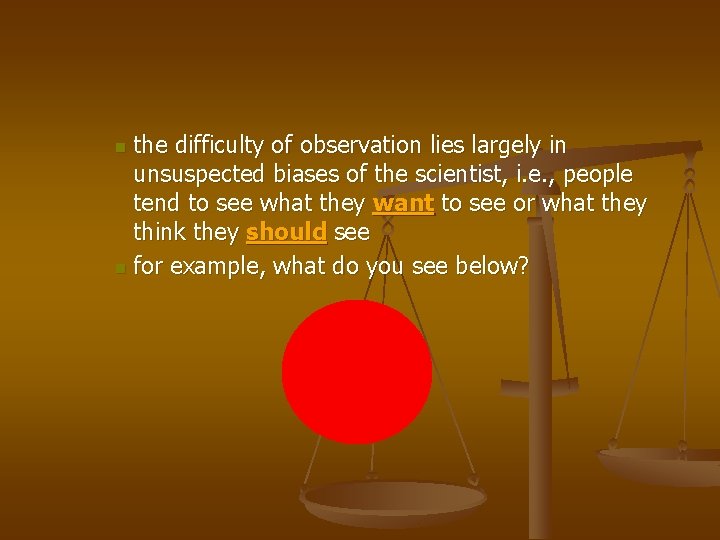
the difficulty of observation lies largely in unsuspected biases of the scientist, i. e. , people tend to see what they want to see or what they think they should see n for example, what do you see below? n
added to the difficulty of making objective observations is the objective description of what is observed n some obstacles to good observation n n n past experience subconscious prejudice “common knowledge” or “common sense” teachers! for these reasons, and more, a scientific observation is not taken at face value until several scientists have repeated the observation independently and have obtained the same results
a scientist does not collect observations because her job requires it n scientists collect observations, because they think the observations are relevant and will help solve a problem, confirm or refute a theory, or contribute to a new theory n
n scientists may use two ways of thinking! scientists do not always agree on the best way to approach scientific study n some scientists think that the only truly scientific form of thinking is induction or inductive reasoning, in which the scientist begins with a number of separate observations and then arrives at general principles n other scientists think that the purest form of scientific thinking is deduction or deductive reasoning, in which the scientist begins with general principles to reach specific conclusions n
n Problem n in defining the problem, the scientist asks questions about the observation n n most questions deal with cause and effect for some observation, not with teleology [the attribution of purpose to natural phenomena, i. e. , asking why] good questions, like good observations, are difficult to formulate
n to be valuable scientifically, a question must be n n n relevant testable the difficulty for many scientists is that it is very hard, or even impossible, to tell in advance whether a question is relevant or irrelevant, testable or untestable
n Hypothesis hypothesis formulation involves the seemingly unscientific procedure of guessing, but the guess is based on pertinent observations n a hypothesis is a tentative explanation that accounts for observed phenomena n whether the hypothesis is or is not correct is determined in the next step n
n Experimentation scientists are never content to simply make hypotheses about their observations; they are obsessed with testing the explanations to determine if they are true or false n experimentation is by far the most difficult part of the scientific method n n n there are few rules to follow, and each experiment is a case unto itself
knowledge and experience usually help technically, but to design the experiment and to decide on the means by which a hypothesis might best be tested are what separate the scientist from the layman n it is the function of every experiment to test the validity of a scientific hypothesis n experimentation must include n n controlled variables replication results of experimentation should support or refute the hypothesis
objectivity in interpreting the results is maintained through the use of statistical analysis of data n if experimentation indicates that the hypothesis is wrong, then the scientist must discard the unsupported explanation and formulate a new hypothesis that once again must be tested for validity by performing new experiments n Proof n n scientists rarely use the term, because it conveys the certainty of the mathematical concept of proof
n Theory n a theory may be proposed when n a hypothesis has been supported by a substantial body of evidence obtained in many different laboratories and by many independent researchers, and the total accumulated evidence is reliable within carefully specified limits (usually statistically within 95% confidence levels, or greater) every good theory has predictive value, i. e. , it does not necessarily say that something will happen, but only that something is likely to happen with a stated degree of probability
n thus, the aim of science is to produce new knowledge by making and using theories to explain natural phenomena, NOT to make value judgments or moral decisions
n Let’s follow the scientific method for a class exercise n Where does all scientific investigation begin? n n With an observation! Let’s start with a few simple observations.
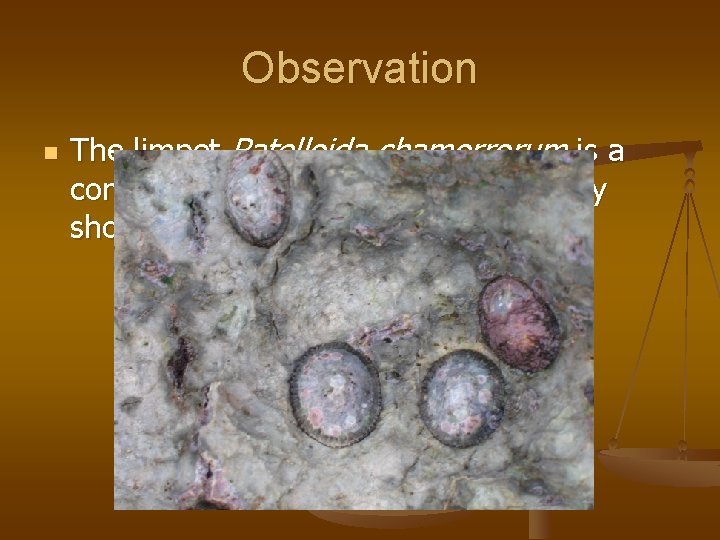
Observation n The limpet Patelloida chamorrorum is a common intertidal gastropod on rocky shores in Guam
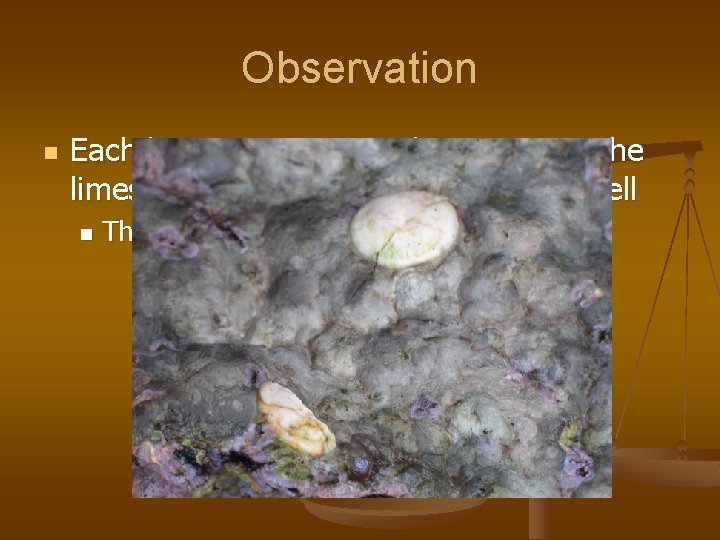
Observation n Each limpet occupies a depression in the limestone that fits the outline of its shell n The depression is called a “home scar. ”
Observation Limpets are herbivores, and they leave their home scars to graze on algae during rising and falling tides. n The depression is called a home scar, because the limpet returns to the same scar following each feeding foray n It is thought that the limpet can reduce its risk of predation and desiccation by clamping its shell to the home scar during high and low tides. n
Problem n Next step? n Define the problem by asking question(s) about the observation. n n N. B. : questions should deal with cause and effect for some observation Problem: How do these limpets find their own home scar among the thousands in the rocky intertidal?
Hypothesis n Next step? n Formulate a hypothesis. n n N. B. : To be valid, the hypothesis must be relevant and testable. Null Hypothesis (Ho): n Limpets locate their home scars by randomly searching until they find them.
Hypothesis n Hypothesis (H 1): n Limpets relocate their home scars by following the scent of the trail they made as they crawled away to graze.
Experiment n Next step? n n Design an experiment to test the hypotheses. How do we remove the trail? Scrub the trail away with a brush and detergent. n Scrub the trail away with a brush and an organic solvent. n n Result: Limpets returned directly to their home scars.
Hypothesis n n Therefore, we reject H 1 and H 0 Now what? n n Either abandon the investigation, or develop a new hypothesis. Hypothesis (H 2): n Limpets relocate their home scars by navigating the micro-landscape from memory.
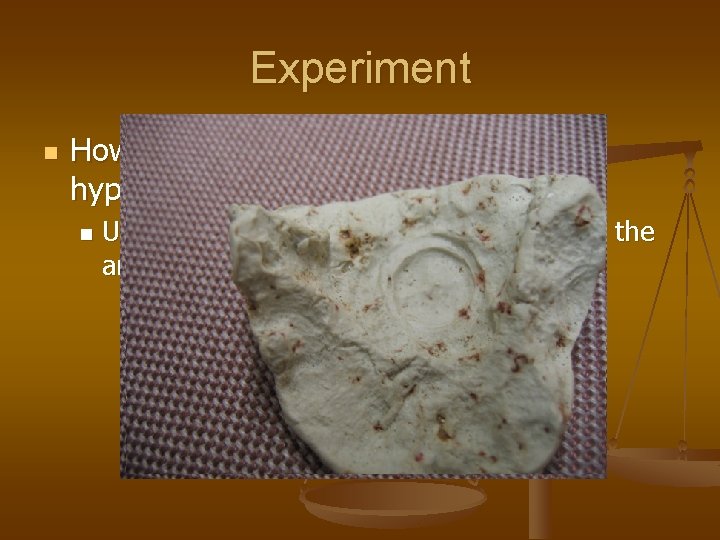
Experiment n How can we test the navigation hypothesis? n Use epoxy to produce an exact replica of the area around the home scar
n Result: Limpets will not cross over the gap between the limestone and the epoxy. n However, limpets that are placed on the epoxy do occupy their scar and will return to it after that cross the gap the first time. n We need to refine the method of implanting the false scar before our results can be accepted. n
II. Taxonomic Classification n Taxonomy is the branch of biology devoted to naming and describing organisms Any particular group of organisms is called a taxon n For example, all snails belong to the taxon known as the Class Gastropoda n
n Need for Classification Scientists need to communicate the results of their research n They must be sure that everyone understands exactly which species was studied in their research n There are more than 1 million species of animals described and about 250, 000 plant species described n
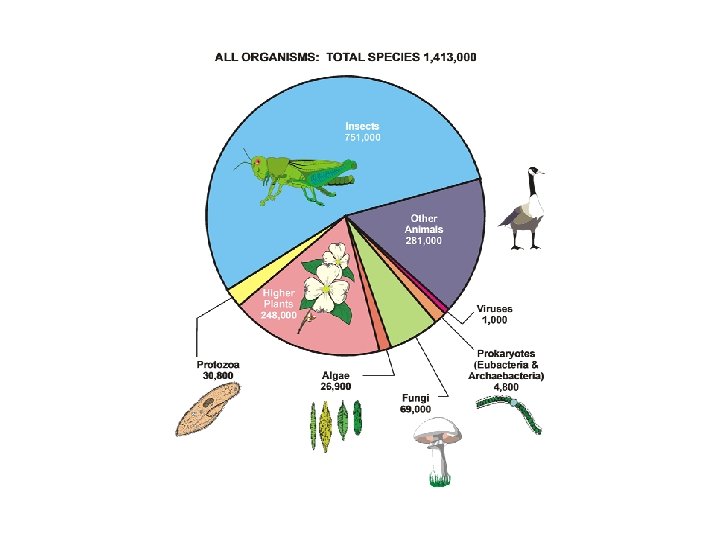
The number of undescribed species may be as many as 99 million n Therefore, scientists must be able to arrange life forms into a workable classification scheme n
§ History of Classification Over the centuries, several classification schemes have been proposed n All are hierarchical—reflecting different degrees of similarity among organisms, i. e. , similar organisms are placed together in the same taxon n n In the early years, similarity in appearance was believed to be a result of common ancestry, but there were some exceptions
n Modern classification dates from mideighteenth century n Carolus Linnaeus (1707– 1778) is considered the Father of Modern Taxonomic Classification n n Linnaeus was a Swedish medical student studying in Belgium n His real name was Carl Ingemarsson To help pay his tuition costs, Linnaeus was contracted by wealthy Dutch patrons to catalog all species in their curio cabinets
n Linnaeus adopted a system of binomial nomenclature n n He assigned a unique, two-part scientific name derived from Latin or Greek to each kind of organism Therefore, each organism is called by its Genus and species names
n Conventions of Linnaean taxonomy: n n A scientific name is always italicized or underlined A genus name begins with UPPERCASE, while a species name is lower case, e. g. , Homo sapiens or Boa constrictor n n The genus is a noun, and the specific epithet is an adjective that must agree with its noun in both number and gender When a binomial designation has been published, then it cannot be used for any other species n Why? n Binomials are unique to eliminate confusion that often arises from regional differences in common names
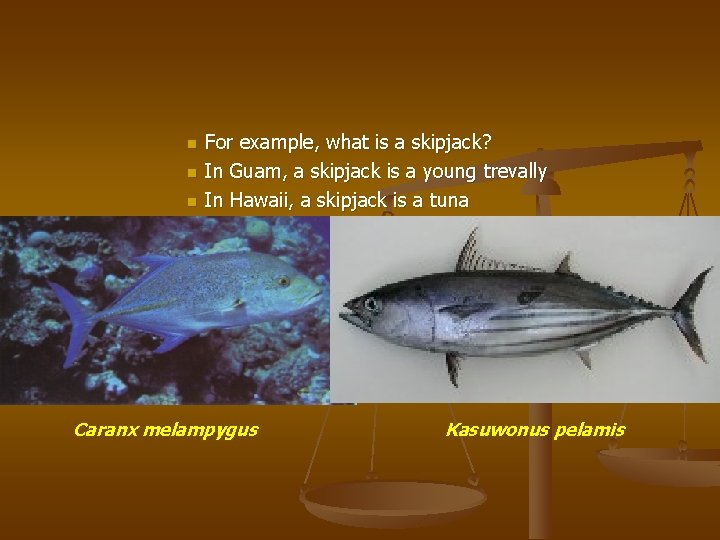
n n n For example, what is a skipjack? In Guam, a skipjack is a young trevally In Hawaii, a skipjack is a tuna Caranx melampygus Kasuwonus pelamis
n Linnaeus began his work on zoological classification with publication of the first edition of Systema Naturae in 1735 (at age 28!) n He subsequently published twelve editions of the Systema in all, but modern zoological taxonomy dates from the 10 th edition, published in 1758 Botanical classification dates from Linnaeus’ Species Plantarum published in 1753 n Linnaeus was such a proponent of his binomial system that he Latinized his own name, changing Carl to Carolus and adopting a new last name based on a huge linden tree that grew near his father’s home n
n Learning scientific names is not difficult, and can even be amusing n In fact, you already know some scientific names n
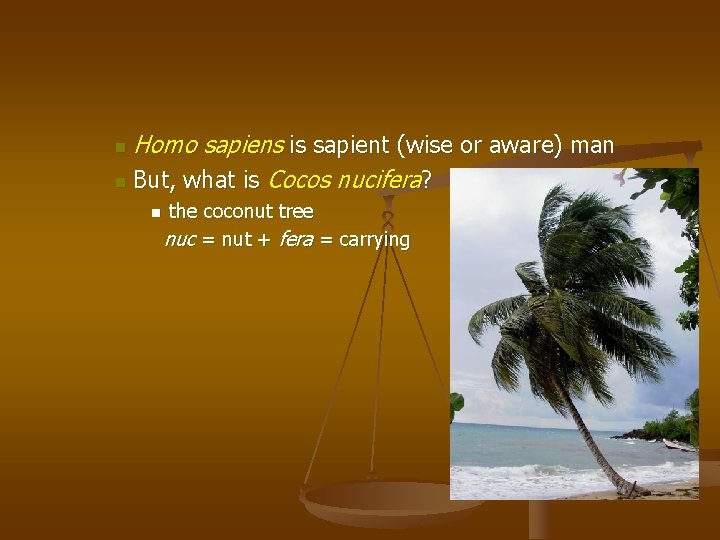
Homo sapiens is sapient (wise or aware) man n But, what is Cocos nucifera? n n the coconut tree nuc = nut + fera = carrying
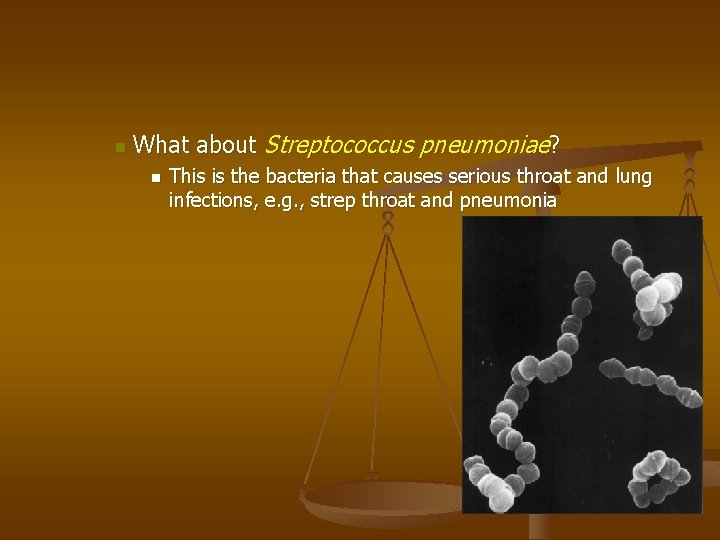
n What about Streptococcus pneumoniae? n This is the bacteria that causes serious throat and lung infections, e. g. , strep throat and pneumonia
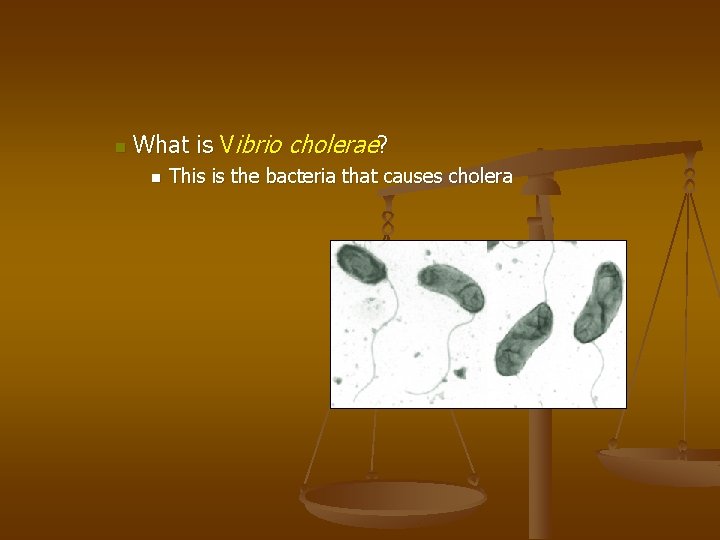
n What is Vibrio cholerae? n This is the bacteria that causes cholera
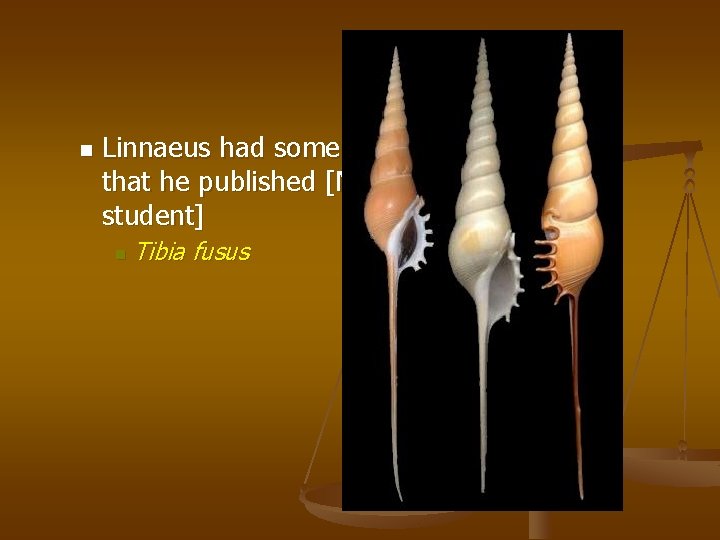
n Linnaeus had some fun with the binomials that he published [N. B. , he was a medical student] n Tibia fusus
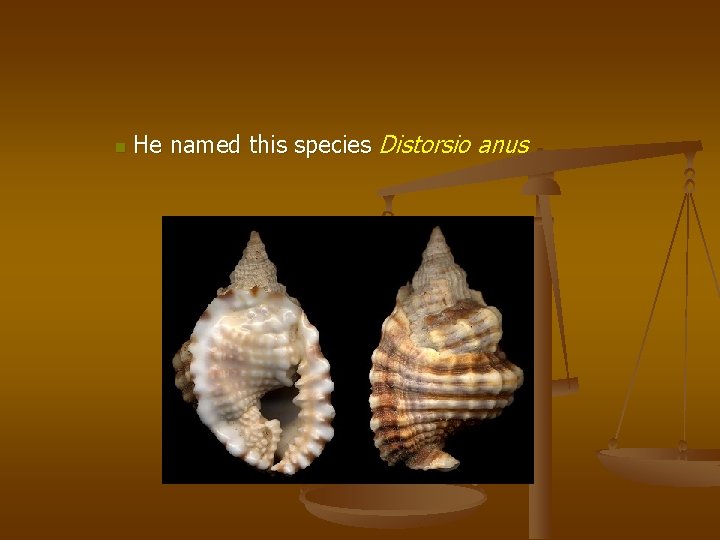
n He named this species Distorsio anus
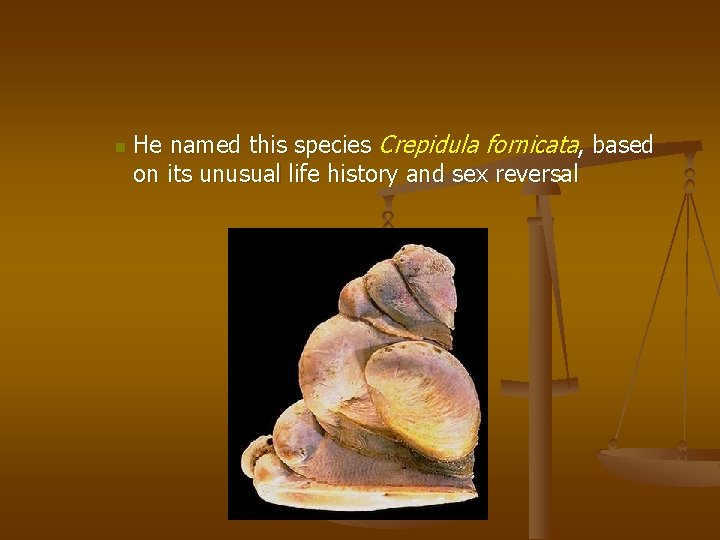
n He named this species Crepidula fornicata, based on its unusual life history and sex reversal
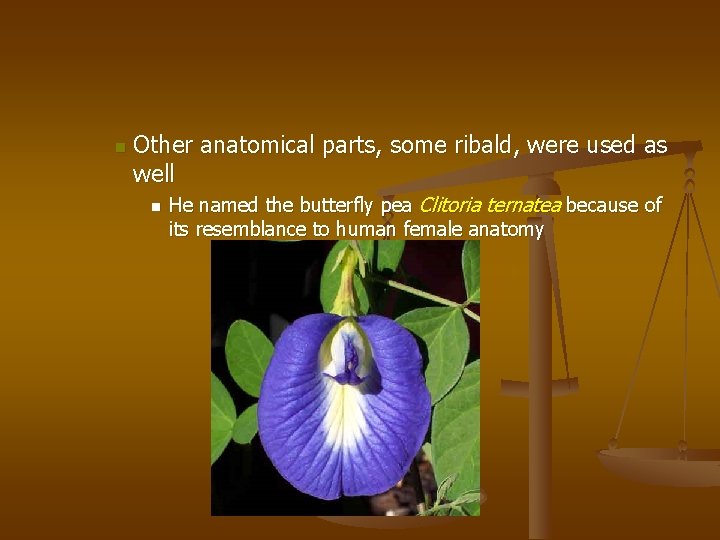
n Other anatomical parts, some ribald, were used as well n He named the butterfly pea Clitoria ternatea because of its resemblance to human female anatomy
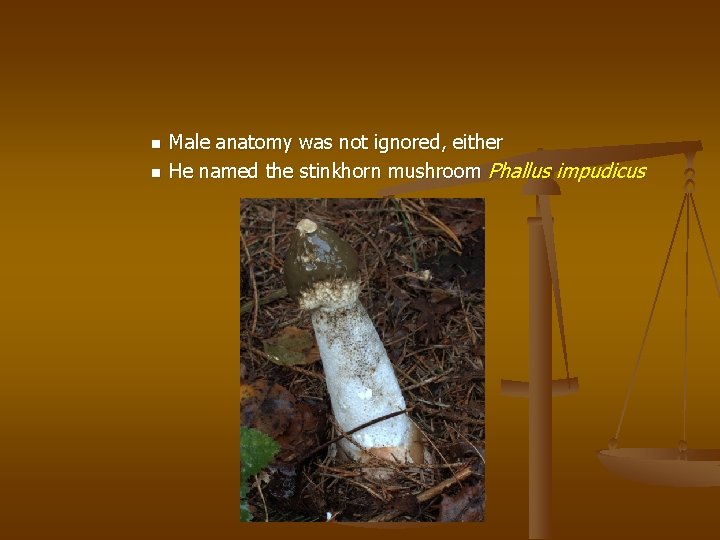
n n Male anatomy was not ignored, either He named the stinkhorn mushroom Phallus impudicus
n Other scientists have revealed a sense of humor n n Surprisingly, the author of a new genus of clams that he called Abra did not describe the first species as Abra cadabra, but another scientist did later Alan Solem enjoyed a good pun n He wanted to name the species that came first when all species were listed in alphabetical order, so he described Aaadonta (to precede Aardvark), but he as been displaced by the genus Aa n He also wanted to name the last species in alphabetical order, so he described Zyzzyxdonta, which interesting enough is the extreme opposite in shell characters as Aaadonta
n n n Solem also described a new species of land snail that he found near the village of Ba in Fiji n The new species did not belong to a recognized genus, so Solem described a new genus, Ba, as well n The new species? Ba humbugi Professor Emeritus Lucius Eldredge named a new tunicate after his favorite drink, Didemnum gintonicum Not all taxonomy is frivolous, and there are rules governing the naming of new species n Rules are established by international bodies, e. g. , the International Commission on Zoological Nomenclature and the International Commission on Botanical Nomenclature
n Higher-Level Classification n Linnaeus also categorized the natural world into higher taxa of kingdoms and classes He recognized three kingdoms: plants, animals, and minerals n Within the animal kingdom, he recognized six classes: mammals, birds, amphibians, fish, insects, and worms n n The number of higher taxa has increased to reflect the complexity of living organisms
n Higher systematics include the following taxa in order of increasing similarity and common ancestry Kingdom Phylum [Bot. = Division] Class Order Family Genus Species
There may be intermediate taxa between these major categories, e. g. , Superclass or Suborder or Infraorder n The hierarchy is designed to reflect phylogenetic relationships n Higher taxa include many organisms that share certain common characteristics & presumably a common ancestor n Higher taxa share fewer similarities but include more organisms n Lower taxa share greater similarities but include fewer organisms n
n Modern Taxonomy n Modern taxonomists strive to classify organisms based on phylogeny rather than just similar in appearance Phylogeny describes the evolutionary relationships of organisms n Therefore, modern classification reflects commonality of descent n Therefore, all taxa in any given group have a common ancestral origin, which is usually depicted in a phylogenetic tree n
n Taxonomists try to determine phylogeny by analyzing as many characters or character states as possible n Characters and character states may include a diversity of factors, including morphology, anatomy, life history, biogeography, habitat, behavior, protein structure, chromosome structure, gene structure
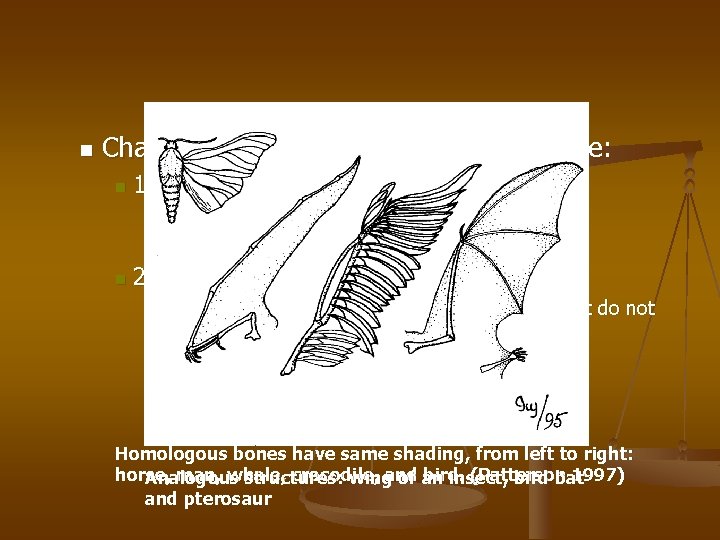
n Character states may be shared because: n 1) organisms are related n n Homologous structures have common origin n e. g. , foreleg of mammal and wing of bird 2) they are convergent n Analogous structures have similar function but do not have common origin n e. g. , wing of insect and wing of bird Homologous bones have same shading, from left to right: horse, man, whale, crocodile, bird. (Patterson 1997) Analogous structures: wingand of an insect, bird bat and pterosaur
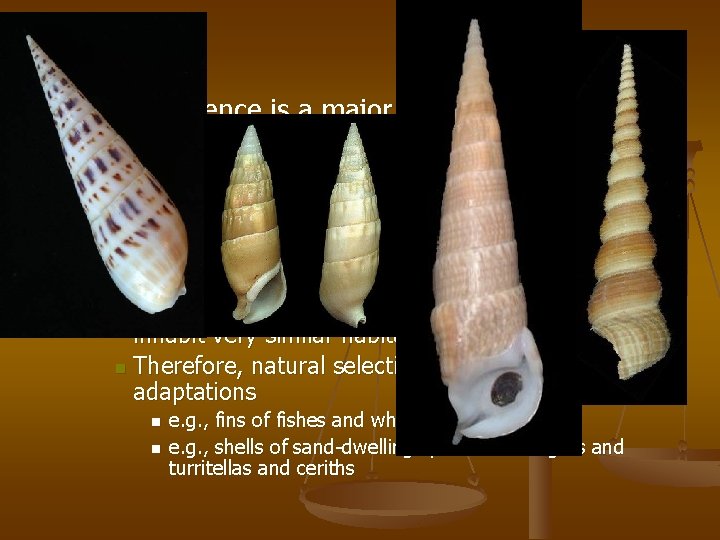
n Convergence is a major difficulty in constructing phylogeny Convergent evolution describes the similarity between two organisms (or proteins or DNA molecules) because of independent evolution along similar lines, rather than because of a common ancestor n Convergence usually occurs when organisms inhabit very similar habitats n Therefore, natural selection favors similar adaptations n n n e. g. , fins of fishes and whales e. g. , shells of sand-dwelling species like augers and turritellas and ceriths
n Species Concept The most objective biological unit of classification is the species, because it is not an artificial construct n A species consists of all the organisms that can interbreed, thereby exchanging genetic information, and producing viable offspring n
n Important points in the definition of a species n n Species are genetically isolated from other species Even if different species attempt to mate, there may be incompatibilities in structure of sex organs or in spermegg interactions Species are self-perpetuating Species may or may not be morphologically distinct (e. g. , sibling species)
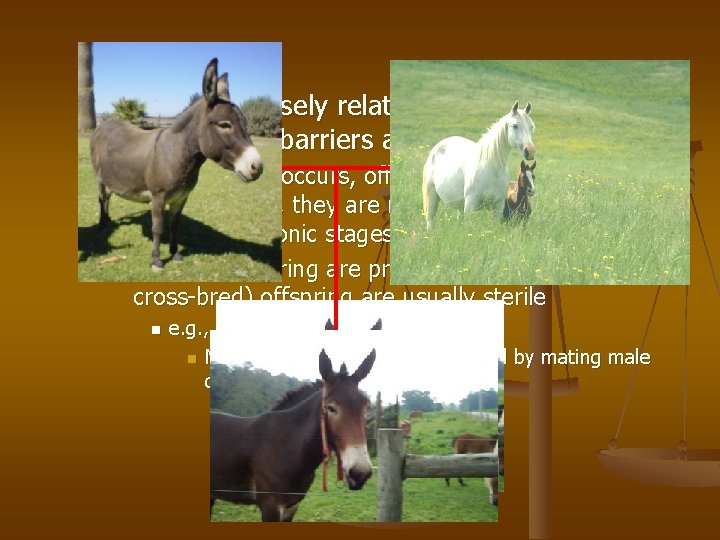
n Sometimes closely related species may overcome the barriers and attempt to mate If fertilization occurs, offspring are usually inviable (i. e. , they are not capable of living either during embryonic stages or after birth) n If viable offspring are produced, the hybrid (or cross-bred) offspring are usually sterile n n e. g. , mules n Mules are sterile hybrids produced by mating male donkey with a female horse
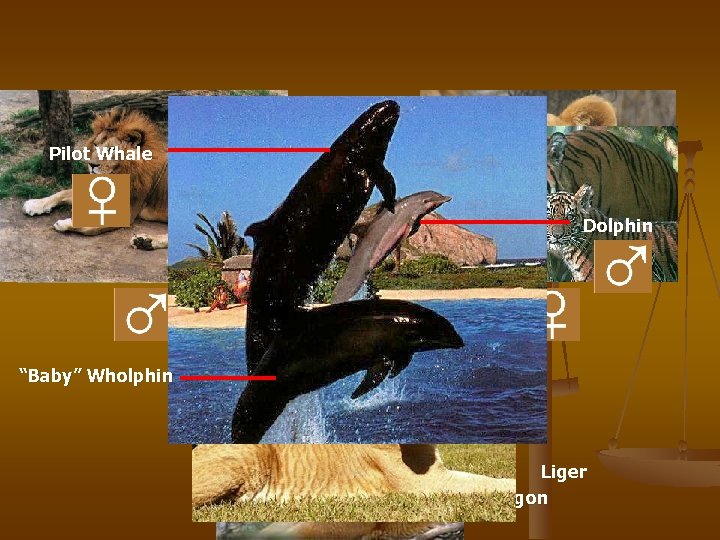
n Pilot Whale n e. g. , ligers and tigons are hybrid offspring of captive lions and tigers e. g. , the “wholphin” at Sea Life Park in Hawaii is a cross between a pilot whale and a dolphin Dolphin “Baby” Wholphin Liger Tigon
n Subspecies are geographically isolated populations of species n They are capable of interbreeding, but they are separated by geographic barriers such as oceans, mountain ranges, etc
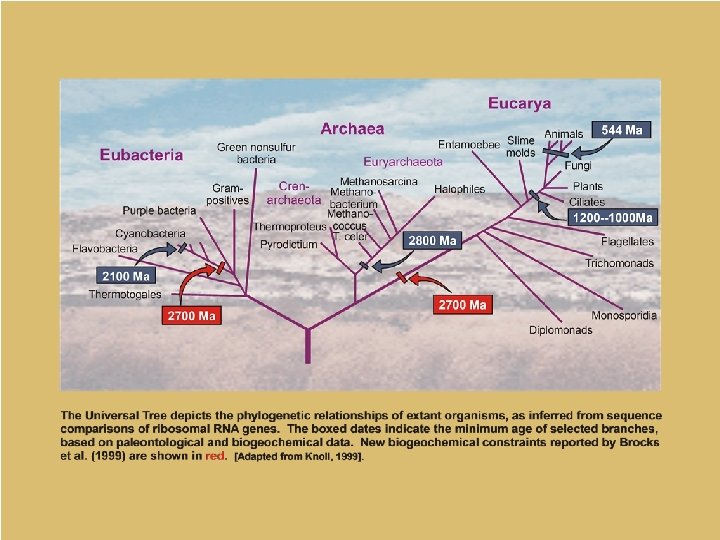
n Three Kingdoms Biologists have found that the Archaebacteria are as different from the Eubacteria as they are from all eukaryotes n Thus, they suggest that there are three kingdoms: Eubacteria, Archaea, and Eucarya instead of the traditional five kingdoms n n (N. B. : Your textbook refers to these as Domains rather than kingdoms)
n Kingdom Archaebacteria inhabit extreme environments, e. g. , hot springs, anaerobic muds, saline ponds n They are believed to be primitive bacteria, possibly similar to life forms of early evolution n This kingdom includes thermophilic bacteria, halophilic bacteria, and methanogens n n Kingdom Eubacteria n This kingdom includes advanced bacteria and cyanobacteria (or blue-green algae)
n Kingdom Eukarya This kingdom includes both unicellular and multicellular organisms that are nucleate and possess complex internal membranes n Organisms range from includes protists and green plants to fungi and animals n Eukarya may be autotrophic or heterotrophic n
- Slides: 64