
The Scientific Method 6 Steps to the Scientific
- Slides: 12
The Scientific Method
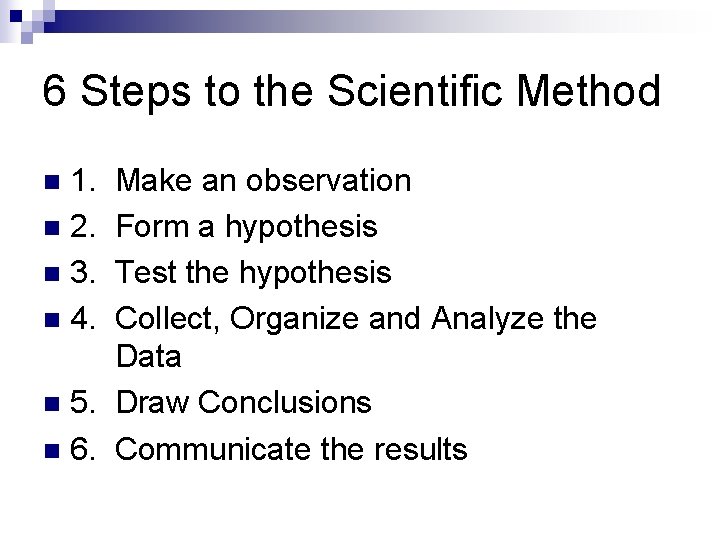
6 Steps to the Scientific Method 1. n 2. n 3. n 4. Make an observation Form a hypothesis Test the hypothesis Collect, Organize and Analyze the Data n 5. Draw Conclusions n 6. Communicate the results n
Step 1: Observations based on senses or tools n Observations of natural events usually raise a question n
Step 2: Form A Hypothesis n Based on observation a Hypothesis is formed which explains your observation or answer your question n n Predictions usually stated in an “if …. . Then” statement. Ex: If I drop a rock then it will fall down toward the ground HYPOTHESIS MUST BE TESTABLE!
Step 3: Test the Hypothesis n Controlled Experiments are used to test a hypothesis ¨A controlled experiment is an experiment that tests only one factor at a time by ¨ Control Group ¨ A variable is a factor that changes in a controlled experiment.
VARIABLES n INDEPENDENT ¨ The n variable being changed in the experiment DEPENDENT ¨ The variable that responds to the changed independent variable ¨ The variable being measured n EX: growing plants with different amounts of fertilizer
Step 3 Continued n n n Scientists try to design experiments that will clearly show whether a particular VARIABLE caused an observed outcome IF IT CANNOT BE OBSERVED THEN IT CANNOT BE TESTED!!! Sometimes models are used to represent a real object ¨ Used when it is difficult to control all of the variables or not possible to test “the real thing”
Step 4: Collect, Organize & Analyze Data n Data collected from experiments ¨ Data is defined as: recorded observations or measurements (qualitative vs. quantitative) ¨ Based on observations ¨ Utilize tools or senses: sight, smell, temperature change etc. n Data is organized in tables, charts and graphs so that it can be more easily analyzed
Step 5: Draw Conclusions Scientists decide whether the results of the experiment support a hypothesis. n When the hypothesis is not supported by the tests the scientist must find another explanation for what they have observed n ¨ NO EXPERIMENT IS A FAILURE: All experiments are observations of real events
Step 6: Communicate the Results must be communicated in the form of a written paper or presentation n Communication helps other scientists performing the same experiments to see if the results of your experiment are the same as their results n ¨ Helps people see if results are repeatable!
Theories n Theories are explanations for some phenomena based on observation, experimentation, and reasoning. ¨ BASED ON MANY EXPERIMENTS ¨ Experiments that explain a theory MUST be repeatable ¨ You must be able to predict from a theory
LAWS Laws are summaries of many experimental results and observations n Laws are not the same as theories because laws tell only what happens, not why it happens. n