
The Science of Matter Chemistry The science that
- Slides: 9
The Science of Matter
Chemistry �The science that investigates and explains the structure and properties of matter �Structure refers to its composition —what matter is made up of and how it is organized �Properties describe the characteristics and behaviors of matter
Views of matter MACROSCOPIC � � Large enough to be seen One you touch, feel, smell, taste, and see SUBMICROSCOPIC � So small that you cannot see it even with the most powerful microscope
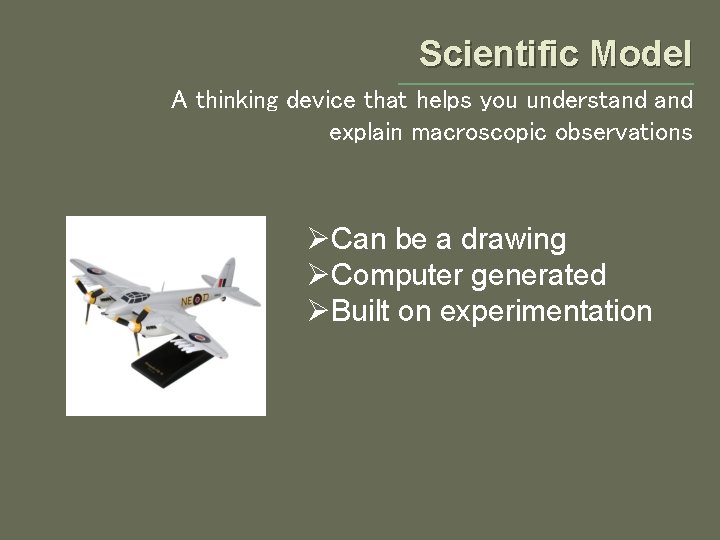
Scientific Model A thinking device that helps you understand explain macroscopic observations ØCan be a drawing ØComputer generated ØBuilt on experimentation
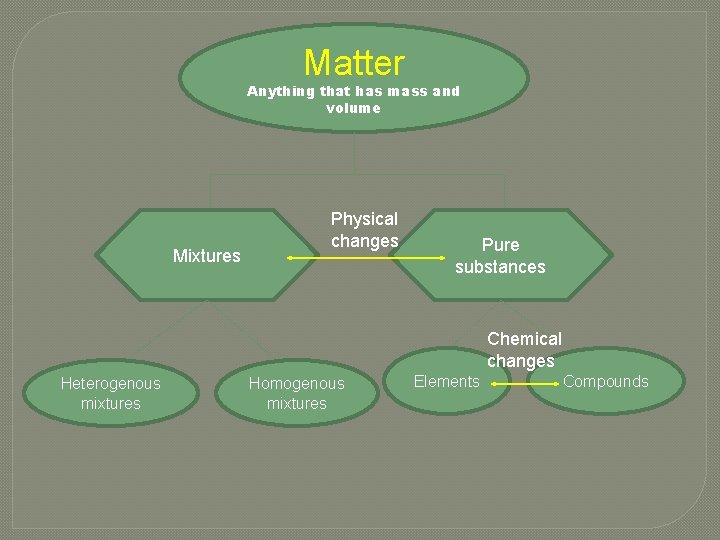
Matter Anything that has mass and volume Mixtures Physical changes Pure substances Chemical changes Heterogenous mixtures Homogenous mixtures Elements Compounds
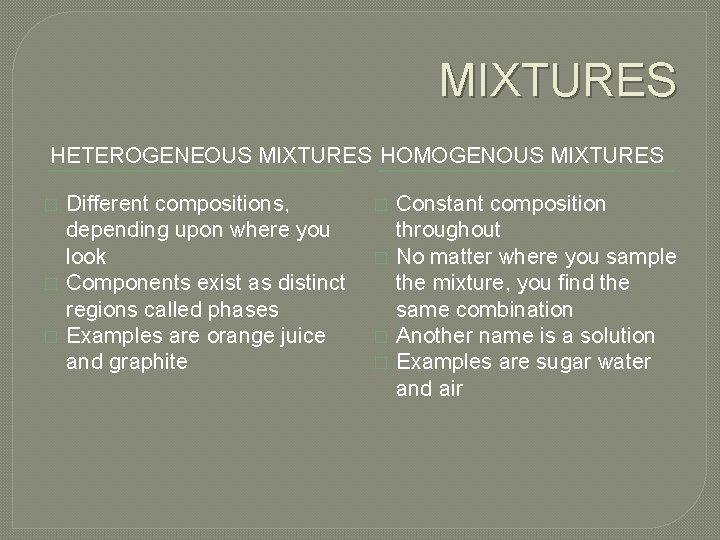
MIXTURES HETEROGENEOUS MIXTURES HOMOGENOUS MIXTURES � � � Different compositions, depending upon where you look Components exist as distinct regions called phases Examples are orange juice and graphite � � Constant composition throughout No matter where you sample the mixture, you find the same combination Another name is a solution Examples are sugar water and air
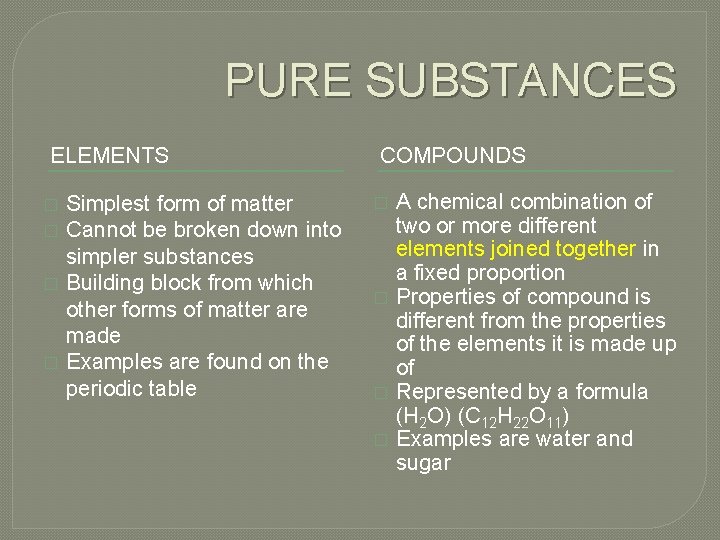
PURE SUBSTANCES ELEMENTS � � Simplest form of matter Cannot be broken down into simpler substances Building block from which other forms of matter are made Examples are found on the periodic table COMPOUNDS � � A chemical combination of two or more different elements joined together in a fixed proportion Properties of compound is different from the properties of the elements it is made up of Represented by a formula (H 2 O) (C 12 H 22 O 11) Examples are water and sugar
Types of Properties • Physical Properties… – Can be observed without changing a substance into another substance. • Boiling point, density, mass, volume, etc. • Chemical Properties… – Can only be observed when a substance is changed into another substance. • Flammability, corrosiveness, reactivity with acid, etc. © 2009, Prentice-Hall, Inc.
Types of Changes �Physical Changes • These are changes in matter that do not change the composition of a substance. �Changes of state, temperature, volume, etc. �Chemical Changes • Chemical changes result in new substances. �Combustion, oxidation, decomposition, etc. © 2009, Prentice-Hall, Inc.