
The Science of Information Technology An introduction to
- Slides: 18
The Science of Information Technology An introduction to the processes allowing and limiting information systems
Contributors to Sc. IT Phil Casabella b Karen Cummings b Michael Danchak b Ivar Giaever b Joe Haus b Arlen Johnson b Dave Joiner b Toh-Ming Lu b Jim Napolitano b Peter Persans b Wayne Roberge b Leo Schowalter b John Schroeder b Tom Shannon b DJ Wagner b Gwo-Ching Wang b
What is Sc. IT? b The Science of Information Technology b New, innovative introductory course in Rensselaer’s Physics Department b An opportunity for students not taking traditional physics courses to learn about laws governing technology b A course drawing upon expertise of university researchers
Chronology of Sc. IT b October, 1998: Committee meeting yields concept b October-December, 1998: Content discussed, decided b January, 1999: Course begins with 33 students b January, 1999: Web. CT account given; instructor starts to learn how to use
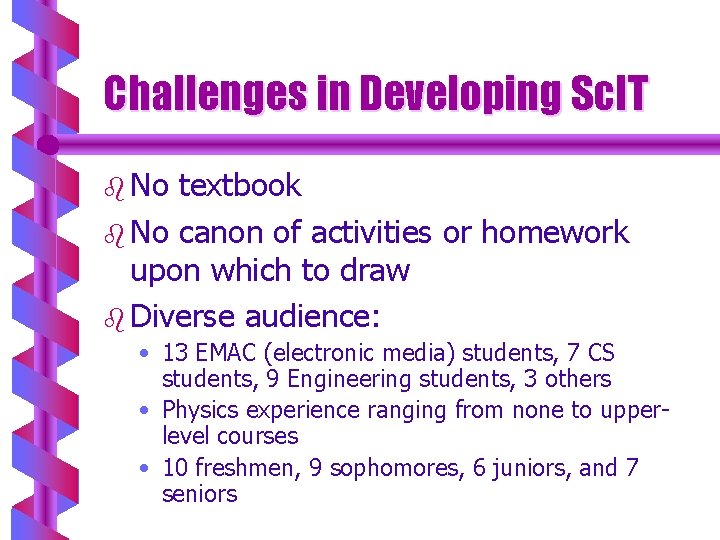
Challenges in Developing Sc. IT b No textbook b No canon of activities or homework upon which to draw b Diverse audience: • 13 EMAC (electronic media) students, 7 CS students, 9 Engineering students, 3 others • Physics experience ranging from none to upperlevel courses • 10 freshmen, 9 sophomores, 6 juniors, and 7 seniors
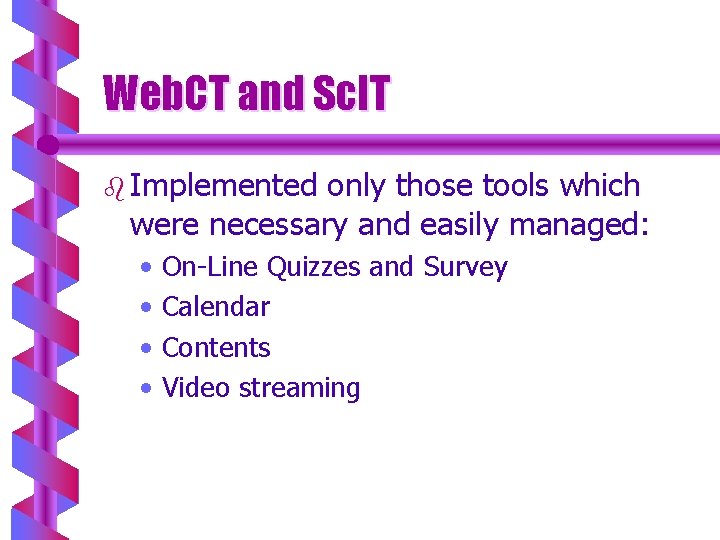
Web. CT and Sc. IT b Implemented only those tools which were necessary and easily managed: • • On-Line Quizzes and Survey Calendar Contents Video streaming
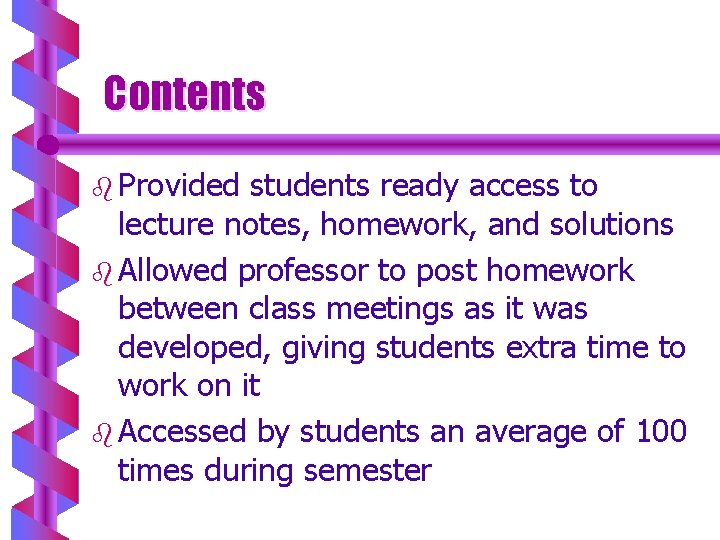
Contents b Provided students ready access to lecture notes, homework, and solutions b Allowed professor to post homework between class meetings as it was developed, giving students extra time to work on it b Accessed by students an average of 100 times during semester
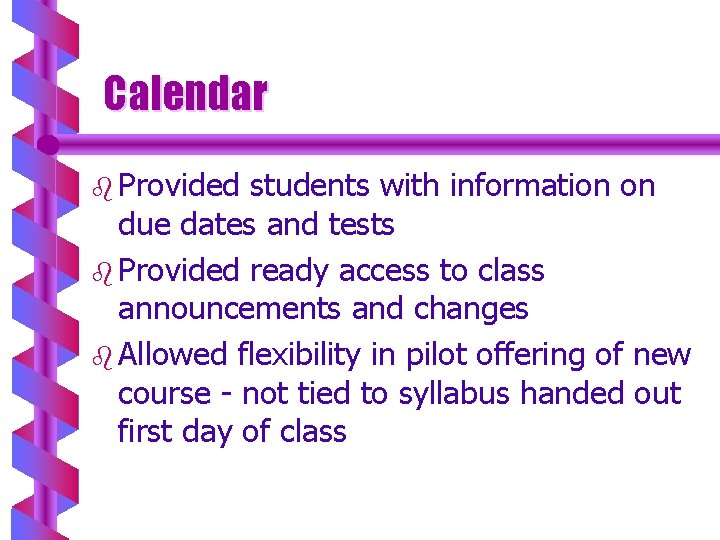
Calendar b Provided students with information on due dates and tests b Provided ready access to class announcements and changes b Allowed flexibility in pilot offering of new course - not tied to syllabus handed out first day of class
Video Streaming b Allowed access to videos of guest lectures by researchers, an integral (and popular) part of Sc. IT • Most guests didn’t have notes in same format as professor for easy posting to web • Most material covered by guests not available in reading assignments • Not all students able to make class for guest lecture
On-Line Quizzes b Ensured reading done before class b Students given 2 tries to encourage review of missed materials b Only 5% of course grade, but high participation b Scored on survey as most useful aspect of course b Provided feedback on reading sources
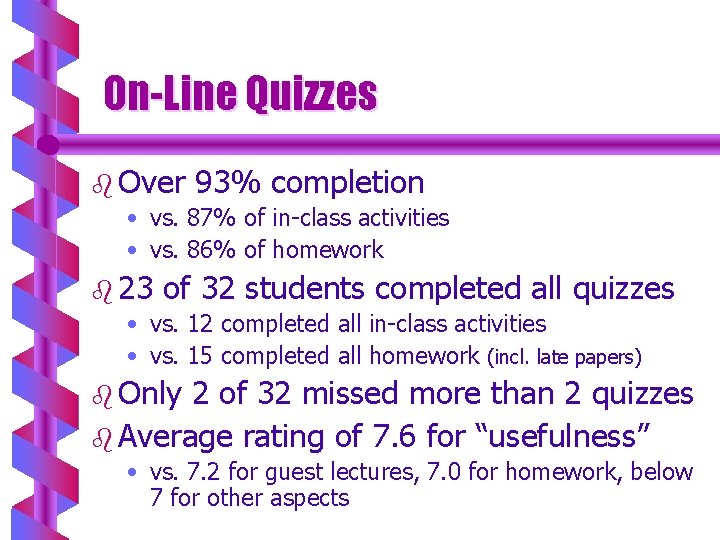
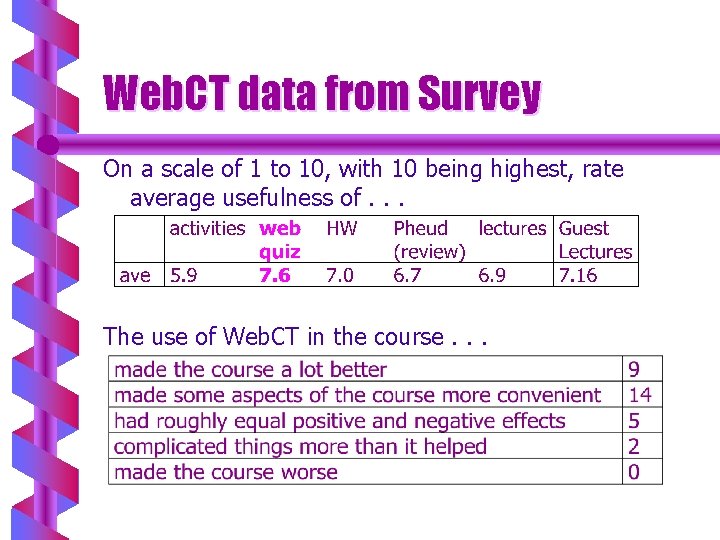
On-Line Quizzes b Over 93% completion • vs. 87% of in-class activities • vs. 86% of homework b 23 of 32 students completed all quizzes • vs. 12 completed all in-class activities • vs. 15 completed all homework (incl. late papers) b Only 2 of 32 missed more than 2 quizzes b Average rating of 7. 6 for “usefulness” • vs. 7. 2 for guest lectures, 7. 0 for homework, below 7 for other aspects
On-Line Survey b 30 of 32 submitted (for extra credit) b Allowed anonymous response while providing record of participation b Provided statistics useful in improving course b Complete record with statistics available
Web. CT data from Survey On a scale of 1 to 10, with 10 being highest, rate average usefulness of. . . The use of Web. CT in the course. . .
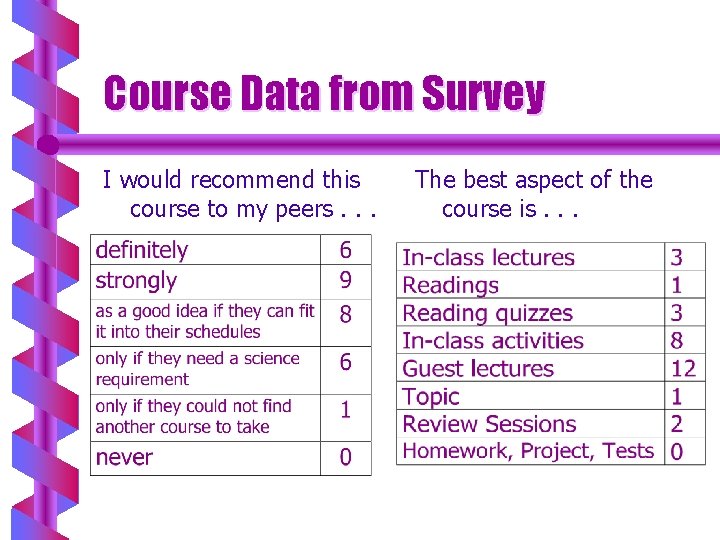
Course Data from Survey I would recommend this course to my peers. . . The best aspect of the course is. . .
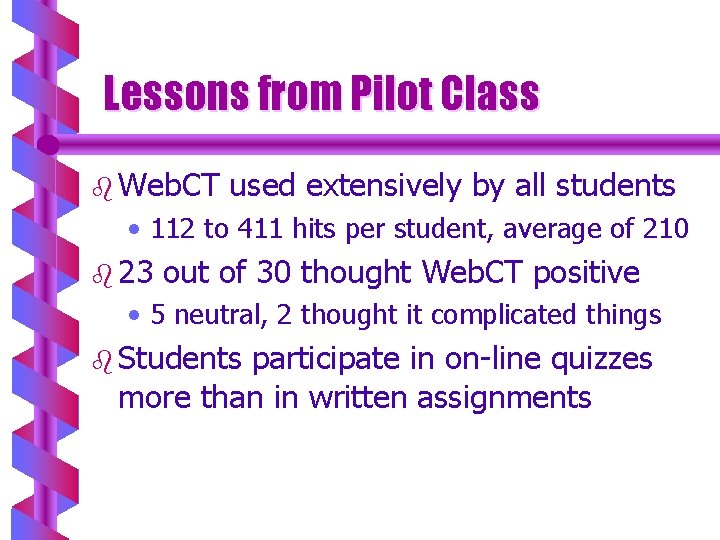
Lessons from Pilot Class b Web. CT used extensively by all students • 112 to 411 hits per student, average of 210 b 23 out of 30 thought Web. CT positive • 5 neutral, 2 thought it complicated things b Students participate in on-line quizzes more than in written assignments
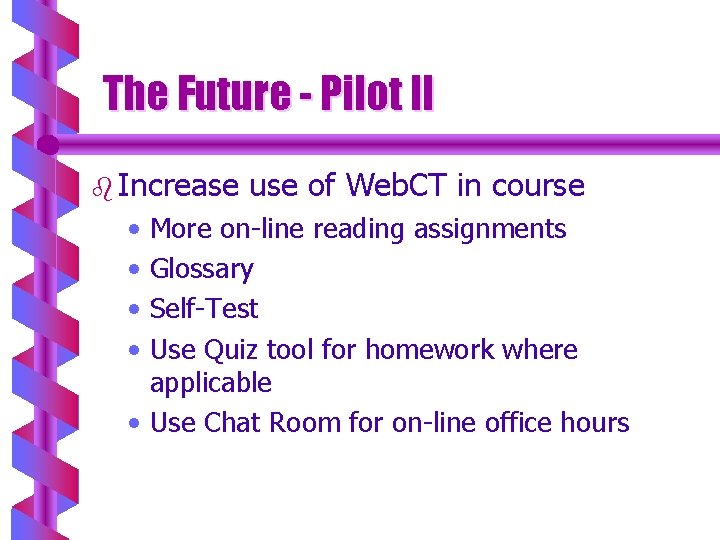
The Future - Pilot II b Increase • • use of Web. CT in course More on-line reading assignments Glossary Self-Test Use Quiz tool for homework where applicable • Use Chat Room for on-line office hours
The Future - Reaching the Working Professional b Develop graduate version of Sc. IT b Distance course: 80% asynchronous b Web. CT can provide • lesson modules with evaluation quizzes • video streaming of guest lectures • security to address copyright and confidentiality issues • Bulletin Board to enable collaboration between sites
Conclusions b Web. CT enhanced development of innovative course with no text or syllabus by instructor ignorant of html b Glitches occurred, but negative was offset by increased learning opportunities (except for 2 disgruntled students) b Web. CT “necessary” for distance graduate version of course