
The Science of Biology Chapter 1 What is
The Science of Biology Chapter 1
What is Science? • The study of the natural world and the search for patterns and connections between events – Only with the natural world – Scientists collect and organize information (scientific method) – Propose explanations by testing hypotheses
What is Science? • Way of knowing – Don’t just memorize facts – Scientific understanding is changing—it’s not static • Scientists question the world around them • Science reaches into health, medicine, and relationships between living and nonliving environment
What is Biology? • Study of life – Bios = life – -ology = study of – Science that seeks to understand the living world • In this class we will discuss a recurring theme: – Organisms evolve and adapt to meet the needs of a changing environment - Natural Selection drives the change in species
Characteristics of Living Things • All living things have the following characteristics: – – – – Made up of cells Reproduce Grow and develop Based on a universal genetic code Get and use energy Respond to their environment Maintain a stable internal environment As a group, living things change over time • We will discuss each in detail
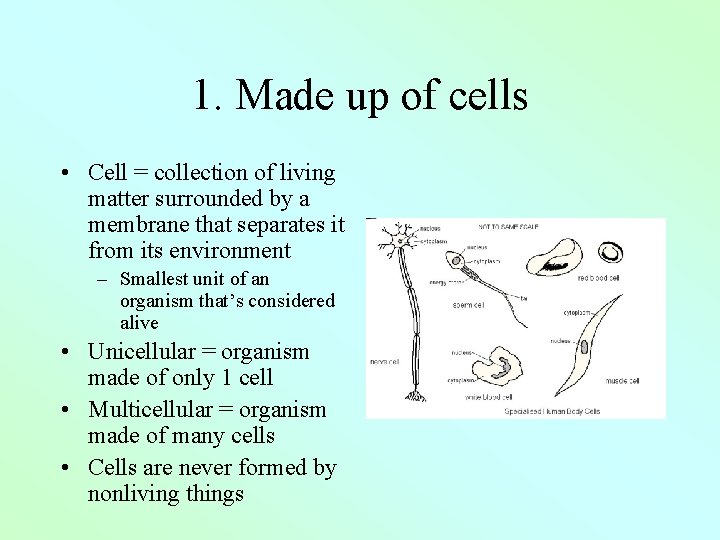
1. Made up of cells • Cell = collection of living matter surrounded by a membrane that separates it from its environment – Smallest unit of an organism that’s considered alive • Unicellular = organism made of only 1 cell • Multicellular = organism made of many cells • Cells are never formed by nonliving things
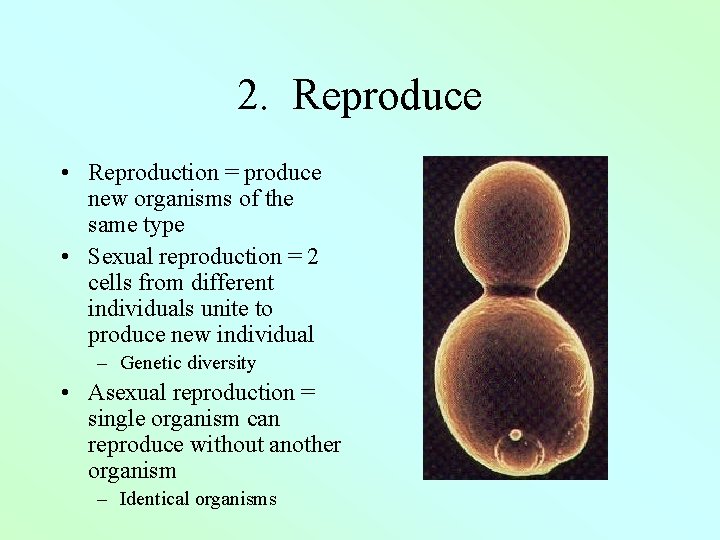
2. Reproduce • Reproduction = produce new organisms of the same type • Sexual reproduction = 2 cells from different individuals unite to produce new individual – Genetic diversity • Asexual reproduction = single organism can reproduce without another organism – Identical organisms
3. Grow and Develop • All grow at least part of their lives – Some just increase in size – Some develop = specialize cells
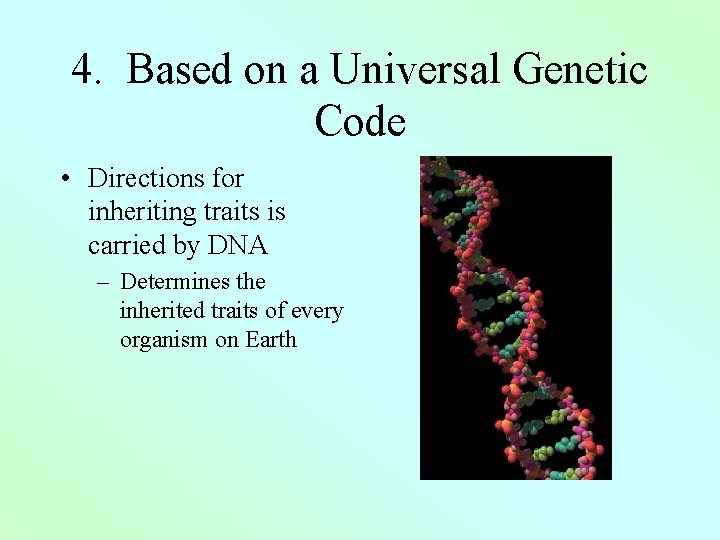
4. Based on a Universal Genetic Code • Directions for inheriting traits is carried by DNA – Determines the inherited traits of every organism on Earth
5. Get and Use Energy • Obtain energy from environment in order to grow, reproduce, and respond to their environment • Need energy to build substances that make up cells • Metabolism = combination of chemical reactions through which an organism builds up or breaks down materials as it carries out its life processes • Plants, some bacteria, algae = energy from sunlight (photosynthesis) • Animals = energy from food (some eat plants, some eat animals) • Decomposers = energy from organisms that have died
6. Respond to their Environment • Organisms respond to stimuli in their environment – Stimulus = a signal that an organism reacts to (ex: light, heat, sound, etc. ) • External stimuli = come from environment (ex: temperature— goose bumps) • Internal stimuli = come from within organism (ex: levels of sugar in blood is low—feel hungry) • Respond in order to improve chance of survival
7. Maintain a Stable Internal Environment • Organisms must keep their internal environment constant even as outside environment changes – Ex: water, temperature – Homeostasis – Also includes feedback mechanisms = something externally changes body reacts to maintain stable environment
8. Evolution • As a group, organisms change over time – As an individual, traits it inherited usually will not change – Over many generations, changes become dramatic – This is evolution
Branches of Biology • Biology is divided into different fields – Paleontology, zoology, botany, ecology, etc. • Molecular = study of life at molecular level (DNA) • Cellular = studies cells and problems at cellular level • Multicellular = studies organisms • Population = studies groups of organisms • Ecologists = organisms and their environment on a global level
How does biology affect you? • Diagnose and treat medical problems • Identifies environmental problems • Provides information regarding food and food production • Understand what affects the quality of your life LIST AT LEAST 3 THINGS YOU ARE INTERESTED IN STUDYING THIS YEAR!
- Slides: 15