
The Science of Biology Chapter 1 The Nature
The Science of Biology Chapter 1
The Nature of Science (What is science? )
Science is… �Based on EVIDENCE (observations). �Subject to CHANGE.

Science is… �Based upon the assumption that natural laws operate today as they did in the past and will continue to do so in the future.
Science is… Characterized by a common set of values including �Logical thinking �Precision �Open-mindedness �Skepticism �Reproducibility of results �Honest and ethical reporting of results �Objectivity/An attempt to avoid bias �Imagination (creativity)

Science is… �ONE WAY of knowing used by many people (not just scientists). �CANNOT ANSWER ALL QUESTIONS.
Facts, Laws & Theories Observations vs. Inferences
FACT �the world’s data Ex: Plants need water to survive.
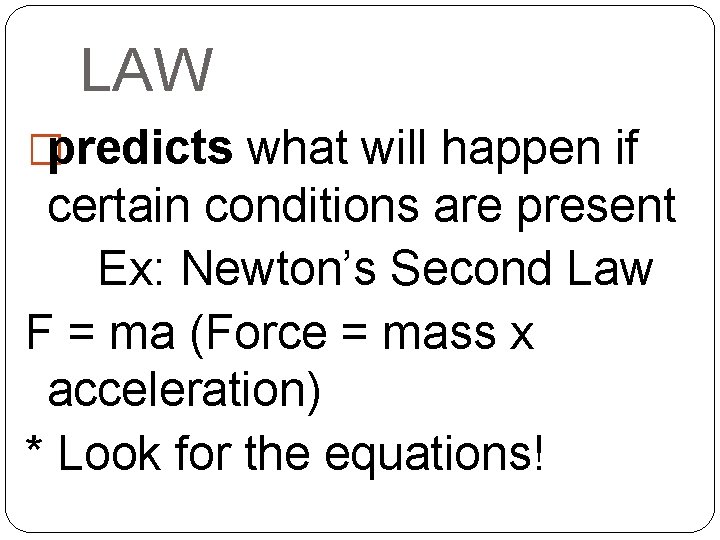
LAW �predicts what will happen if certain conditions are present Ex: Newton’s Second Law F = ma (Force = mass x acceleration) * Look for the equations!
THEORY �well tested explanation based on observations Ex: natural selection A good review
Observations �Using the five senses to gather information. � The apple is red.
Types of Observations: �Quantitative: involve measuring and the use of numbers. �For example: The plant grew 5 cm in the last 7 days. �Qualitative: involve descriptions. �For example: The plant is growing more on the side that is facing the
Inferences �A logical interpretation based on ones prior knowledge and experiences. � For example: The plant is growing toward the light because it needs light for photosynthesis.
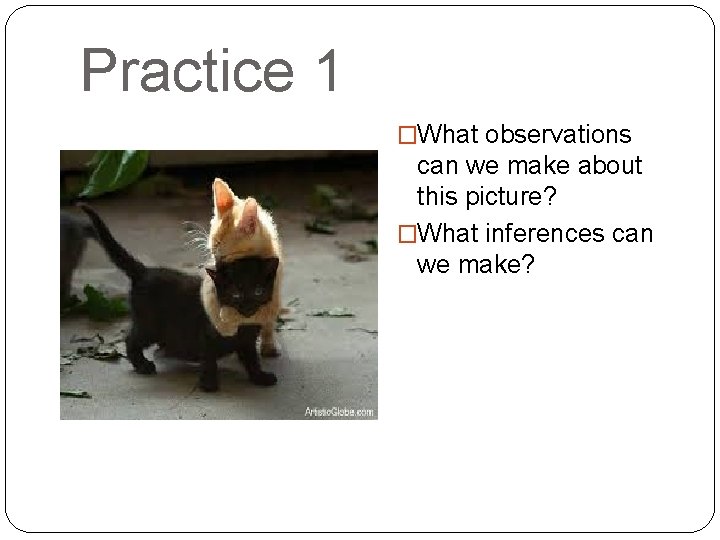
Practice 1 �What observations can we make about this picture? �What inferences can we make?
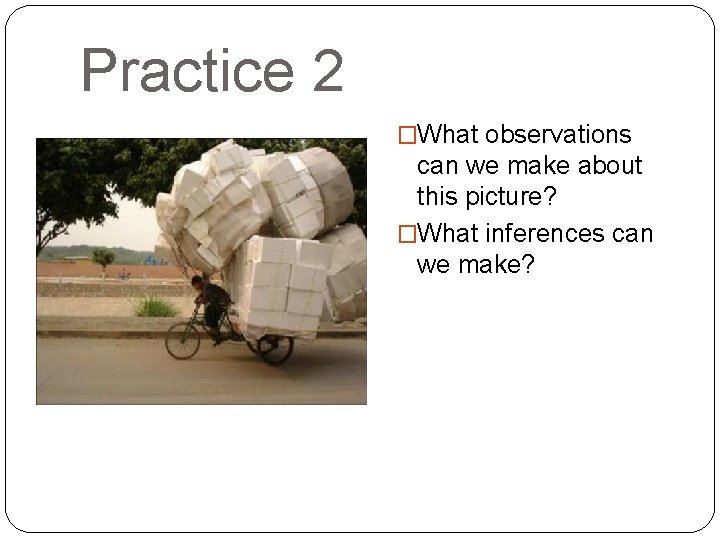
Practice 2 �What observations can we make about this picture? �What inferences can we make?
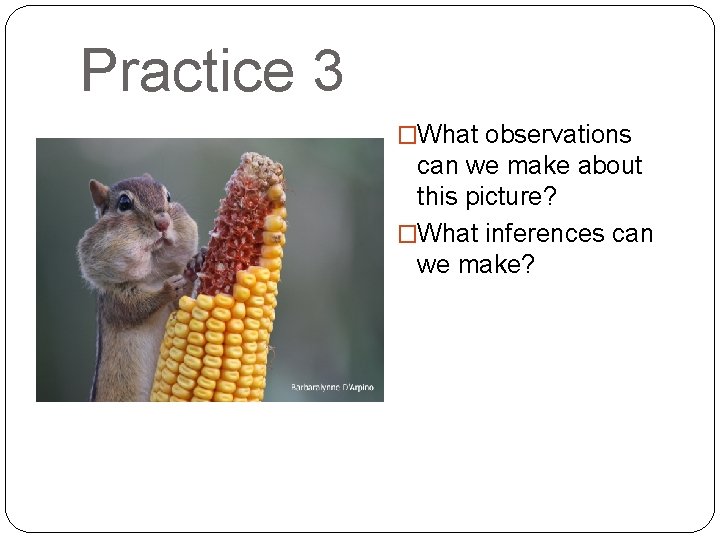
Practice 3 �What observations can we make about this picture? �What inferences can we make?
Scientific Method
� Note: There is no set order to the scientific method!!!
�State the PROBLEM. �Usually a QUESTION about what you want to learn. �RESEARCH the topic. �Form a HYPOTHESIS. �HYPOTHESIS = an educated prediction or solution based on your research.
�Set up the EXPERIMENT. � Include the MATERIALS LIST and PROCEDURES.
�Change only 1 variable. �CONTROL: Normal, unchanged part �EXPERIMENTAL GROUP: Changed part �INDEPENDENT VARIABLE: “I” change the “I”ndependent variable. �DEPENDENT VARIABLE: depends on your change. �CONSTANTS: everything that is kept the same between the control and experimental group
�Collect data. �CHARTS and GRAPHS are good. �Form a CONCLUSION. �Accept or reject your hypothesis. �REPEAT your work. �COMMUNICATE your findings.
Talking to Plants http: //www. youtube. com/watch? v=9 M 8 FFJW 7 U QM Record the following for this experiment: 1. ) Question 2. ) Hypothesis (If… then…) 3. ) Independent Variable 4. ) Dependent Variable 5. ) Constants 6. ) Initial Results
Characteristics of Life
�biology: study of life �organism: any living thing
All living things: 1. ) Made up of cells. 2. ) Reproduce. (sexually or asexually) 3. ) Based on a genetic code. (DNA) 4. ) Grow and develop.
All living things: 5. ) Obtain and use materials and energy. 6. ) Respond to changes in it's environment. �ex: Plant growing toward light. 7. ) Maintain a stable internal environment. (homeostasis) �Ex: body temperature 8. ) Adapt and evolve. (change over time)
- Slides: 27