
The Science of Biology Chapter 1 Copyright Mc
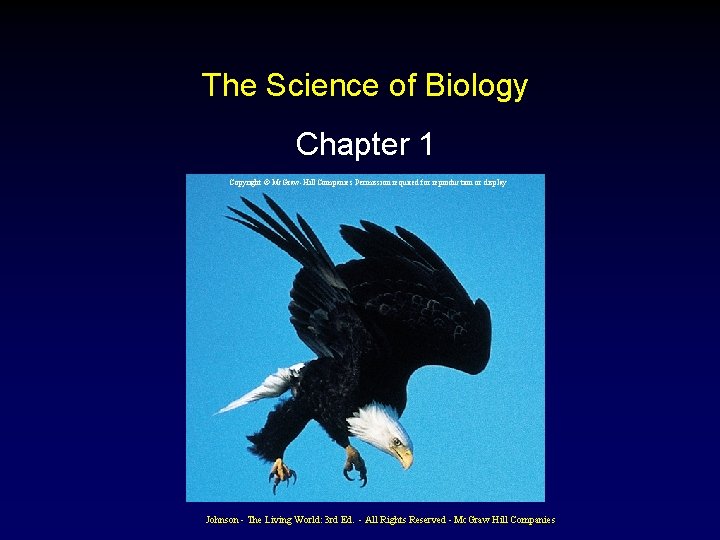
The Science of Biology Chapter 1 Copyright © Mc. Graw-Hill Companies Permission required for reproduction or display Johnson - The Living World: 3 rd Ed. - All Rights Reserved - Mc. Graw Hill Companies
Outline • • Properties of Life Organization of Life Biological Themes The Nature of Science v Deductive vs. Inductive Reasoning Science in Nature - Ozone Layer Scientific Process Theory and Certainty v Limitations of Science Johnson - The Living World: 3 rd Ed. - All Rights Reserved - Mc. Graw Hill Companies
Properties of Life • Three important properties shared by most living organisms, and non-living objects: v Complexity v Movement v Response to Stimulation Johnson - The Living World: 3 rd Ed. - All Rights Reserved - Mc. Graw Hill Companies
Properties of Living Organisms • • • Cellular Organization v All living organisms are composed of at least one cell. Metabolism v All organisms use energy. Homeostasis v All organisms maintain stable internal conditions. Johnson - The Living World: 3 rd Ed. - All Rights Reserved - Mc. Graw Hill Companies
Properties of Living Organisms • • Reproduction v All organisms reproduce. Heredity v All organisms possess a genetic system based on DNA. Johnson - The Living World: 3 rd Ed. - All Rights Reserved - Mc. Graw Hill Companies

Organization of Life • • Hierarchy of increasing complexity: Organ Systems v Organs - Tissues Ø Cell § Organelle Johnson - The Living World: 3 rd Ed. - All Rights Reserved - Mc. Graw Hill Companies
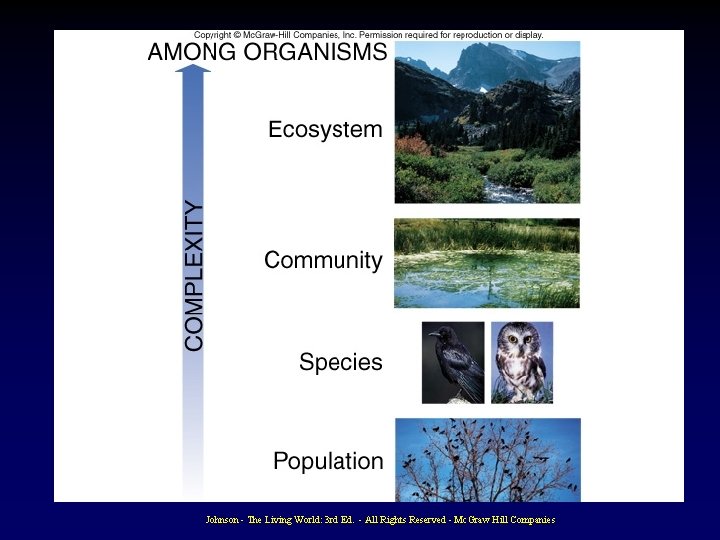
Organization of Life • • Hierarchy of increasing complexity: Ecosystem - Collection of different communities. v Community - Collection of different populations - Population - Individuals of the same type (species) living together. Johnson - The Living World: 3 rd Ed. - All Rights Reserved - Mc. Graw Hill Companies
Johnson - The Living World: 3 rd Ed. - All Rights Reserved - Mc. Graw Hill Companies
Biological Themes • • Evolution - Genetic change in a species over successive generations. Flow of Energy - All organisms require energy. v Sun is the source of energy driving all ecosystems. - Plants capture energy via photosynthesis. Johnson - The Living World: 3 rd Ed. - All Rights Reserved - Mc. Graw Hill Companies
Biological Themes • • • Cooperation - Cooperation between organisms is a pivotal role in evolution of life. Structure Determines Function - Biological structures are well suited to their functions. Homeostasis - Organisms act to maintain a relatively stable internal environment. Johnson - The Living World: 3 rd Ed. - All Rights Reserved - Mc. Graw Hill Companies
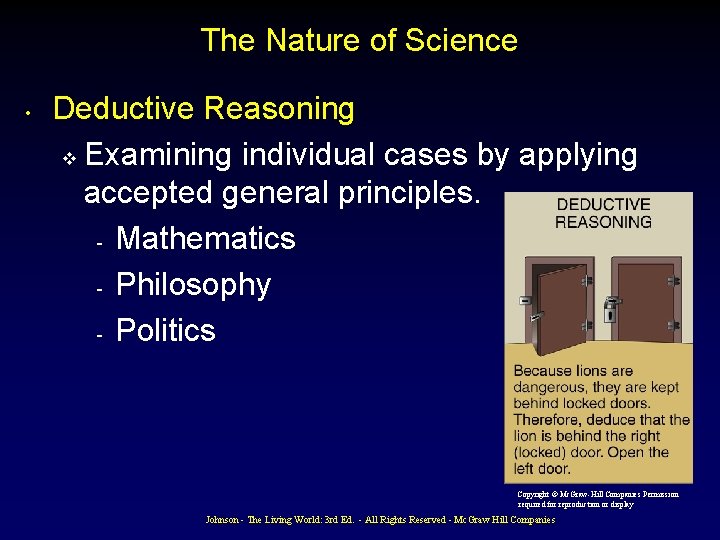
The Nature of Science • Deductive Reasoning v Examining individual cases by applying accepted general principles. - Mathematics - Philosophy - Politics Copyright © Mc. Graw-Hill Companies Permission required for reproduction or display Johnson - The Living World: 3 rd Ed. - All Rights Reserved - Mc. Graw Hill Companies
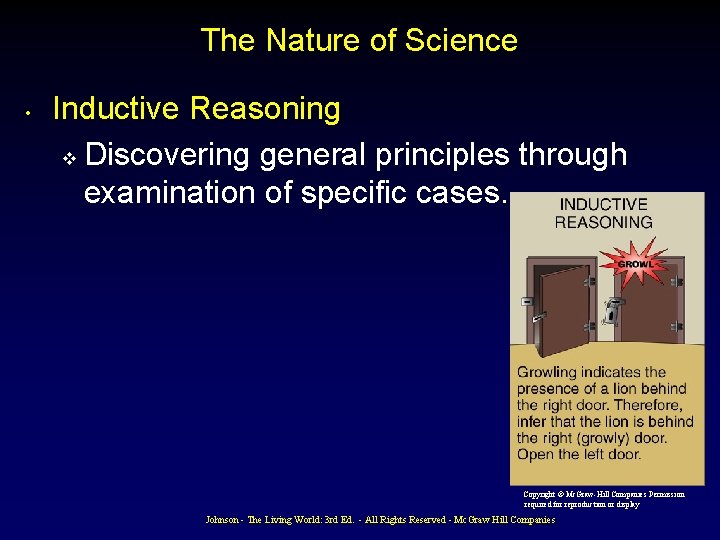
The Nature of Science • Inductive Reasoning v Discovering general principles through examination of specific cases. Copyright © Mc. Graw-Hill Companies Permission required for reproduction or display Johnson - The Living World: 3 rd Ed. - All Rights Reserved - Mc. Graw Hill Companies
Science in Action - Ozone Layer • 1985 - Research found lowered levels of ozone in the upper atmosphere of the Antarctic (25 -40 km above surface). v Chlorofluorocarbons (CFC) culprit - CFC’s condense into ice crystals - US is major producer v Increased ultraviolet radiation (UV) a serious concern. Johnson - The Living World: 3 rd Ed. - All Rights Reserved - Mc. Graw Hill Companies
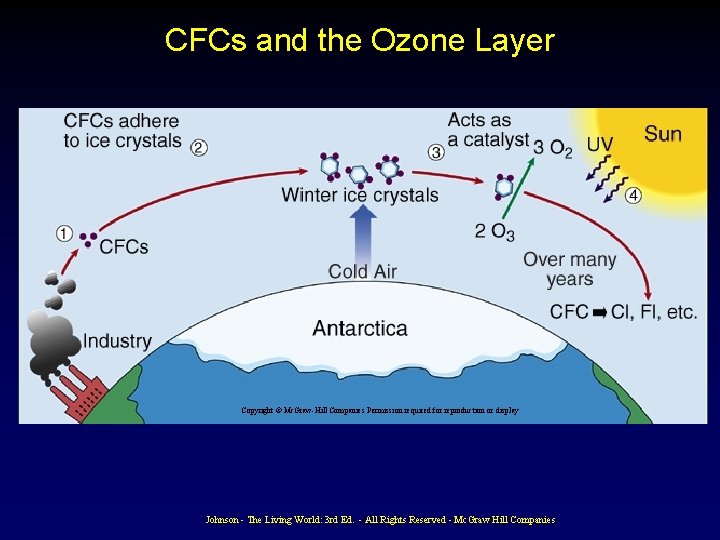
CFCs and the Ozone Layer Copyright © Mc. Graw-Hill Companies Permission required for reproduction or display Johnson - The Living World: 3 rd Ed. - All Rights Reserved - Mc. Graw Hill Companies
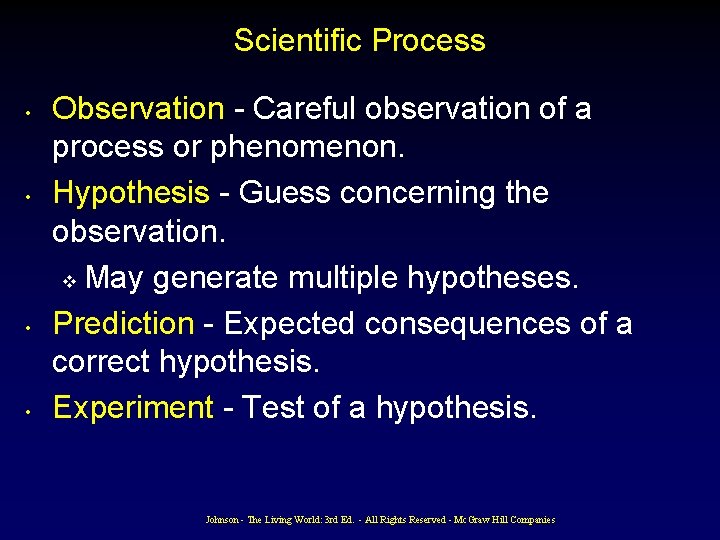
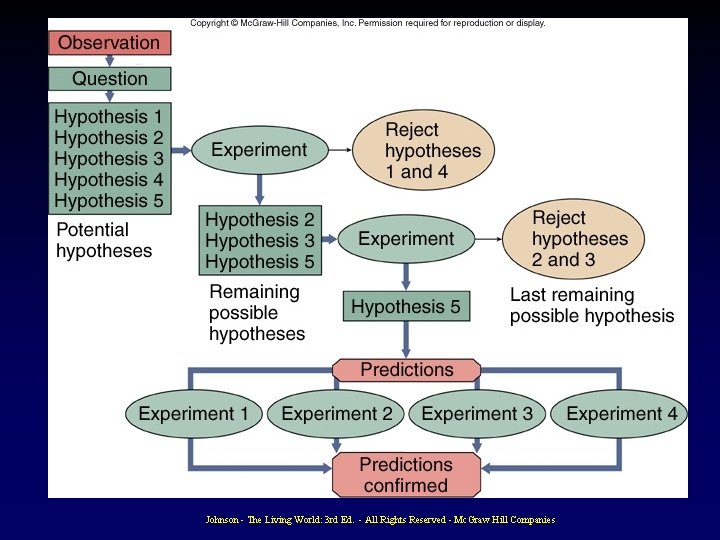
Scientific Process • • Observation - Careful observation of a process or phenomenon. Hypothesis - Guess concerning the observation. v May generate multiple hypotheses. Prediction - Expected consequences of a correct hypothesis. Experiment - Test of a hypothesis. Johnson - The Living World: 3 rd Ed. - All Rights Reserved - Mc. Graw Hill Companies
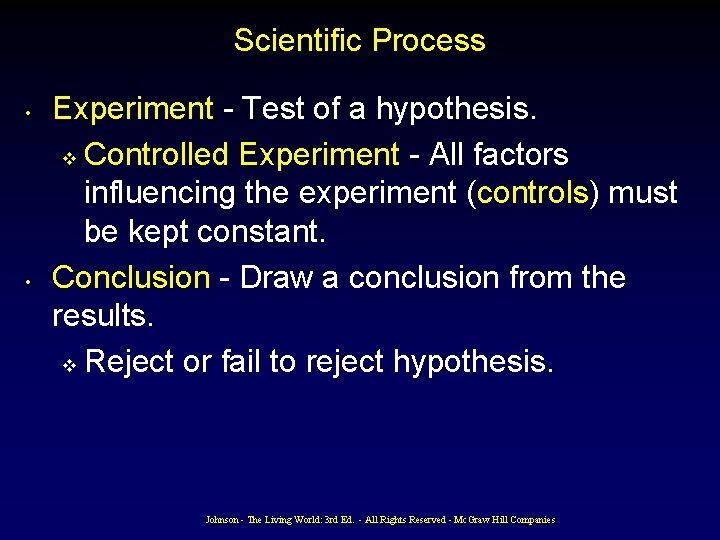
Scientific Process • • Experiment - Test of a hypothesis. v Controlled Experiment - All factors influencing the experiment (controls) must be kept constant. Conclusion - Draw a conclusion from the results. v Reject or fail to reject hypothesis. Johnson - The Living World: 3 rd Ed. - All Rights Reserved - Mc. Graw Hill Companies
Johnson - The Living World: 3 rd Ed. - All Rights Reserved - Mc. Graw Hill Companies
Theory and Certainty • Theory - Set of hypotheses that have been thoroughly tested over time, and generally accepted by the scientific community. v Acceptance is always provisional - To the general public a theory is synonymous with a guess due to lack of knowledge. Johnson - The Living World: 3 rd Ed. - All Rights Reserved - Mc. Graw Hill Companies
Limitations of Science • Scientific study is limited to area that can be observed and measured. v Cannot be used to address all questions. v Bound by practical limits - Temporal and spatial considerations Johnson - The Living World: 3 rd Ed. - All Rights Reserved - Mc. Graw Hill Companies
Review • • Properties of Life Organization of Life Biological Themes The Nature of Science v Deductive vs. Inductive Reasoning Science in Nature - Ozone Layer Scientific Process Theory and Certainty v Limitations of Science Johnson - The Living World: 3 rd Ed. - All Rights Reserved - Mc. Graw Hill Companies
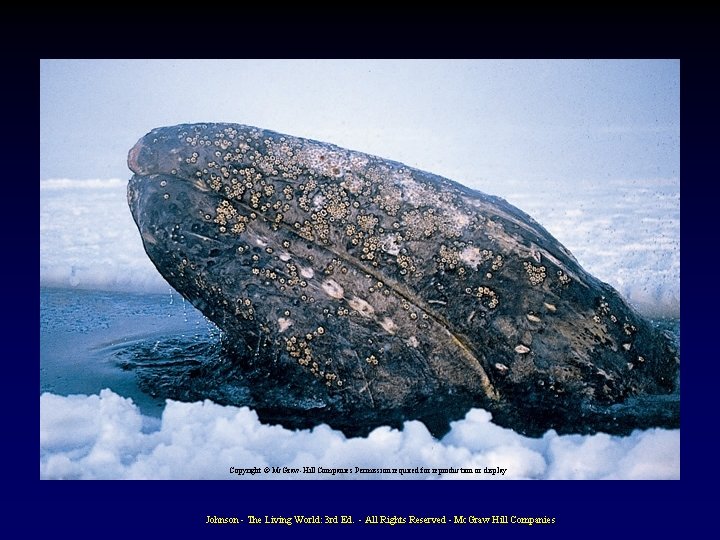
Copyright © Mc. Graw-Hill Companies Permission required for reproduction or display Johnson - The Living World: 3 rd Ed. - All Rights Reserved - Mc. Graw Hill Companies
- Slides: 21