
The Science of Biology Anchoring Phenomenon A magic
The Science of Biology
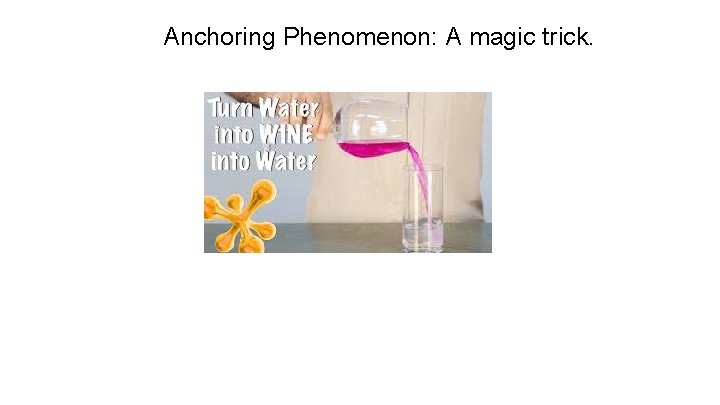
Anchoring Phenomenon: A magic trick.
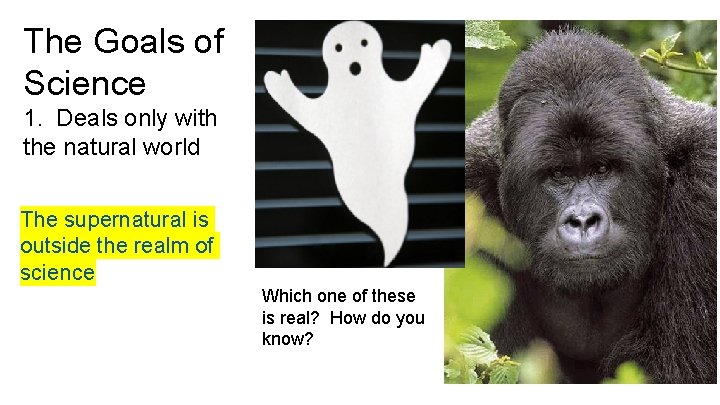
The Goals of Science 1. Deals only with the natural world The supernatural is outside the realm of science Which one of these is real? How do you know?
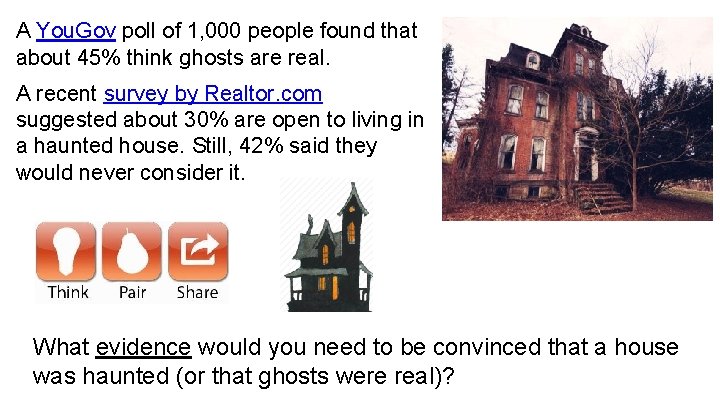
A You. Gov poll of 1, 000 people found that about 45% think ghosts are real. A recent survey by Realtor. com suggested about 30% are open to living in a haunted house. Still, 42% said they would never consider it. What evidence would you need to be convinced that a house was haunted (or that ghosts were real)?
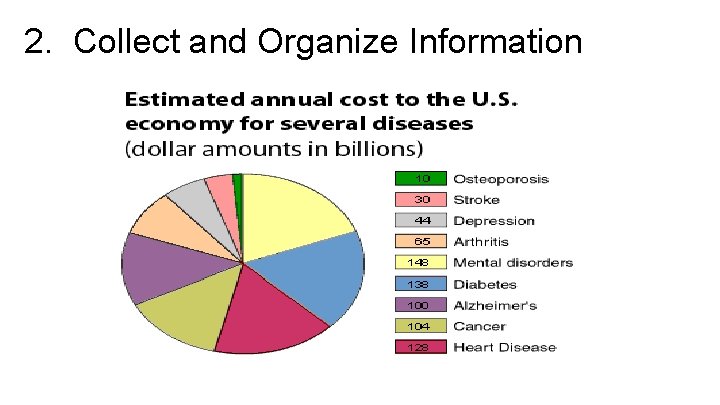
2. Collect and Organize Information
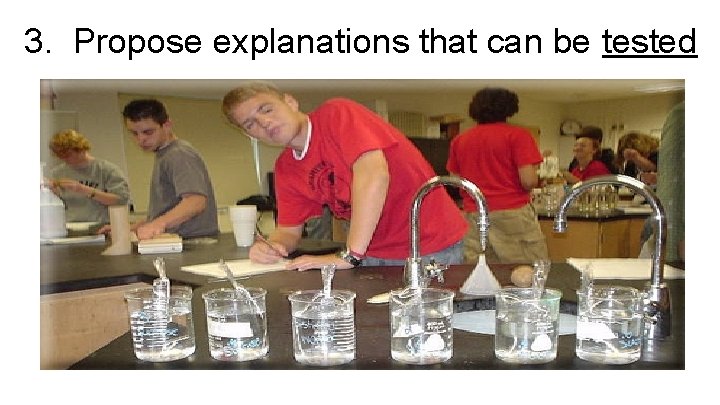
3. Propose explanations that can be tested
Summarizing. . . SCIENCE is a body of knowledge that explains the natural world.
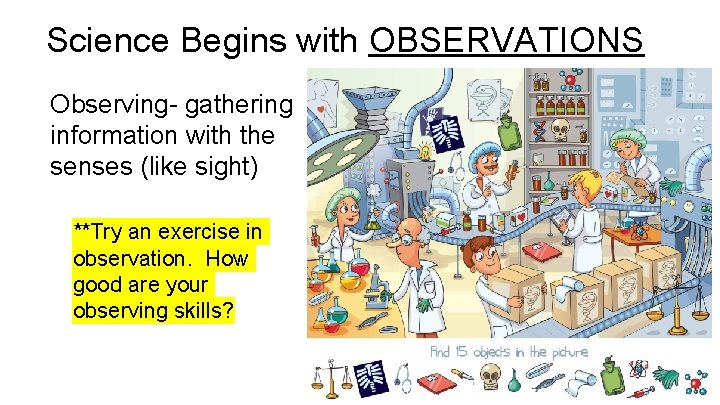
Science Begins with OBSERVATIONS Observing- gathering information with the senses (like sight) **Try an exercise in observation. How good are your observing skills?
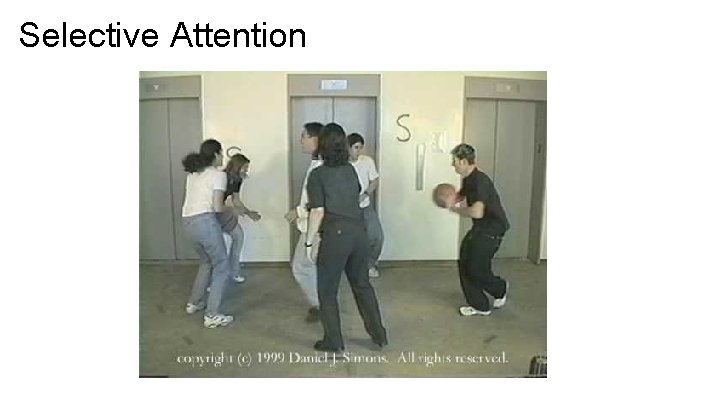
Selective Attention
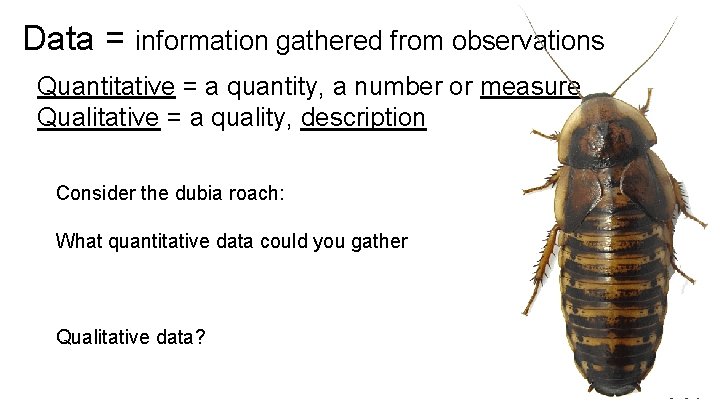
Data = information gathered from observations Quantitative = a quantity, a number or measure Qualitative = a quality, description Consider the dubia roach: What quantitative data could you gather Qualitative data?

INFERENCE - a logical interpretation based on observations and prior knowledge What conclusions can you draw from the photo?
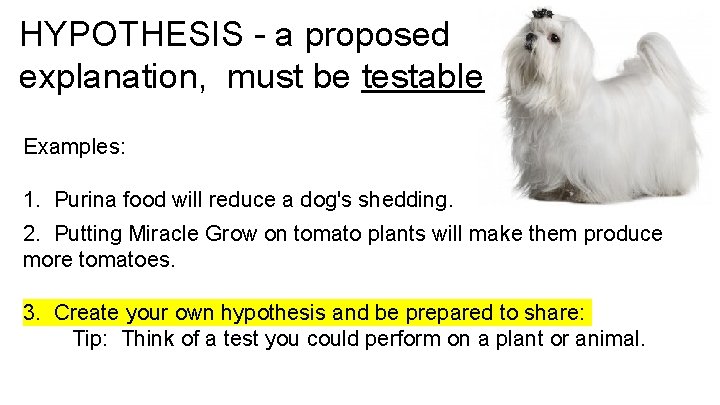
HYPOTHESIS - a proposed explanation, must be testable Examples: 1. Purina food will reduce a dog's shedding. 2. Putting Miracle Grow on tomato plants will make them produce more tomatoes. 3. Create your own hypothesis and be prepared to share: Tip: Think of a test you could perform on a plant or animal.
Checkpoint: Which of these hypotheses is best? 1. Plants grown under a blacklight will die. 2. Plants grown under a blacklight will grow taller. 3. Plants grown under a blacklight will grow taller than plants grown under a white light? 4. What will happen to plants grown under a blacklight? 5. Plants need light to grow.
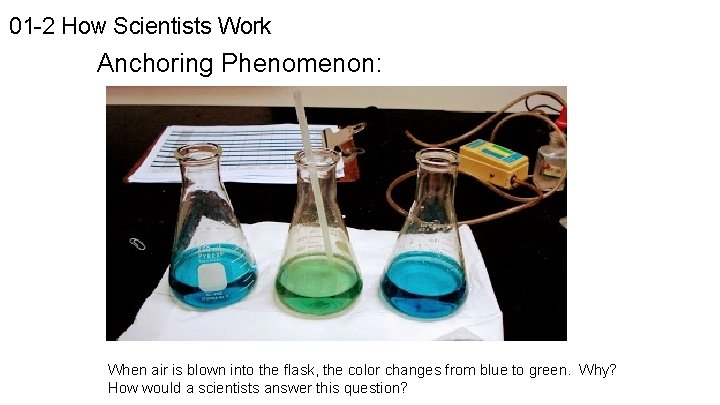
01 -2 How Scientists Work Anchoring Phenomenon: When air is blown into the flask, the color changes from blue to green. Why? How would a scientists answer this question?
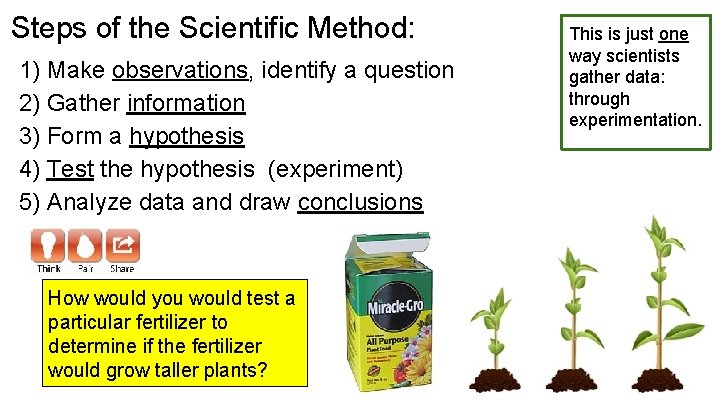
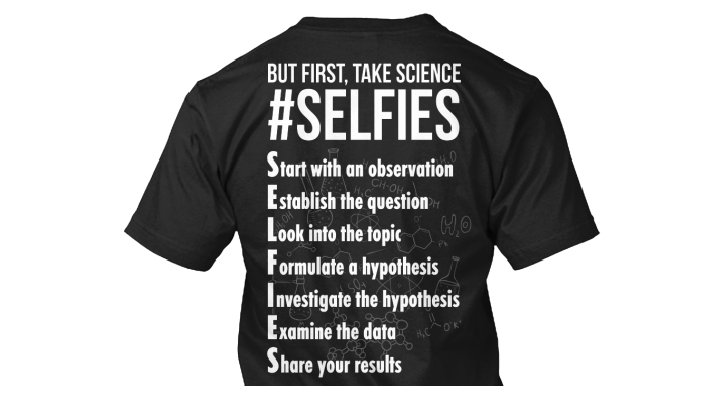
Steps of the Scientific Method: 1) Make observations, identify a question 2) Gather information 3) Form a hypothesis 4) Test the hypothesis (experiment) 5) Analyze data and draw conclusions How would you would test a particular fertilizer to determine if the fertilizer would grow taller plants? This is just one way scientists gather data: through experimentation.
Manipulated variable - the thing you change What is the manipulated variable in your plant experiment? Responding variable - what you observe or measure What is the responding variable in your plant experiment?
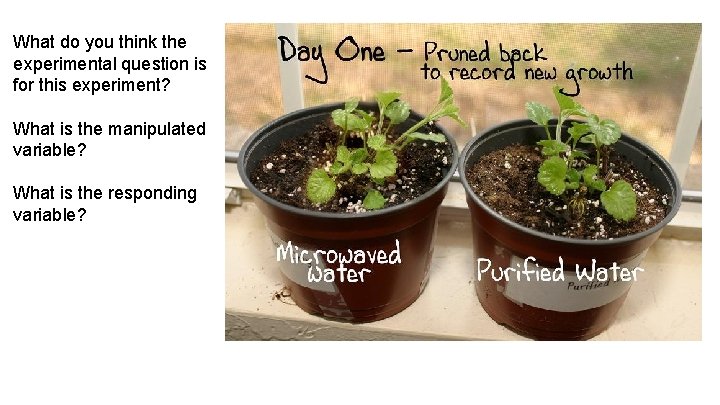
What do you think the experimental question is for this experiment? What is the manipulated variable? What is the responding variable?
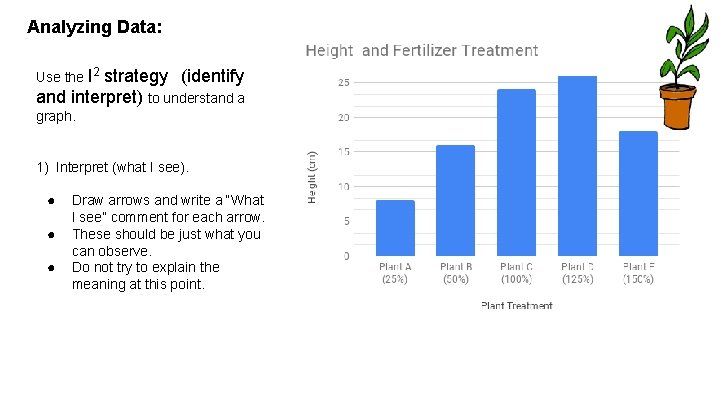
Analyzing Data: Use the I 2 strategy (identify and interpret) to understand a graph. 1) Interpret (what I see). ● ● ● Draw arrows and write a “What I see” comment for each arrow. These should be just what you can observe. Do not try to explain the meaning at this point.
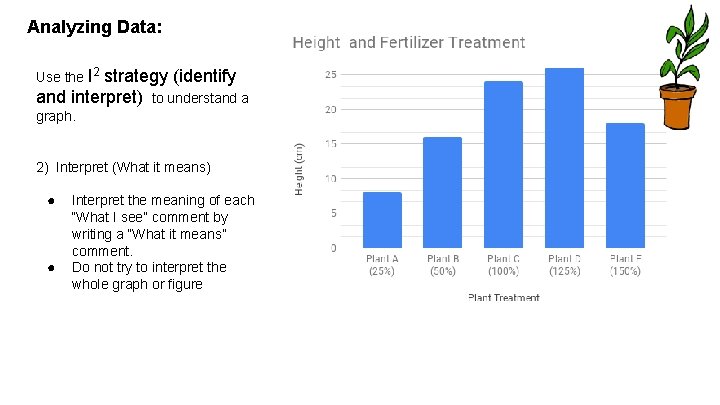
Analyzing Data: Use the I 2 strategy (identify and interpret) to understand a graph. 2) Interpret (What it means) ● ● Interpret the meaning of each “What I see” comment by writing a “What it means” comment. Do not try to interpret the whole graph or figure
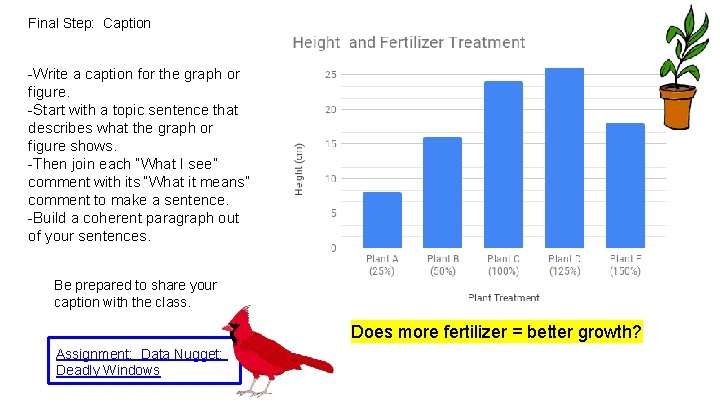
Final Step: Caption -Write a caption for the graph or figure. -Start with a topic sentence that describes what the graph or figure shows. -Then join each “What I see” comment with its “What it means” comment to make a sentence. -Build a coherent paragraph out of your sentences. Be prepared to share your caption with the class. Does more fertilizer = better growth? Assignment: Data Nugget: Deadly Windows
Scientific Reasoning Often scientists make CLAIMS about their findings. Good scientists can support those claims with EVIDENCE and scientific REASONING. The C-E-R model is a common tool to present a case about a reading, an experiment
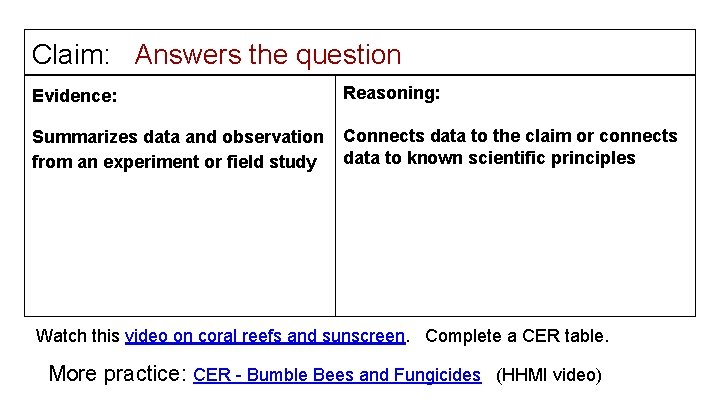
Claim: Answers the question Evidence: Reasoning: Summarizes data and observation from an experiment or field study Connects data to the claim or connects data to known scientific principles Watch this video on coral reefs and sunscreen. Complete a CER table. More practice: CER - Bumble Bees and Fungicides (HHMI video)
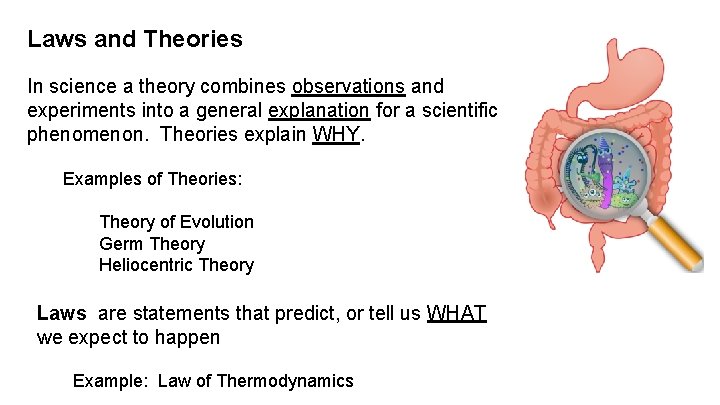
Laws and Theories In science a theory combines observations and experiments into a general explanation for a scientific phenomenon. Theories explain WHY. Examples of Theories: Theory of Evolution Germ Theory Heliocentric Theory Laws are statements that predict, or tell us WHAT we expect to happen Example: Law of Thermodynamics
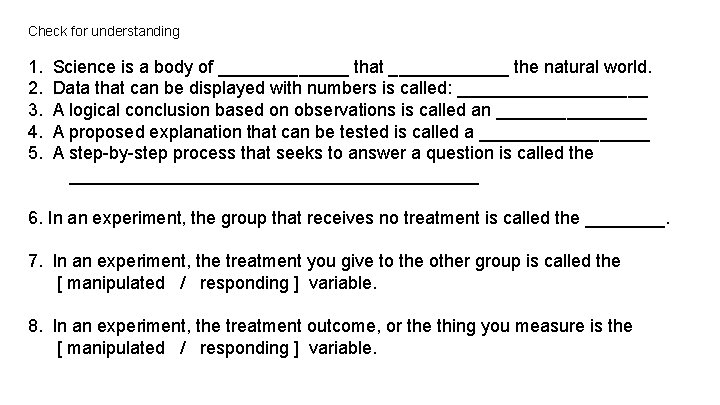
Check for understanding 1. 2. 3. 4. 5. Science is a body of _______ that ______ the natural world. Data that can be displayed with numbers is called: __________ A logical conclusion based on observations is called an ________ A proposed explanation that can be tested is called a _________ A step-by-step process that seeks to answer a question is called the _____________________ 6. In an experiment, the group that receives no treatment is called the ____. 7. In an experiment, the treatment you give to the other group is called the [ manipulated / responding ] variable. 8. In an experiment, the treatment outcome, or the thing you measure is the [ manipulated / responding ] variable.
- Slides: 25