
The Science Information Cycle Researcher has an idea
- Slides: 3
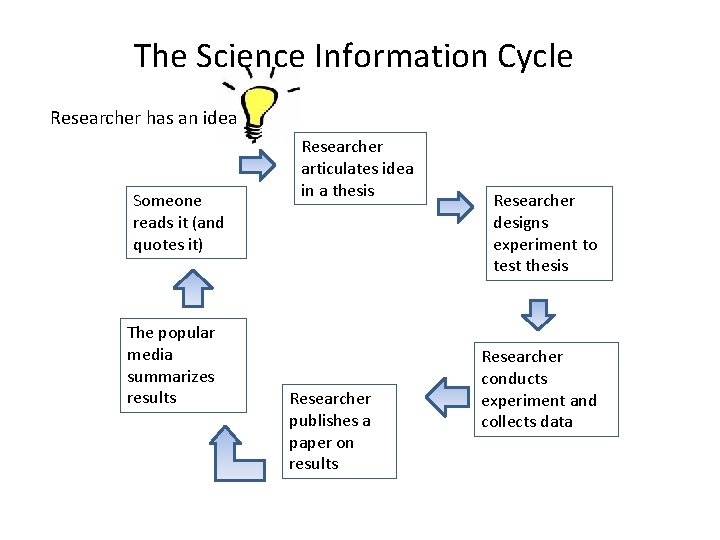
The Science Information Cycle Researcher has an idea Someone reads it (and quotes it) The popular media summarizes results Researcher articulates idea in a thesis Researcher publishes a paper on results Researcher designs experiment to test thesis Researcher conducts experiment and collects data
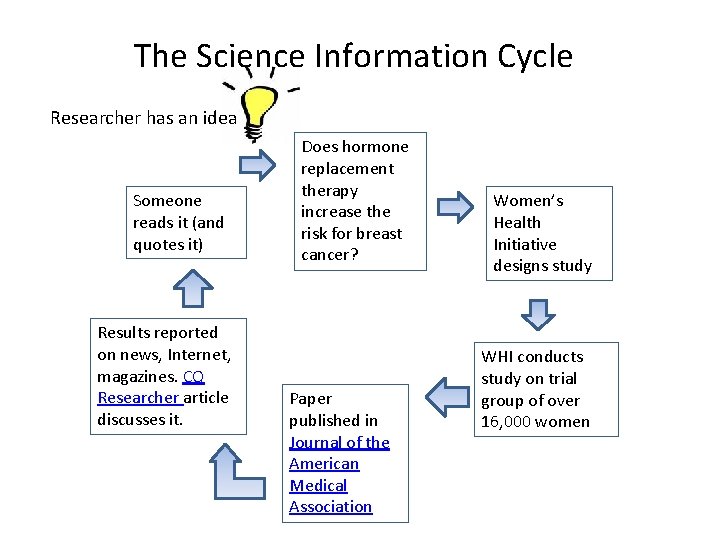
The Science Information Cycle Researcher has an idea Someone reads it (and quotes it) Results reported on news, Internet, magazines. CQ Researcher article discusses it. Does hormone replacement therapy increase the risk for breast cancer? Paper published in Journal of the American Medical Association Women’s Health Initiative designs study WHI conducts study on trial group of over 16, 000 women
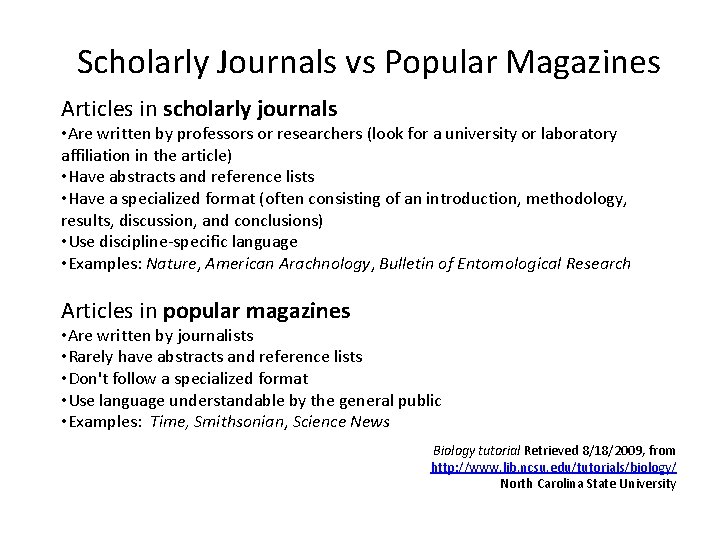
Scholarly Journals vs Popular Magazines Articles in scholarly journals • Are written by professors or researchers (look for a university or laboratory affiliation in the article) • Have abstracts and reference lists • Have a specialized format (often consisting of an introduction, methodology, results, discussion, and conclusions) • Use discipline-specific language • Examples: Nature, American Arachnology, Bulletin of Entomological Research Articles in popular magazines • Are written by journalists • Rarely have abstracts and reference lists • Don't follow a specialized format • Use language understandable by the general public • Examples: Time, Smithsonian, Science News Biology tutorial Retrieved 8/18/2009, from http: //www. lib. ncsu. edu/tutorials/biology/ North Carolina State University