
THE SCIENCE BEHIND CLEANER AIR ENERGY INDUSTRY FUNDAMENTALS
THE SCIENCE BEHIND CLEANER AIR ENERGY INDUSTRY FUNDAMENTALS: MODULE 1, UNIT A— The Evolution of the Power Industry and Its Regulatory Structure
Monitoring Particulate Air Pollution � Many developing countries do not have air monitoring sensors, so it is difficult to estimate the amount of pollution � Particle pollution is one-tenth the diameter of a human hair (PM 2. 5 = 2. 5 micrometers or less in diameter) � Suspected of contributing to millions of premature deaths around the world each year ENERGY INDUSTRY FUNDAMENTALS: MODULE 1, UNIT A— The Evolution of the Power Industry and Its Regulatory Structure
Health Impacts � Fine particulate matter can enter the lungs and then the bloodstream � Causes asthma, cardiovascular disease, bronchitis � The American Heart Association estimates that PM 2. 5 contributes to 60, 000 deaths a year in the U. S. ENERGY INDUSTRY FUNDAMENTALS: MODULE 1, UNIT A— The Evolution of the Power Industry and Its Regulatory Structure
Satellites Offer a Global Perspective � Problem: most satellite instruments cannot tell the difference between particles that are close to the ground and those high in the atmosphere � Canadian researchers Donkelaar & Martin used data from two NASA satellite instruments and a computer modeling program to develop a new map ENERGY INDUSTRY FUNDAMENTALS: MODULE 1, UNIT A— The Evolution of the Power Industry and Its Regulatory Structure
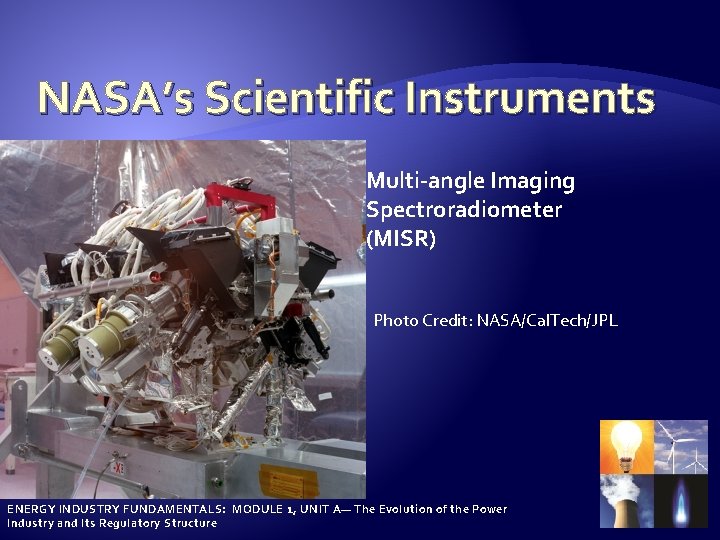
NASA’s Scientific Instruments Multi-angle Imaging Spectroradiometer (MISR) Photo Credit: NASA/Cal. Tech/JPL ENERGY INDUSTRY FUNDAMENTALS: MODULE 1, UNIT A— The Evolution of the Power Industry and Its Regulatory Structure
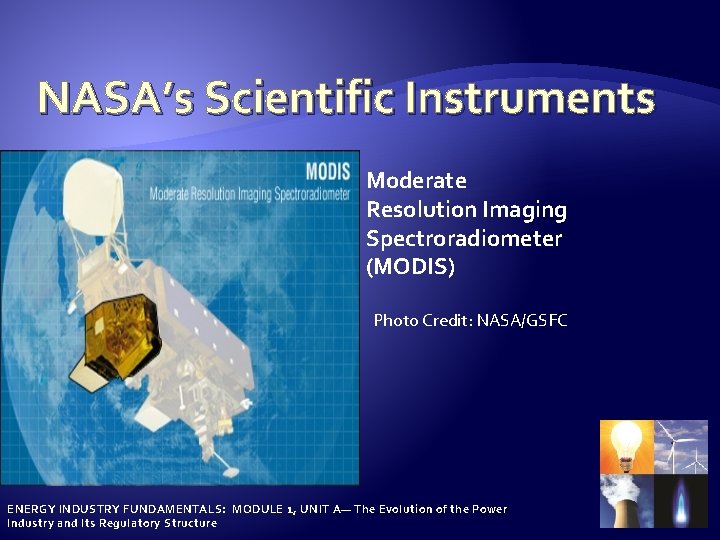
NASA’s Scientific Instruments Moderate Resolution Imaging Spectroradiometer (MODIS) Photo Credit: NASA/GSFC ENERGY INDUSTRY FUNDAMENTALS: MODULE 1, UNIT A— The Evolution of the Power Industry and Its Regulatory Structure
The New Map � Provides an estimate of PM 2. 5 pollution over developing countries, something that has been hard to do in the past � When compared with maps of population density, the new map suggests that more than 80% of the world’s population breathes air that exceeds the World Health Organization’s limits on air particulates ENERGY INDUSTRY FUNDAMENTALS: MODULE 1, UNIT A— The Evolution of the Power Industry and Its Regulatory Structure
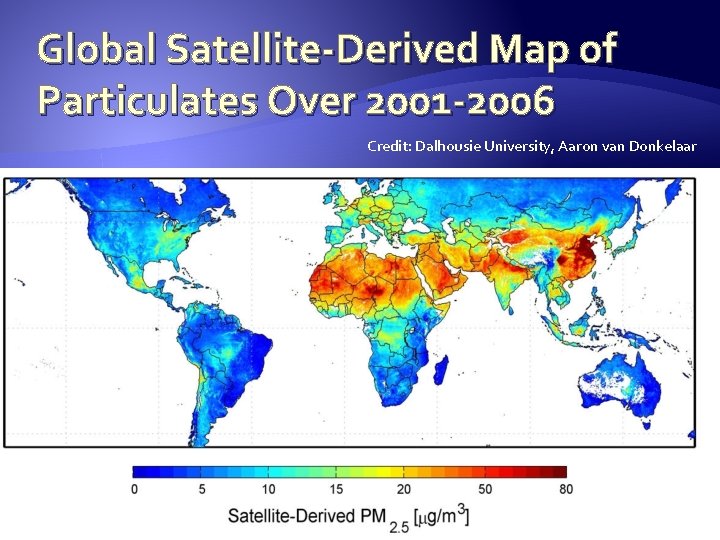
Global Satellite-Derived Map of Particulates Over 2001 -2006 Credit: Dalhousie University, Aaron van Donkelaar ENERGY INDUSTRY FUNDAMENTALS: MODULE 1, UNIT A— The Evolution of the Power Industry and Its Regulatory Structure
Where do you see the highest concentrations of PM 2. 5? � Saudi Arabia (Middle East) � Niger, Chad, Mali, Western Sahara (Africa) � Eastern China � Northern India ENERGY INDUSTRY FUNDAMENTALS: MODULE 1, UNIT A— The Evolution of the Power Industry and Its Regulatory Structure
Why are particulate emissions higher in these areas? � Hint #1: particulates come from both natural and man-made sources � Hint #2: particulates come from coal-fired power plants and factories � Hint #3: particulates come from vehicle exhaust � Hint #4: particulates come from burning of fields � Hint #5: wind blows dust from roads and deserts into the air ENERGY INDUSTRY FUNDAMENTALS: MODULE 1, UNIT A— The Evolution of the Power Industry and Its Regulatory Structure
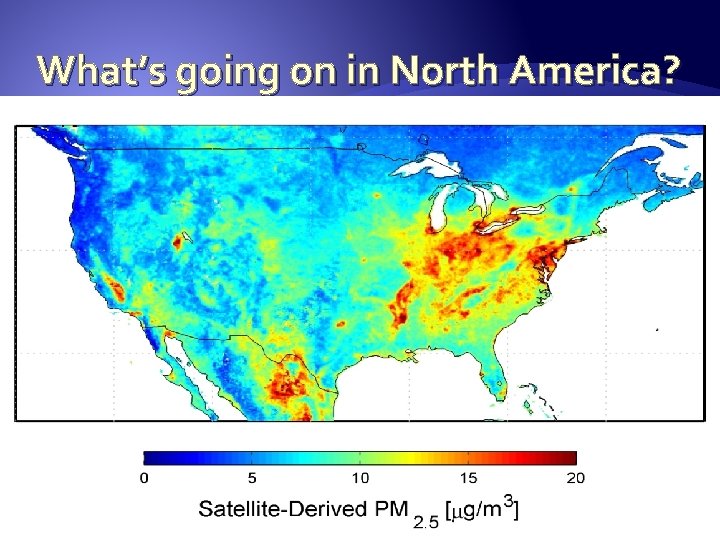
What’s going on in North America? ENERGY INDUSTRY FUNDAMENTALS: MODULE 1, UNIT A— The Evolution of the Power Industry and Its Regulatory Structure
Resources � “New Map Offers a Global View of Health- Sapping Air Pollution, ” Adam Volland, Sept. 22, 2010, NASA’s Earth Science News Team http: //www. nasa. gov/topics/earth/features/healthsapping. html ENERGY INDUSTRY FUNDAMENTALS: MODULE 1, UNIT A— The Evolution of the Power Industry and Its Regulatory Structure
- Slides: 12