
The Scholarly Communication Cycle and Research Data Linda


- Slides: 44
The Scholarly Communication Cycle and Research Data Linda Pikula NOAA Central Library at Miami (AOML and NHC) Linda. pikula@noaa. gov Research Data Management Kenya Marine Fisheries and Research Institute Mombasa, Kenya 3 -7, July 2017 With the support of the Government of Flanders, Belgium
Learning Outcomes • Following this session you will be able to: Discuss new and developing methodologies as well as data mandates by scientific funding agencies, governments, etc Students will understand the e-science mandate and life-cycle and their possible future role in this Become Acquainted with benchmarks in Managing the scientific output of their organization and/or country Understand the roles of Data Managers and Information Managers in Research Data Management and how they can become collaborators in this RDM Recognize the importance of good research data management practice Research Data Management
Research Data Management Scholarly Communication Cycle and Research Data Management
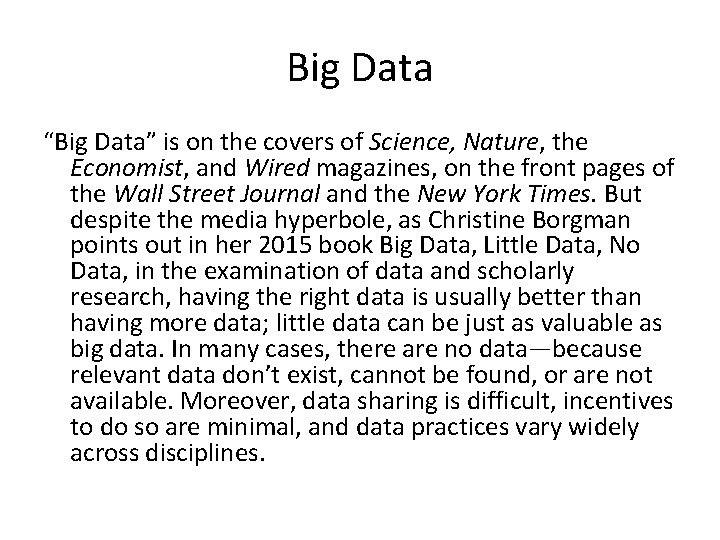
Big Data “Big Data” is on the covers of Science, Nature, the Economist, and Wired magazines, on the front pages of the Wall Street Journal and the New York Times. But despite the media hyperbole, as Christine Borgman points out in her 2015 book Big Data, Little Data, No Data, in the examination of data and scholarly research, having the right data is usually better than having more data; little data can be just as valuable as big data. In many cases, there are no data—because relevant data don’t exist, cannot be found, or are not available. Moreover, data sharing is difficult, incentives to do so are minimal, and data practices vary widely across disciplines.
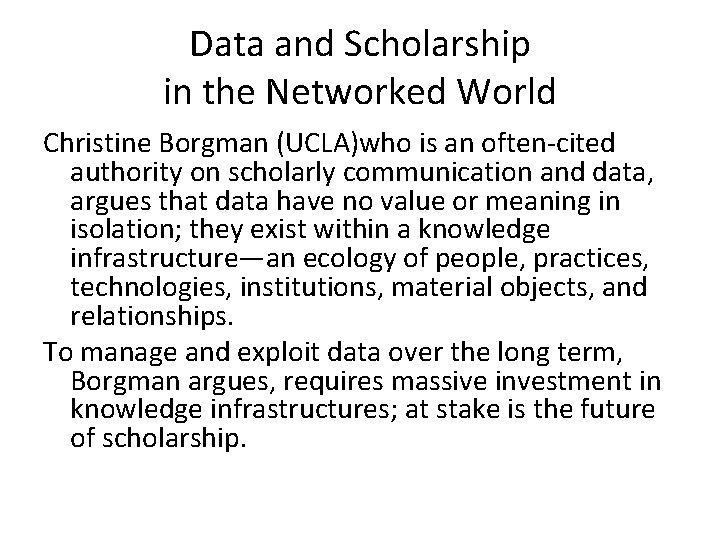
Data and Scholarship in the Networked World Christine Borgman (UCLA)who is an often-cited authority on scholarly communication and data, argues that data have no value or meaning in isolation; they exist within a knowledge infrastructure—an ecology of people, practices, technologies, institutions, material objects, and relationships. To manage and exploit data over the long term, Borgman argues, requires massive investment in knowledge infrastructures; at stake is the future of scholarship.
Organizations and Disciplines have different Data Life. Cycle Models Examine Some: CEOS Data Life Cycle Models and Concepts Report (Committee on Earth Observation Satellites Working Group on Information Systems and Services and the U. S. Geological Survey Community for Data Integration Data Management Best Practices ) • url: wgiss. ceos. org/dsig/whitepapers/Data Lifecycle. . .
Some Data Life Cycle Models
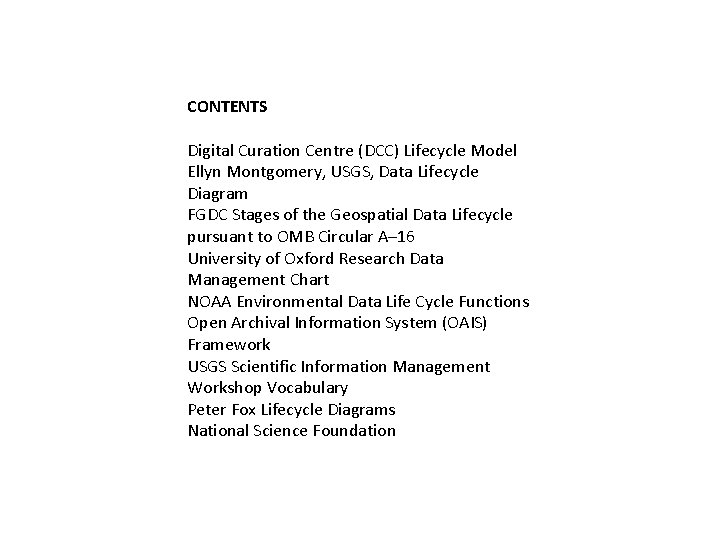
CONTENTS Digital Curation Centre (DCC) Lifecycle Model Ellyn Montgomery, USGS, Data Lifecycle Diagram FGDC Stages of the Geospatial Data Lifecycle pursuant to OMB Circular A– 16 University of Oxford Research Data Management Chart NOAA Environmental Data Life Cycle Functions Open Archival Information System (OAIS) Framework USGS Scientific Information Management Workshop Vocabulary Peter Fox Lifecycle Diagrams National Science Foundation
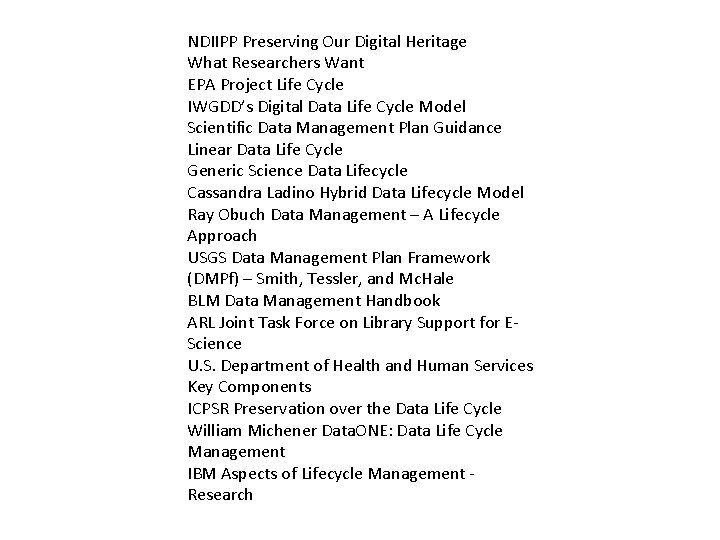
NDIIPP Preserving Our Digital Heritage What Researchers Want EPA Project Life Cycle IWGDD’s Digital Data Life Cycle Model Scientific Data Management Plan Guidance Linear Data Life Cycle Generic Science Data Lifecycle Cassandra Ladino Hybrid Data Lifecycle Model Ray Obuch Data Management – A Lifecycle Approach USGS Data Management Plan Framework (DMPf) – Smith, Tessler, and Mc. Hale BLM Data Management Handbook ARL Joint Task Force on Library Support for EScience U. S. Department of Health and Human Services Key Components ICPSR Preservation over the Data Life Cycle William Michener Data. ONE: Data Life Cycle Management IBM Aspects of Lifecycle Management - Research
University of California San Diego Digital Curation Program University of Miami Scientific Data Lifecycle Managing Research Data Lifecycles through Context Purdue University Research Repository Collaborative Model Data Lifecycle Management at Dell John Faundeen & Ellyn Montgomery “Spins” Data. Train Model 1 Data. Train Model 2 Steve Tessler Data Management Cycles Peter Fox Full Life Cycle of Data Guide to Social Science Data Preparation and Archiving: Best Practice Throughout the Data Life Cycle Steve Tessler Data and System Lifecycle Models University of Virginia Library Mario Valle Michigan State University Records Life Cycle Model
Dr. Liz Lyon from the UK: “We must Build the links between research data, scholarly communication and learning”
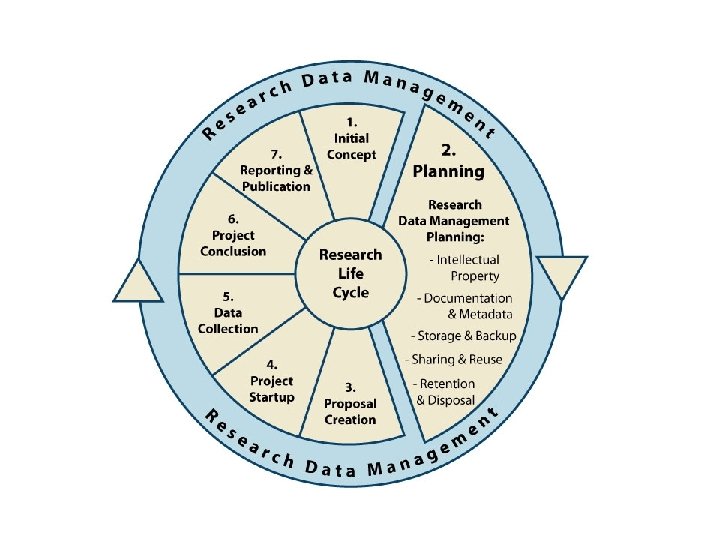
From Western Australia The Research Data Management Cycle
Let us look at Part 7 of the Process: Reporting and Publication
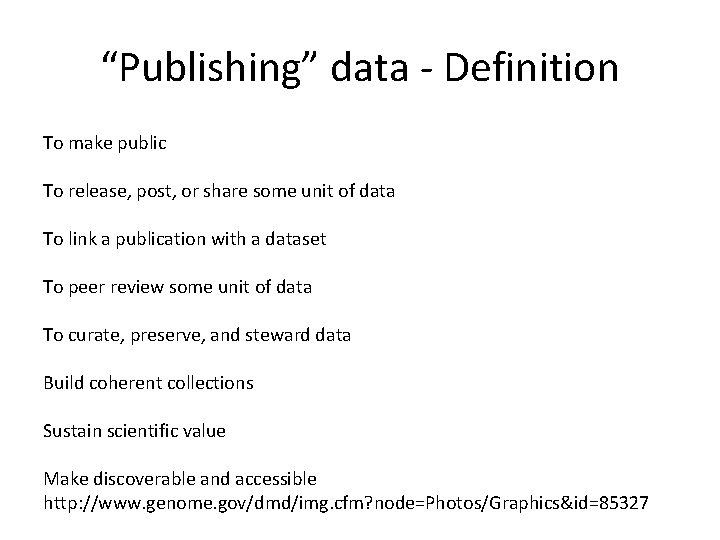
“Publishing” data - Definition To make public To release, post, or share some unit of data To link a publication with a dataset To peer review some unit of data To curate, preserve, and steward data Build coherent collections Sustain scientific value Make discoverable and accessible http: //www. genome. gov/dmd/img. cfm? node=Photos/Graphics&id=85327
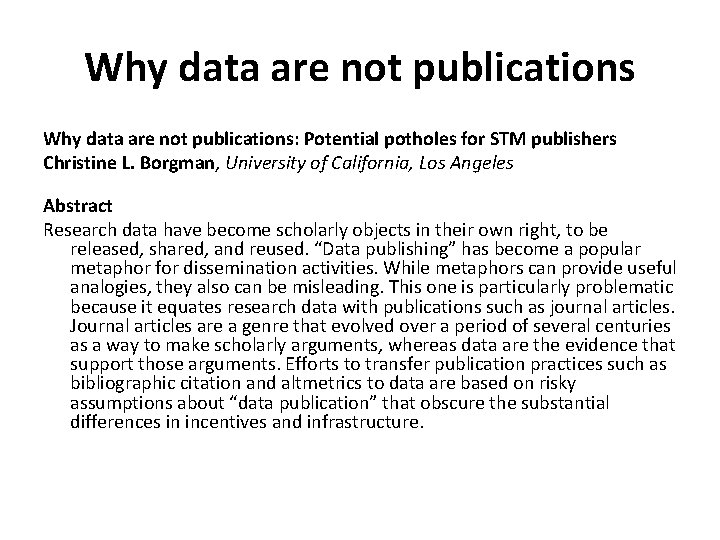
Why data are not publications: Potential potholes for STM publishers Christine L. Borgman, University of California, Los Angeles Abstract Research data have become scholarly objects in their own right, to be released, shared, and reused. “Data publishing” has become a popular metaphor for dissemination activities. While metaphors can provide useful analogies, they also can be misleading. This one is particularly problematic because it equates research data with publications such as journal articles. Journal articles are a genre that evolved over a period of several centuries as a way to make scholarly arguments, whereas data are the evidence that support those arguments. Efforts to transfer publication practices such as bibliographic citation and altmetrics to data are based on risky assumptions about “data publication” that obscure the substantial differences in incentives and infrastructure.
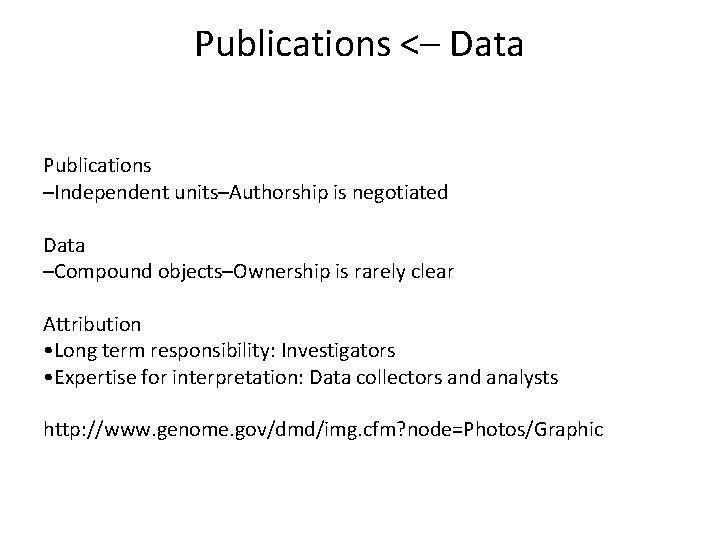
Publications <– Data Publications –Independent units–Authorship is negotiated Data –Compound objects–Ownership is rarely clear Attribution • Long term responsibility: Investigators • Expertise for interpretation: Data collectors and analysts http: //www. genome. gov/dmd/img. cfm? node=Photos/Graphic
Definitions: Publications Data • Publications <–> Data • Publications are arguments made by authors, and data are the evidence used to support the arguments. • C. L. Borgman (2015). Big Data, Little Data, No Data: Scholarship in the Networked World. MIT Press
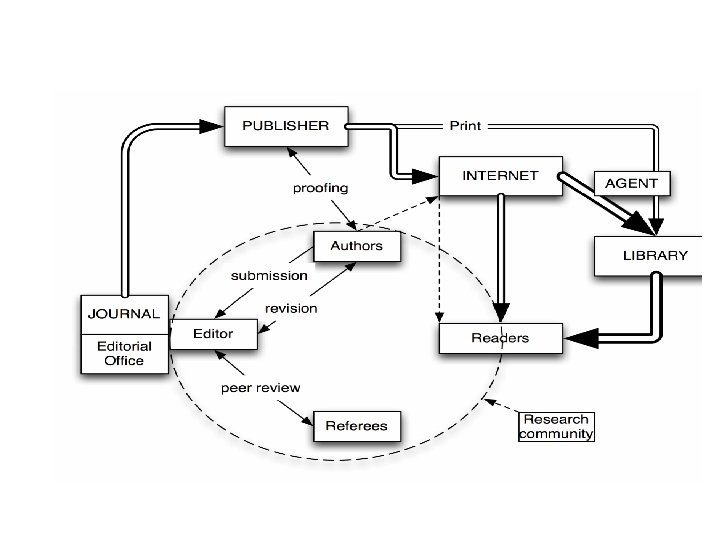
Traditional Publication Life. Cycle
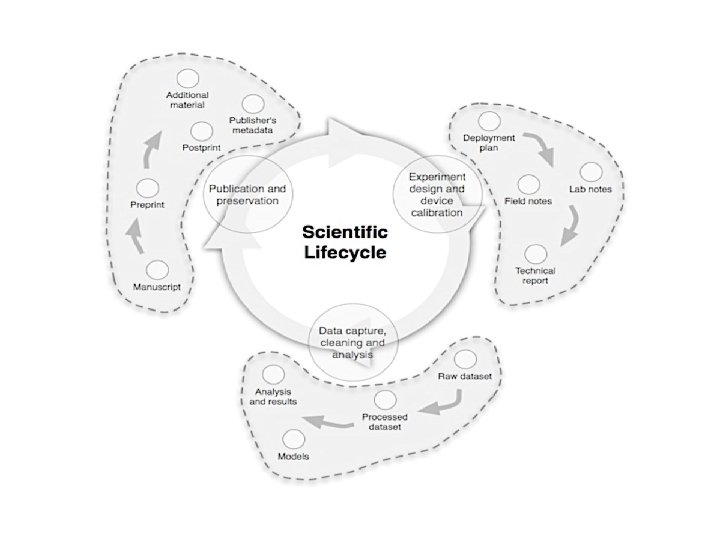
Scientific Life. Cycle Including Data Collection
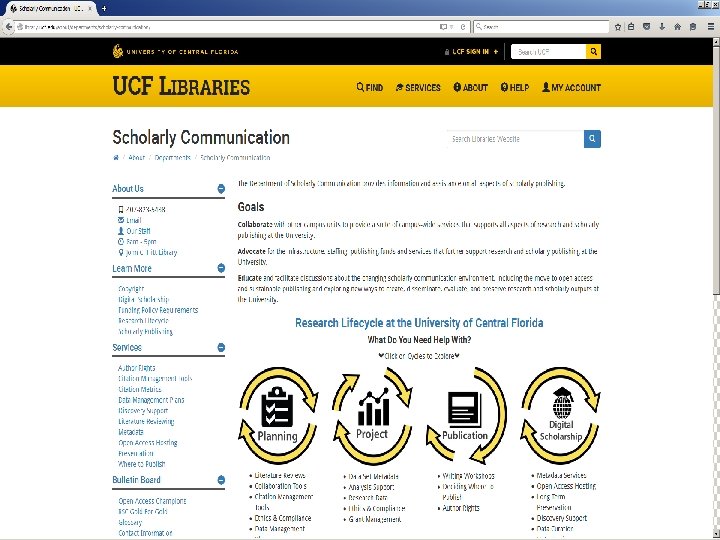
Scholarly Communication As a wonderful example of the new model of Scholarly Communication the. . University of Central Florida website on this subject http: //library. ucf. edu/about/departments/schol arly-communication/ Please go to this website
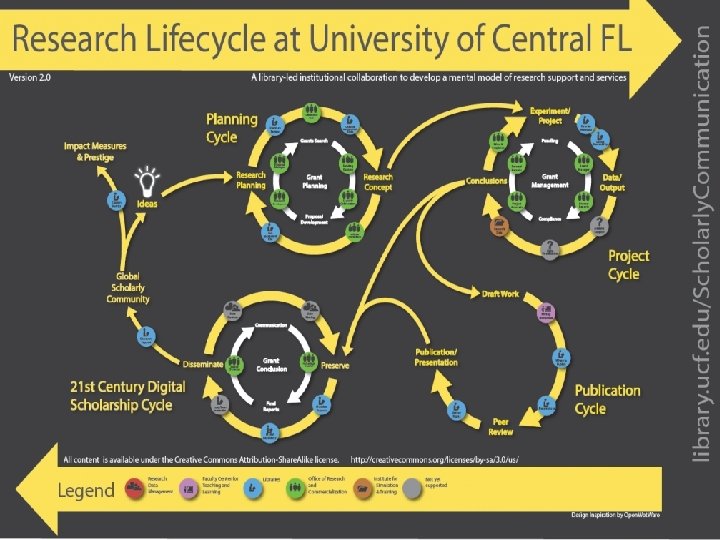
21 st Century Digital Scholarship Cycle
Class Exercise and discussion 1. What does the publication cycle look like now in your organization? Consider data in this question. 2. How has it changed in the last few years, if at all? 3. Go to the CEOS WGISS Report and find a data life cycle mode that most closely resembles your organizations data life cycle. Be prepared to discuss and contrast and compare url: wgiss. ceos. org/dsig/whitepapers/Data Lifecycle. . .
Examples from NOAA Look up this publication in the NOAA Catalog: url for NOAA Catalog is: http: //www. lib. noaa. gov/uhtbin/webcat Oceanographic data collected in the Straits of Florida at 27°N during the year 2000, including the estimated Florida Current transport
NOAA Data Publication and Sharing Directive for Grants, Cooperative Agreements and Contracts From Jeff de la Beaujardiere , NOAA Data Architect presentation, Nov. 2015
Goals of NOAA Data & Publication Sharing Directive • Environmental data produced using extramural NOAA funding are made publicly accessible • Manuscripts of publications are publicly accessible (after embargo) • Data used to support conclusions of peer reviewed papers are cited and preserved
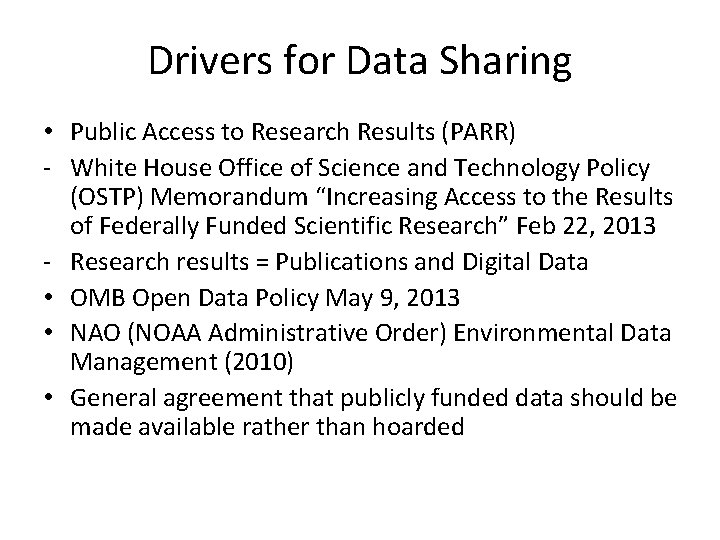
Drivers for Data Sharing • Public Access to Research Results (PARR) - White House Office of Science and Technology Policy (OSTP) Memorandum “Increasing Access to the Results of Federally Funded Scientific Research” Feb 22, 2013 - Research results = Publications and Digital Data • OMB Open Data Policy May 9, 2013 • NAO (NOAA Administrative Order) Environmental Data Management (2010) • General agreement that publicly funded data should be made available rather than hoarded
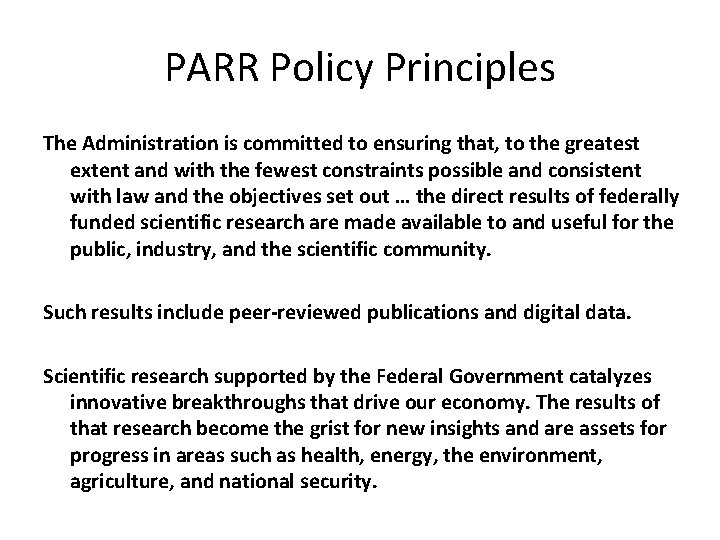
PARR Policy Principles The Administration is committed to ensuring that, to the greatest extent and with the fewest constraints possible and consistent with law and the objectives set out … the direct results of federally funded scientific research are made available to and useful for the public, industry, and the scientific community. Such results include peer-reviewed publications and digital data. Scientific research supported by the Federal Government catalyzes innovative breakthroughs that drive our economy. The results of that research become the grist for new insights and are assets for progress in areas such as health, energy, the environment, agriculture, and national security.
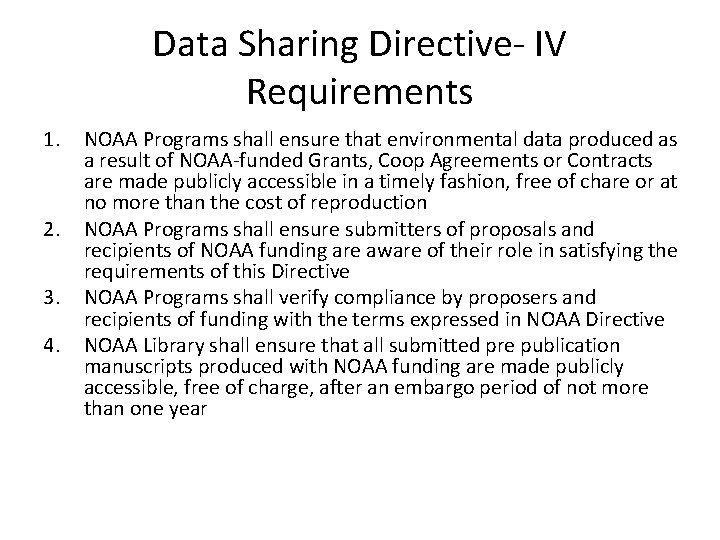
Data Sharing Directive- IV Requirements 1. 2. 3. 4. NOAA Programs shall ensure that environmental data produced as a result of NOAA-funded Grants, Coop Agreements or Contracts are made publicly accessible in a timely fashion, free of chare or at no more than the cost of reproduction NOAA Programs shall ensure submitters of proposals and recipients of NOAA funding are aware of their role in satisfying the requirements of this Directive NOAA Programs shall verify compliance by proposers and recipients of funding with the terms expressed in NOAA Directive NOAA Library shall ensure that all submitted pre publication manuscripts produced with NOAA funding are made publicly accessible, free of charge, after an embargo period of not more than one year
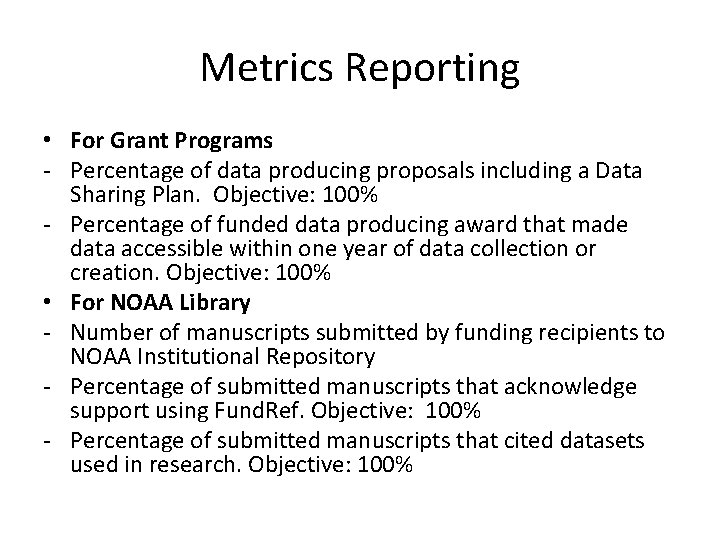
Metrics Reporting • For Grant Programs - Percentage of data producing proposals including a Data Sharing Plan. Objective: 100% - Percentage of funded data producing award that made data accessible within one year of data collection or creation. Objective: 100% • For NOAA Library - Number of manuscripts submitted by funding recipients to NOAA Institutional Repository - Percentage of submitted manuscripts that acknowledge support using Fund. Ref. Objective: 100% - Percentage of submitted manuscripts that cited datasets used in research. Objective: 100%
Research Libraries “ Research libraries have a significant role to play, along with data archives and scientific publishers in providing a safety net for capturing and retaining the products of scientific research” J. Jacobs and C. Humphrey “Preserving Research Data, Com. of the ACM. , v. 47 (9)
Class Assignment Develop the Roles of Researcher/Data Manager And Information Specialist (Librarian) in the Scholarly Life Cycle
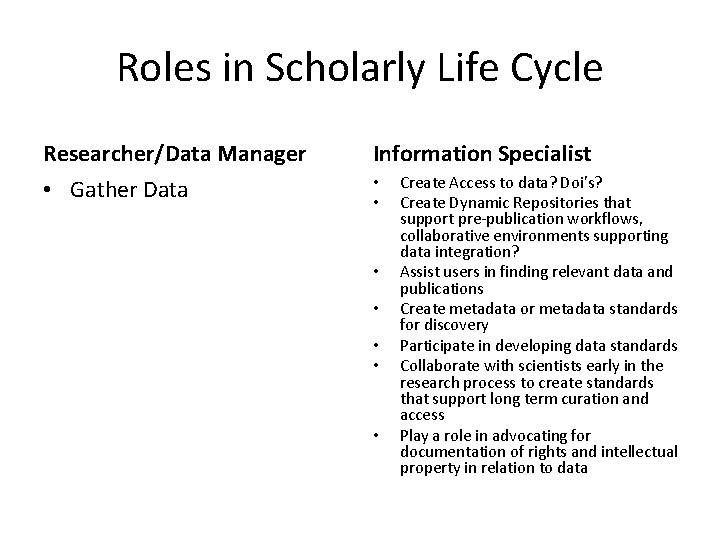
Roles in Scholarly Life Cycle Researcher/Data Manager Information Specialist • Gather Data • • Create Access to data? Doi’s? Create Dynamic Repositories that support pre-publication workflows, collaborative environments supporting data integration? Assist users in finding relevant data and publications Create metadata or metadata standards for discovery Participate in developing data standards Collaborate with scientists early in the research process to create standards that support long term curation and access Play a role in advocating for documentation of rights and intellectual property in relation to data
Researcher/Data Manager
Information Specialist
Roles of Data Manager and Librarian • What is your role in this cycle now? • Do you see it changing?
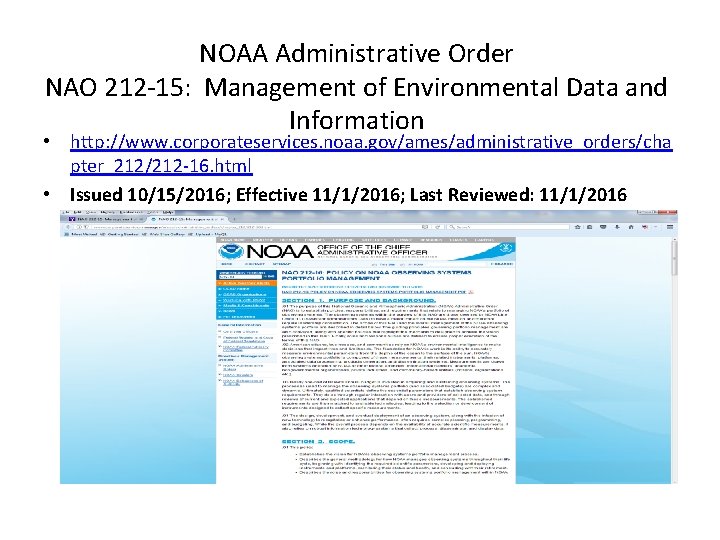
NOAA Administrative Order NAO 212 -15: Management of Environmental Data and Information • http: //www. corporateservices. noaa. gov/ames/administrative_orders/cha pter_212/212 -16. html • Issued 10/15/2016; Effective 11/1/2016; Last Reviewed: 11/1/2016
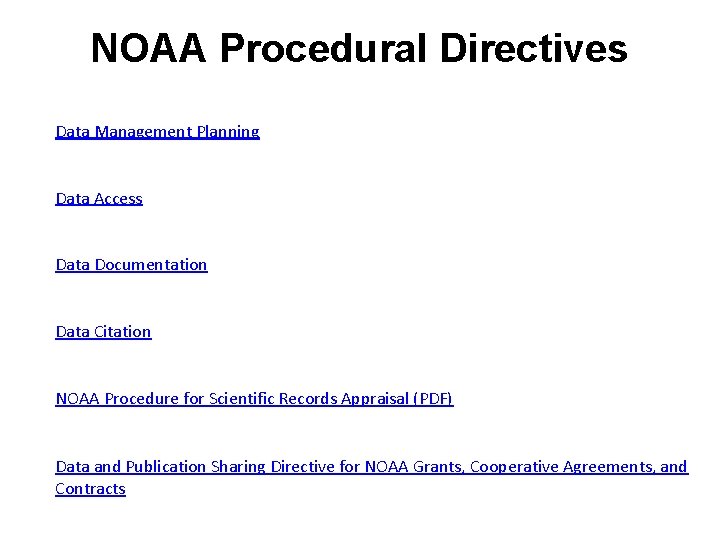
NOAA Procedural Directives Data Management Planning Data Access Data Documentation Data Citation NOAA Procedure for Scientific Records Appraisal (PDF) Data and Publication Sharing Directive for NOAA Grants, Cooperative Agreements, and Contracts
Credits • Borgman, Christine L. Big Data, Little Data, No Data : Scholarship in the Networked World. MIT Press, 2015. • De La Beaujardiere, Jeff. Data and Publication Sharing Directive for grants, Coop Agreements and Contracts. Presentation to NOAA Research Council, November 11, 2015 • Kaske, Neal and Elswick, Stanley. Presentation to NOAA Research Council, Nov. 2014. • CEOS Data Life Cycle Models and Concepts. CEOS. WGISS. DSIG. Tno 1 Issue 1. 2 April 2012 • Corti, L. , Verie Van den Eynden, Libby Bishop and Matthew Woodlard. Managing and Sharing Research Data: A guide to good practice. Sage Publications, 2014. • DCC Curation Lifecycle Model http: //www. dcc. ac. uk/resources/curation-lifecycle-model/
Access to Referenced Documents Presidents PARR Directive White House. Office of Science and Technology Policy. Increasing Access to the Results of Federally Funded Research, memorandum for the heads of executive departments and agencies, issued Feb. 22, 2013 (https: //www 2. icsu-wds. org/files/ostppublic-access-memo-2013. pdf) NOAA Response to PARR (Plan) NOAA Research Council. NOAA Plan for Increasing Public Access to the Results of Research issued Feb. 2015 (http: //dx. doi. org/10. 7289/V 5 F 47 M 2 H) NOAA IR https: //repository. library. noaa. gov Current NOAA Library Catalog http: //www. lib. noaa. gov/uhtbin/webcat New NOAA Public Access Policy for Scholarly Publications Policy (version June 2015) to go into effect October 2015 Handouts – this is not posted online NOAA Administrative Orders NOAA Administrative Order 212 -15 Management of Environmental Data and Information, issued 8/22/91; effective 11/04/10. (http: //www. corporateservices. noaa. gov/ames/administrative_orders/chapter_212/212 -15. html) NOAA Administrative Order 201 -32 G Scientific and Technical Publications, issued 02/04/93; effective 01/27/93 (under review). (http: //www. corporateservices. noaa. gov/ames/administrative_orders/chapter_201/201 -32 G. html)