
THE SCARLET IBIS By James Hurst FORMAT FOR
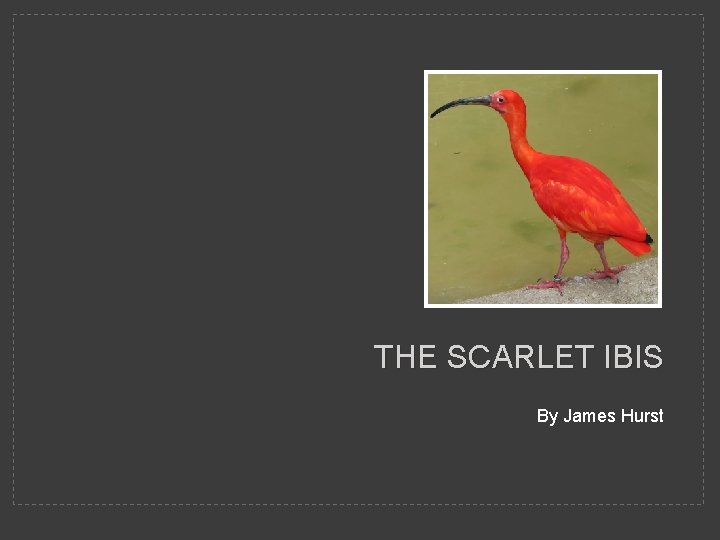
THE SCARLET IBIS By James Hurst
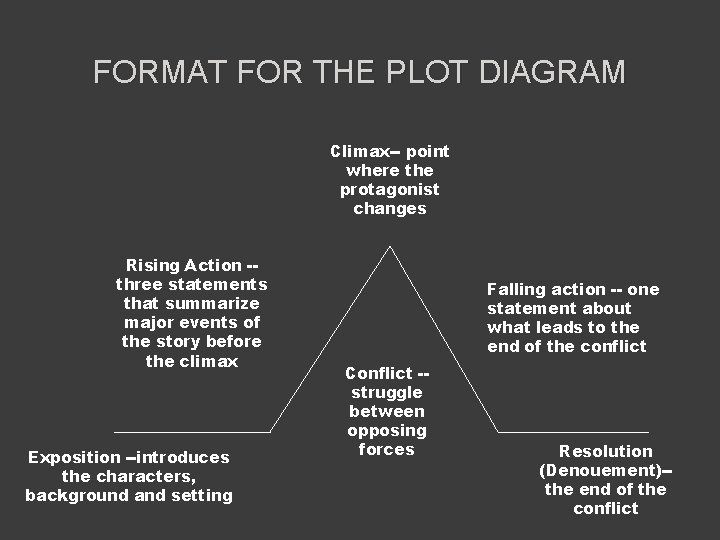
FORMAT FOR THE PLOT DIAGRAM Climax-- point where the protagonist changes Rising Action -three statements that summarize major events of the story before the climax Exposition --introduces the characters, background and setting Falling action -- one statement about what leads to the end of the conflict Conflict -struggle between opposing forces Resolution (Denouement)-the end of the conflict
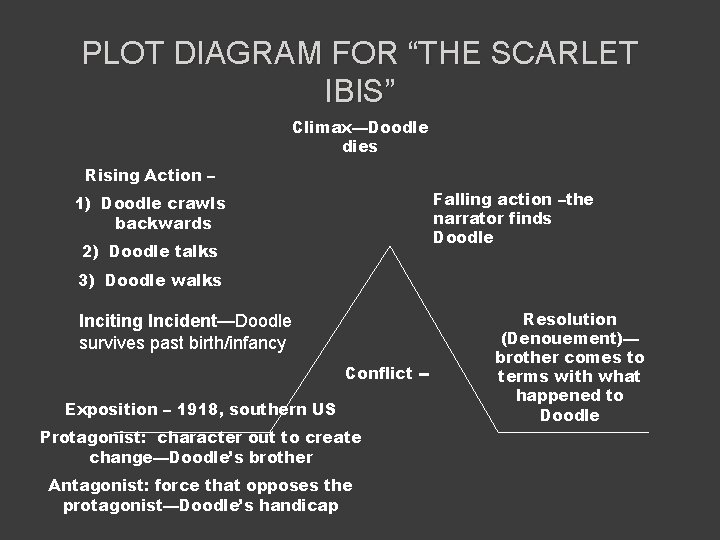
PLOT DIAGRAM FOR “THE SCARLET IBIS” Climax—Doodle dies Rising Action – Falling action –the narrator finds Doodle 1) Doodle crawls backwards 2) Doodle talks 3) Doodle walks Inciting Incident—Doodle survives past birth/infancy Conflict -Exposition – 1918, southern US Protagonist: character out to create change—Doodle’s brother Antagonist: force that opposes the protagonist—Doodle’s handicap Resolution (Denouement)— brother comes to terms with what happened to Doodle
KEY TERMINOLOGY Retrospect: contemplation of the past; thinking about past events Transition: smoothly moving from one topic to another Point of View: the perspective from which the author is telling the story Simile: a comparison using “like” or “as”
KEY TERMINOLOGY Irony: the least expected outcome Foreshadowing: hints or glimpses into the future of the story Allusion: a reference to another, well-known, literary work Imagery: very detailed description that allows a reader to form a mental picture Symbol: an object or a person represents something else
KEY TERMINOLOGY Characterization: the methods used by the author to develop the characters Indirect Characterization: the author reveals information about a character and that character’s personality through the character’s actions, thoughts, and words as well as through those of other characters Direct Characterization: the author directly states information and descriptions concerning a character
- Slides: 6