
The Sampling Proclivity Unit 1 Data and Variability
The Sampling Proclivity Unit 1 – Data and Variability 1/3/2022 Algebra 1 Institute 1
Population and Sample • Population: The entire group that we want information about • Sample: a representative portion of the population – A representative sample is one in which the relevant characteristics of the sample members are generally the same as the characteristics of the population. – Two advantages of sampling • the cost is lower • data collection is faster 1/3/2022 Algebra 1 Institute 2
Selecting a Sample • Improper or biased sample selection can produce misleading conclusions. • Sample selection is biased if it systematically favors certain outcomes. • We need to select our sample in an unbiased fashion. 1/3/2022 Algebra 1 Institute 3
Random Sampling Methods: • Simple Random Sampling (SRS): Each individual is chosen entirely by chance and each member of the population has an equal chance of being included in the sample. Every possible sample of a given size has the same chance of selection. • Stratified Sampling: There may often be factors which divide up the population into sub-populations (groups / strata) and we may expect the measurement of interest to vary among the different sub-populations. A stratified sample is obtained by taking samples from each stratum or sub-group of a population. • Cluster Sampling: Cluster sampling is a sampling technique where the entire population is divided into groups, or clusters, and a random sample of these clusters are selected. All observations in the selected clusters are included in the sample. 1/3/2022 Algebra 1 Institute 4
Sampling Rectangles • In 15 seconds – choose 5 typical rectangles • Record the areas. – Each small square in the figure represents an area of 1 square unit. • Find the average area (looking ahead: “mean”) 1/3/2022 Algebra 1 Institute 5
Random Numbers • In Excel “=RANDBETWEEN(1, 100)” • Select 5 rectangles • Find the average area • Pool results from both samples 1/3/2022 Algebra 1 Institute 6
Compare Area Data • • Compare the area averages Compare the range of area values Any unusual values? Distribution: a description of where the data appear and in what quantity (looking ahead: use a dot plot to describe the distribution) • Population average area is 7. 42 square units 1/3/2022 Algebra 1 Institute 7
Sample size • Using the Random number generator, find a sample of 10 rectangles (larger sample than before) • Find the sample average • Pool results • Compare this area data to that found with sample size of 5 (averages, distributions) • What is the effect of sample size? 1/3/2022 Algebra 1 Institute 8
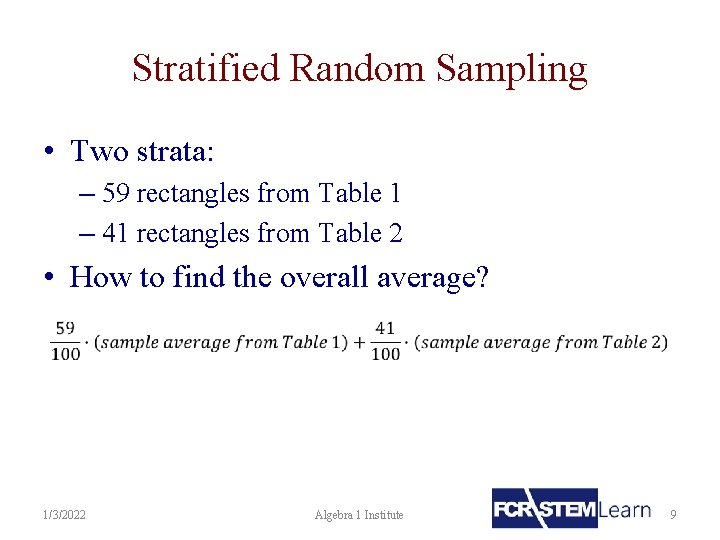
Stratified Random Sampling • Two strata: – 59 rectangles from Table 1 – 41 rectangles from Table 2 • How to find the overall average? 1/3/2022 Algebra 1 Institute 9
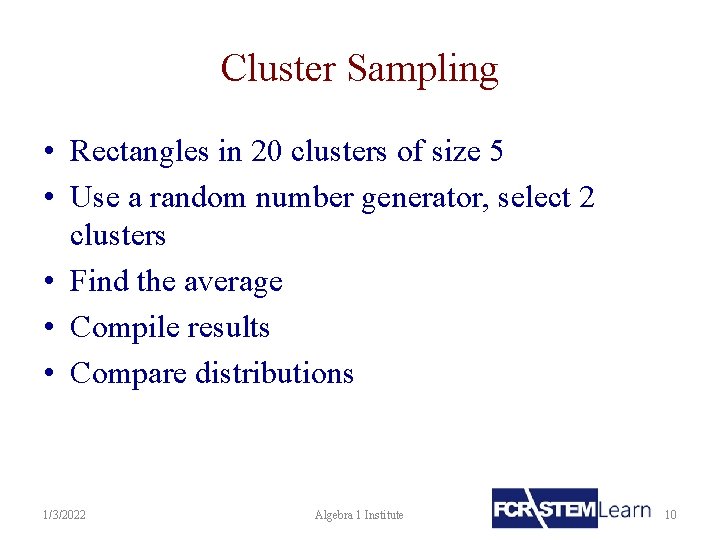
Cluster Sampling • Rectangles in 20 clusters of size 5 • Use a random number generator, select 2 clusters • Find the average • Compile results • Compare distributions 1/3/2022 Algebra 1 Institute 10
Conclusion • What could be said about the sample size? • What observations can be made about the sampling methods explored: simple random sampling, stratified random sampling, and cluster sampling? 1/3/2022 Algebra 1 Institute 11
- Slides: 11