
The Sales Process Seven Steps of Selling Seven
- Slides: 17
+ The Sales Process Seven Steps of Selling
+ Seven Steps of the Selling Process n Step 1: Approach n Step 2: Determine Needs n Step 3: Present the Product n Step 4: Overcome Objections n Step 5: Close the Sale n Step 6: Suggestion Selling n Step 7: Build Relationships
+ Step 1: The Approach n The approach, also known as the sales opening, is the first face -to-face contact with the customer. n Tips for effective sales openings: n Treat customers as individuals n Be aware of customer’s personality and buying styles. n Show interest in the customer by maintaining eye contact n Learn and use the customer’s name n Grab the customer’s attention n Recognize that sales approaches differ in organization and retail selling situations.
+ Organizational Selling (B 2 B) n Sales people usually make appointments to meet n Sales person should arrive early n Use proper etiquette: Greet the customer by name and introduces him- or herself and the company with a firm handshake and smile n Engage the customer with comments on recent event’s in the customer’s industry n Gather information about your customer to create a personal connection
+ Retail Selling n Time the approach appropriately n n When customers are in a hurry, you should approach them quickly Three methods of approaching a customer in retail n Greeting Approach: The sales person welcomes the customer to the store. n Service Approach: Salesperson ask customers if they need assistance n Merchandise or Theme Approach: The salesperson makes a comment or asks questions about a product in which the customer shows an interest.
+ Step 2: Determine Needs n Determine needs right after approaching the customer n The service and merchandise approach allows you to asking customers a question about their needs n Three ways to determine needs: n Observing n Listening n Questioning
+ Observing n Read your customer by observing them n Nonverbal communication is expressing oneself without the use of words. n Facial expressions, hand motions, eye movement, and other forms of nonverbal communication can give you clues about a customer’s interest in a product
+ Listening n Listening is one of the most important interpersonal skills you need to practice in selling n Giving customers your undivided attention and listening with empathy are two specific skills that will encourage your customers to talk freely
+ Questioning n One way to engage a customer in conversation is to ask questions n First ask general questions about the intended use of the product and any previous experience with it n Build questions around words like who, what, when, where, how and why n Once you have an idea about the customer’s general needs, then you can ask more specific questions relating to the product
+ Questioning Do’s and Don’ts n Do ask open-ended questions that encourage customers to do the talking. n Do ask clarifying questions to make sure you understand the customers’ needs. n Don’t ask too many questions in a row. This will make the customers feel as if they are cross-examined. n Don’t ask questions that might embarrass customers or put them in the defense.
+ Step 3: Presenting the Product n After learning the customer’s needs, you should be able to select a few samples to match those needs. n If the selection is not accurate, ask questions to get the feedback to select another product. n Begin by showing moderately priced products. You can move up or down in price once you get customer feedback. n Avoid overwhelming the customer by showing no more than three products at a time. n Present the product’s selling points. Educate the customer by explaining how the product’s features relate to their needs. n Use layman’s terms, words the average customer can understand.
+ Plan the Presentation n Planning is necessary for an effective product presentation. n Handle the product with respect and use hand gestures to show the significance of certain features. n Demonstrate the product if you can to build customer confidence. n Use sale aides to help emphasize certain selling points if you are unable to demonstrate. n Involve the customer. Let the customer try the product and feel what it would be like to own it. n Hold the customer’s attention
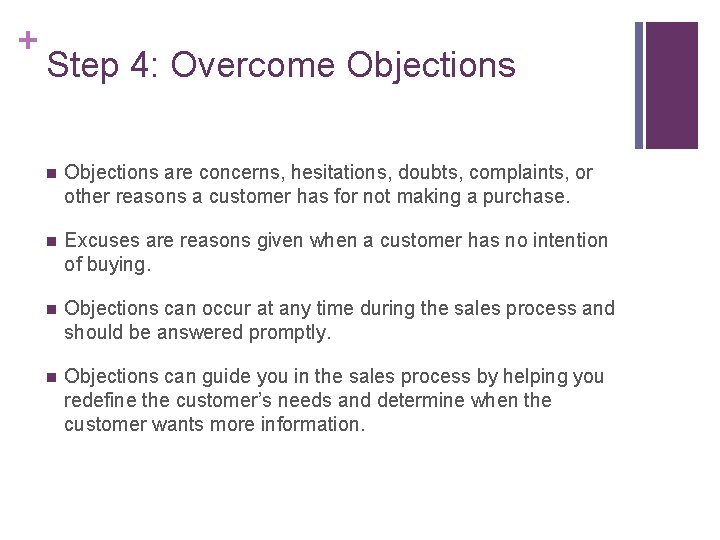
+ Step 4: Overcome Objections n Objections are concerns, hesitations, doubts, complaints, or other reasons a customer has for not making a purchase. n Excuses are reasons given when a customer has no intention of buying. n Objections can occur at any time during the sales process and should be answered promptly. n Objections can guide you in the sales process by helping you redefine the customer’s needs and determine when the customer wants more information.
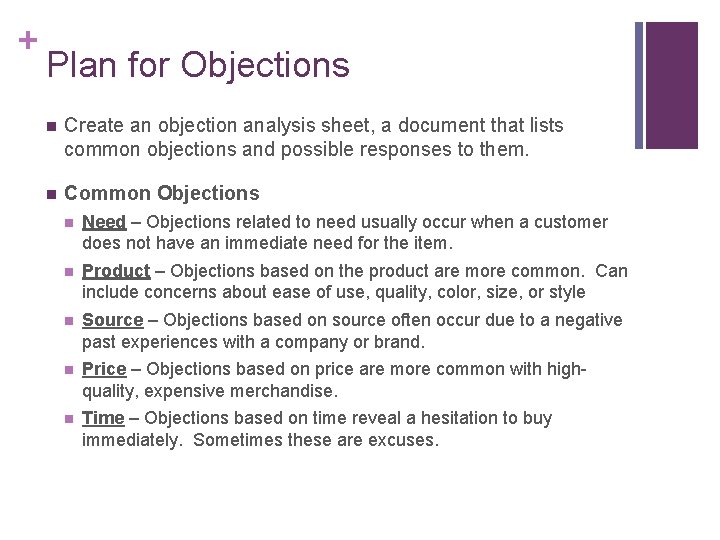
+ Plan for Objections n Create an objection analysis sheet, a document that lists common objections and possible responses to them. n Common Objections n Need – Objections related to need usually occur when a customer does not have an immediate need for the item. n Product – Objections based on the product are more common. Can include concerns about ease of use, quality, color, size, or style n Source – Objections based on source often occur due to a negative past experiences with a company or brand. n Price – Objections based on price are more common with highquality, expensive merchandise. n Time – Objections based on time reveal a hesitation to buy immediately. Sometimes these are excuses.
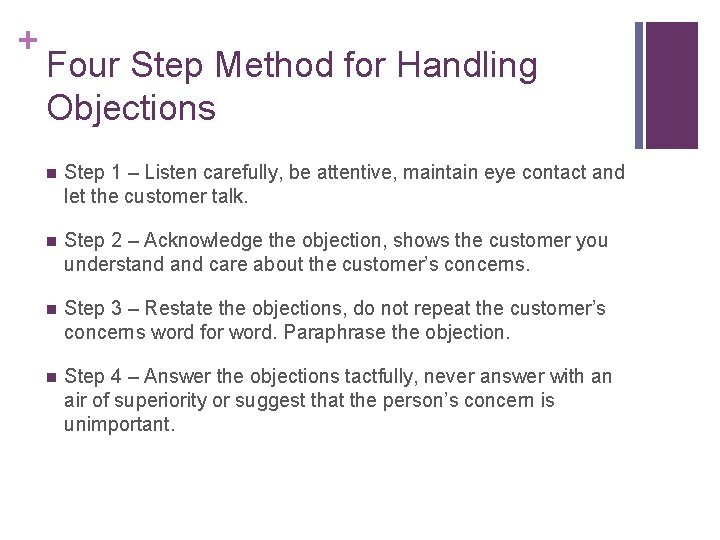
+ Four Step Method for Handling Objections n Step 1 – Listen carefully, be attentive, maintain eye contact and let the customer talk. n Step 2 – Acknowledge the objection, shows the customer you understand care about the customer’s concerns. n Step 3 – Restate the objections, do not repeat the customer’s concerns word for word. Paraphrase the objection. n Step 4 – Answer the objections tactfully, never answer with an air of superiority or suggest that the person’s concern is unimportant.
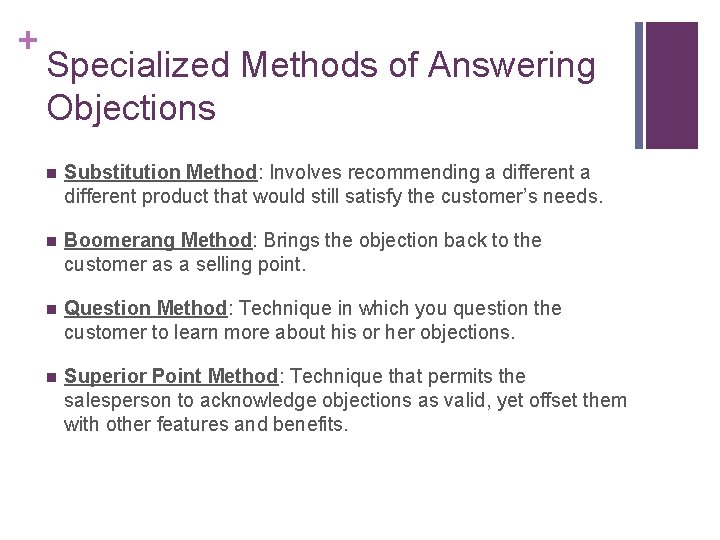
+ Specialized Methods of Answering Objections n Substitution Method: Involves recommending a different product that would still satisfy the customer’s needs. n Boomerang Method: Brings the objection back to the customer as a selling point. n Question Method: Technique in which you question the customer to learn more about his or her objections. n Superior Point Method: Technique that permits the salesperson to acknowledge objections as valid, yet offset them with other features and benefits.
+ Specialized Methods of Answering Objections n Denial Method: When the customer’s objection is based on misinformation. It is best to provide proof and accurate information in answer to objection. n Demonstration Method: Seeing is believing. Demonstrate to show the product actually being used. n Third Party Method: Involves using a previous customer or another neutral person who can give a testimonial about the product.