
The Saigon CTT Semester 1 CHAPTER 5 Le

- Slides: 96
The Saigon CTT Semester 1 CHAPTER 5 Le Chi Trung
The Saigon CTT }Content • Most common LAN media • Making cable - LAB • Layer 1 components and devices • Collisions and collision domains
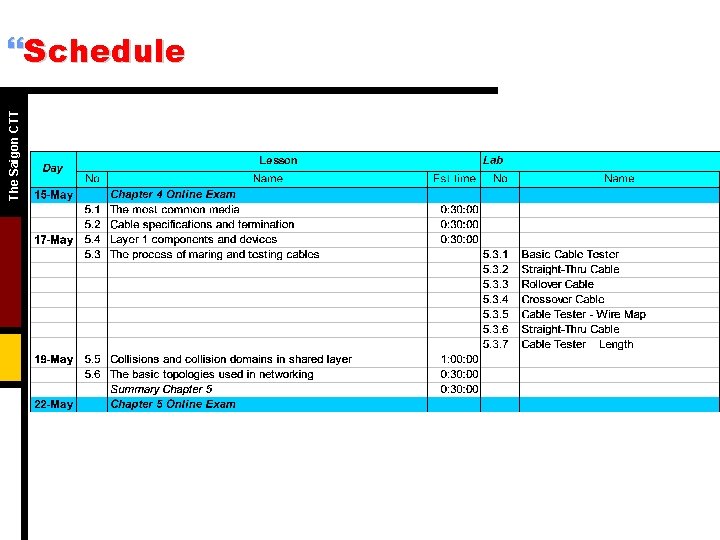
The Saigon CTT }Schedule
The Saigon CTT MOST COMMON LAN MEDIA
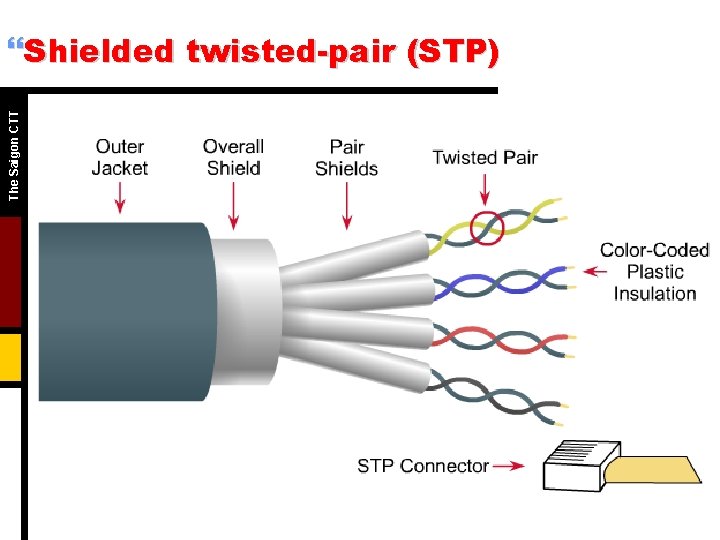
The Saigon CTT }Shielded twisted-pair (STP)
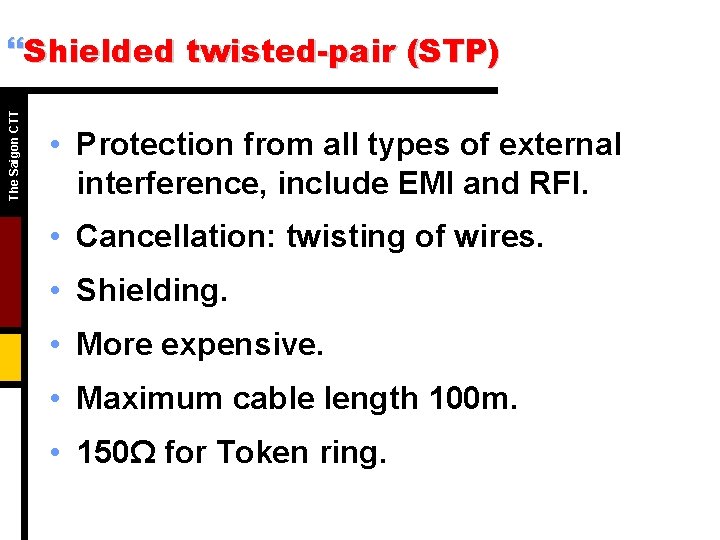
The Saigon CTT }Shielded twisted-pair (STP) • Protection from all types of external interference, include EMI and RFI. • Cancellation: twisting of wires. • Shielding. • More expensive. • Maximum cable length 100 m. • 150Ω for Token ring.
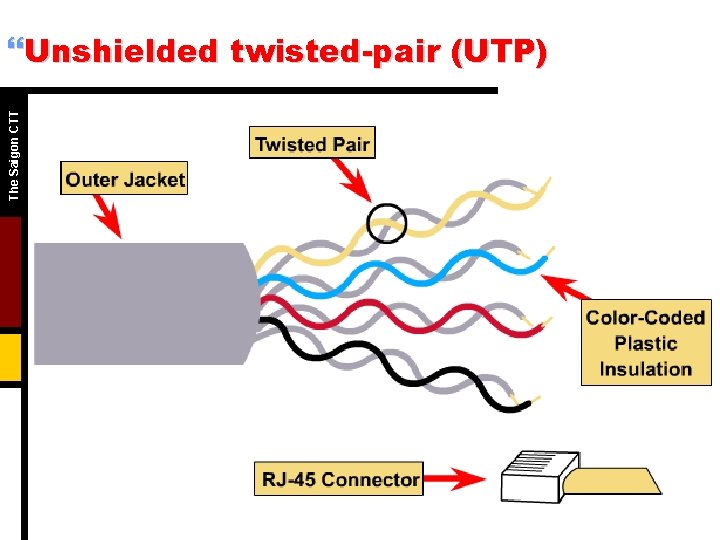
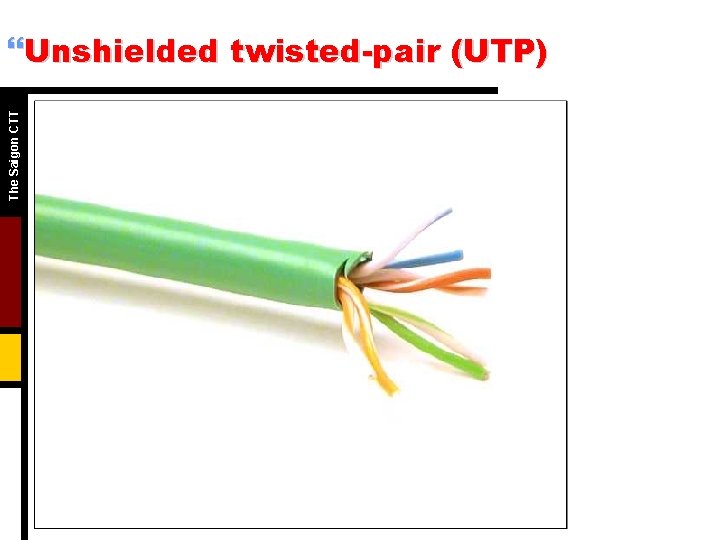
The Saigon CTT }Unshielded twisted-pair (UTP)
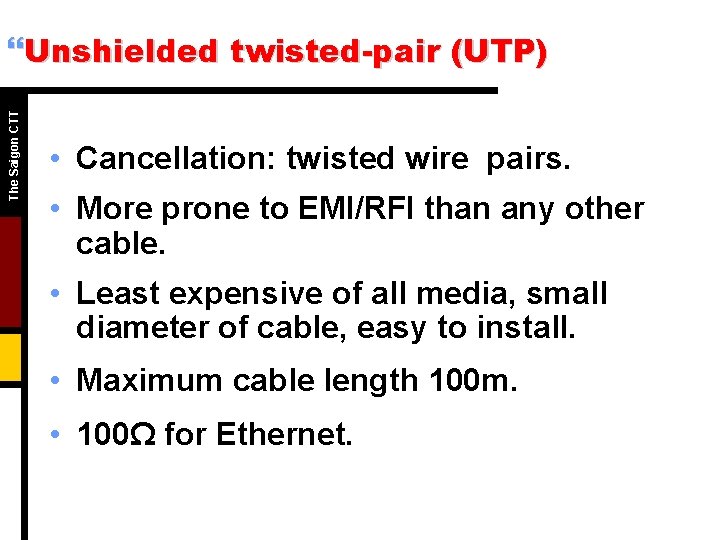
The Saigon CTT }Unshielded twisted-pair (UTP) • Cancellation: twisted wire pairs. • More prone to EMI/RFI than any other cable. • Least expensive of all media, small diameter of cable, easy to install. • Maximum cable length 100 m. • 100Ω for Ethernet.
The Saigon CTT }Unshielded twisted-pair (UTP)
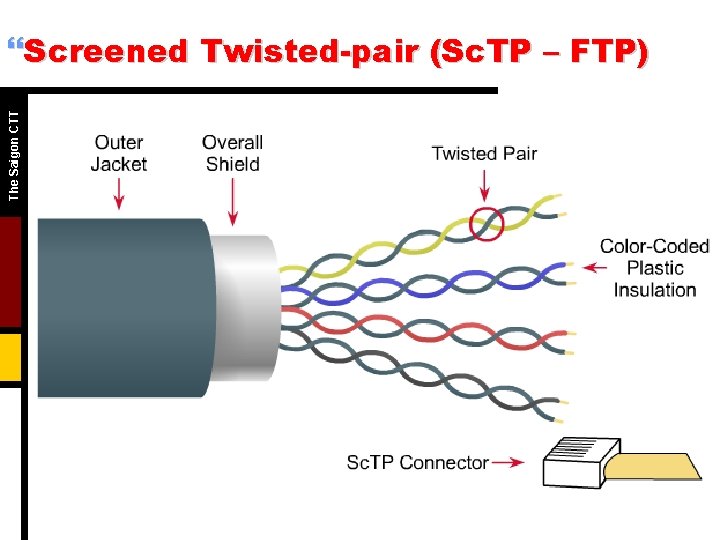
The Saigon CTT }Screened Twisted-pair (Sc. TP – FTP)
The Saigon CTT }Screened Twisted-pair (Sc. TP – FTP) • Hybrid of UTP with STP. • Maximum cable length 100 m. • 100Ω for Ethernet.
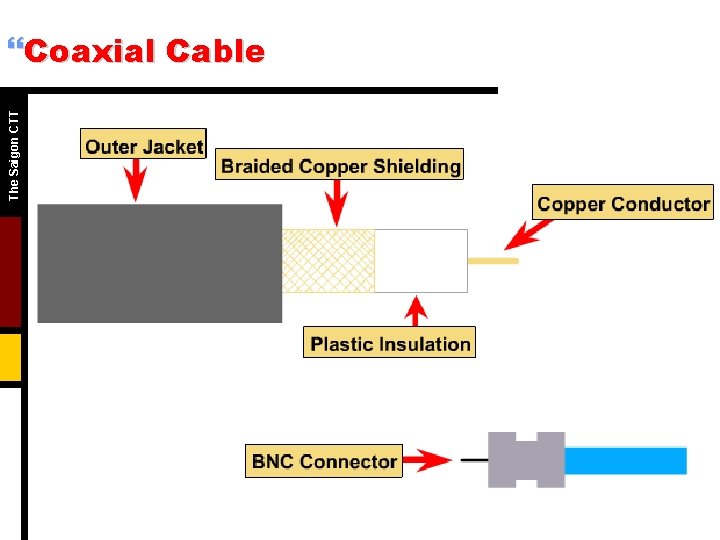
The Saigon CTT }Coaxial Cable
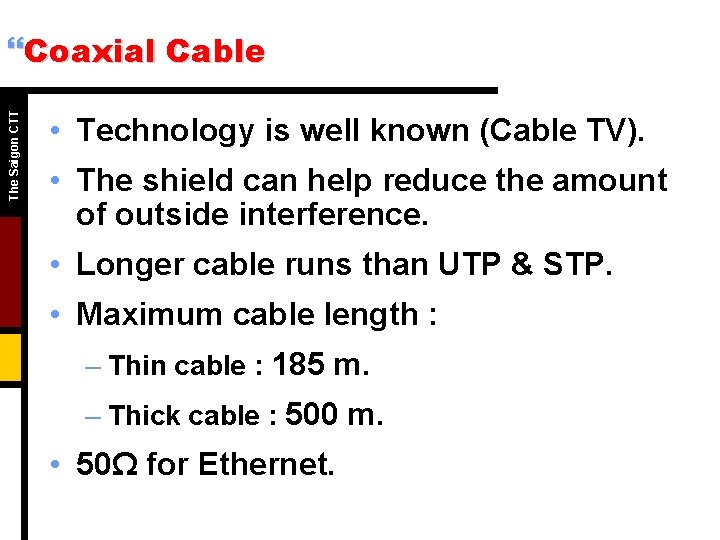
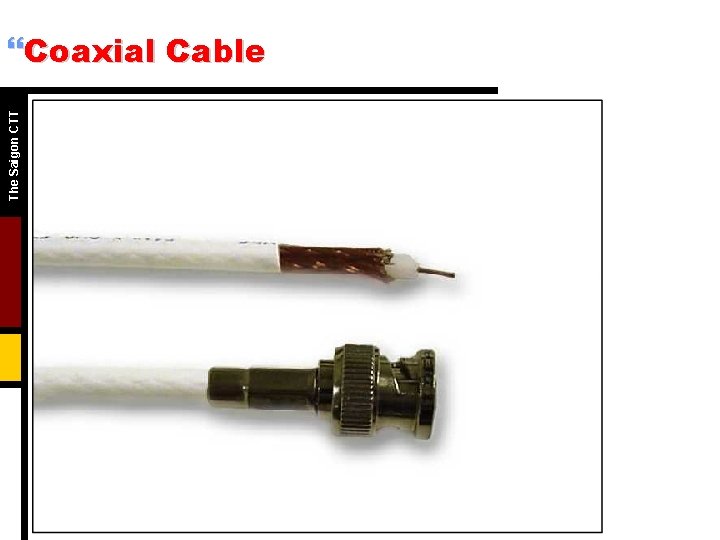
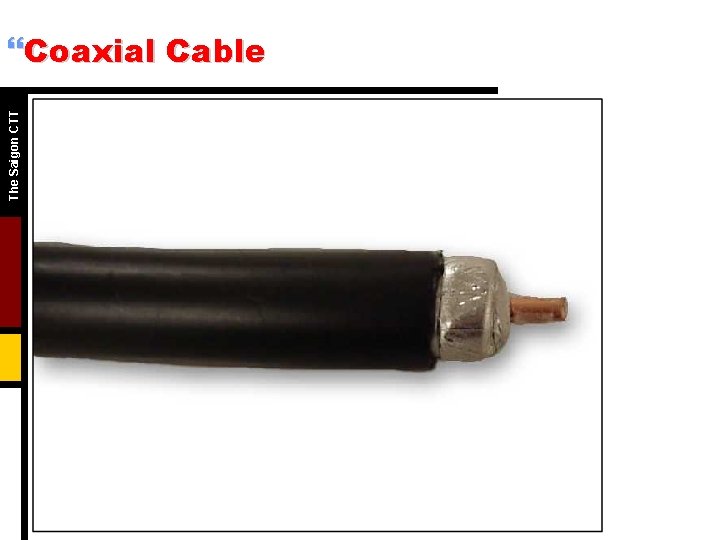
The Saigon CTT }Coaxial Cable • Technology is well known (Cable TV). • The shield can help reduce the amount of outside interference. • Longer cable runs than UTP & STP. • Maximum cable length : – Thin cable : 185 m. – Thick cable : 500 m. • 50Ω for Ethernet.
The Saigon CTT }Coaxial Cable
The Saigon CTT }Coaxial Cable
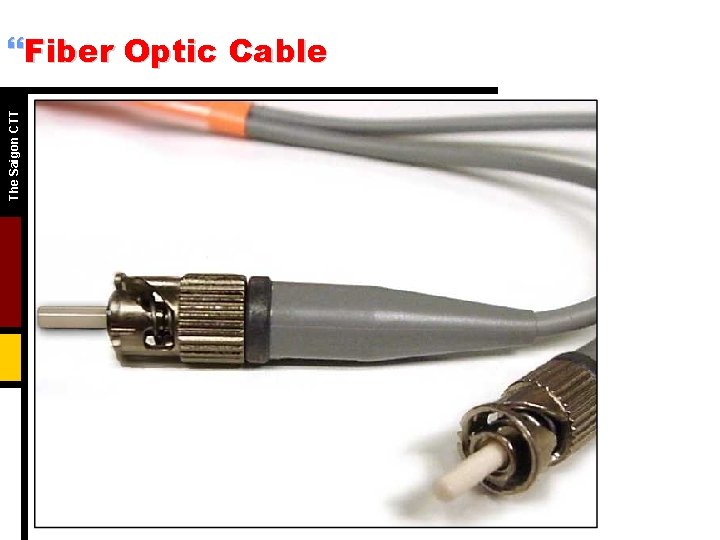
The Saigon CTT }Fiber Optic Cable
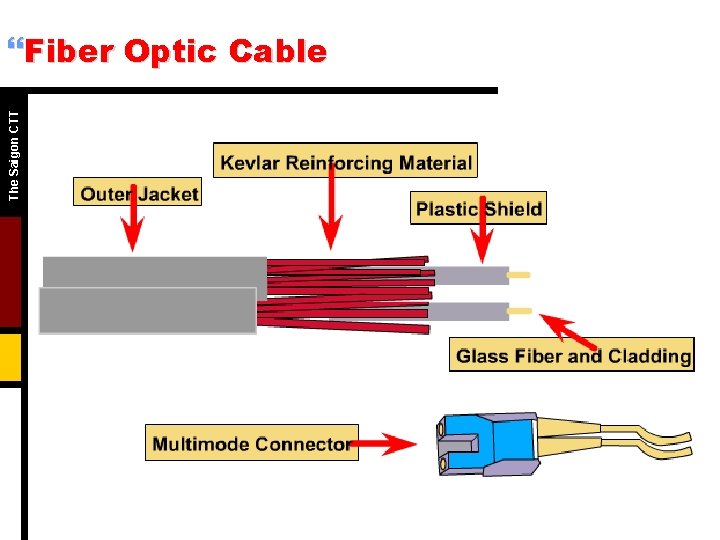
The Saigon CTT }Fiber Optic Cable • Medium capable of light transmissions. • Higher data rates (>100 Mbps). • NO EMI and RFI. • Very expensive. • Difficult to install. • Maximum cable length : – Single Mode : 3000 m. – Multi Mode : 2000 m.
The Saigon CTT }Fiber Optic Cable
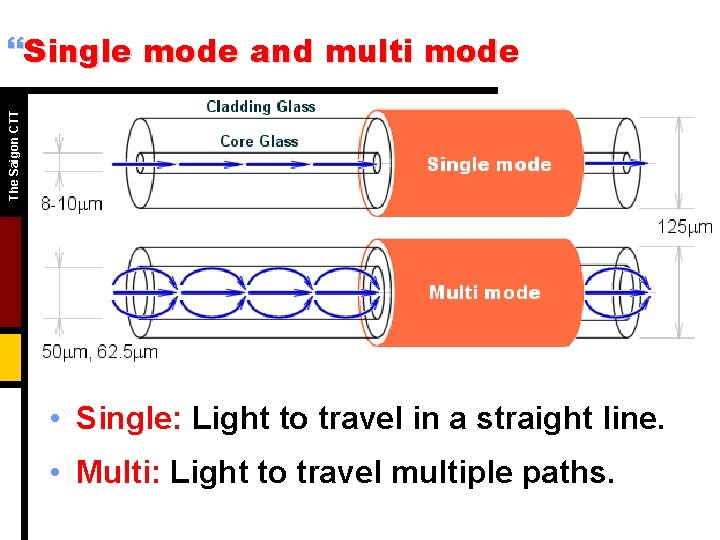
The Saigon CTT }Single mode and multi mode • Single: Light to travel in a straight line. • Multi: Light to travel multiple paths.
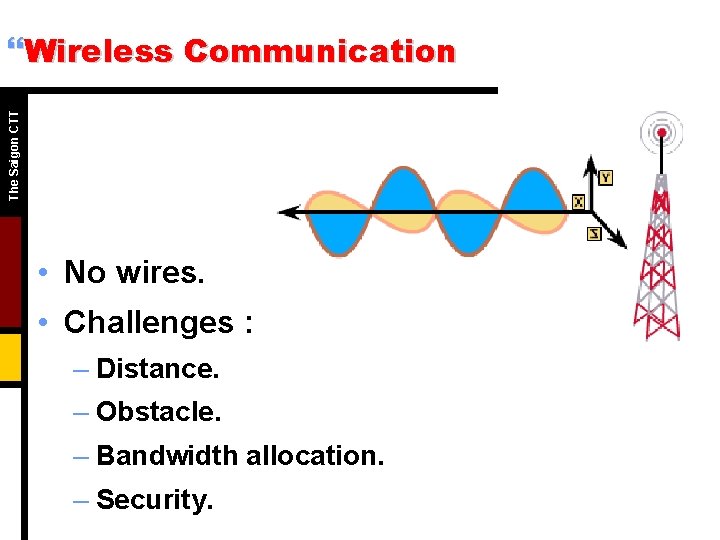
The Saigon CTT }Wireless Communication • No wires. • Challenges : – Distance. – Obstacle. – Bandwidth allocation. – Security.
The Saigon CTT }Electromagnetic Calculator
The Saigon CTT }Movie Fiber Optic
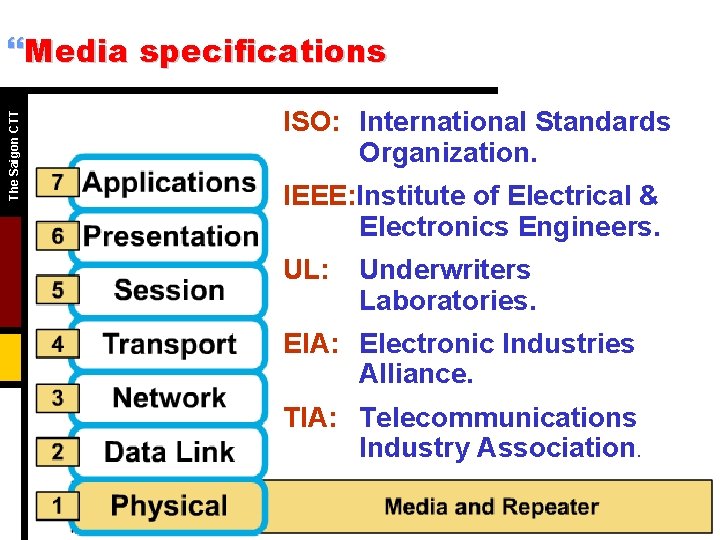
The Saigon CTT }Media specifications ISO: International Standards Organization. IEEE: Institute of Electrical & Electronics Engineers. UL: Underwriters Laboratories. EIA: Electronic Industries Alliance. TIA: Telecommunications Industry Association.
The Saigon CTT }Standard • Standards are sets of rules or procedures that are either widely used, or officially specified. • The OSI model standards ensured compatibility and interoperability between the various types of network technologies that were produced by the many companies around the world.
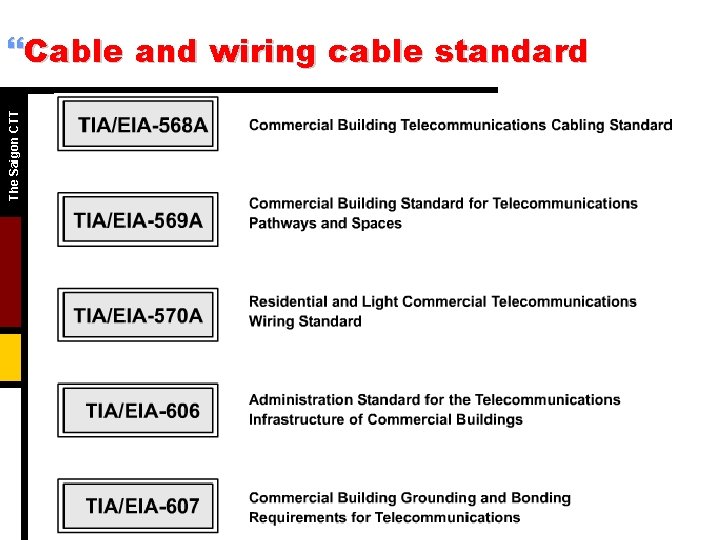
The Saigon CTT }Cable and wiring cable standard
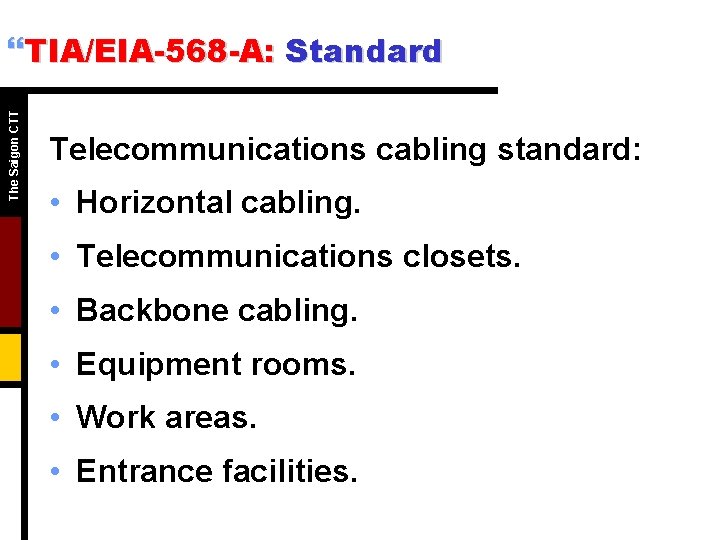
The Saigon CTT }TIA/EIA-568 -A: Standard Telecommunications cabling standard: • Horizontal cabling. • Telecommunications closets. • Backbone cabling. • Equipment rooms. • Work areas. • Entrance facilities.
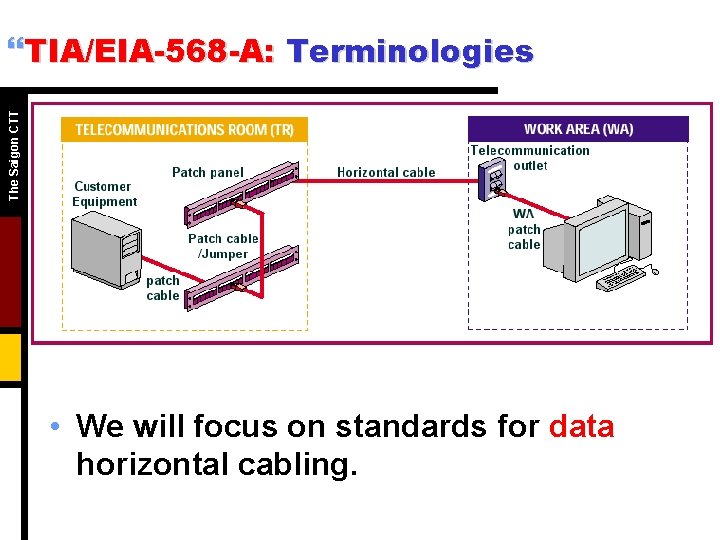
The Saigon CTT }TIA/EIA-568 -A: Terminologies • We will focus on standards for data horizontal cabling.
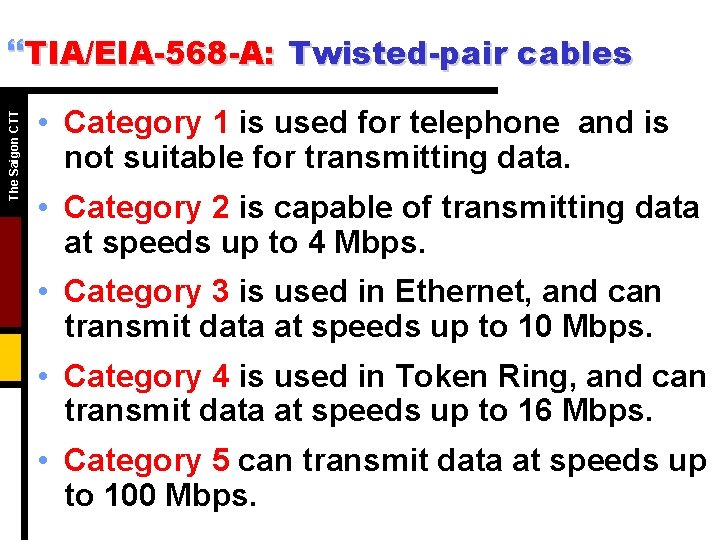
The Saigon CTT }TIA/EIA-568 -A: Twisted-pair cables • Category 1 is used for telephone and is not suitable for transmitting data. • Category 2 is capable of transmitting data at speeds up to 4 Mbps. • Category 3 is used in Ethernet, and can transmit data at speeds up to 10 Mbps. • Category 4 is used in Token Ring, and can transmit data at speeds up to 16 Mbps. • Category 5 can transmit data at speeds up to 100 Mbps.
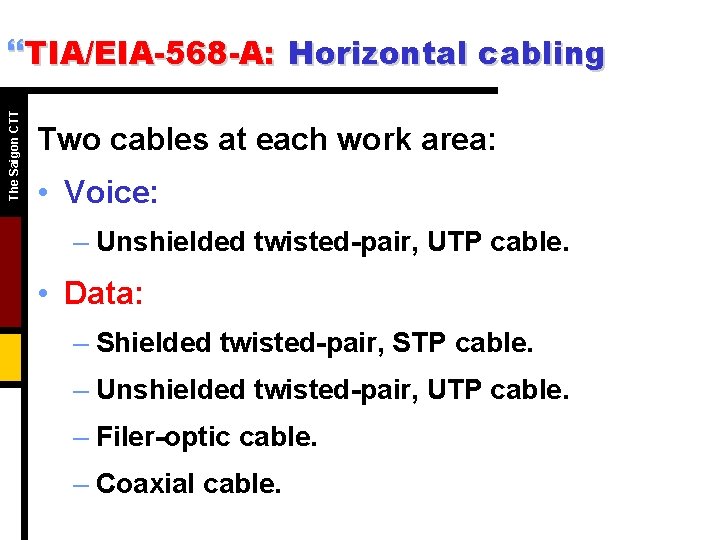
The Saigon CTT }TIA/EIA-568 -A: Horizontal cabling Two cables at each work area: • Voice: – Unshielded twisted-pair, UTP cable. • Data: – Shielded twisted-pair, STP cable. – Unshielded twisted-pair, UTP cable. – Filer-optic cable. – Coaxial cable.
The Saigon CTT }TIA/EIA-568 -A: Purpose • To specify a generic telecommunications cabling system. • To provide direction for the design of telecommunications equipment and cabling products. • To enable the planning and installation of the structured cable system, that is capable of supporting diverse telecom. • To establish technical criteria for various types of cable and connecting hardware.
The Saigon CTT }Review • Types of networking media may be used to connect computers. • TIA/EIA-568 -A is the most widely used standards.
The Saigon CTT MAKING CABLE - LAB
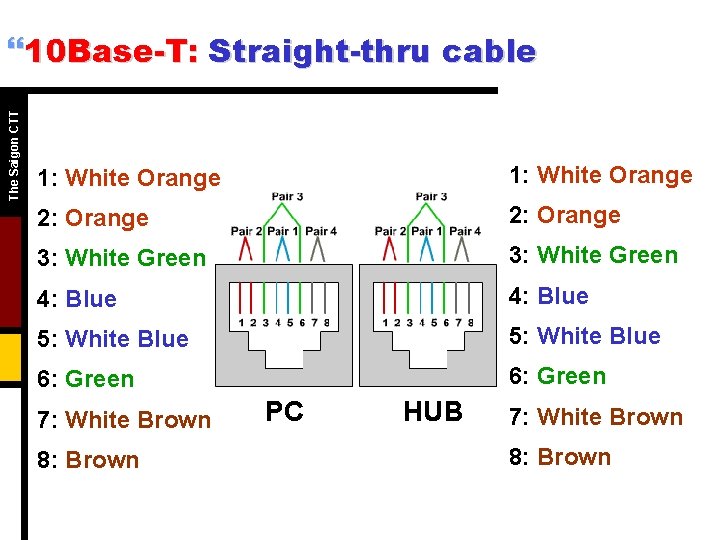
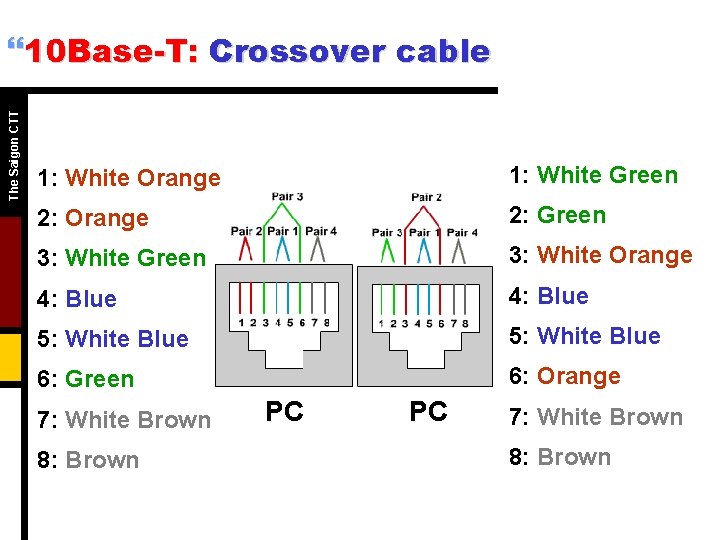
The Saigon CTT }Making cables • Making Ethernet 10 Base-T cables: – Straight-thru cable: PC-to-HUB. – Crossover cable: PC-to-PC. • Making console cables: – Rollover cable: • Serial port-to-console port of Cisco equipments.
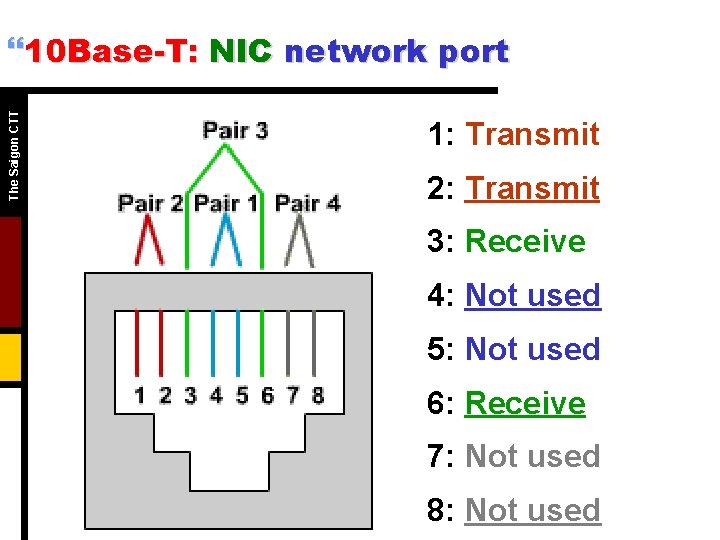
The Saigon CTT }10 Base-T: NIC network port 1: Transmit 2: Transmit 3: Receive 4: Not used 5: Not used 6: Receive 7: Not used 8: Not used
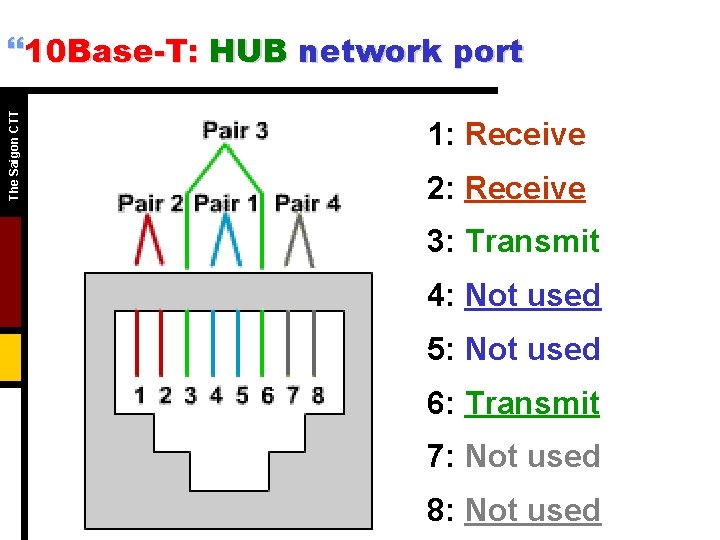
The Saigon CTT }10 Base-T: HUB network port 1: Receive 2: Receive 3: Transmit 4: Not used 5: Not used 6: Transmit 7: Not used 8: Not used
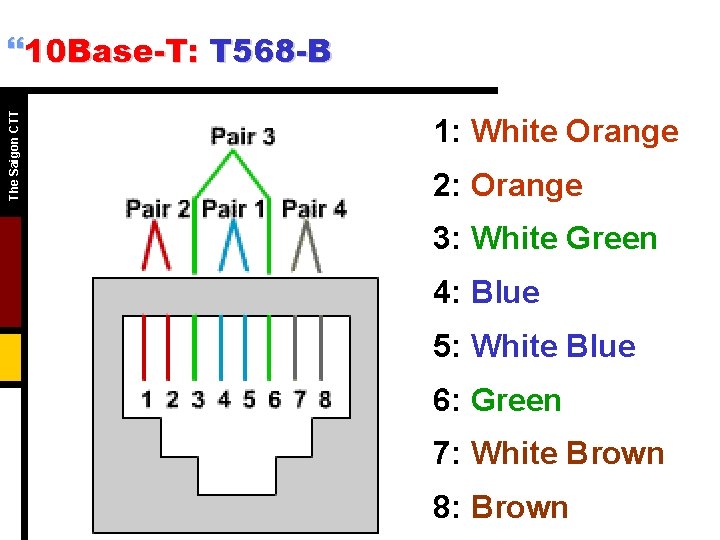
The Saigon CTT }10 Base-T: T 568 -B 1: White Orange 2: Orange 3: White Green 4: Blue 5: White Blue 6: Green 7: White Brown 8: Brown
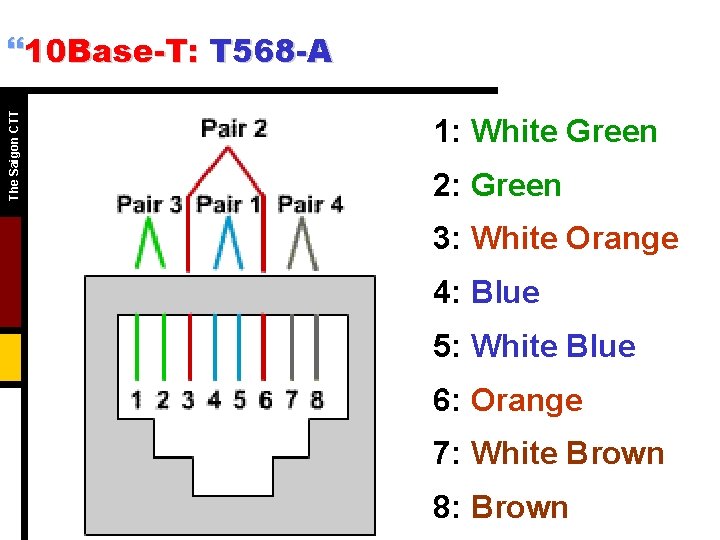
The Saigon CTT }10 Base-T: T 568 -A 1: White Green 2: Green 3: White Orange 4: Blue 5: White Blue 6: Orange 7: White Brown 8: Brown
The Saigon CTT }10 Base-T: Straight-thru cable 1: White Orange 2: Orange 3: White Green 4: Blue 5: White Blue 6: Green 7: White Brown 8: Brown PC HUB 7: White Brown 8: Brown
The Saigon CTT }10 Base-T: Crossover cable 1: White Orange 1: White Green 2: Orange 2: Green 3: White Orange 4: Blue 5: White Blue 6: Green 6: Orange 7: White Brown 8: Brown PC PC 7: White Brown 8: Brown
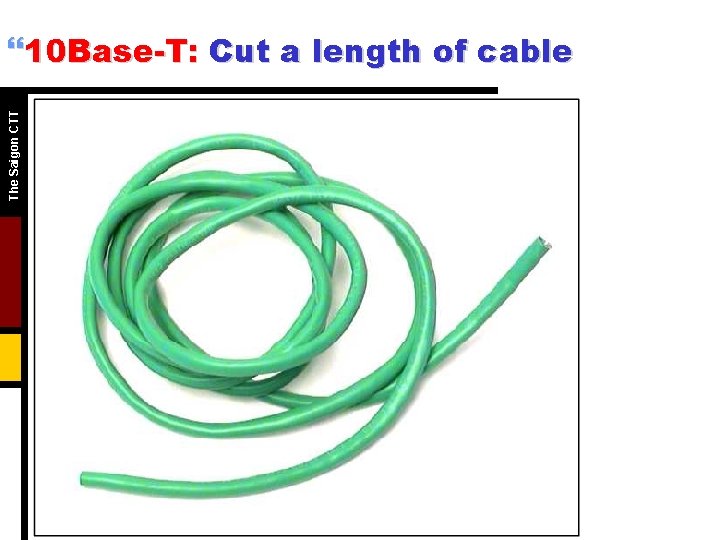
The Saigon CTT }10 Base-T: Cut a length of cable
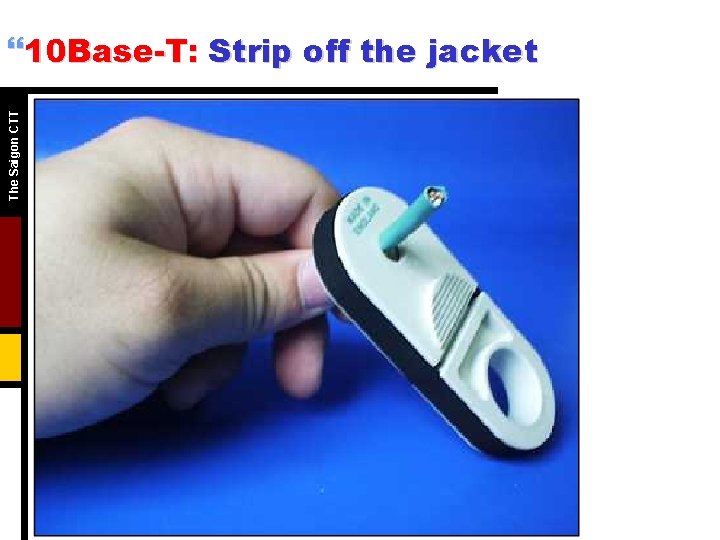
The Saigon CTT }10 Base-T: Strip off the jacket
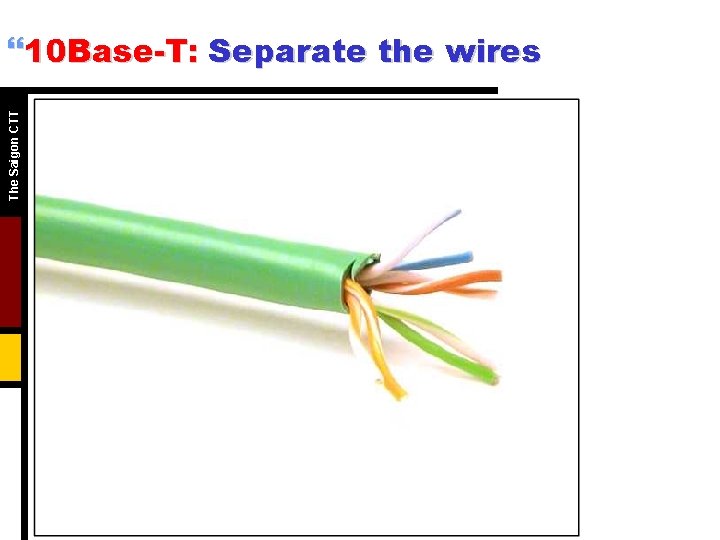
The Saigon CTT }10 Base-T: Separate the wires
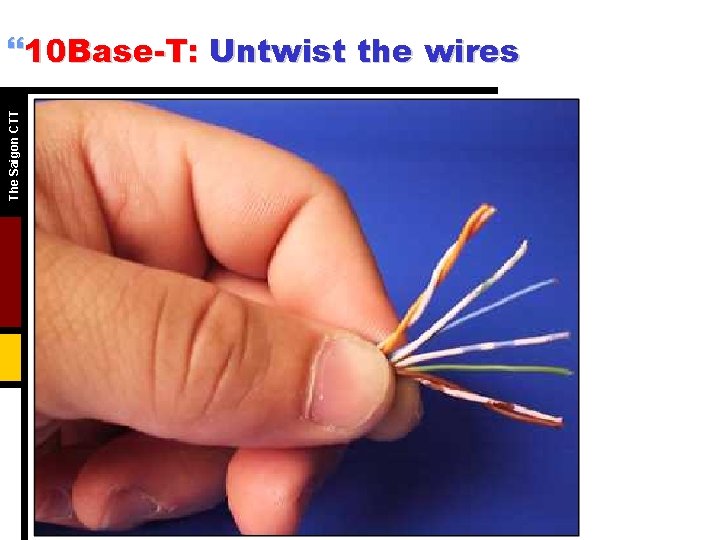
The Saigon CTT }10 Base-T: Untwist the wires
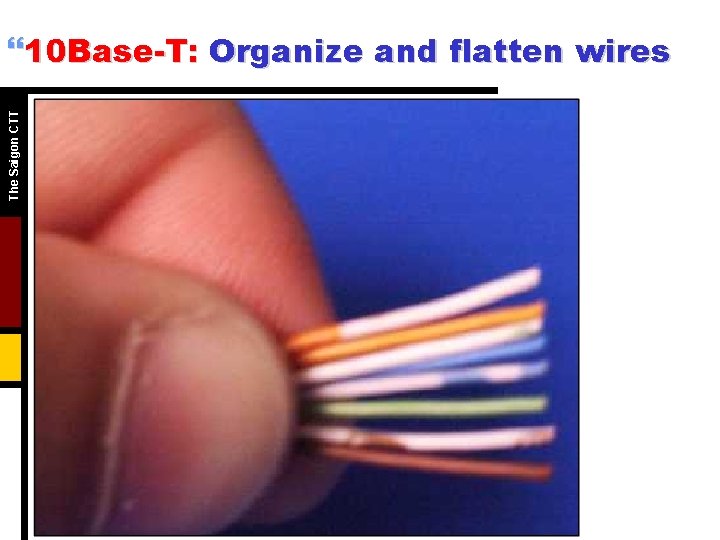
The Saigon CTT }10 Base-T: Organize and flatten wires
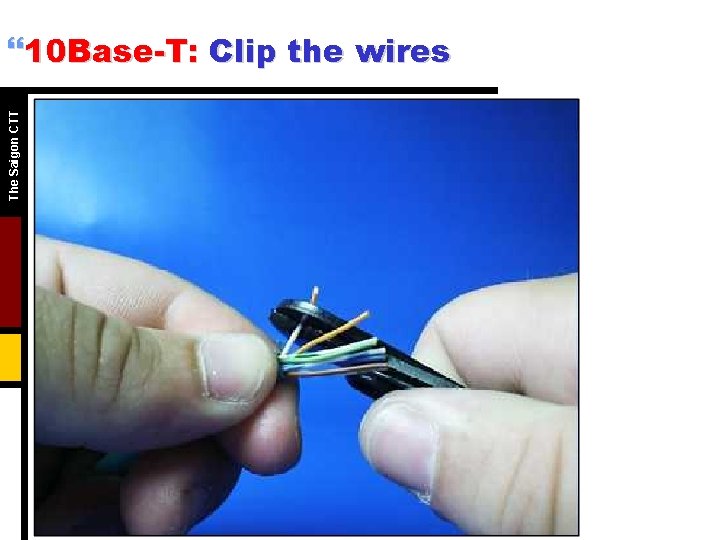
The Saigon CTT }10 Base-T: Clip the wires
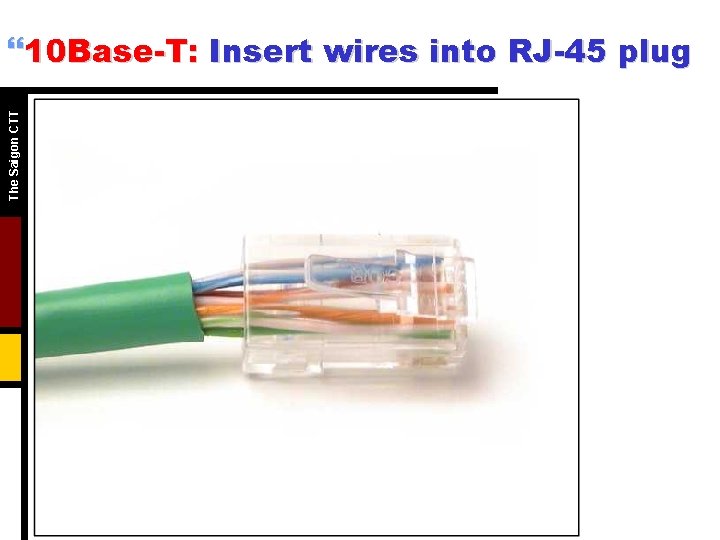
The Saigon CTT }10 Base-T: Insert wires into RJ-45 plug
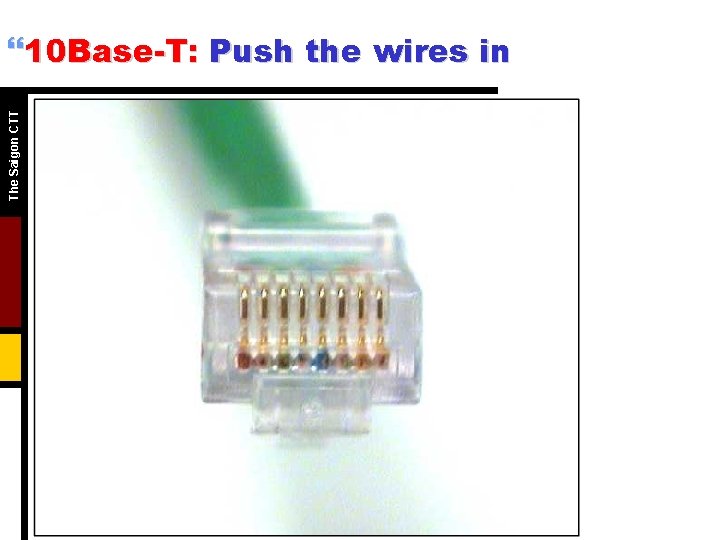
The Saigon CTT }10 Base-T: Push the wires in
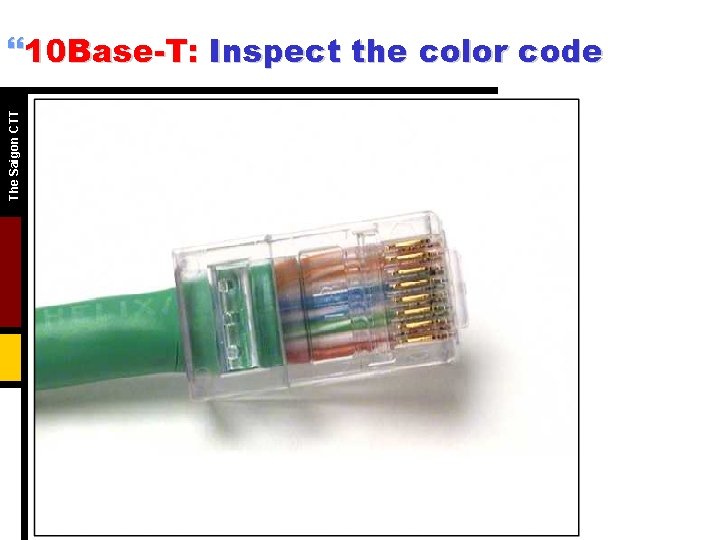
The Saigon CTT }10 Base-T: Inspect the color code
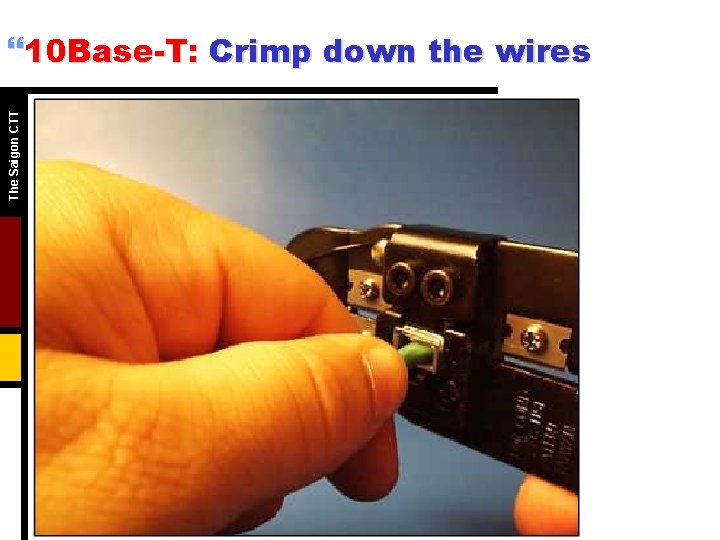
The Saigon CTT }10 Base-T: Crimp down the wires
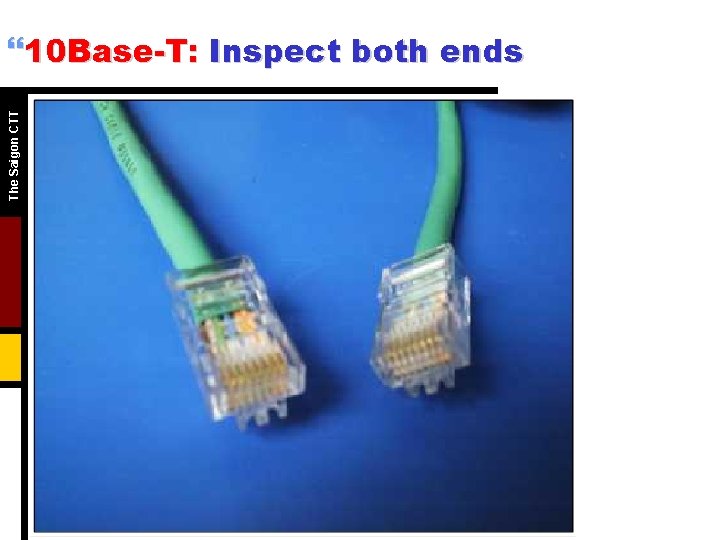
The Saigon CTT }10 Base-T: Inspect both ends
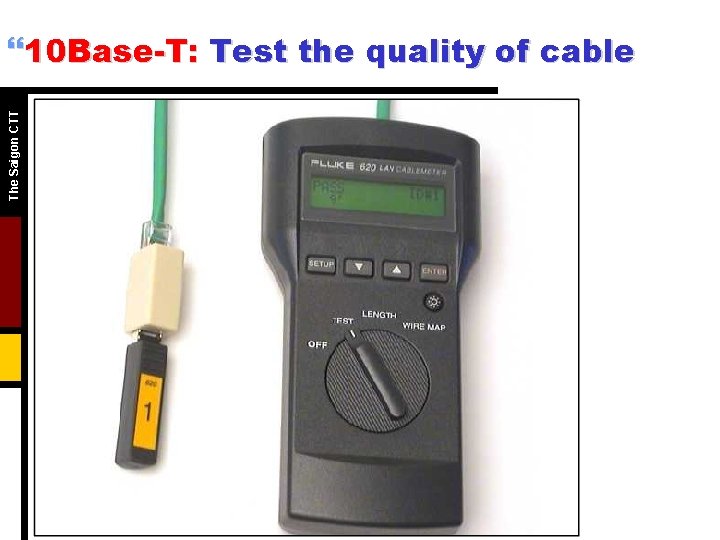
The Saigon CTT }10 Base-T: Test the quality of cable
The Saigon CTT }Preparation for LAB • 5. 3. 2: Straight-through cable. • 5. 3. 3: Crossover cable. • 5. 3. 5: Cable tester – wire map. • Lab companion: – 5. 3. 2. – 5. 3. 3. – 5. 3. 5.
The Saigon CTT }Review • Making 10 Base-T straight-thru cable. • Making 10 Base-T crossover cable.
The Saigon CTT LAYER 1 COMPONENTS AND DEVICES
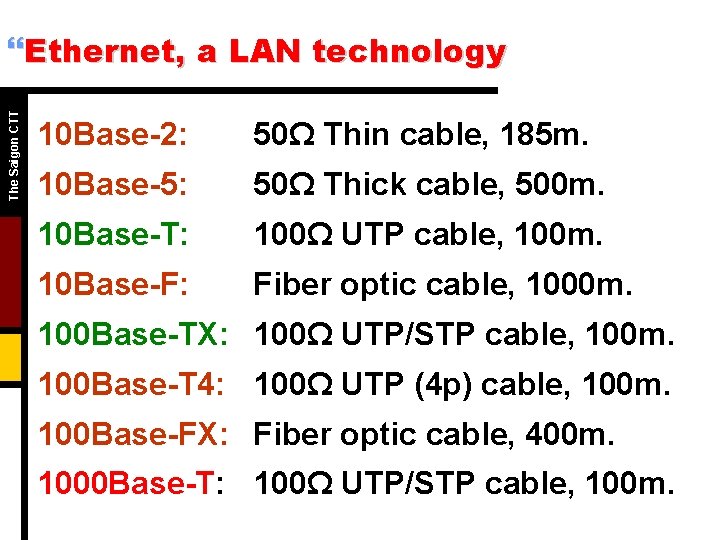
The Saigon CTT }Ethernet, a LAN technology 10 Base-2: 50Ω Thin cable, 185 m. 10 Base-5: 50Ω Thick cable, 500 m. 10 Base-T: 100Ω UTP cable, 100 m. 10 Base-F: Fiber optic cable, 1000 m. 100 Base-TX: 100Ω UTP/STP cable, 100 m. 100 Base-T 4: 100Ω UTP (4 p) cable, 100 m. 100 Base-FX: Fiber optic cable, 400 m. 1000 Base-T: 100Ω UTP/STP cable, 100 m.
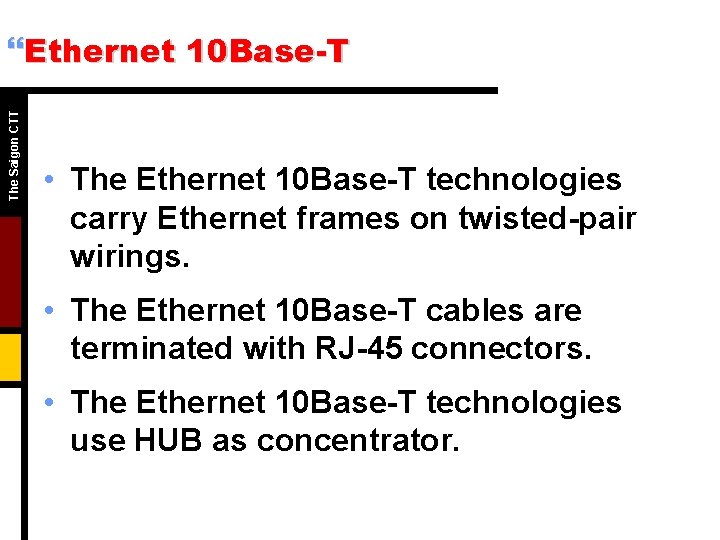
The Saigon CTT }Ethernet 10 Base-T • The Ethernet 10 Base-T technologies carry Ethernet frames on twisted-pair wirings. • The Ethernet 10 Base-T cables are terminated with RJ-45 connectors. • The Ethernet 10 Base-T technologies use HUB as concentrator.
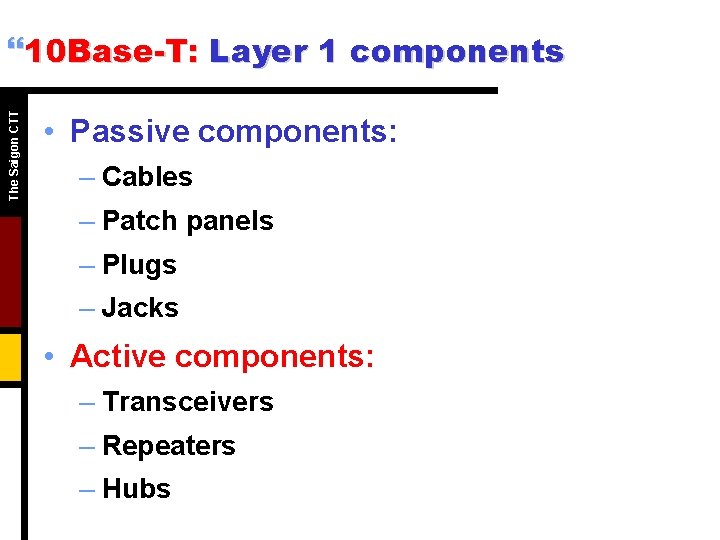
The Saigon CTT }10 Base-T: Layer 1 components • Passive components: – Cables – Patch panels – Plugs – Jacks • Active components: – Transceivers – Repeaters – Hubs
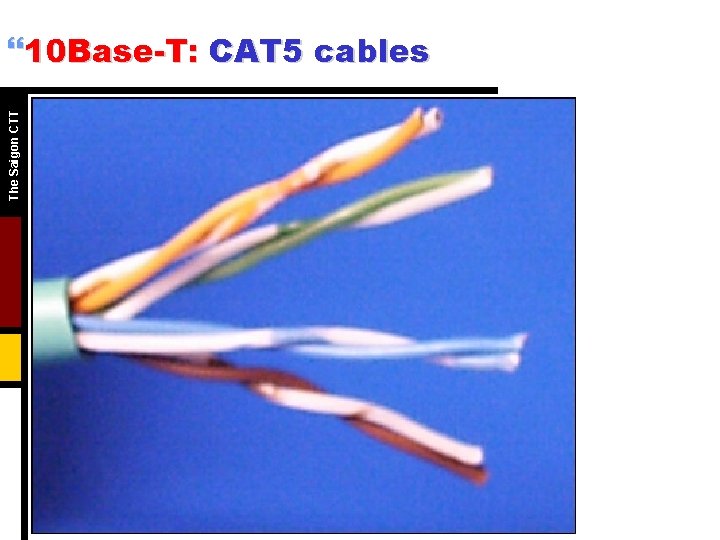
The Saigon CTT }10 Base-T: CAT 5 cables • The 10 Base-T standard cable. • UTP cable. • The twisting of wires limits interference. • Maximum length 100 m.
The Saigon CTT }10 Base-T: CAT 5 cables
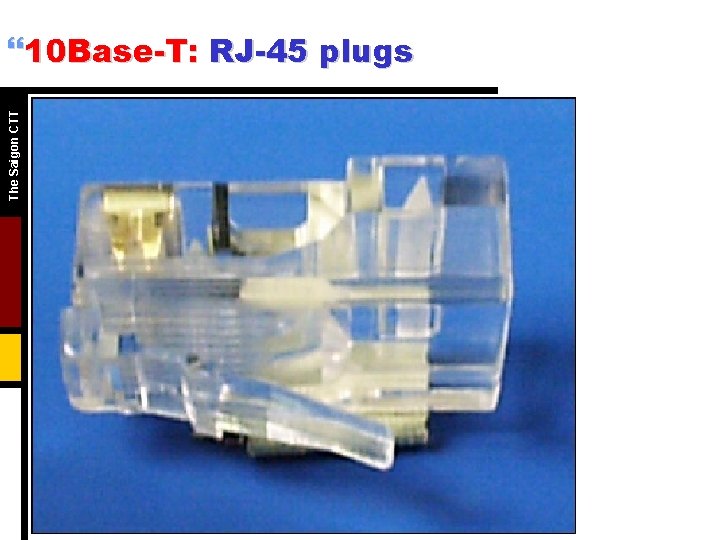
The Saigon CTT }10 Base-T: RJ-45 plugs • Connector, Terminator. • Standard 10 Base-T terminator is the RJ 45 plugs (Registered Jack 45). • Similar to phone plug except the RJ-45 has 8 pins instead of 4 pins. • Reduces noise, reflection & mechanical stability problems.
The Saigon CTT }10 Base-T: RJ-45 plugs
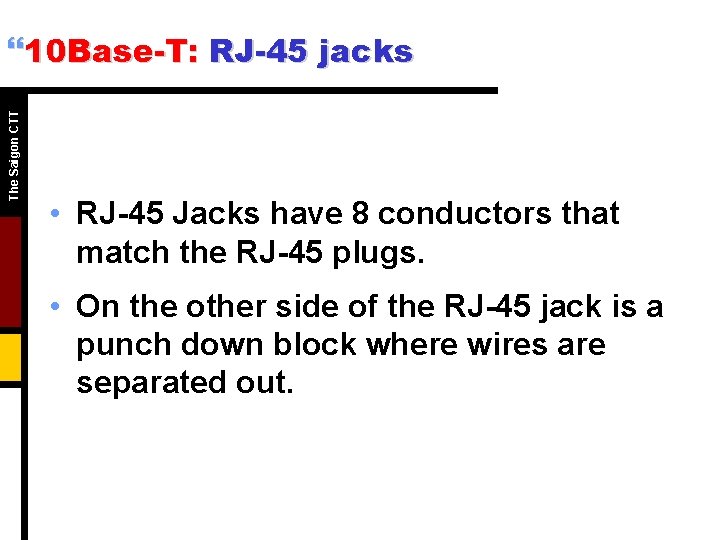
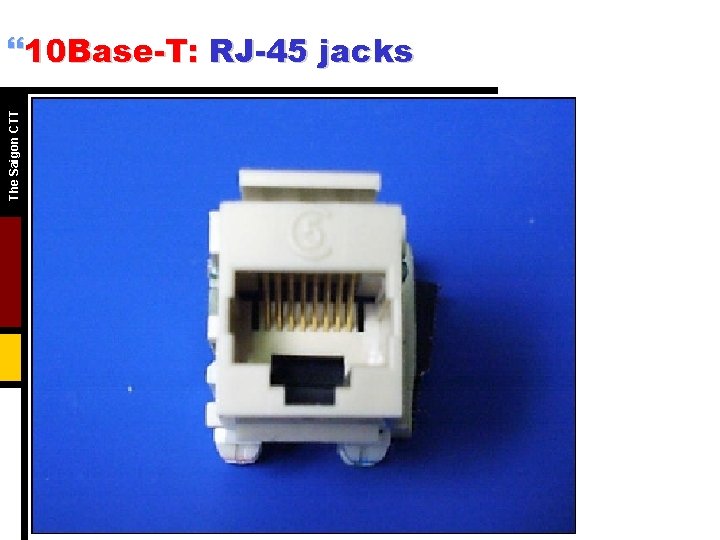
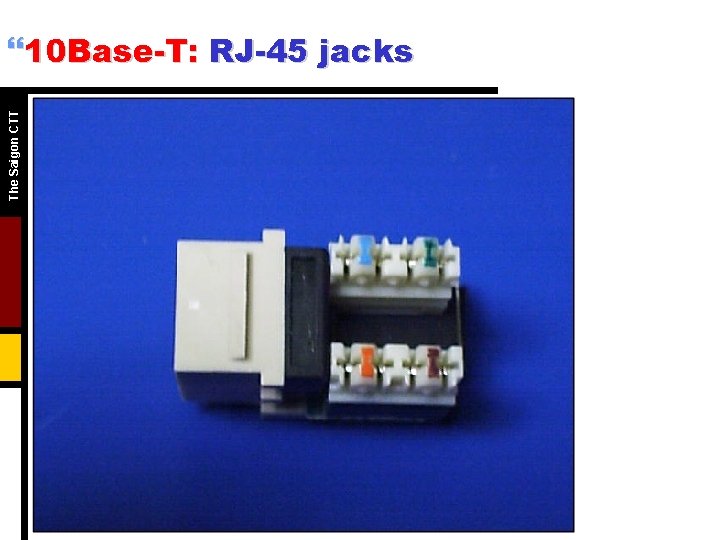
The Saigon CTT }10 Base-T: RJ-45 jacks • RJ-45 Jacks have 8 conductors that match the RJ-45 plugs. • On the other side of the RJ-45 jack is a punch down block where wires are separated out.
The Saigon CTT }10 Base-T: RJ-45 jacks
The Saigon CTT }10 Base-T: RJ-45 jacks
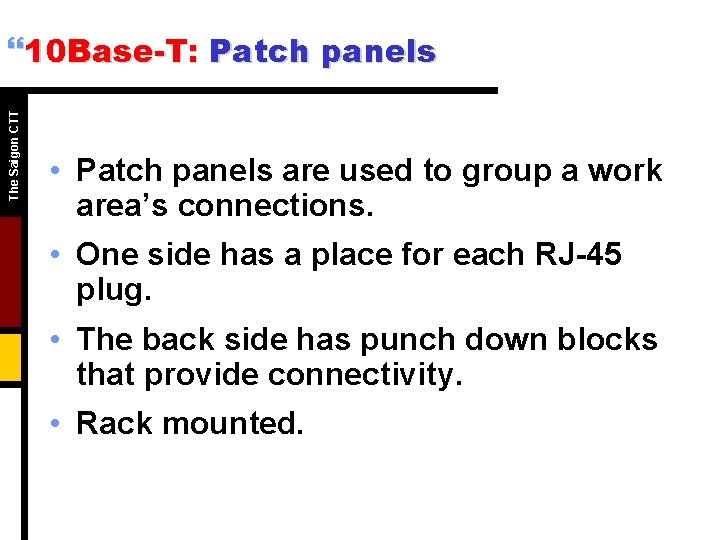
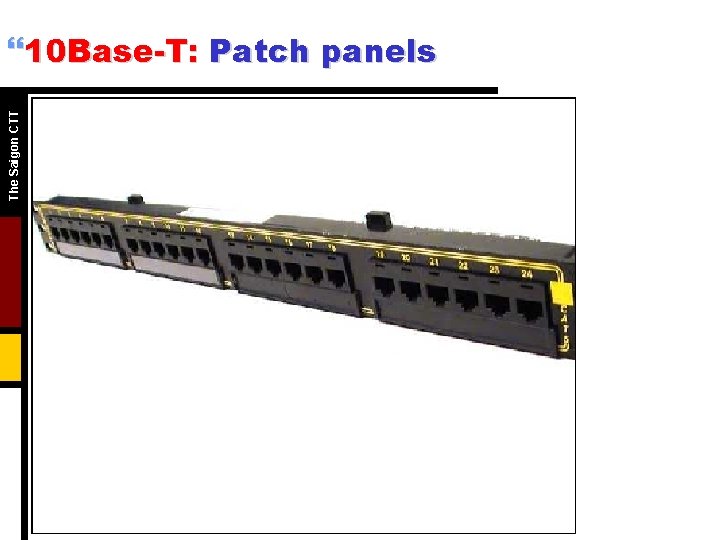
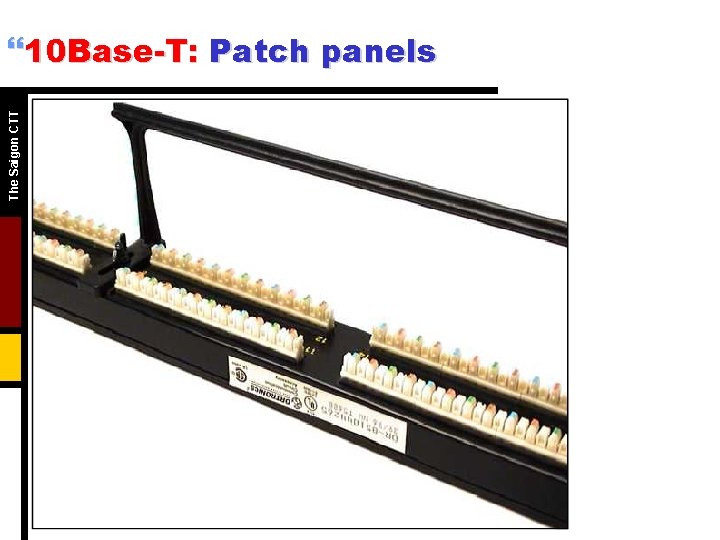
The Saigon CTT }10 Base-T: Patch panels • Patch panels are used to group a work area’s connections. • One side has a place for each RJ-45 plug. • The back side has punch down blocks that provide connectivity. • Rack mounted.
The Saigon CTT }10 Base-T: Patch panels
The Saigon CTT }10 Base-T: Patch panels
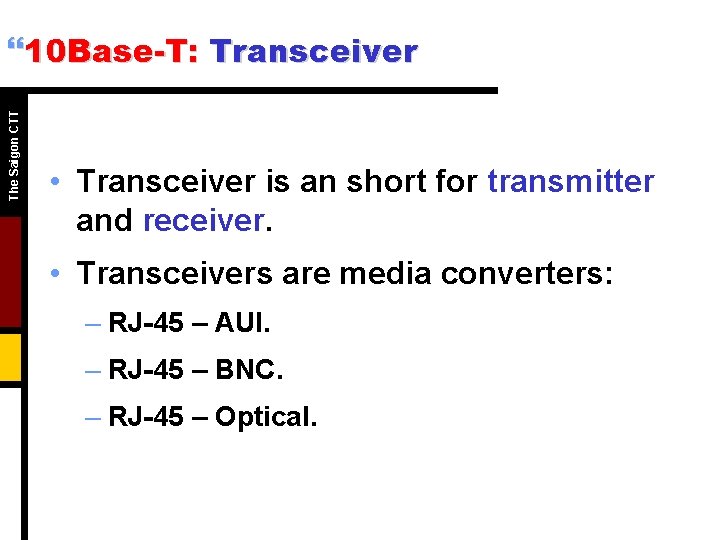
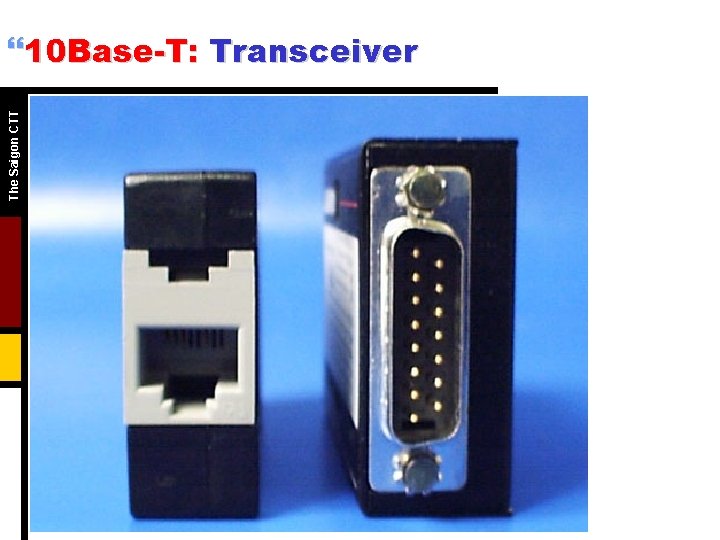
The Saigon CTT }10 Base-T: Transceiver • Transceiver is an short for transmitter and receiver. • Transceivers are media converters: – RJ-45 – AUI. – RJ-45 – BNC. – RJ-45 – Optical.
The Saigon CTT }10 Base-T: Transceiver
The Saigon CTT }10 Base-T: Repeater • Regenerates signals: – Enables cables to extend farther to reach longer distances. – Increase number of nodes that can be connected to a network. • Cannot filter traffic.
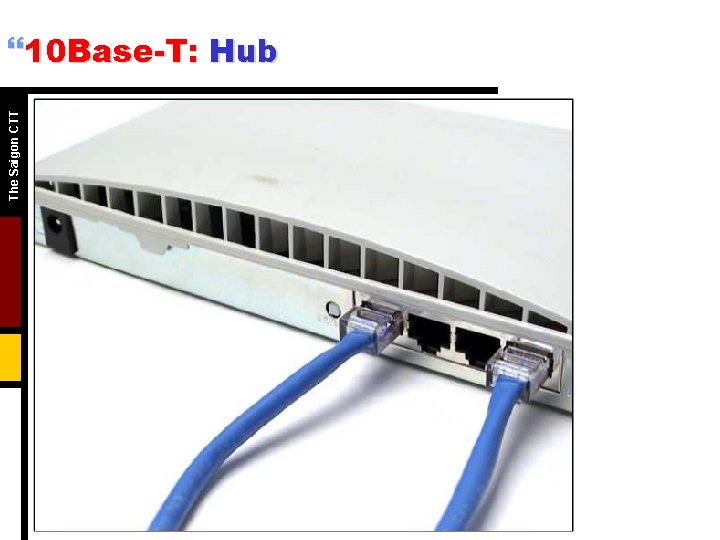
The Saigon CTT }10 Base-T: Hub • Multi port repeater. • Allows many devices to be interconnected. • Center of a star topology network. • Cannot filter traffic.
The Saigon CTT }10 Base-T: Hub
The Saigon CTT }Review • All of layer 1 devices: – Create or act on the bits. – Recognize no frame, no address, no data. • Many network problems are traceable to bad RJ-45 terminations, jacks, punchdowns, repeaters, hubs, or transceivers.
The Saigon CTT COLLISIONS AND COLLISION DOMAINS
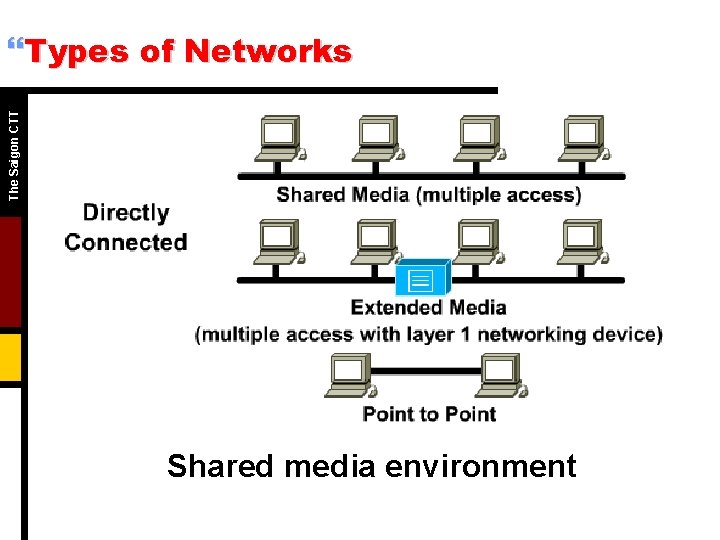
The Saigon CTT }Types of Networks Shared media environment
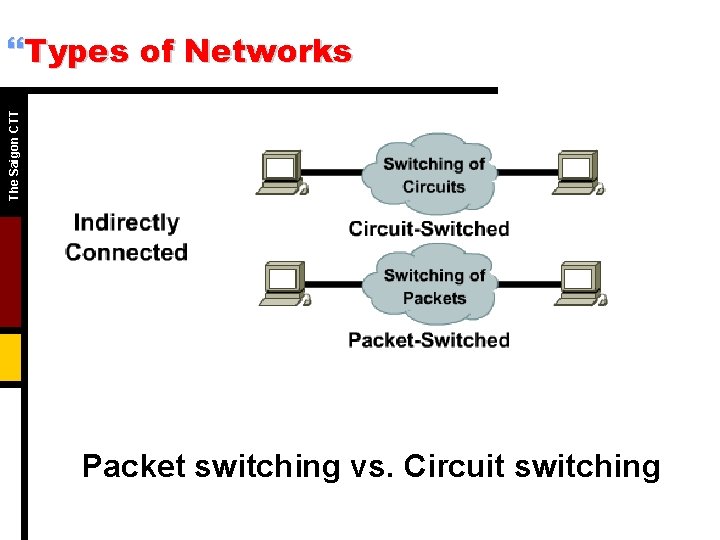
The Saigon CTT }Types of Networks Packet switching vs. Circuit switching
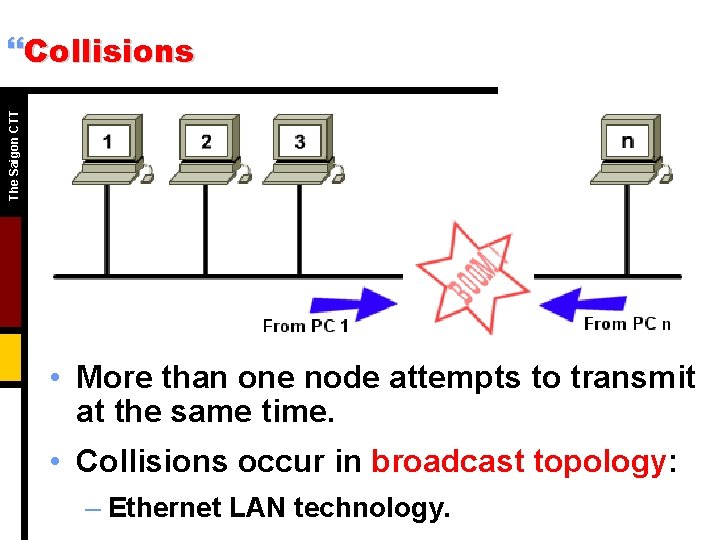
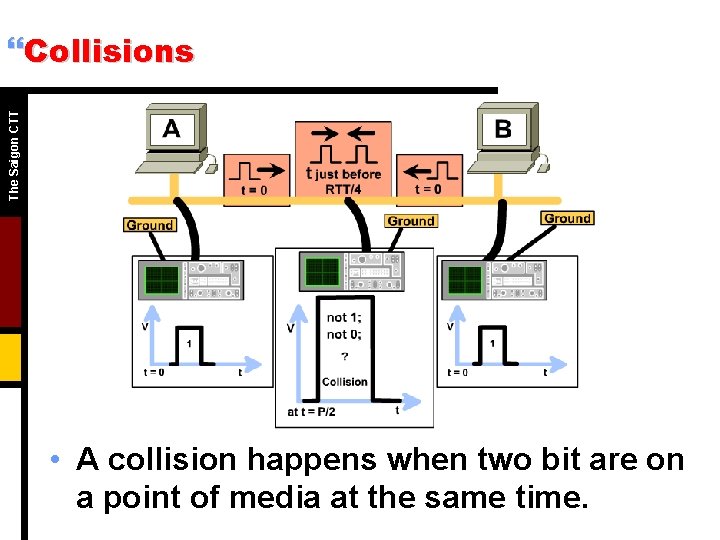
The Saigon CTT }Collisions • More than one node attempts to transmit at the same time. • Collisions occur in broadcast topology: – Ethernet LAN technology.
The Saigon CTT }Collisions • A collision happens when two bit are on a point of media at the same time.
The Saigon CTT }Ethernet technology: Collision Detect • Allow only one data packet to access the cable at any one time.
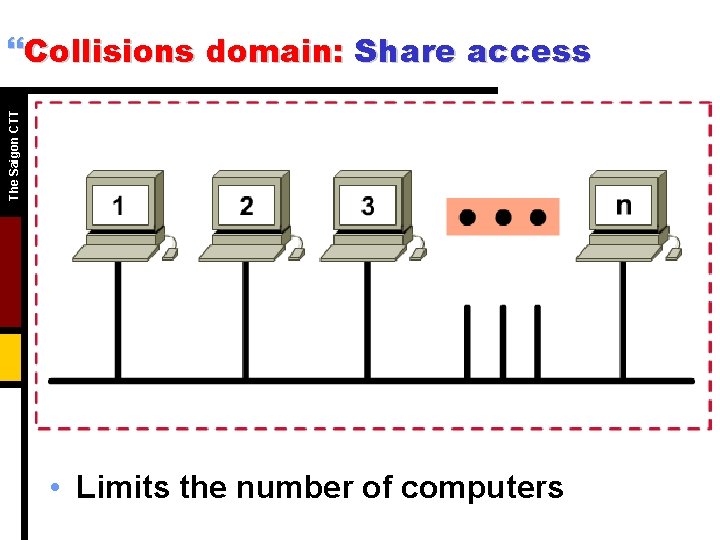
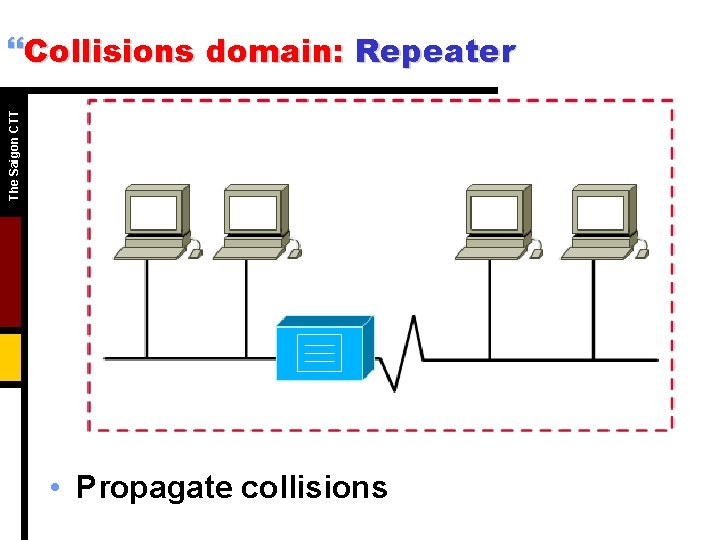
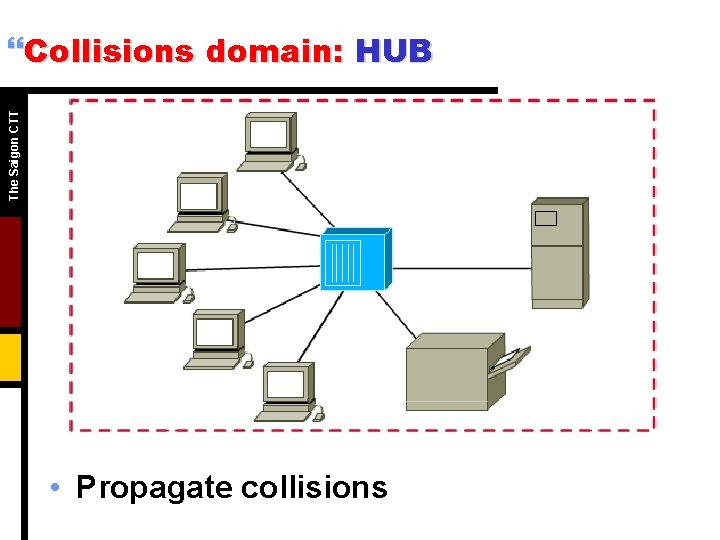
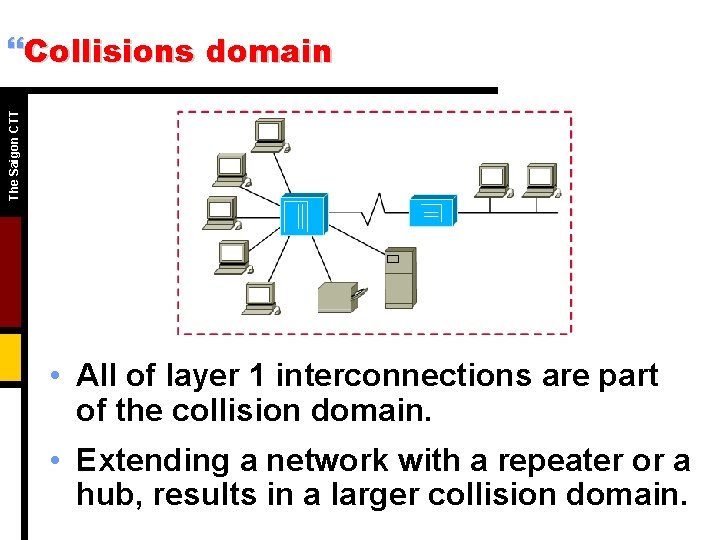
The Saigon CTT }Collisions domain • Collision Domains are the area where collisions occur. • Layer 1 devices will not solve collision problems. • Layer 1 devices simply extend collision domains.
The Saigon CTT }Collisions domain: Share access • Limits the number of computers
The Saigon CTT }Collisions domain: Repeater • Propagate collisions
The Saigon CTT }Collisions domain: HUB • Propagate collisions
The Saigon CTT }Collisions domain • All of layer 1 interconnections are part of the collision domain. • Extending a network with a repeater or a hub, results in a larger collision domain.
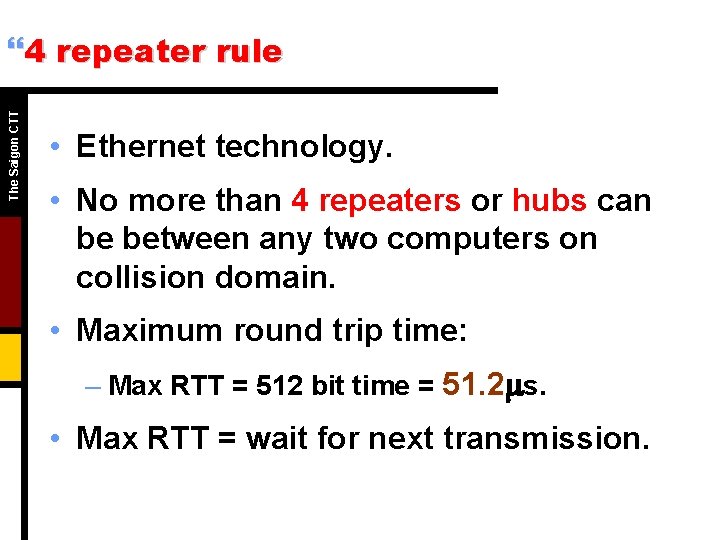
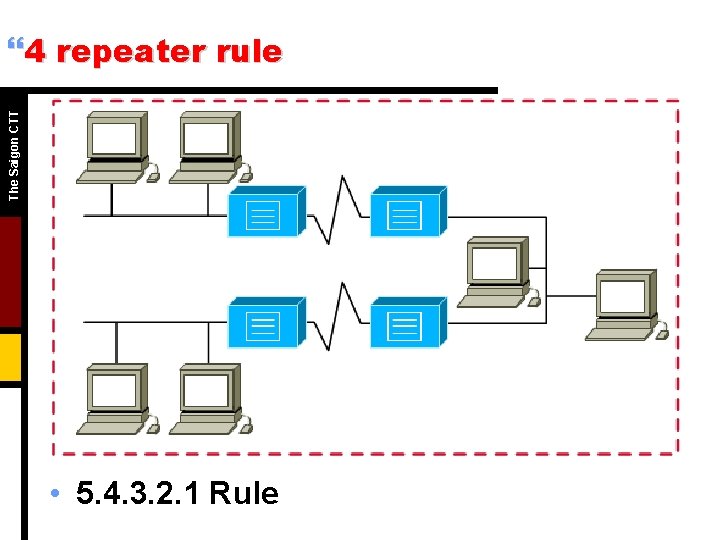
The Saigon CTT }4 repeater rule • Ethernet technology. • No more than 4 repeaters or hubs can be between any two computers on collision domain. • Maximum round trip time: – Max RTT = 512 bit time = 51. 2 ms. • Max RTT = wait for next transmission.
The Saigon CTT }4 repeater rule • 5. 4. 3. 2. 1 Rule
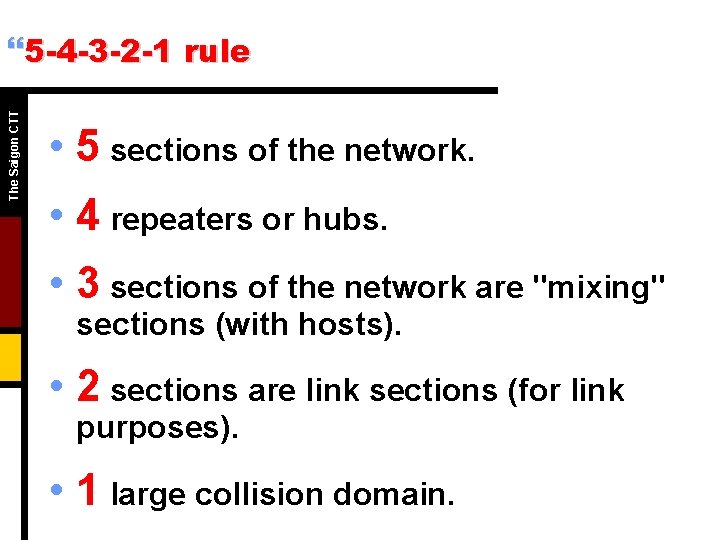
The Saigon CTT }5 -4 -3 -2 -1 rule • 5 sections of the network. • 4 repeaters or hubs. • 3 sections of the network are "mixing" sections (with hosts). • 2 sections are link sections (for link purposes). • 1 large collision domain.
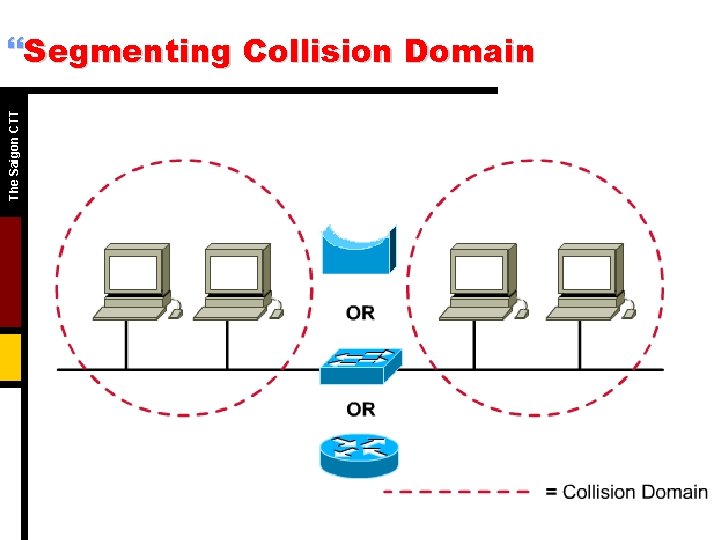
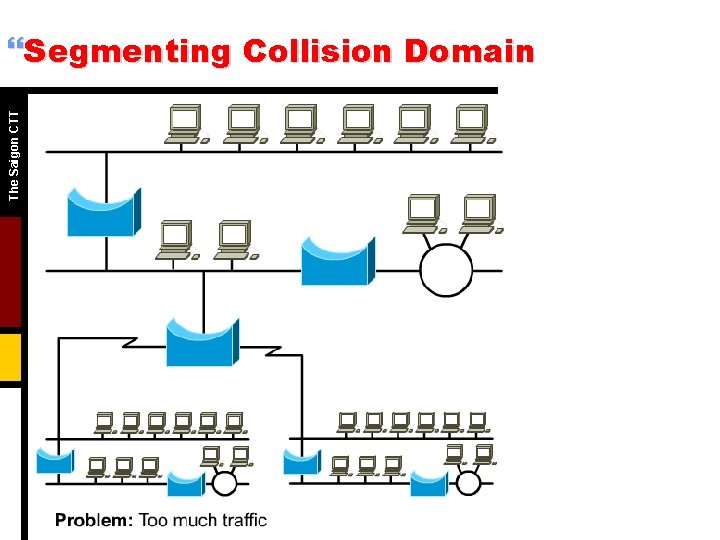
The Saigon CTT }Collision Domain Segmentation • Layer 1 devices will not segment a collision domain. Why? • Segmentation is the process of dividing a collision domain into two or more collision domains. • The only way to segment a collision domain is to use a device that can filter network traffic. • What devices are capable of filtering?
The Saigon CTT }Segmenting Collision Domain
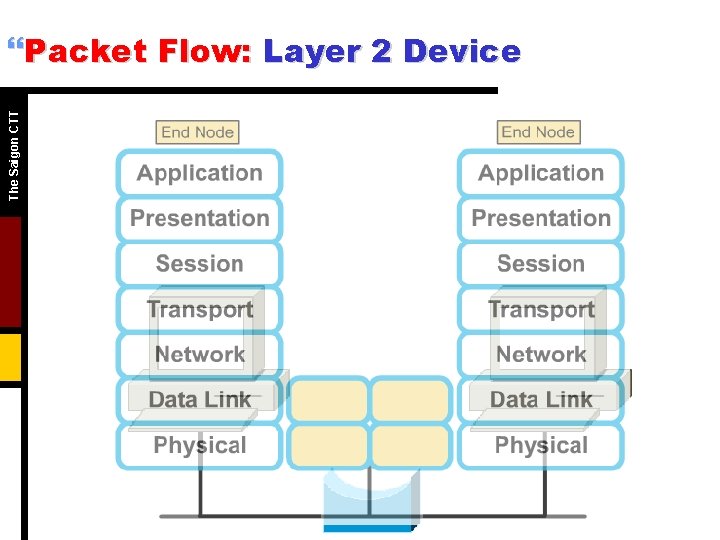
The Saigon CTT }Packet Flow: Layer 2 Device
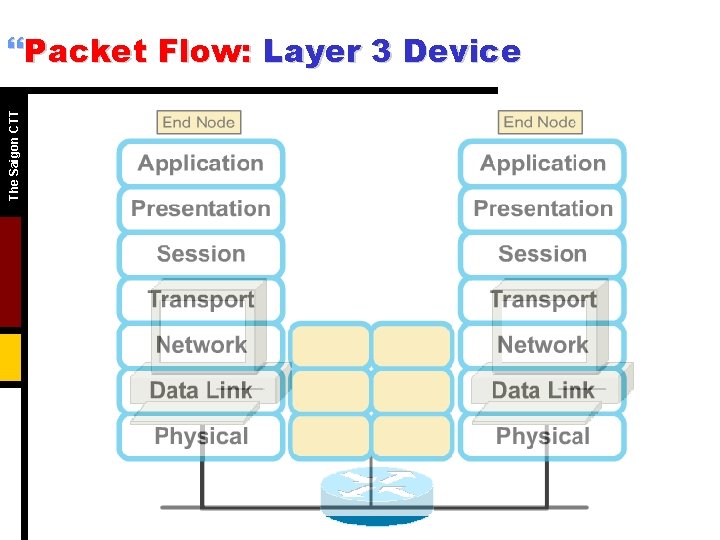
The Saigon CTT }Packet Flow: Layer 3 Device
The Saigon CTT }Segmenting Collision Domain
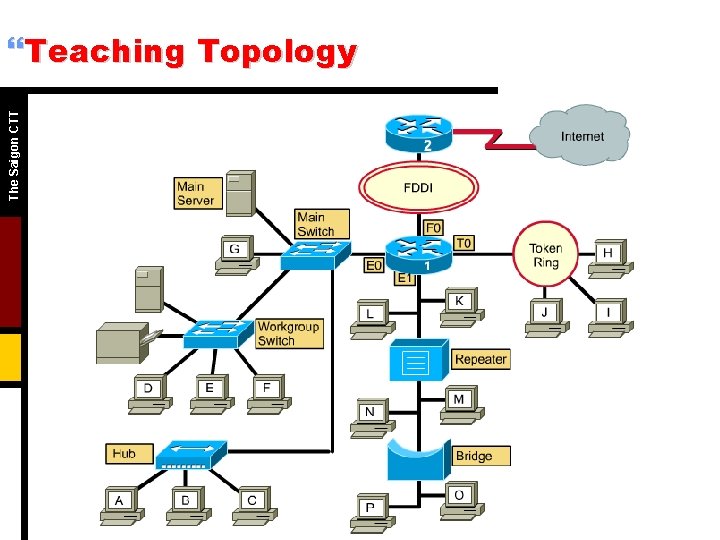
The Saigon CTT }Teaching Topology
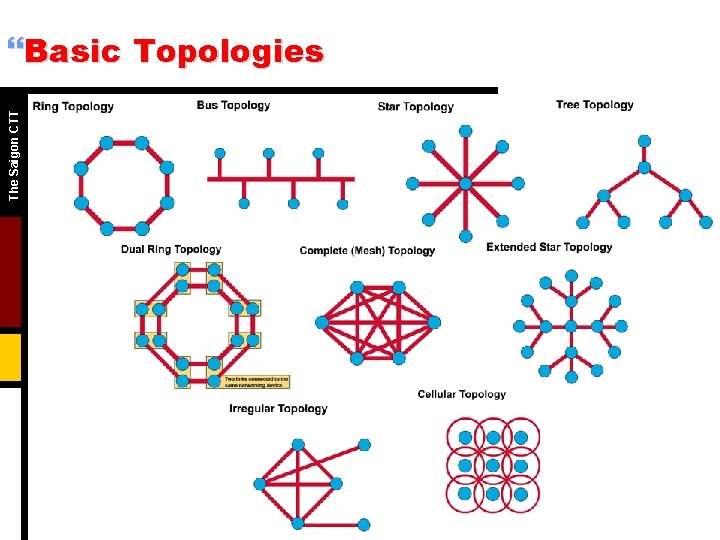
The Saigon CTT }Basic Topologies
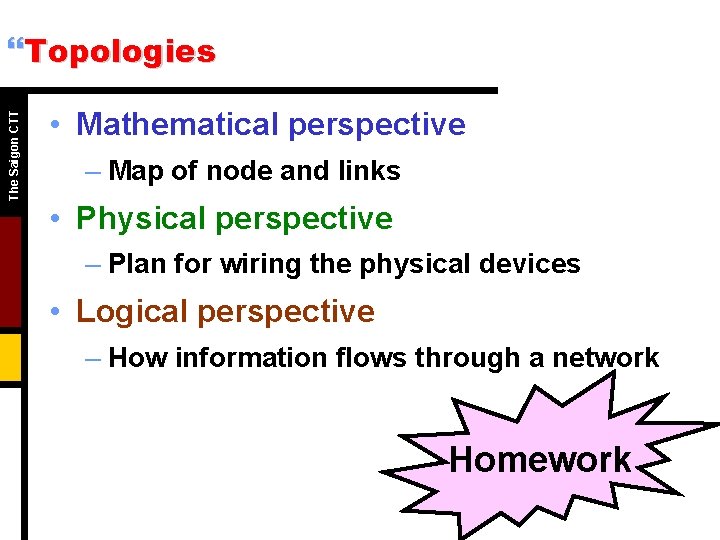
The Saigon CTT }Topologies • Mathematical perspective – Map of node and links • Physical perspective – Plan for wiring the physical devices • Logical perspective – How information flows through a network Homework
The Saigon CTT }Review • Collision domain. • How to separate collision domain.