
The Safe Foodhandler 4 1 Apply Your Knowledge
- Slides: 20
The Safe Foodhandler 4 -1
Apply Your Knowledge: Test Your Food Safety Knowledge 1. True or False: During handwashing, foodhandlers must vigorously scrub their hands and arms for five seconds 2. 2. True or False: Gloves should be changed before beginning a different task 3. 3. True or False: Foodhandlers must wash their hands after smoking 4. 4. True or False: A foodhandler diagnosed with shigellosis cannot continue to work at an establishment while he or she has the illness 5. 5. True or False: Hand antiseptics should only be used before handwashing 4 -2
How Foodhandlers Contaminate Foodhandlers can contaminate food when they: n Have a foodborne illness n Show symptoms of gastrointestinal illness n Have infected wounds or cuts n Live with, or are exposed to, a person who is ill n Touch anything that may contaminate their hands 4 -3
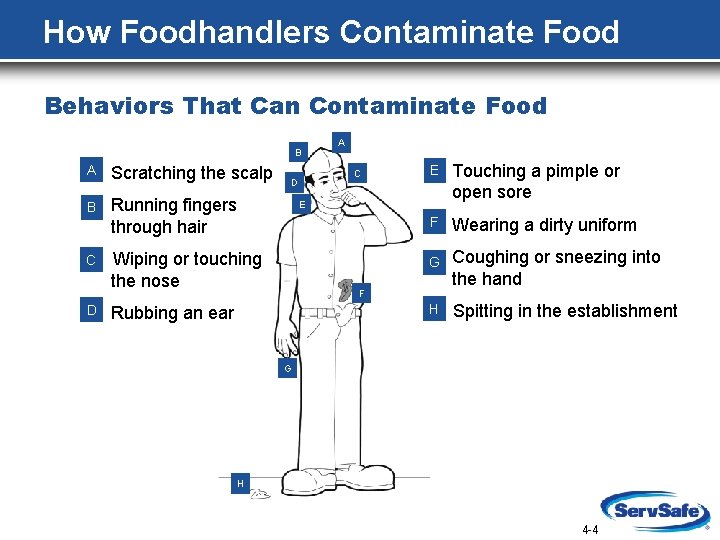
How Foodhandlers Contaminate Food Behaviors That Can Contaminate Food B A Scratching the scalp B Running fingers through hair C Wiping or touching the nose D A C D E Touching a pimple or open sore F Wearing a dirty uniform G Coughing or sneezing into the hand H Spitting in the establishment E F Rubbing an ear G H 4 -4
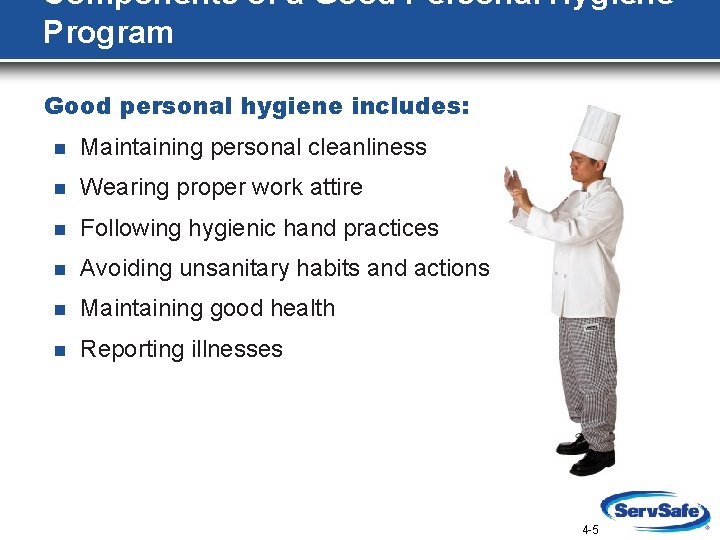
Components of a Good Personal Hygiene Program Good personal hygiene includes: n Maintaining personal cleanliness n Wearing proper work attire n Following hygienic hand practices n Avoiding unsanitary habits and actions n Maintaining good health n Reporting illnesses 4 -5
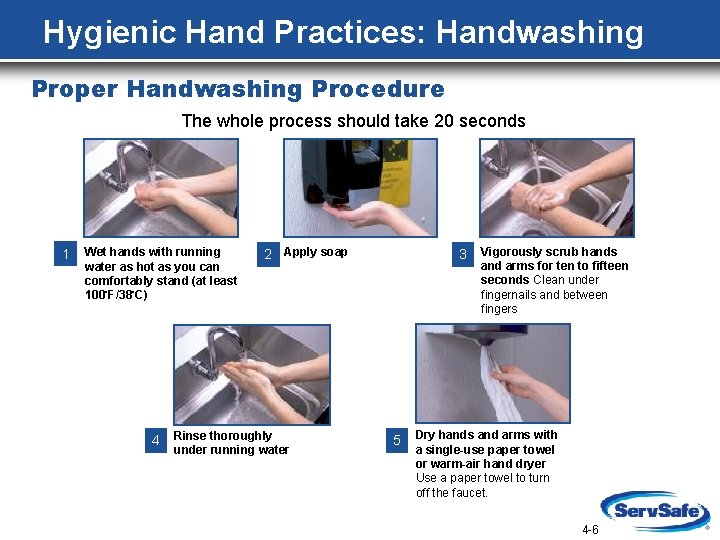
Hygienic Hand Practices: Handwashing Proper Handwashing Procedure The whole process should take 20 seconds 1 Wet hands with running water as hot as you can comfortably stand (at least 100°F/38°C) 4 2 Apply soap Rinse thoroughly under running water 3 Vigorously scrub hands and arms for ten to fifteen seconds Clean under fingernails and between fingers 5 5 Dry hands and arms with a single-use paper towel or warm-air hand dryer Use a paper towel to turn off the faucet. 4 -6
Hygienic Hand Practices: Hand Antiseptics n Must comply with Food and Drug Administration standards n Should be used after handwashing (if used in the establishment) n Must never be used in place of handwashing 4 -7
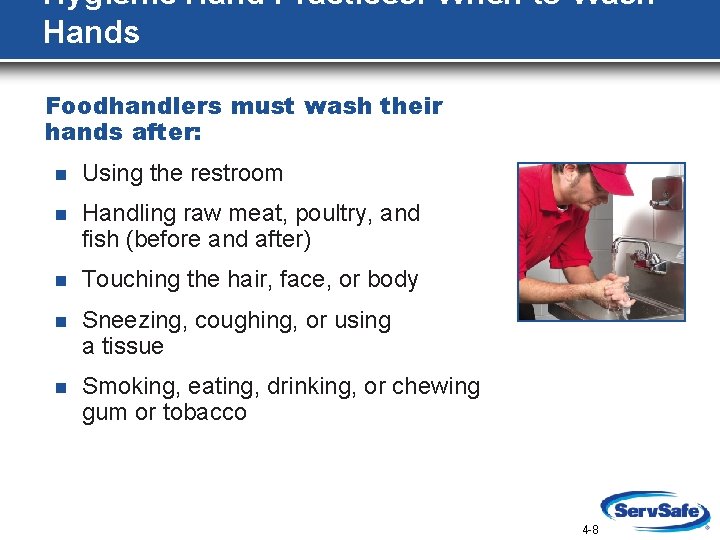
Hygienic Hand Practices: When to Wash Hands Foodhandlers must wash their hands after: n Using the restroom n Handling raw meat, poultry, and fish (before and after) n Touching the hair, face, or body n Sneezing, coughing, or using a tissue n Smoking, eating, drinking, or chewing gum or tobacco 4 -8
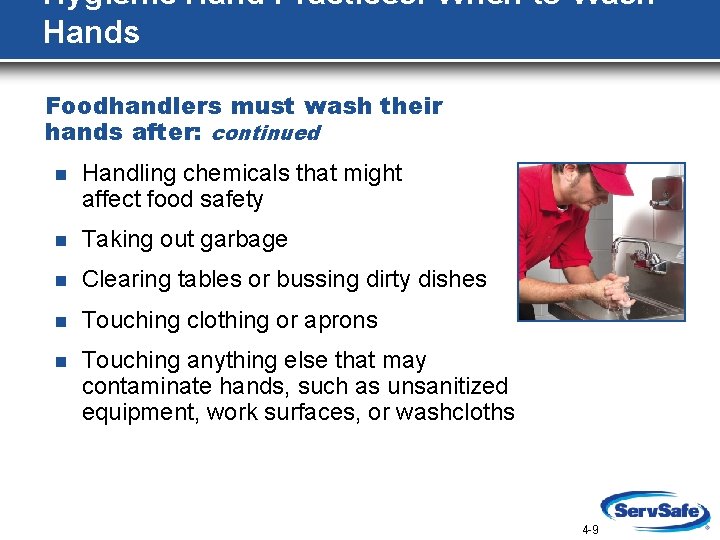
Hygienic Hand Practices: When to Wash Hands Foodhandlers must wash their hands after: continued n Handling chemicals that might affect food safety n Taking out garbage n Clearing tables or bussing dirty dishes n Touching clothing or aprons n Touching anything else that may contaminate hands, such as unsanitized equipment, work surfaces, or washcloths 4 -9
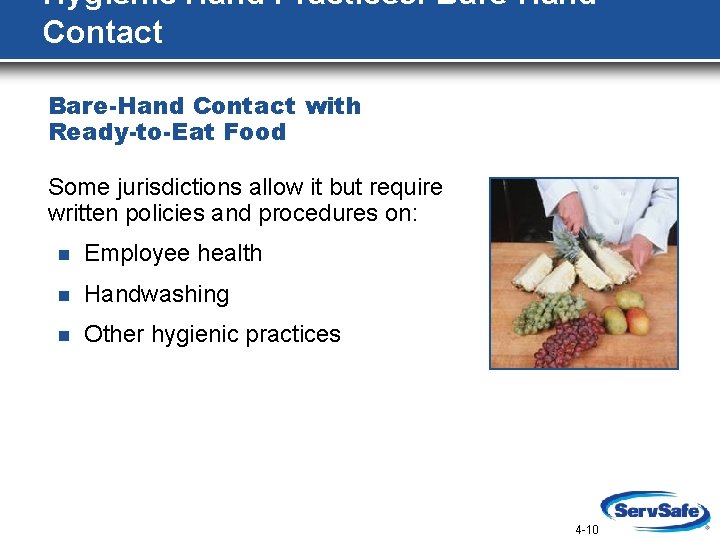
Hygienic Hand Practices: Bare-Hand Contact with Ready-to-Eat Food Some jurisdictions allow it but require written policies and procedures on: n Employee health n Handwashing n Other hygienic practices 4 -10
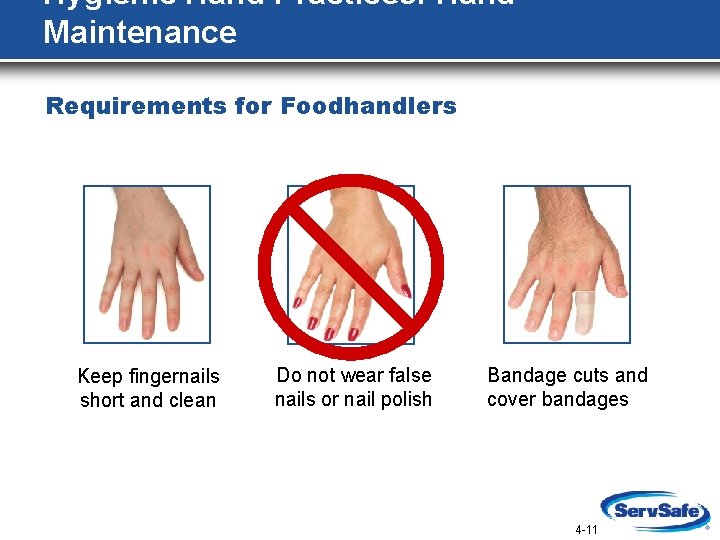
Hygienic Hand Practices: Hand Maintenance Requirements for Foodhandlers Keep fingernails short and clean Do not wear false nails or nail polish Bandage cuts and cover bandages 4 -11
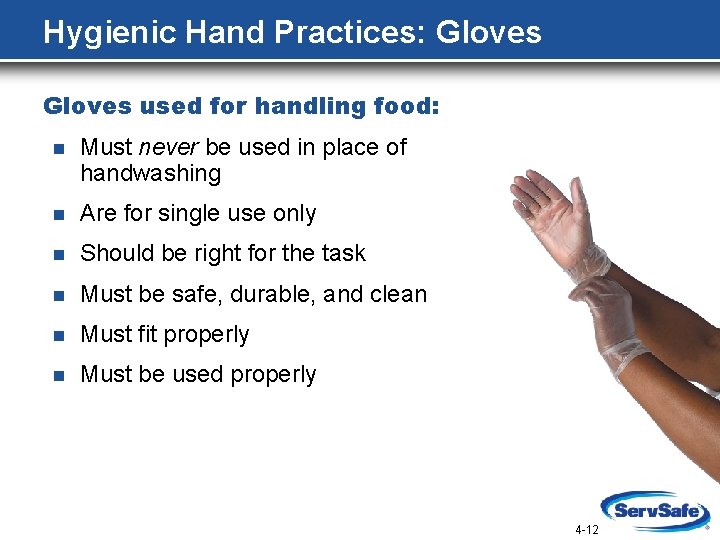
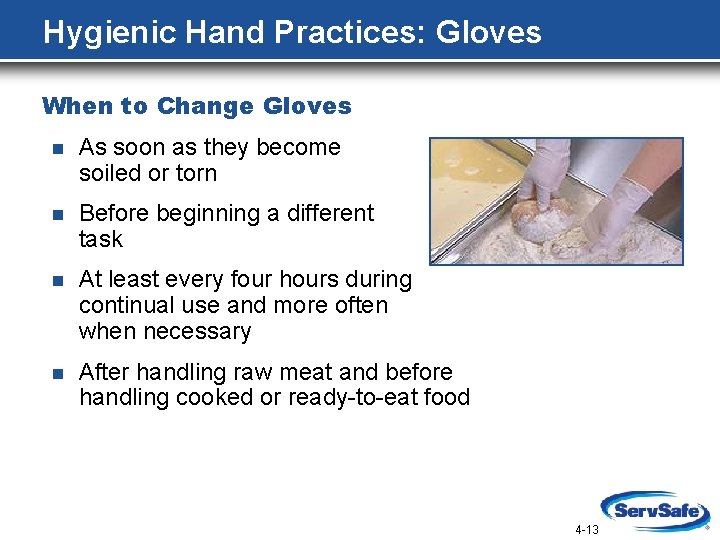
Hygienic Hand Practices: Gloves used for handling food: n Must never be used in place of handwashing n Are for single use only n Should be right for the task n Must be safe, durable, and clean n Must fit properly n Must be used properly 4 -12
Hygienic Hand Practices: Gloves When to Change Gloves n As soon as they become soiled or torn n Before beginning a different task n At least every four hours during continual use and more often when necessary n After handling raw meat and before handling cooked or ready-to-eat food 4 -13
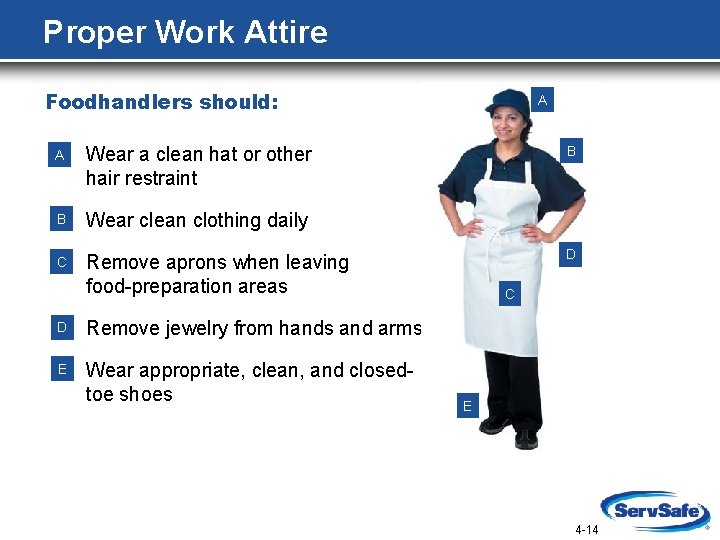
Proper Work Attire Foodhandlers should: A Wear a clean hat or other hair restraint B Wear clean clothing daily C Remove aprons when leaving food-preparation areas D Remove jewelry from hands and arms E Wear appropriate, clean, and closedtoe shoes A B D C E 4 -14
Policies Regarding Eating, Drinking, and Smoking Foodhandlers must not: n Smoke, chew gum or tobacco, eat or drink When n Preparing or serving food n Working in food-preparation areas n Working in areas used to clean utensils and equipment 4 -15
Handling Employee Illnesses IF: n The foodhandler has a sore throat with fever THEN: n Restrict the employee from working with or around food n Exclude the employee from the establishment if you primarily serve a high-risk population 4 -16
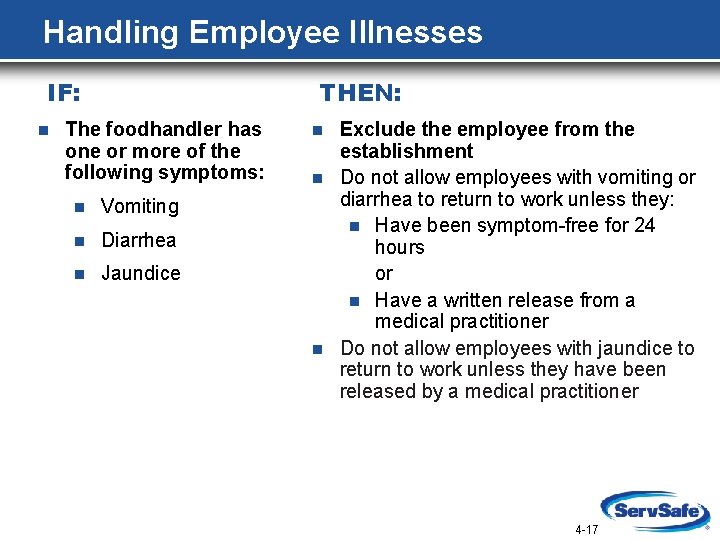
Handling Employee Illnesses IF: n THEN: The foodhandler has one or more of the following symptoms: n Vomiting n Diarrhea n Jaundice n n n Exclude the employee from the establishment Do not allow employees with vomiting or diarrhea to return to work unless they: n Have been symptom-free for 24 hours or n Have a written release from a medical practitioner Do not allow employees with jaundice to return to work unless they have been released by a medical practitioner 4 -17
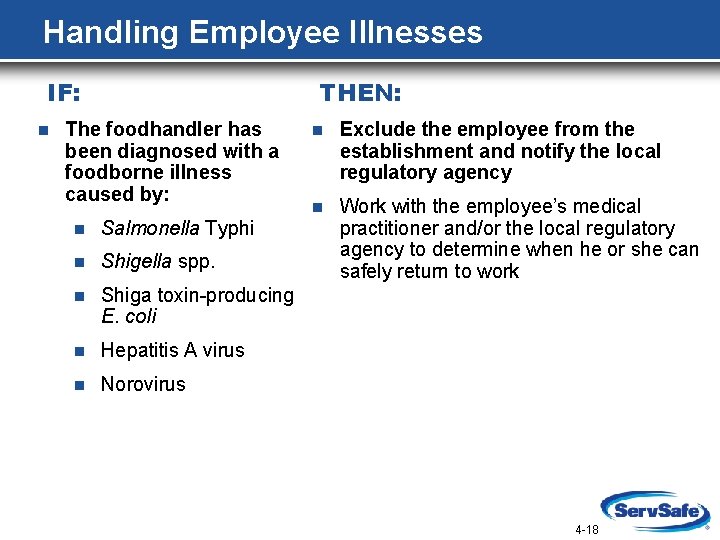
Handling Employee Illnesses IF: n THEN: The foodhandler has been diagnosed with a foodborne illness caused by: n Salmonella Typhi n Shigella spp. n Shiga toxin-producing E. coli n Hepatitis A virus n Norovirus n Exclude the employee from the establishment and notify the local regulatory agency n Work with the employee’s medical practitioner and/or the local regulatory agency to determine when he or she can safely return to work 4 -18
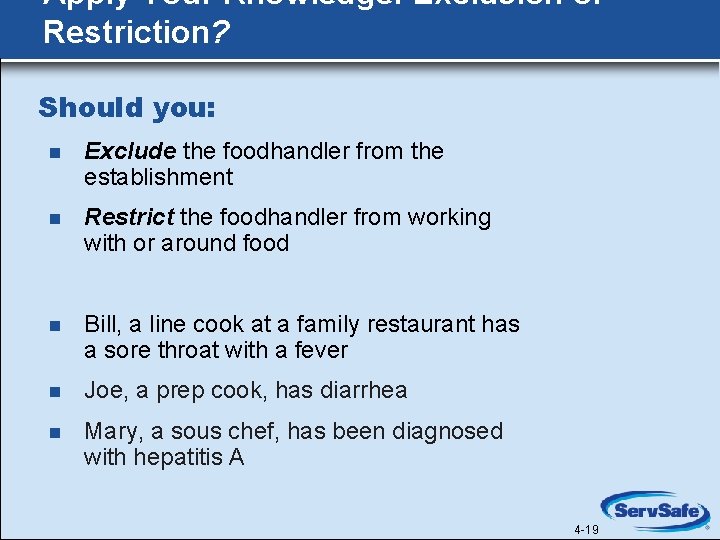
Apply Your Knowledge: Exclusion or Restriction? Should you: n Exclude the foodhandler from the establishment n Restrict the foodhandler from working with or around food n Bill, a line cook at a family restaurant has a sore throat with a fever n Joe, a prep cook, has diarrhea n Mary, a sous chef, has been diagnosed with hepatitis A 4 -19
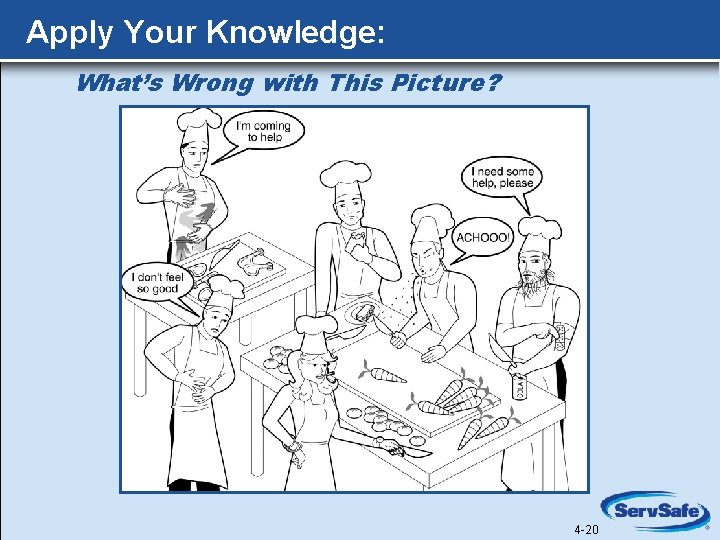
Apply Your Knowledge: What’s Wrong with This Picture? 4 -20