
the Safe and Together model Making good decisions


- Slides: 32
the Safe and Together™ model: Making good decisions for children impacted by domestic and family violence David Mandel, MA, LPC April 2014 3 rd Annual NW AZ Infant/Toddler Mental Health Symposium International Center for Innovation in Domestic Violence Practice (ICIDVP)
Materials related to today’s training including Power Point available at: http: //endingviolence. com/nwazsym (c) 2013 David Mandel Associates LLC Do not reproduce or distribute without permission
International Center for Innovation in Domestic Violence Practice (ICIDVP) Mission • The ICIDVP’s mission is to research, incubate, develop, and implement innovative ideas and sustainable practices to reduce and end domestic violence and child maltreatment. • ICIDVP is committed to advancing domestic violence practice at the individual, organizational and community level through partnerships with researchers, practitioners, and policy makers. • We are committed to helping our clients, who are individual practitioners, community agencies and collaborations, and government organizations, achieve their mission to improve the lives of children and families. (c) 2013 David Mandel Associates LLC Do not reproduce or distribute without permission
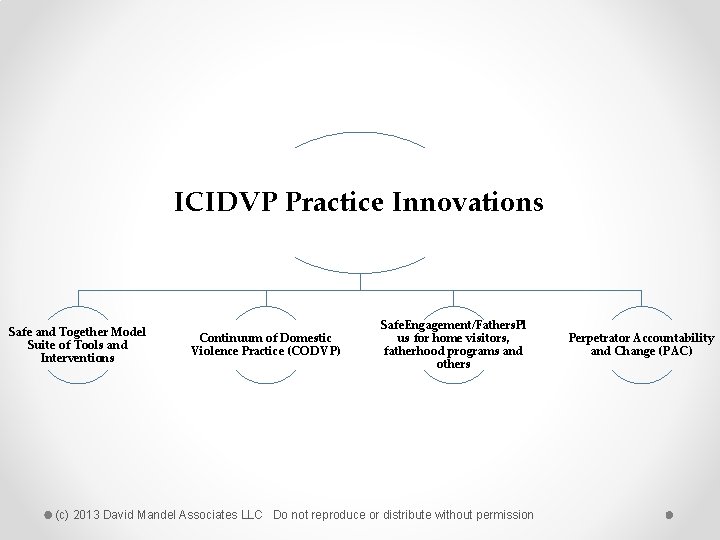
ICIDVP Practice Innovations Safe and Together Model Suite of Tools and Interventions Continuum of Domestic Violence Practice (CODVP) Safe. Engagement/Fathers. Pl us for home visitors, fatherhood programs and others (c) 2013 David Mandel Associates LLC Do not reproduce or distribute without permission Perpetrator Accountability and Change (PAC)
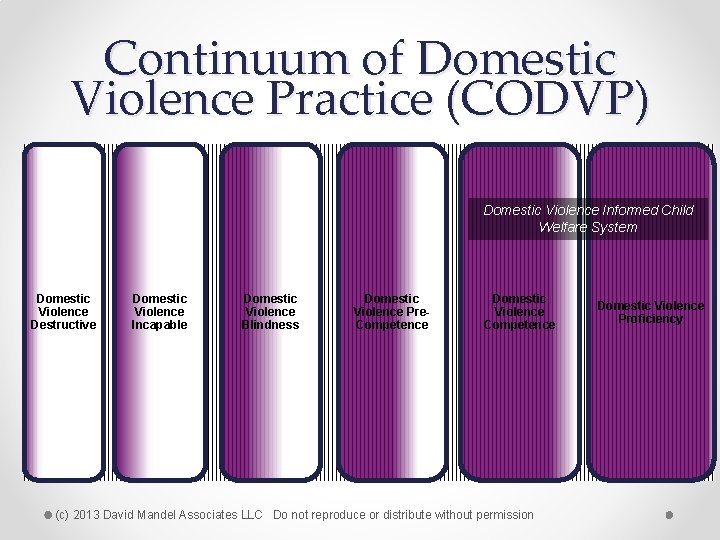
Continuum of Domestic Violence Practice (CODVP) Domestic Violence Informed Child Welfare System Domestic Violence Destructive Domestic Violence Incapable Domestic Violence Blindness Domestic Violence Pre. Competence Domestic Violence Competence (c) 2013 David Mandel Associates LLC Do not reproduce or distribute without permission Domestic Violence Proficiency
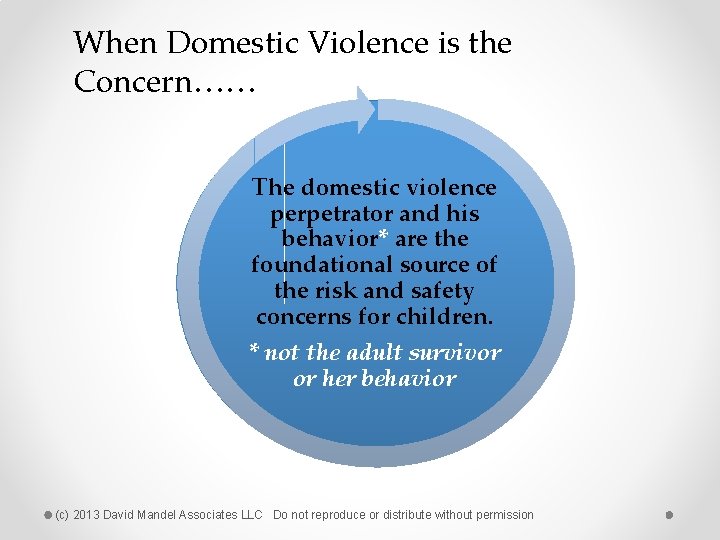
When Domestic Violence is the Concern…… The domestic violence perpetrator and his behavior* are the foundational source of the risk and safety concerns for children. * not the adult survivor or her behavior (c) 2013 David Mandel Associates LLC Do not reproduce or distribute without permission
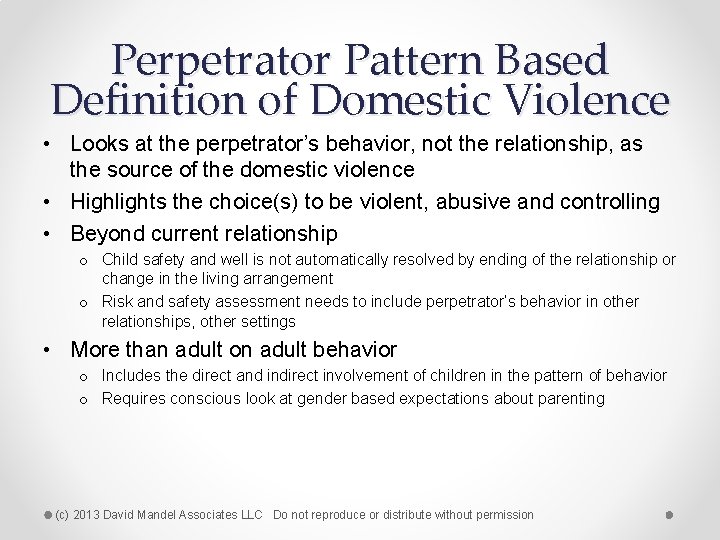
Perpetrator Pattern Based Definition of Domestic Violence • Looks at the perpetrator’s behavior, not the relationship, as the source of the domestic violence • Highlights the choice(s) to be violent, abusive and controlling • Beyond current relationship o Child safety and well is not automatically resolved by ending of the relationship or change in the living arrangement o Risk and safety assessment needs to include perpetrator’s behavior in other relationships, other settings • More than adult on adult behavior o Includes the direct and indirect involvement of children in the pattern of behavior o Requires conscious look at gender based expectations about parenting (c) 2013 David Mandel Associates LLC Do not reproduce or distribute without permission
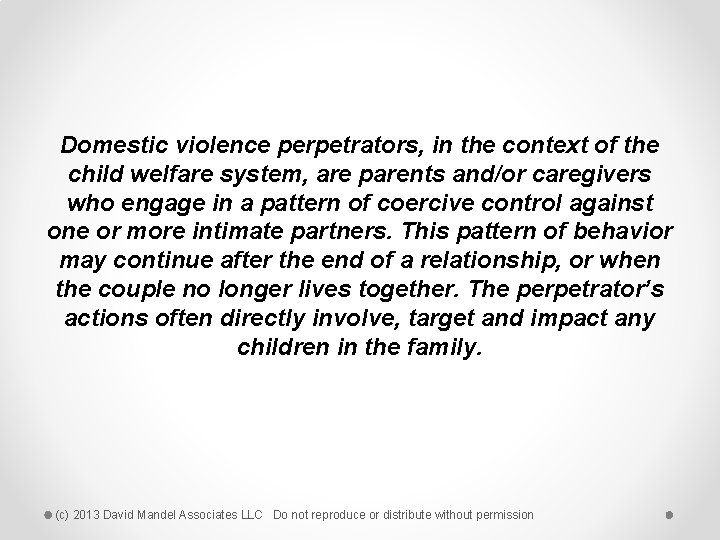
Domestic violence perpetrators, in the context of the child welfare system, are parents and/or caregivers who engage in a pattern of coercive control against one or more intimate partners. This pattern of behavior may continue after the end of a relationship, or when the couple no longer lives together. The perpetrator’s actions often directly involve, target and impact any children in the family. (c) 2013 David Mandel Associates LLC Do not reproduce or distribute without permission
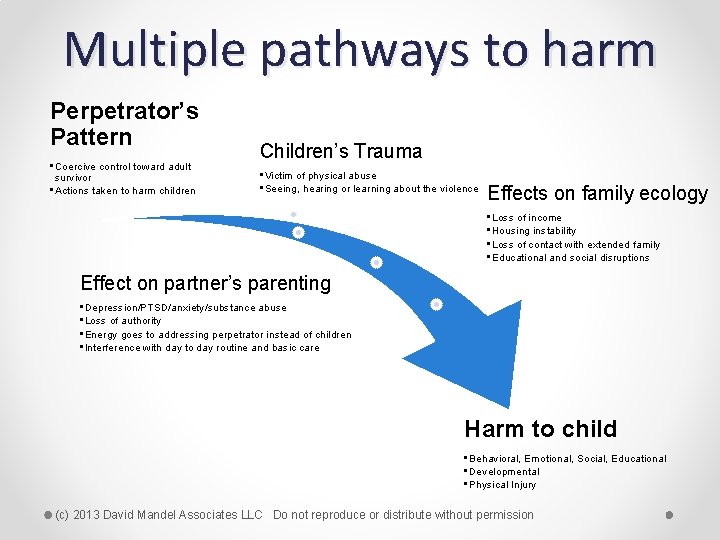
Multiple pathways to harm Perpetrator’s Pattern • Coercive control toward adult survivor • Actions taken to harm children Children’s Trauma • Victim of physical abuse • Seeing, hearing or learning about the violence Effects on family ecology • Loss of income • Housing instability • Loss of contact with extended family • Educational and social disruptions Effect on partner’s parenting • Depression/PTSD/anxiety/substance abuse • Loss of authority • Energy goes to addressing perpetrator instead of children • Interference with day to day routine and basic care Harm to child • Behavioral, Emotional, Social, Educational • Developmental • Physical Injury (c) 2013 David Mandel Associates LLC Do not reproduce or distribute without permission
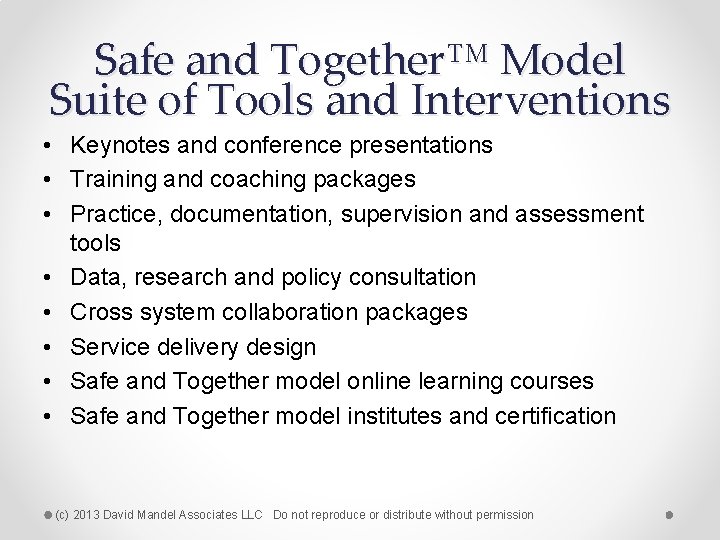
Safe and Together™ Model Suite of Tools and Interventions • Keynotes and conference presentations • Training and coaching packages • Practice, documentation, supervision and assessment tools • Data, research and policy consultation • Cross system collaboration packages • Service delivery design • Safe and Together model online learning courses • Safe and Together model institutes and certification (c) 2013 David Mandel Associates LLC Do not reproduce or distribute without permission
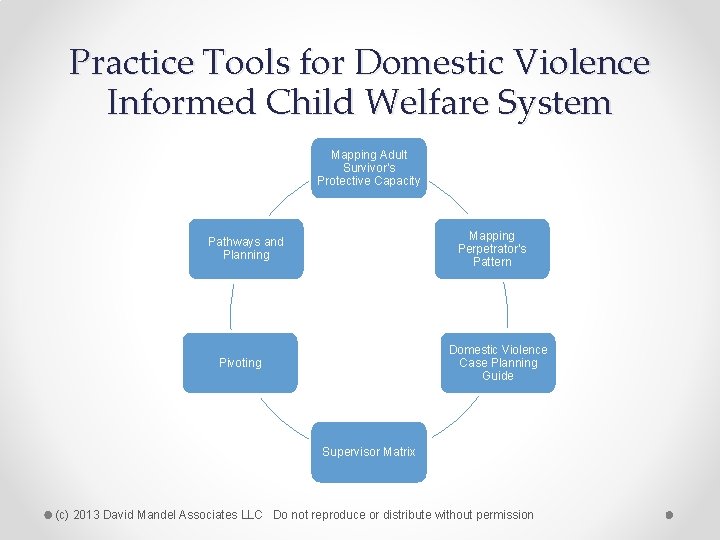
Practice Tools for Domestic Violence Informed Child Welfare System Mapping Adult Survivor’s Protective Capacity Mapping Perpetrator’s Pattern Pathways and Planning Domestic Violence Case Planning Guide Pivoting Supervisor Matrix (c) 2013 David Mandel Associates LLC Do not reproduce or distribute without permission
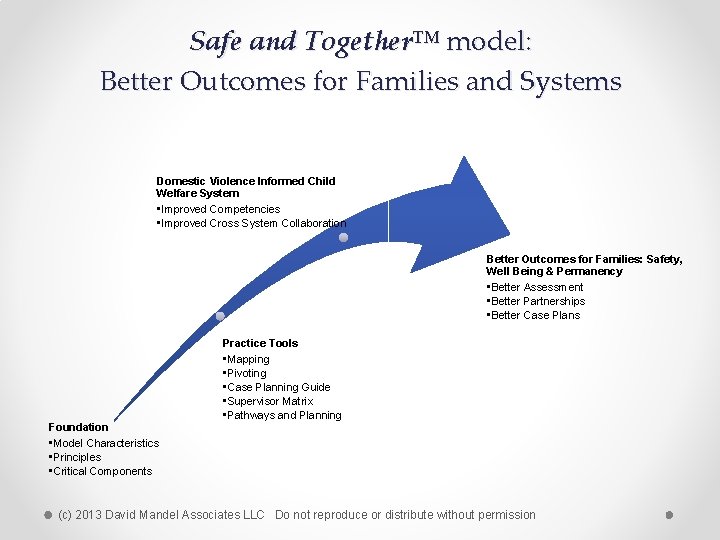
Safe and Together™ model: Better Outcomes for Families and Systems Domestic Violence Informed Child Welfare System • Improved Competencies • Improved Cross System Collaboration Better Outcomes for Families: Safety, Well Being & Permanency • Better Assessment • Better Partnerships • Better Case Plans Foundation • Model Characteristics • Principles • Critical Components Practice Tools • Mapping • Pivoting • Case Planning Guide • Supervisor Matrix • Pathways and Planning (c) 2013 David Mandel Associates LLC Do not reproduce or distribute without permission
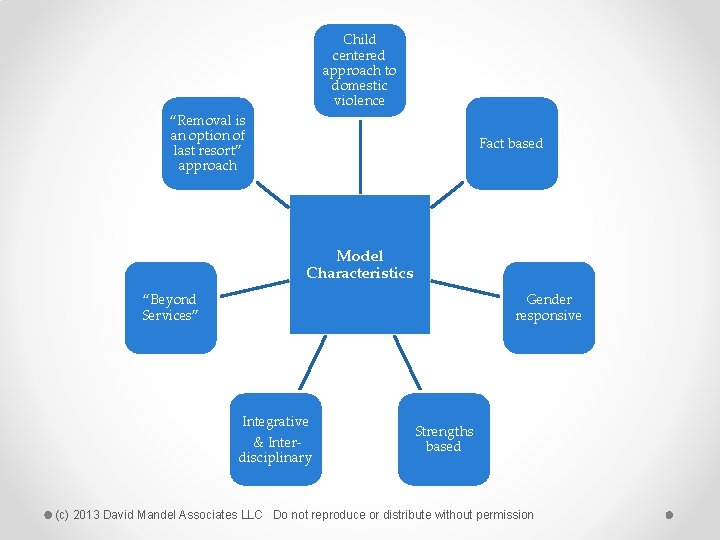
Child centered approach to domestic violence “Removal is an option of last resort” approach Fact based Model Characteristics “Beyond Services” Gender responsive Integrative & Interdisciplinary Strengths based (c) 2013 David Mandel Associates LLC Do not reproduce or distribute without permission
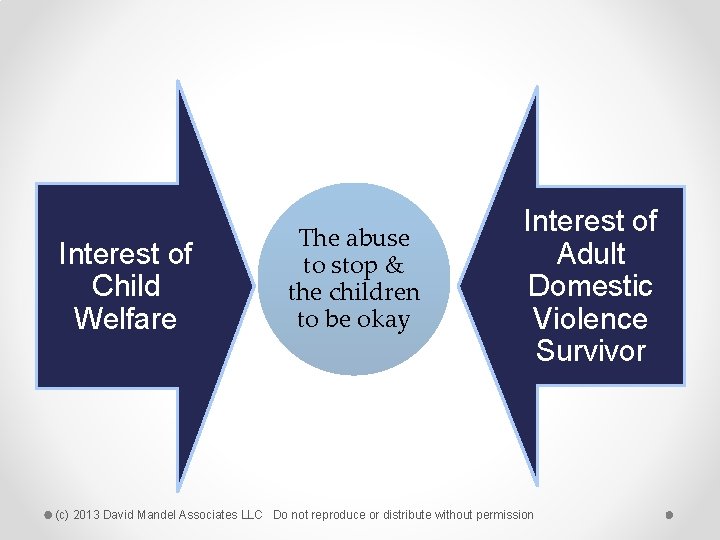
Interest of Child Welfare The abuse to stop & the children to be okay Interest of Adult Domestic Violence Survivor (c) 2013 David Mandel Associates LLC Do not reproduce or distribute without permission
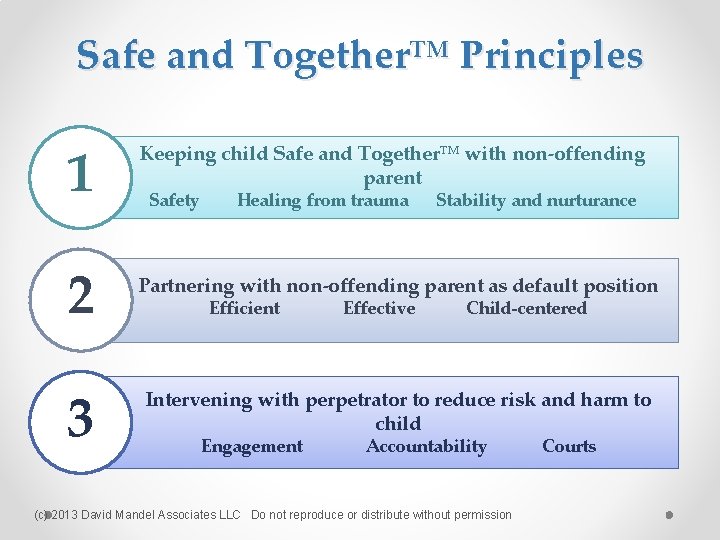
Safe and Together™ Principles 1 Keeping child Safe and Together™ with non-offending parent 2 Partnering with non-offending parent as default position 3 Intervening with perpetrator to reduce risk and harm to child Safety Healing from trauma Efficient Engagement Effective Stability and nurturance Child-centered Accountability (c) 2013 David Mandel Associates LLC Do not reproduce or distribute without permission Courts
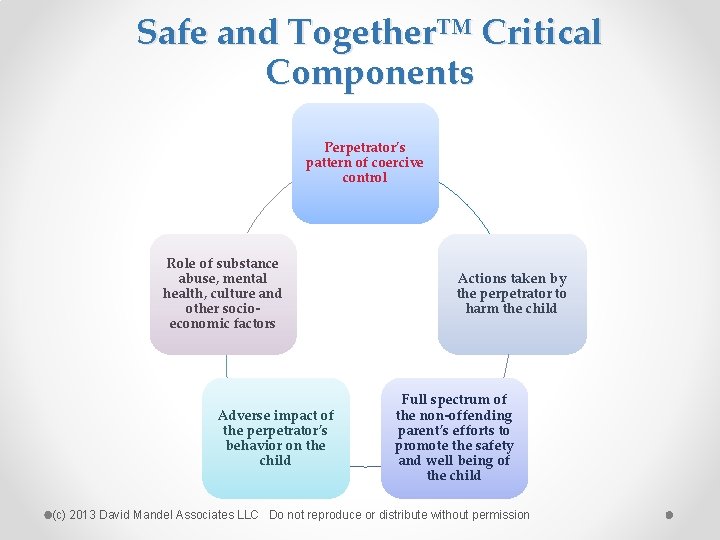
Safe and Together™ Critical Components Perpetrator’s pattern of coercive control Role of substance abuse, mental health, culture and other socioeconomic factors Adverse impact of the perpetrator’s behavior on the child Actions taken by the perpetrator to harm the child Full spectrum of the non-offending parent’s efforts to promote the safety and well being of the child (c) 2013 David Mandel Associates LLC Do not reproduce or distribute without permission
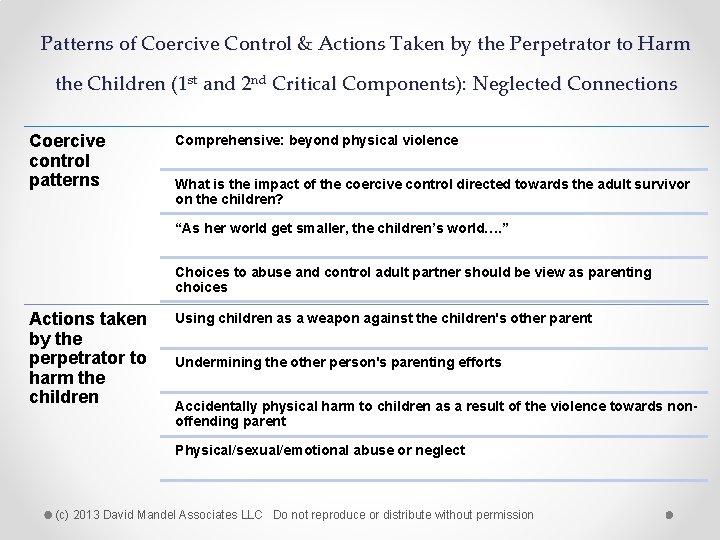
Patterns of Coercive Control & Actions Taken by the Perpetrator to Harm the Children (1 st and 2 nd Critical Components): Neglected Connections Coercive control patterns Comprehensive: beyond physical violence What is the impact of the coercive control directed towards the adult survivor on the children? “As her world get smaller, the children’s world…. ” Choices to abuse and control adult partner should be view as parenting choices Actions taken by the perpetrator to harm the children Using children as a weapon against the children's other parent Undermining the other person's parenting efforts Accidentally physical harm to children as a result of the violence towards nonoffending parent Physical/sexual/emotional abuse or neglect (c) 2013 David Mandel Associates LLC Do not reproduce or distribute without permission
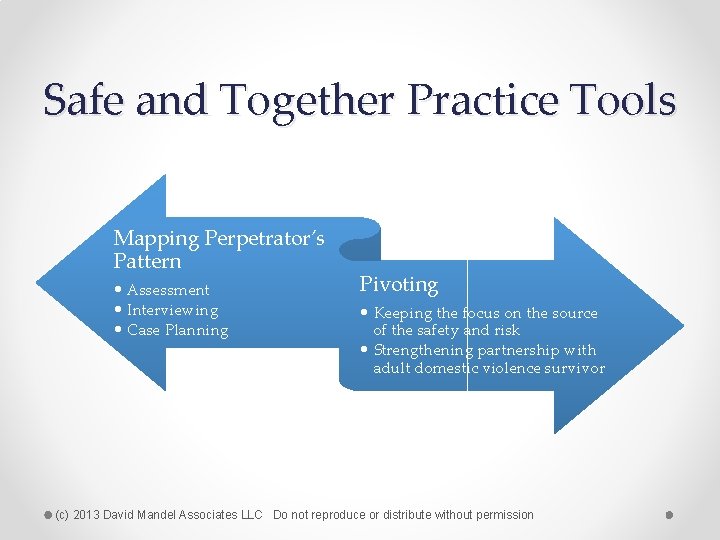
Safe and Together Practice Tools Mapping Perpetrator’s Pattern • Assessment • Interviewing • Case Planning Pivoting • Keeping the focus on the source of the safety and risk • Strengthening partnership with adult domestic violence survivor (c) 2013 David Mandel Associates LLC Do not reproduce or distribute without permission
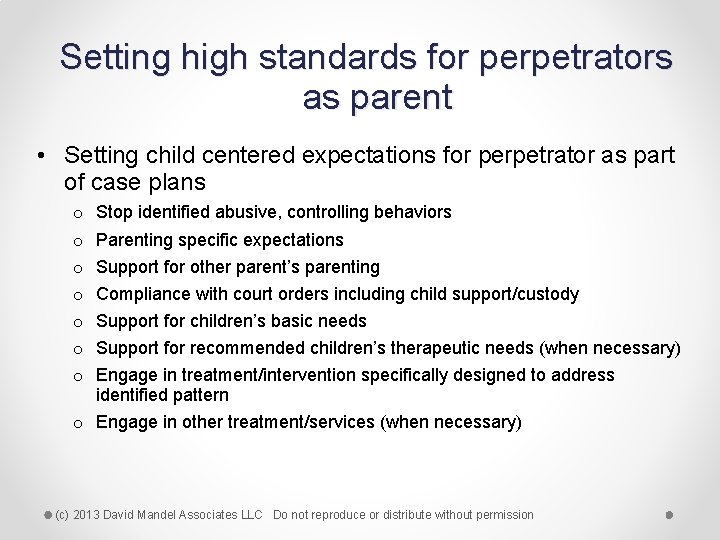
Setting high standards for perpetrators as parent • Setting child centered expectations for perpetrator as part of case plans o o o o Stop identified abusive, controlling behaviors Parenting specific expectations Support for other parent’s parenting Compliance with court orders including child support/custody Support for children’s basic needs Support for recommended children’s therapeutic needs (when necessary) Engage in treatment/intervention specifically designed to address identified pattern o Engage in other treatment/services (when necessary) (c) 2013 David Mandel Associates LLC Do not reproduce or distribute without permission
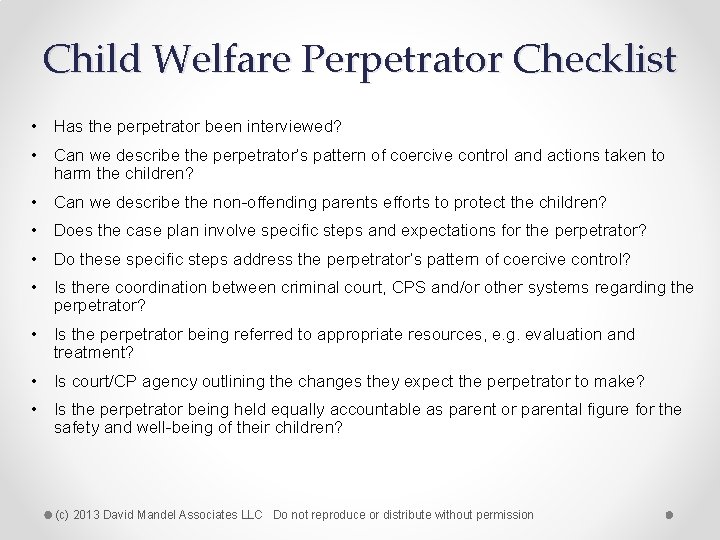
Child Welfare Perpetrator Checklist • Has the perpetrator been interviewed? • Can we describe the perpetrator’s pattern of coercive control and actions taken to harm the children? • Can we describe the non-offending parents efforts to protect the children? • Does the case plan involve specific steps and expectations for the perpetrator? • Do these specific steps address the perpetrator’s pattern of coercive control? • Is there coordination between criminal court, CPS and/or other systems regarding the perpetrator? • Is the perpetrator being referred to appropriate resources, e. g. evaluation and treatment? • Is court/CP agency outlining the changes they expect the perpetrator to make? • Is the perpetrator being held equally accountable as parent or parental figure for the safety and well-being of their children? (c) 2013 David Mandel Associates LLC Do not reproduce or distribute without permission
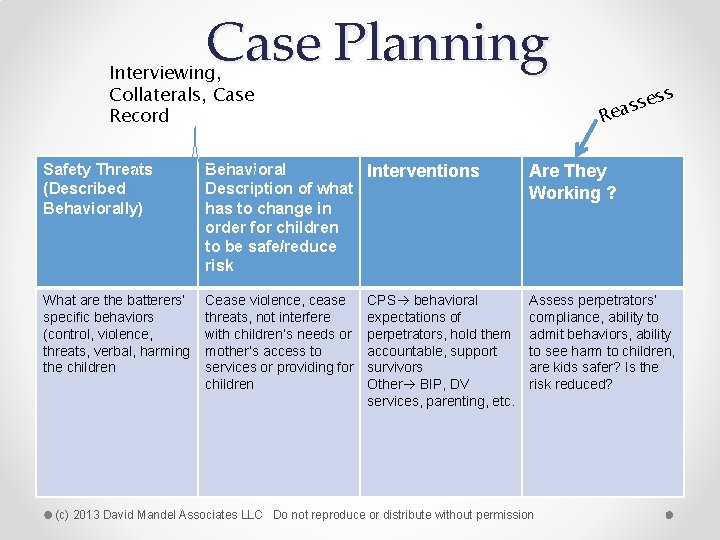
Case Planning Interviewing, Collaterals, Case Record ss Rea Safety Threats (Described Behaviorally) Behavioral Interventions Description of what has to change in order for children to be safe/reduce risk What are the batterers’ specific behaviors (control, violence, threats, verbal, harming the children Cease violence, cease threats, not interfere with children’s needs or mother’s access to services or providing for children CPS behavioral expectations of perpetrators, hold them accountable, support survivors Other BIP, DV services, parenting, etc. ess Are They Working ? Assess perpetrators’ compliance, ability to admit behaviors, ability to see harm to children, are kids safer? Is the risk reduced? (c) 2013 David Mandel Associates LLC Do not reproduce or distribute without permission
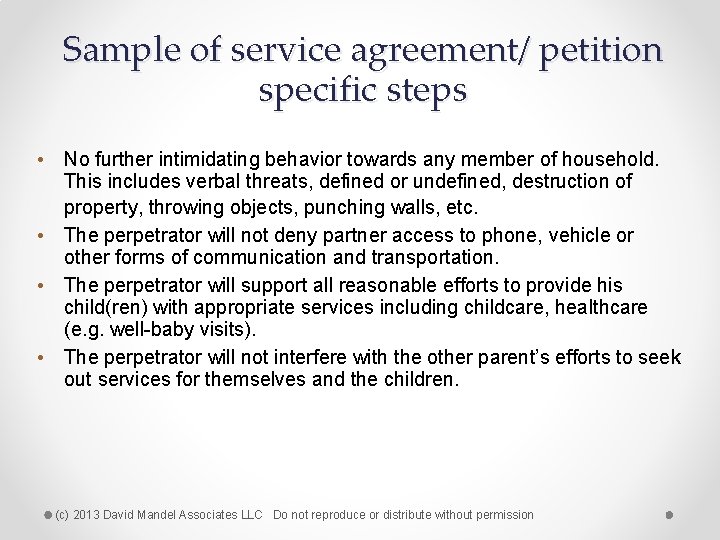
Sample of service agreement/ petition specific steps • • No further intimidating behavior towards any member of household. This includes verbal threats, defined or undefined, destruction of property, throwing objects, punching walls, etc. The perpetrator will not deny partner access to phone, vehicle or other forms of communication and transportation. The perpetrator will support all reasonable efforts to provide his child(ren) with appropriate services including childcare, healthcare (e. g. well-baby visits). The perpetrator will not interfere with the other parent’s efforts to seek out services for themselves and the children. (c) 2013 David Mandel Associates LLC Do not reproduce or distribute without permission
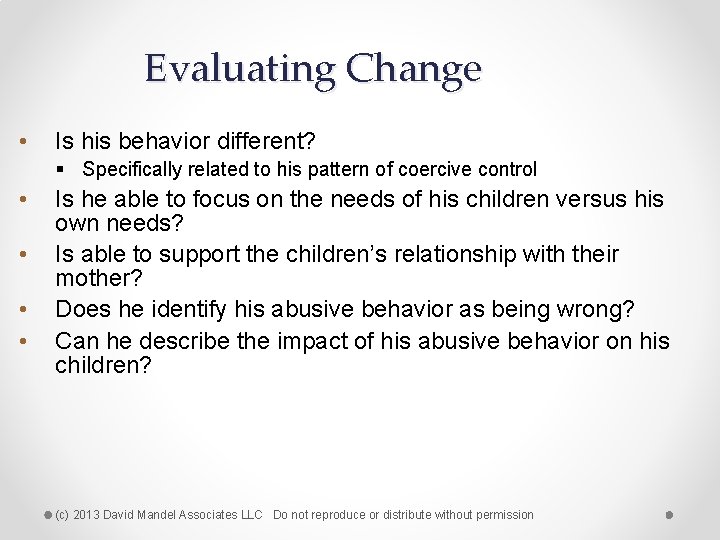
Evaluating Change • Is his behavior different? § Specifically related to his pattern of coercive control • • Is he able to focus on the needs of his children versus his own needs? Is able to support the children’s relationship with their mother? Does he identify his abusive behavior as being wrong? Can he describe the impact of his abusive behavior on his children? (c) 2013 David Mandel Associates LLC Do not reproduce or distribute without permission
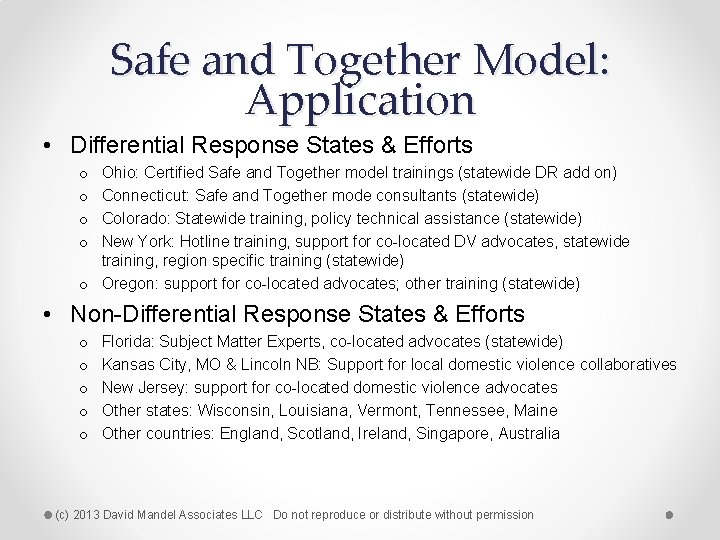
Safe and Together Model: Application • Differential Response States & Efforts Ohio: Certified Safe and Together model trainings (statewide DR add on) Connecticut: Safe and Together mode consultants (statewide) Colorado: Statewide training, policy technical assistance (statewide) New York: Hotline training, support for co-located DV advocates, statewide training, region specific training (statewide) o Oregon: support for co-located advocates; other training (statewide) o o • Non-Differential Response States & Efforts o o o Florida: Subject Matter Experts, co-located advocates (statewide) Kansas City, MO & Lincoln NB: Support for local domestic violence collaboratives New Jersey: support for co-located domestic violence advocates Other states: Wisconsin, Louisiana, Vermont, Tennessee, Maine Other countries: England, Scotland, Ireland, Singapore, Australia (c) 2013 David Mandel Associates LLC Do not reproduce or distribute without permission
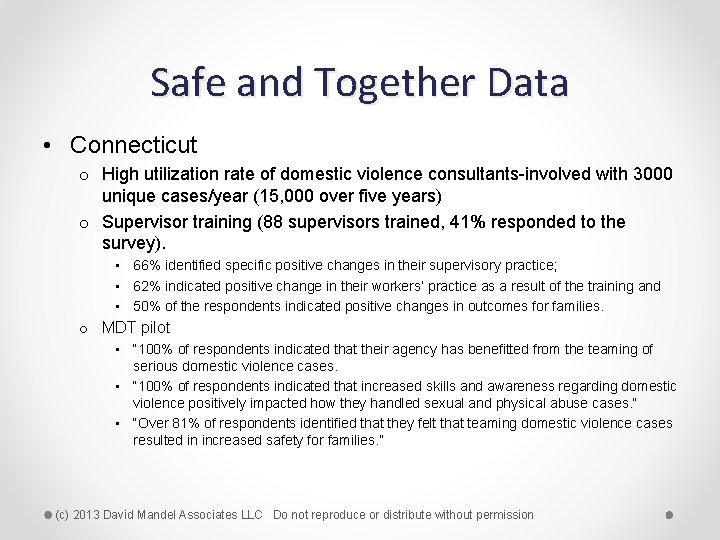
Safe and Together Data • Connecticut o High utilization rate of domestic violence consultants-involved with 3000 unique cases/year (15, 000 over five years) o Supervisor training (88 supervisors trained, 41% responded to the survey). • 66% identified specific positive changes in their supervisory practice; • 62% indicated positive change in their workers’ practice as a result of the training and • 50% of the respondents indicated positive changes in outcomes for families. o MDT pilot • “ 100% of respondents indicated that their agency has benefitted from the teaming of serious domestic violence cases. • “ 100% of respondents indicated that increased skills and awareness regarding domestic violence positively impacted how they handled sexual and physical abuse cases. ” • “Over 81% of respondents identified that they felt that teaming domestic violence cases resulted in increased safety for families. ” (c) 2013 David Mandel Associates LLC Do not reproduce or distribute without permission
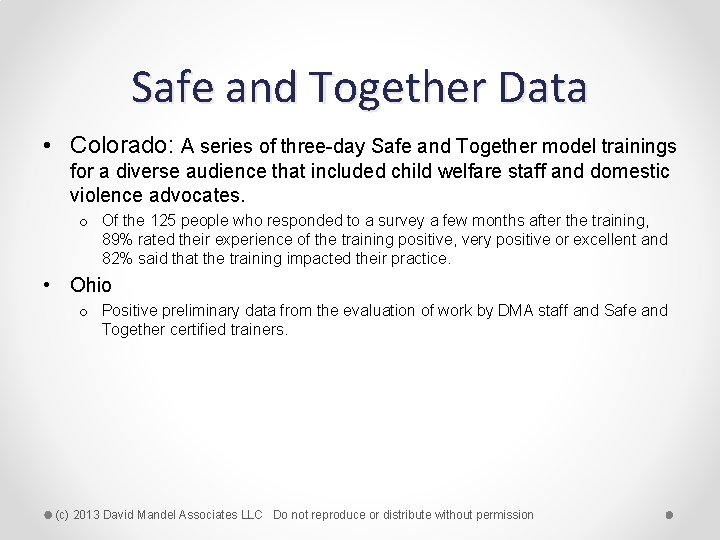
Safe and Together Data • Colorado: A series of three-day Safe and Together model trainings for a diverse audience that included child welfare staff and domestic violence advocates. o Of the 125 people who responded to a survey a few months after the training, 89% rated their experience of the training positive, very positive or excellent and 82% said that the training impacted their practice. • Ohio o Positive preliminary data from the evaluation of work by DMA staff and Safe and Together certified trainers. (c) 2013 David Mandel Associates LLC Do not reproduce or distribute without permission
(c) 2013 David Mandel Associates LLC Do not reproduce or distribute without permission
(c) 2013 David Mandel Associates LLC Do not reproduce or distribute without permission
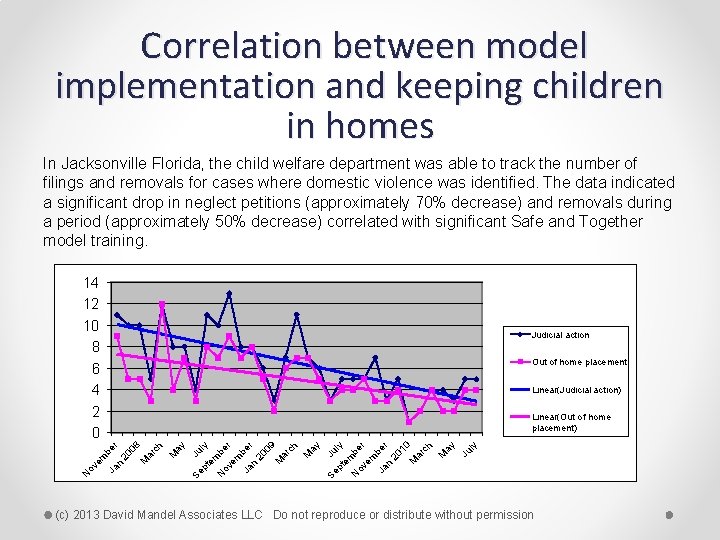
Correlation between model implementation and keeping children in homes In Jacksonville Florida, the child welfare department was able to track the number of filings and removals for cases where domestic violence was identified. The data indicated a significant drop in neglect petitions (approximately 70% decrease) and removals during a period (approximately 50% decrease) correlated with significant Safe and Together model training. Judicial action Out of home placement Linear(Judicial action) ly Ju M ay Se Ju pt ly em N b ov er em Ja ber n 20 10 M ar ch M ay Linear(Out of home placement) Se Ju pt ly em N b ov er em Ja ber n 20 09 M ar ch N ov e m Ja ber n 20 08 M ar ch 14 12 10 8 6 4 2 0 (c) 2013 David Mandel Associates LLC Do not reproduce or distribute without permission
REGISTRATION NOW OPEN! 2014 2 nd National Safe and Together Model Symposium October 22 -24, 2014 Seattle, Washington Seattle Marriott Waterfront Building on successful 1 st National Safe and Together Symposium, our 2014 event will have the following enhanced features: • Full day pre-Symposium workshops- October 22, 2014 • Presentations by Safe and Together sites and partners • A wider focus including workshops on fathers, domestic violence informed child welfare systems, implementation fidelity and other topics REGISTER FOR CONFERENCE AT http: //www. endingviolence. com
Materials related to today’s training including Power Point available at: http: //endingviolence. com/nwazsym (c) 2013 David Mandel Associates LLC Do not reproduce or distribute without permission
David Mandel & Associates LLC 860 -319 -0966 (USA) www. endingviolence. com davidmandel@endingviolence. com Friend us on Facebook at: http: //www. facebook. com/David. Mandel. And. Associates and on Twitter: https: //twitter. com/Safeand. Together For more information International Center for Innovation in Domestic Violence Practice (ICIDVP)