
The SacramentoSan Joaquin River Delta Michael Patrick George
- Slides: 13
The Sacramento/San Joaquin River Delta Michael Patrick George, Delta Watermaster The WEF’s Delta Tour June 14, 2017
Disclaimers Ø I am not speaking for the SWRCB or the DSC Ø I am not presenting State policy Ø I am expressing personal observations and opinions, except where specifically referenced to published materials
Role of the Delta Watermaster Ø The Office of the Delta Watermaster was created as part of the Delta Reform Act of 2009 Ø The Watermaster is an independent officer of the State Ø Appointed to a four-year term by the State Water Resources Control Board (Water Board) Ø Reports jointly to the Water Board and the Delta Stewardship Council Ø The Watermaster is responsible for: • • Administration of water rights in the Delta Assisting with realization of legislative mandates (co-equal goals) Coordinating implementation activities of many agencies Advising on policy and practice in the Delta
Brief Overview of Water Rights Ø Strange bedfellows: • Riparian: carryover from English common law; unquantified; limited by beneficial use on streamside property; shares correlatively in shortage • Pre-1914: invention of miners; “first in time, first in right; ” ossified by the Water Commission Act • License: regulation originated in 1914; Projects closed out in 1927 • Groundwater: 2014 law born of the drought
Coordinating Plans and Actions Ø Demise of the Bay Delta Accord and the 2009 Delta Reform Act: Grand Bargain or Temporary Truce? Ø Demise of the Bay Delta Conservation Plan • Water. Fix: Pending proposals for alternative water conveyance • Eco. Restore: Restoration or reconciliation? Ø Bay-Delta Water Quality Control Plan Update • Phases 1 through 4 • Litigation or Voluntary Agreements? Ø The Delta Plan (and the DPICC)
“You can’t manage what you don’t measure, ” Ø so…we’re working on several fronts to improve both data and insight about water use in the Delta • Measuring diversions presents specific challenges in the Delta: o o Tidal influence (including use of tidal pumps to capture water) Siphons are inherently unstable Retrofit of heritage systems is expensive and value is uncertain Delta Measurement Experimentation Consortium is organized and working Study of Delta consumptive use will be published this summer Delta drainage water is probably next for study under CWA Knowing three variables should allow us to solve for seepage Refinement of Delta inflow/outflow estimation is progressing with the usual contentiousness • There is a lot at stake, so everyone is watching to protect a host of conflicting interests • •
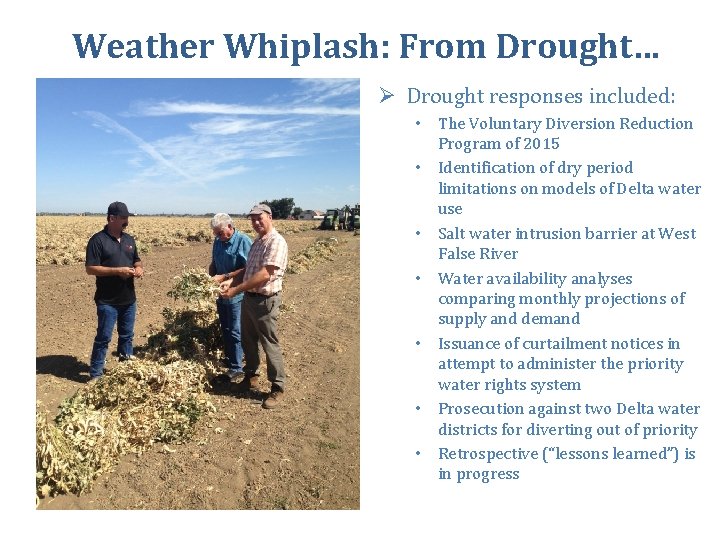
Weather Whiplash: From Drought… Ø Drought responses included: • The Voluntary Diversion Reduction Program of 2015 • Identification of dry period limitations on models of Delta water use • Salt water intrusion barrier at West False River • Water availability analyses comparing monthly projections of supply and demand • Issuance of curtailment notices in attempt to administer the priority water rights system • Prosecution against two Delta water districts for diverting out of priority • Retrospective (“lessons learned”) is in progress
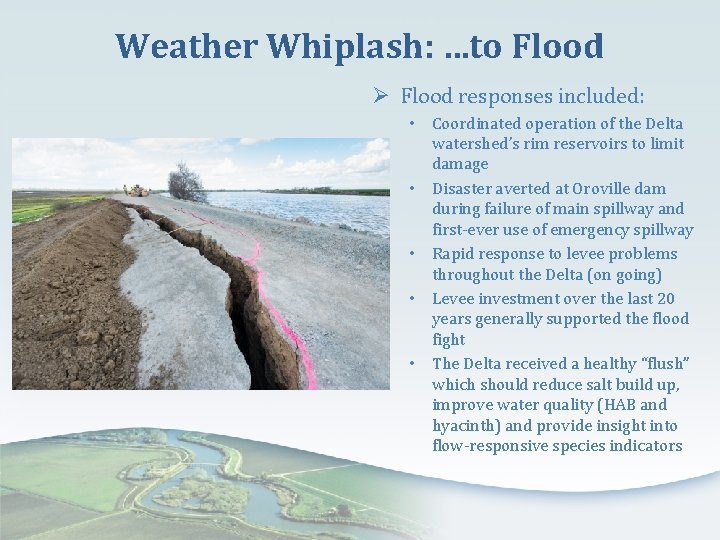
Weather Whiplash: …to Flood Ø Flood responses included: • Coordinated operation of the Delta watershed’s rim reservoirs to limit damage • Disaster averted at Oroville dam during failure of main spillway and first-ever use of emergency spillway • Rapid response to levee problems throughout the Delta (on going) • Levee investment over the last 20 years generally supported the flood fight • The Delta received a healthy “flush” which should reduce salt build up, improve water quality (HAB and hyacinth) and provide insight into flow-responsive species indicators
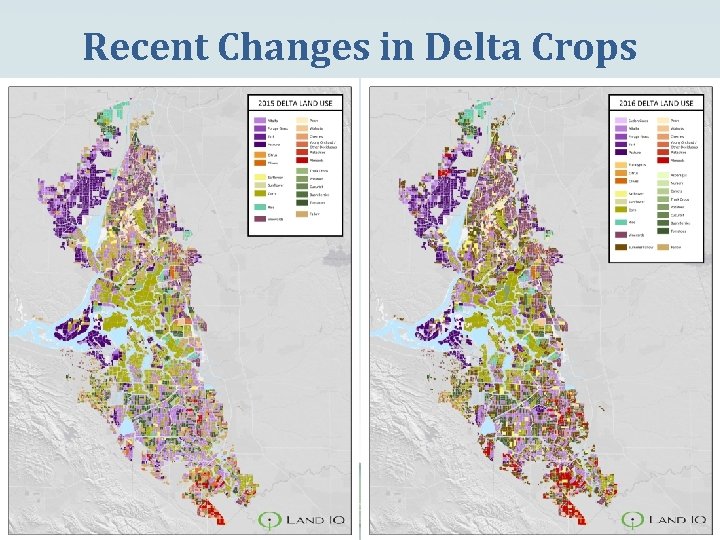
Land/Water Uses Are Changing Ø Most of the Delta is limited to agricultural use by statute, but economics currently favor migration to permanent crops (led, predictably, by almonds) Ø Irrigation techniques are evolving—more in relation to yield and quality than water shortage Ø Demand for land suitable for habitat restoration is projected to grow Ø Fish- and bird-friendly farming experiments appear promising, particularly in the northern Delta Ø Sea level rise is a predictable threat to sustainable agriculture—and to land values—in the Delta
Recent Changes in Delta Crops
Implications of Changing Land Use Ø Migration from variable annual water demand toward predictable but hardened water demand Ø Questions related to sustainability of permanent crops in the Delta based on groundwater levels, water quality and other factors Ø Flux in value at risk indicators for pending Delta Levy Investment Strategies Ø Constraints on long-term options for the Delta ecosystem and reconciliation Ø Potential impacts on through-Delta conveyance
Some Final Observations Ø In all but the wettest years, there is not enough water in California to serve all beneficial uses at current rates Ø There is no good mechanism to allocate scarce water to best use, partly because society’s notions of “best use” are in flux Ø Weather Whiplash alerts us that current systems are inadequate to managing the priority water right system at the extremes of our weather variability Ø Infrastructure designed and financed to serve water supply purposes is being redirected to serve environmental and other societal purposes inadequately Ø The Delta as you see it today is unsustainable: how will we respond?
Questions Michael George – Delta Watermaster Email: michael. george@waterboards. ca. gov Phone: (916) 445 -5962 Lauren Barva – Communication and Outreach Specialist Email: lauren. barva@waterboards. ca. gov Phone: (916) 319 -8264