
The SA National PMTCT Guidelines 2019 Outline The






- Slides: 49
The SA National PMTCT Guidelines (2019)
Outline • The ideal PMTCT pathway • Detail of new interventions to move us towards the ideal PMTCT pathway for mother and her infant
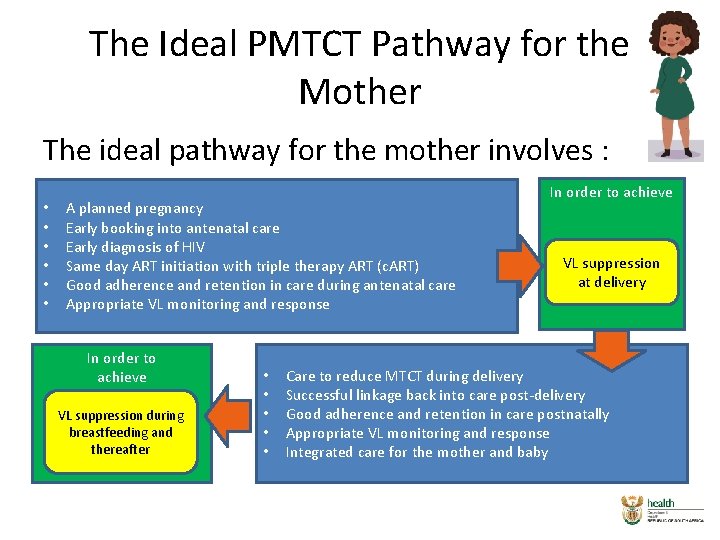
The Ideal PMTCT Pathway for the Mother The ideal pathway for the mother involves : • • • A planned pregnancy Early booking into antenatal care Early diagnosis of HIV Same day ART initiation with triple therapy ART (c. ART) Good adherence and retention in care during antenatal care Appropriate VL monitoring and response In order to achieve VL suppression during breastfeeding and thereafter • • • In order to achieve VL suppression at delivery Care to reduce MTCT during delivery Successful linkage back into care post-delivery Good adherence and retention in care postnatally Appropriate VL monitoring and response Integrated care for the mother and baby
A Planned Pregnancy • Integration of ART and family planning services are essential in the era DTG. • Guidance is provided on both contraception and safe conception • At every visit, issues of childbearing and contraception should be discussed to understand current fertility desires and health care needs 4
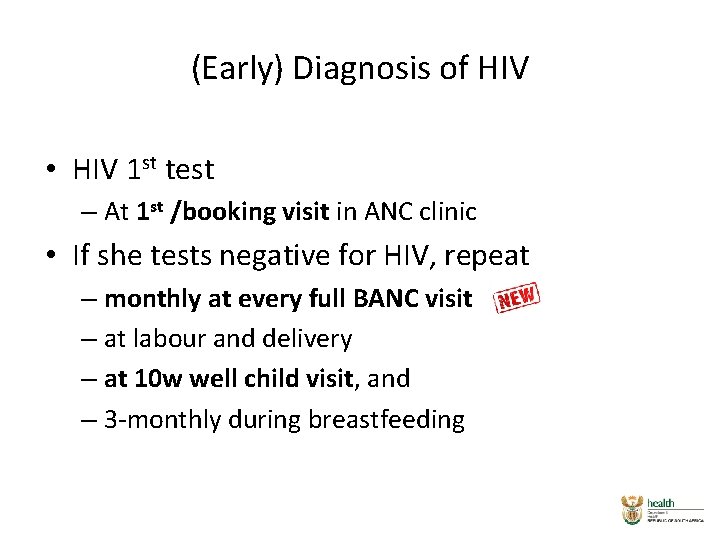
(Early) Diagnosis of HIV • HIV 1 st test – At 1 st /booking visit in ANC clinic • If she tests negative for HIV, repeat – monthly at every full BANC visit – at labour and delivery – at 10 w well child visit, and – 3 -monthly during breastfeeding
Same day ART Initiation Three factors related to ART initiation are of critical importance in pregnant / lactating mothers 1. Timing of ART initiation 2. Potency of the regimen 3. The safety of the regimen Enter… The new kid on the block….
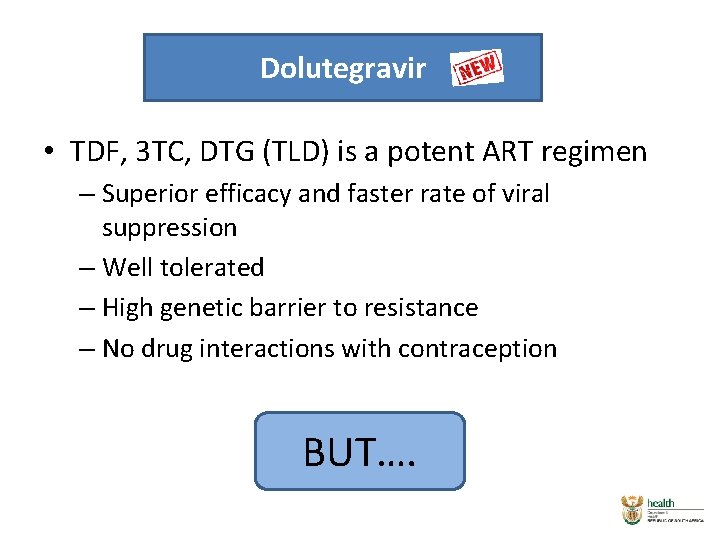
Dolutegravir • TDF, 3 TC, DTG (TLD) is a potent ART regimen – Superior efficacy and faster rate of viral suppression – Well tolerated – High genetic barrier to resistance – No drug interactions with contraception BUT….
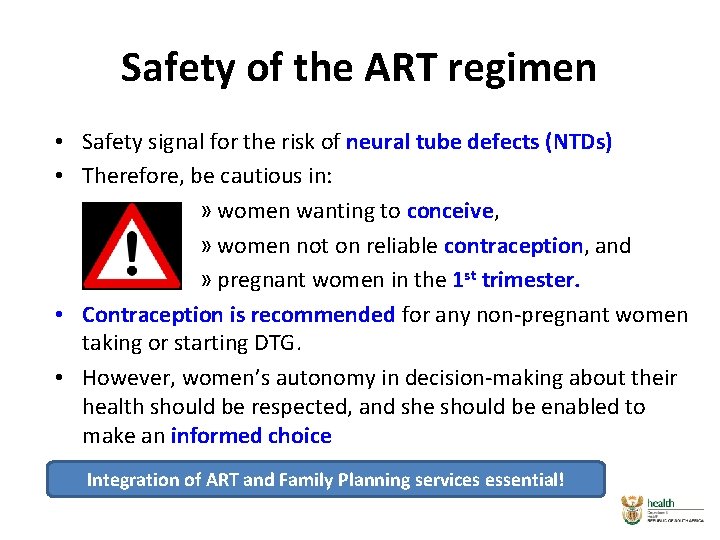
Safety of the ART regimen • Safety signal for the risk of neural tube defects (NTDs) • Therefore, be cautious in: » women wanting to conceive, » women not on reliable contraception, and » pregnant women in the 1 st trimester. • Contraception is recommended for any non-pregnant women taking or starting DTG. • However, women’s autonomy in decision-making about their health should be respected, and she should be enabled to make an informed choice Integration of ART and Family Planning services essential!
Enabling a Client to Make an Informed Choice • The clinician should enable a client to make an informed choice by doing the following: 1 2 Understand her current pregnancy status and fertility intentions: Is she pregnant? Does she desire a pregnancy: now? or in the future? or not at all? Explain the risks and benefits of DTG vs EFV (see next slide) Remember that EFV remains a safe and effective alternative 3 Discuss and provide a choice of contraceptive options as desired Remember that dual methods are recommended
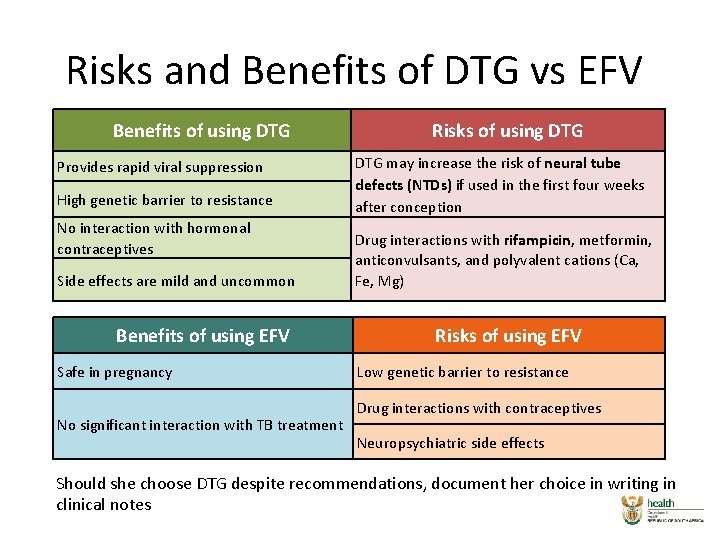
Risks and Benefits of DTG vs EFV Benefits of using DTG Provides rapid viral suppression High genetic barrier to resistance No interaction with hormonal contraceptives Side effects are mild and uncommon Benefits of using EFV Safe in pregnancy No significant interaction with TB treatment Risks of using DTG may increase the risk of neural tube defects (NTDs) if used in the first four weeks after conception Drug interactions with rifampicin, metformin, anticonvulsants, and polyvalent cations (Ca, Fe, Mg) Risks of using EFV Low genetic barrier to resistance Drug interactions with contraceptives Neuropsychiatric side effects Should she choose DTG despite recommendations, document her choice in writing in clinical notes
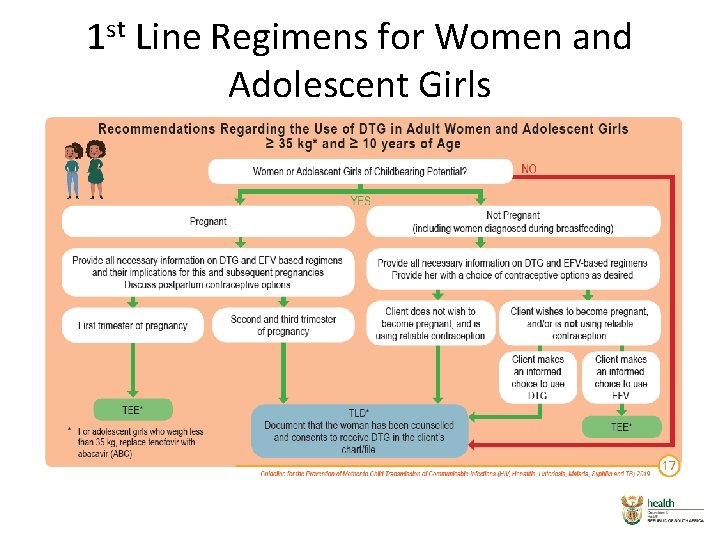
1 st Line Regimens for Women and Adolescent Girls
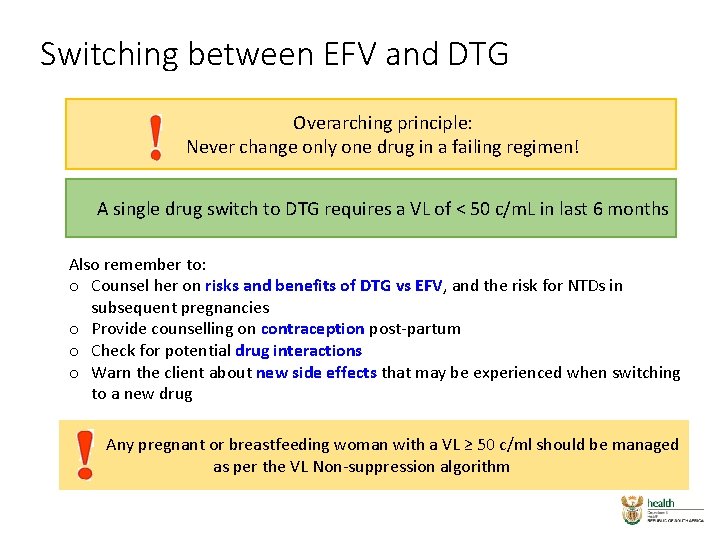
Switching between EFV and DTG Overarching principle: Never change only one drug in a failing regimen! A single drug switch to DTG requires a VL of < 50 c/m. L in last 6 months Also remember to: o Counsel her on risks and benefits of DTG vs EFV, and the risk for NTDs in subsequent pregnancies o Provide counselling on contraception post-partum o Check for potential drug interactions o Warn the client about new side effects that may be experienced when switching to a new drug Any pregnant or breastfeeding woman with a VL ≥ 50 c/ml should be managed as per the VL Non-suppression algorithm
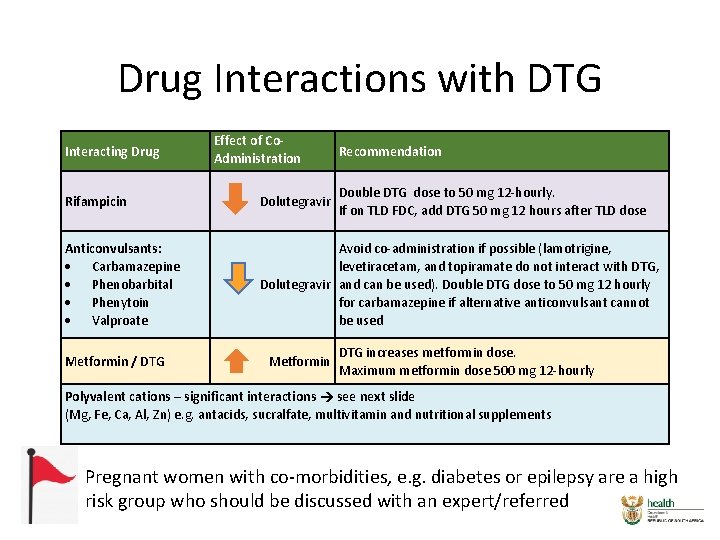
Drug Interactions with DTG Interacting Drug Effect of Co. Administration Recommendation Double DTG dose to 50 mg 12 -hourly. If on TLD FDC, add DTG 50 mg 12 hours after TLD dose Rifampicin Dolutegravir Anticonvulsants: Carbamazepine Phenobarbital Phenytoin Valproate Avoid co-administration if possible (lamotrigine, levetiracetam, and topiramate do not interact with DTG, Dolutegravir and can be used). Double DTG dose to 50 mg 12 hourly for carbamazepine if alternative anticonvulsant cannot be used Metformin / DTG Metformin DTG increases metformin dose. Maximum metformin dose 500 mg 12 -hourly Polyvalent cations – significant interactions see next slide (Mg, Fe, Ca, Al, Zn) e. g. antacids, sucralfate, multivitamin and nutritional supplements Pregnant women with co-morbidities, e. g. diabetes or epilepsy are a high risk group who should be discussed with an expert/referred
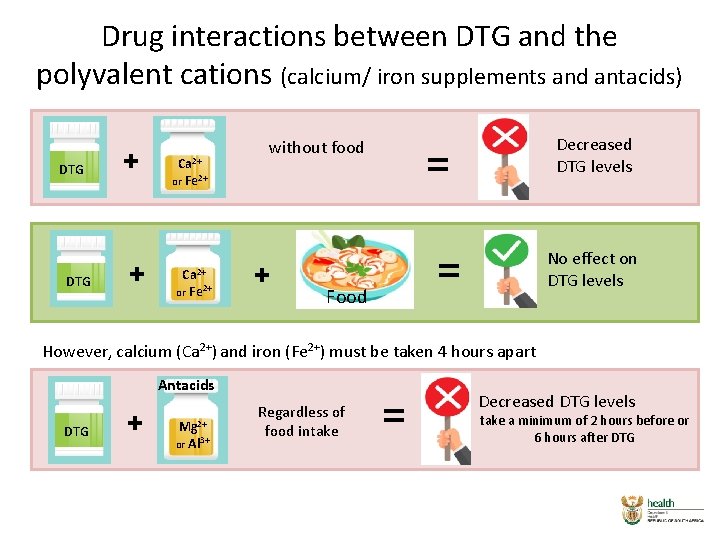
Drug interactions between DTG and the polyvalent cations (calcium/ iron supplements and antacids) DTG + + Ca 2+ or Fe 2+ = without food + Decreased DTG levels = Food No effect on DTG levels However, calcium (Ca 2+) and iron (Fe 2+) must be taken 4 hours apart Antacids DTG + Mg 2+ or Al 3+ Regardless of food intake = Decreased DTG levels take a minimum of 2 hours before or 6 hours after DTG
Suggested Dosing Schedule DTG (TLD) can be taken in the morning or evening with calcium and with food If insomnia is experienced, dose in the morning Option 1 • DTG + Calcium 500 mg + food in the morning • Ferrous sulphate 200 mg at lunch with food (better tolerated) • Calcium 500 mg in the evening Option 2 • Calcium 500 mg + food in the morning • Ferrous sulphate 200 mg at lunch with food (better tolerated) • DTG + Calcium 500 mg with food in the evening
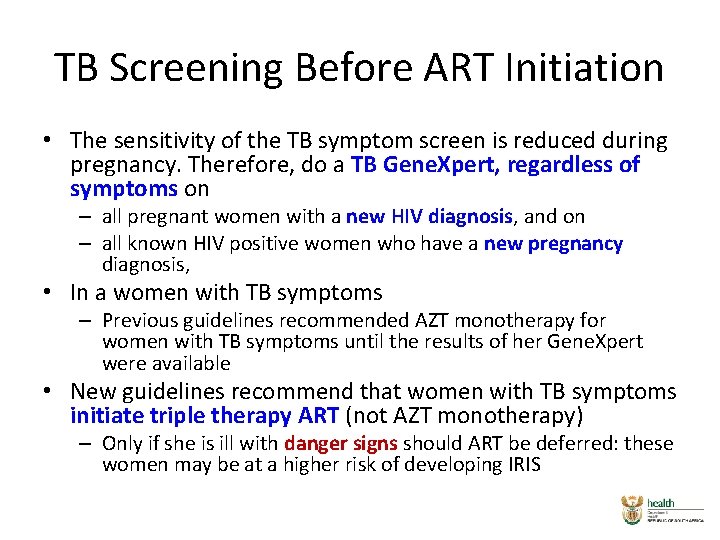
TB Screening Before ART Initiation • The sensitivity of the TB symptom screen is reduced during pregnancy. Therefore, do a TB Gene. Xpert, regardless of symptoms on – all pregnant women with a new HIV diagnosis, and on – all known HIV positive women who have a new pregnancy diagnosis, • In a women with TB symptoms – Previous guidelines recommended AZT monotherapy for women with TB symptoms until the results of her Gene. Xpert were available • New guidelines recommend that women with TB symptoms initiate triple therapy ART (not AZT monotherapy) – Only if she is ill with danger signs should ART be deferred: these women may be at a higher risk of developing IRIS
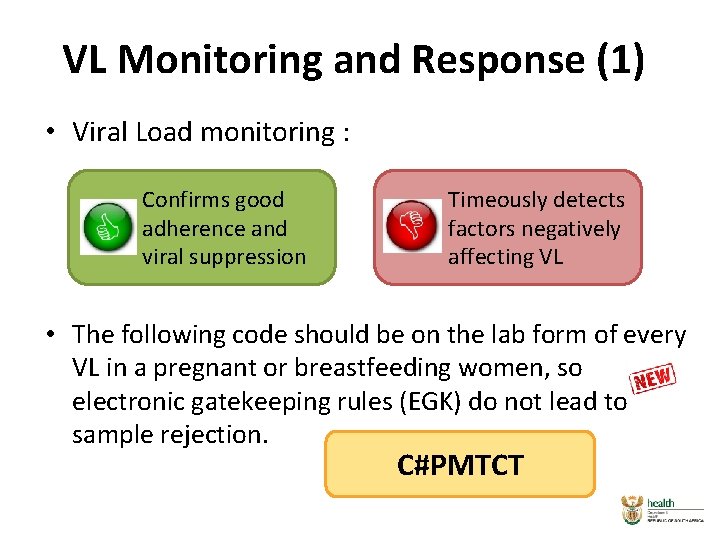
VL Monitoring and Response (1) • Viral Load monitoring : Confirms good adherence and viral suppression Timeously detects factors negatively affecting VL • The following code should be on the lab form of every VL in a pregnant or breastfeeding women, so electronic gatekeeping rules (EGK) do not lead to sample rejection. C#PMTCT
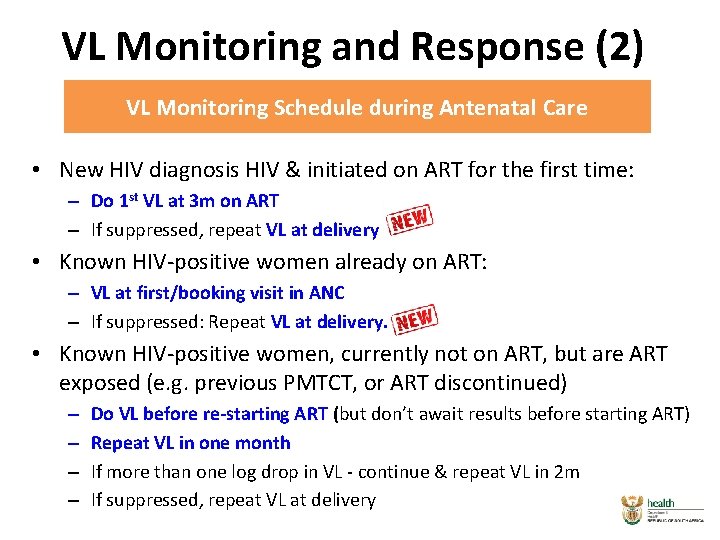
VL Monitoring and Response (2) VL Monitoring Schedule during Antenatal Care • New HIV diagnosis HIV & initiated on ART for the first time: – Do 1 st VL at 3 m on ART – If suppressed, repeat VL at delivery • Known HIV-positive women already on ART: – VL at first/booking visit in ANC – If suppressed: Repeat VL at delivery. • Known HIV-positive women, currently not on ART, but are ART exposed (e. g. previous PMTCT, or ART discontinued) – – Do VL before re-starting ART (but don’t await results before starting ART) Repeat VL in one month If more than one log drop in VL - continue & repeat VL in 2 m If suppressed, repeat VL at delivery
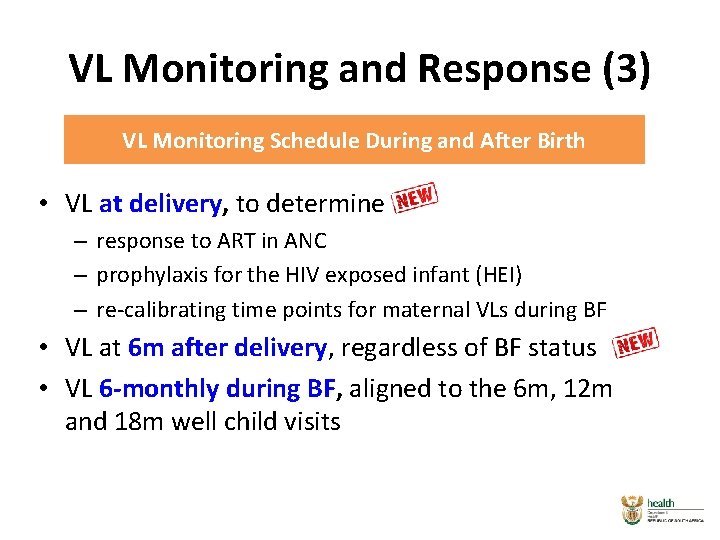
VL Monitoring and Response (3) VL Monitoring Schedule During and After Birth • VL at delivery, to determine – response to ART in ANC – prophylaxis for the HIV exposed infant (HEI) – re-calibrating time points for maternal VLs during BF • VL at 6 m after delivery, regardless of BF status • VL 6 -monthly during BF, aligned to the 6 m, 12 m and 18 m well child visits
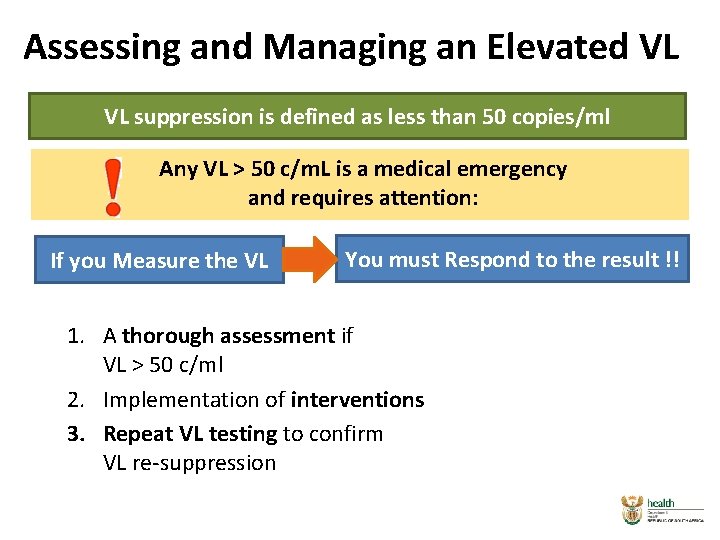
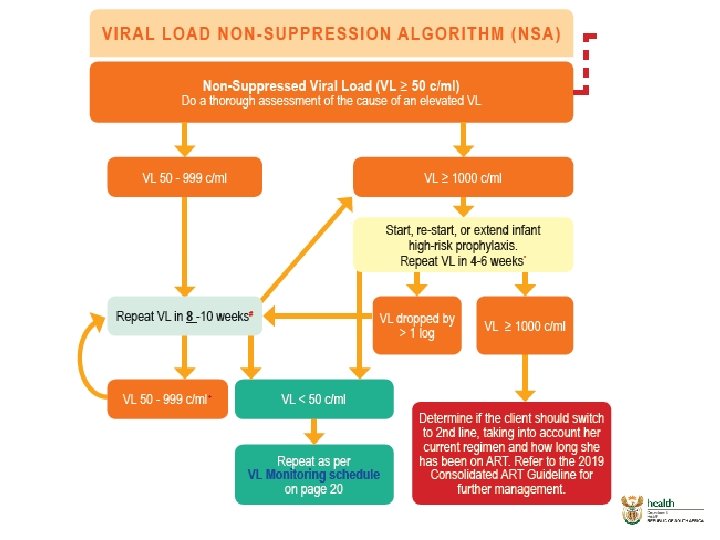
Assessing and Managing an Elevated VL VL suppression is defined as less than 50 copies/ml Any VL > 50 c/m. L is a medical emergency and requires attention: If you Measure the VL You must Respond to the result !! 1. A thorough assessment if VL > 50 c/ml 2. Implementation of interventions 3. Repeat VL testing to confirm VL re-suppression
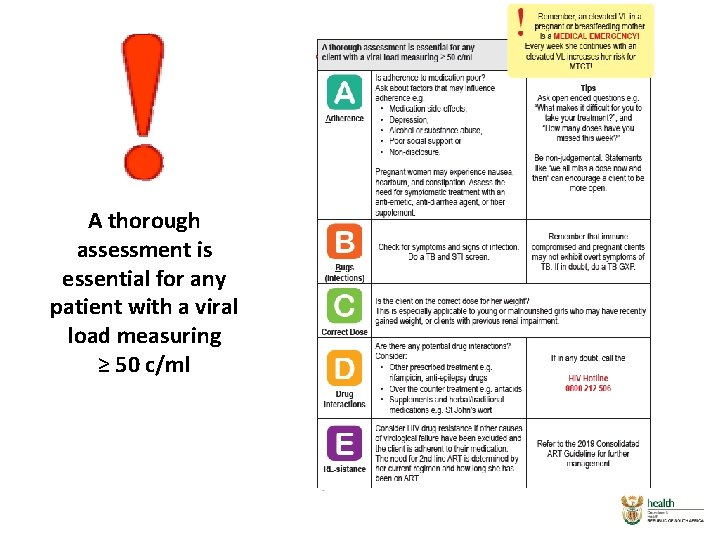
A thorough assessment is essential for any patient with a viral load measuring ≥ 50 c/ml
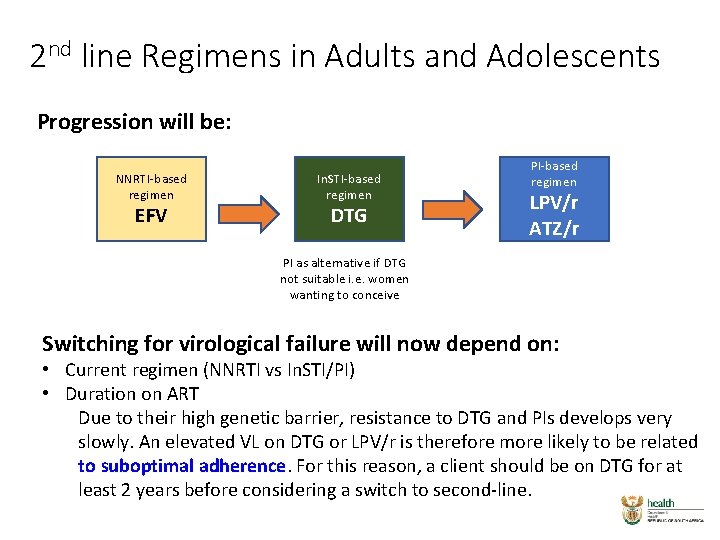
2 nd line Regimens in Adults and Adolescents Progression will be: NNRTI-based regimen EFV In. STI-based regimen DTG PI-based regimen LPV/r ATZ/r PI as alternative if DTG not suitable i. e. women wanting to conceive Switching for virological failure will now depend on: • Current regimen (NNRTI vs In. STI/PI) • Duration on ART Due to their high genetic barrier, resistance to DTG and PIs develops very slowly. An elevated VL on DTG or LPV/r is therefore more likely to be related to suboptimal adherence. For this reason, a client should be on DTG for at least 2 years before considering a switch to second-line.
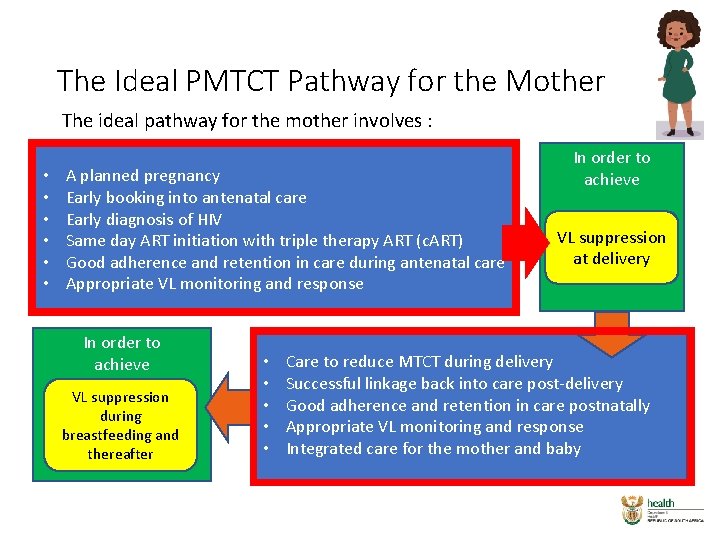
The Ideal PMTCT Pathway for the Mother The ideal pathway for the mother involves : • • • A planned pregnancy Early booking into antenatal care Early diagnosis of HIV Same day ART initiation with triple therapy ART (c. ART) Good adherence and retention in care during antenatal care Appropriate VL monitoring and response In order to achieve VL suppression during breastfeeding and thereafter • • • In order to achieve VL suppression at delivery Care to reduce MTCT during delivery Successful linkage back into care post-delivery Good adherence and retention in care postnatally Appropriate VL monitoring and response Integrated care for the mother and baby
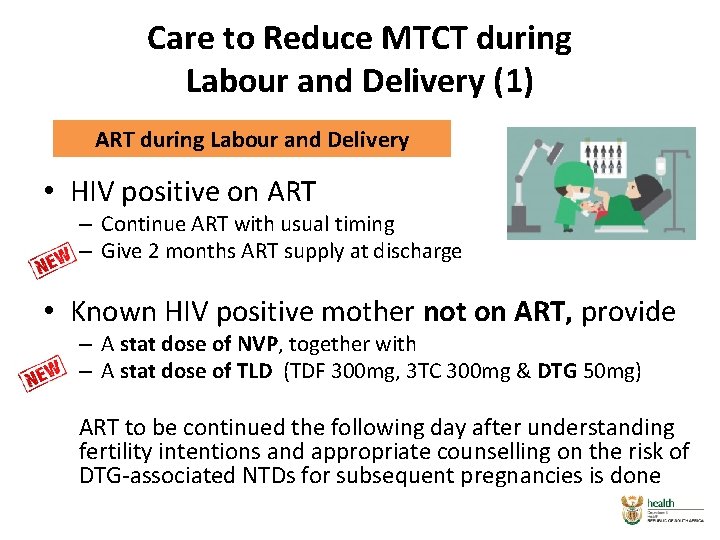
Care to Reduce MTCT during Labour and Delivery (1) ART during Labour and Delivery • HIV positive on ART – Continue ART with usual timing – Give 2 months ART supply at discharge • Known HIV positive mother not on ART, provide – A stat dose of NVP, together with – A stat dose of TLD (TDF 300 mg, 3 TC 300 mg & DTG 50 mg) ART to be continued the following day after understanding fertility intentions and appropriate counselling on the risk of DTG-associated NTDs for subsequent pregnancies is done
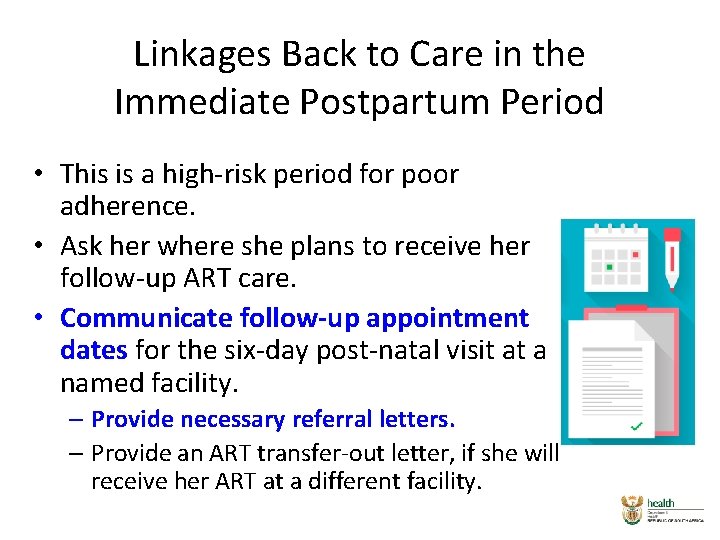
Linkages Back to Care in the Immediate Postpartum Period • This is a high-risk period for poor adherence. • Ask her where she plans to receive her follow-up ART care. • Communicate follow-up appointment dates for the six-day post-natal visit at a named facility. – Provide necessary referral letters. – Provide an ART transfer-out letter, if she will receive her ART at a different facility.
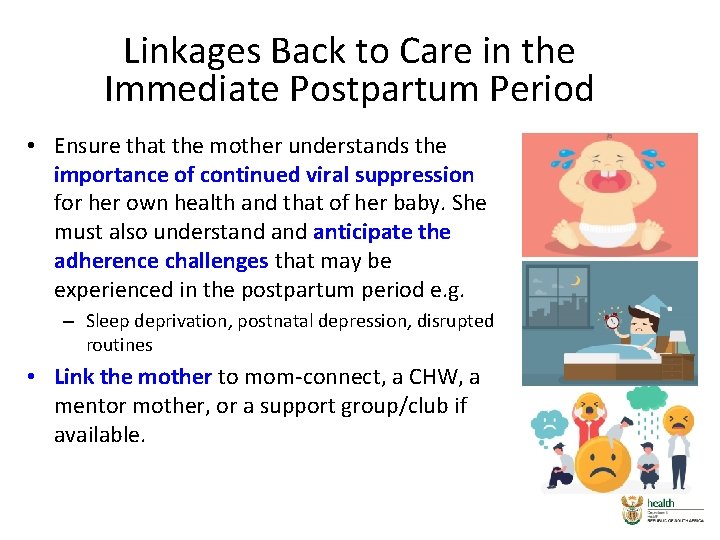
Linkages Back to Care in the Immediate Postpartum Period • Ensure that the mother understands the importance of continued viral suppression for her own health and that of her baby. She must also understand anticipate the adherence challenges that may be experienced in the postpartum period e. g. – Sleep deprivation, postnatal depression, disrupted routines • Link the mother to mom-connect, a CHW, a mentor mother, or a support group/club if available.
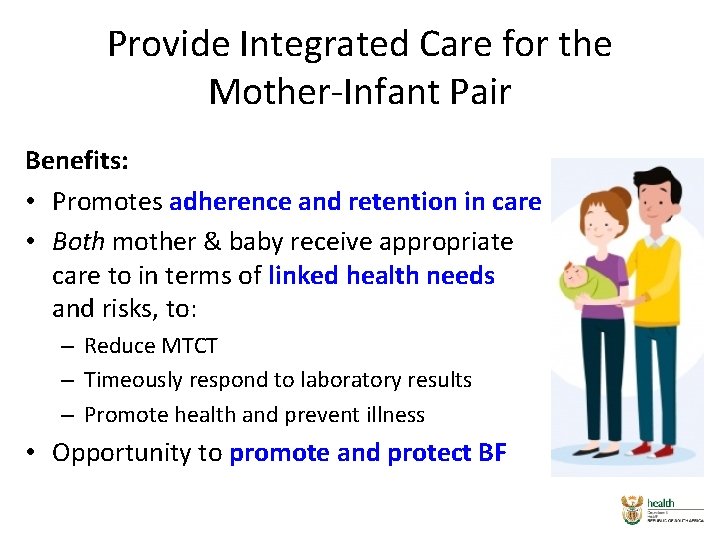
Provide Integrated Care for the Mother-Infant Pair Benefits: • Promotes adherence and retention in care • Both mother & baby receive appropriate care to in terms of linked health needs and risks, to: – Reduce MTCT – Timeously respond to laboratory results – Promote health and prevent illness • Opportunity to promote and protect BF
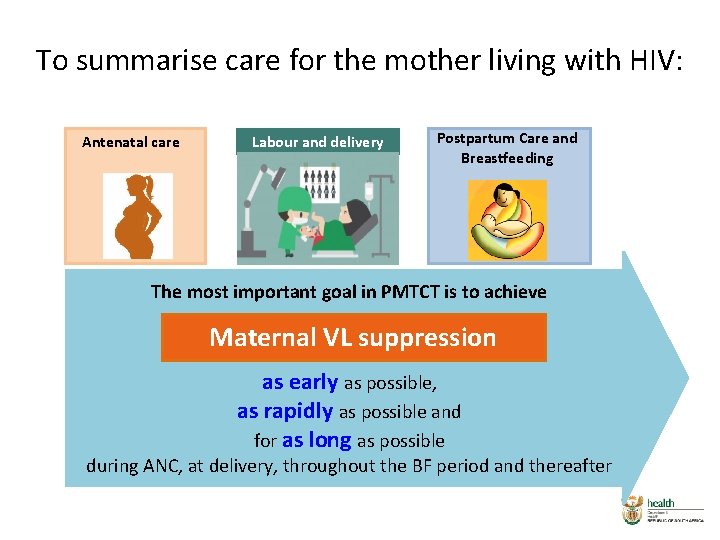
To summarise care for the mother living with HIV: Antenatal care Labour and delivery Postpartum Care and Breastfeeding The most important goal in PMTCT is to achieve Maternal VL suppression as early as possible, as rapidly as possible and for as long as possible during ANC, at delivery, throughout the BF period and thereafter
New South African National PMTCT Guideline (2019) We will now move along each step of the ideal PMTCT pathway and describe the recommended interventions for the HIV-exposed infant
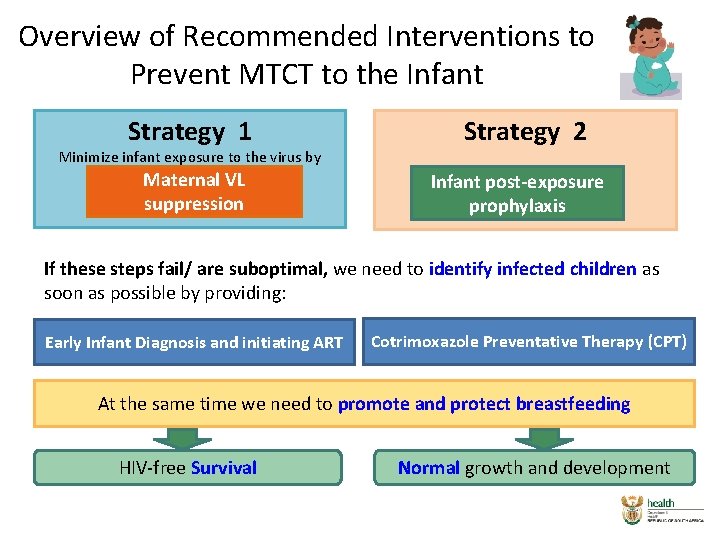
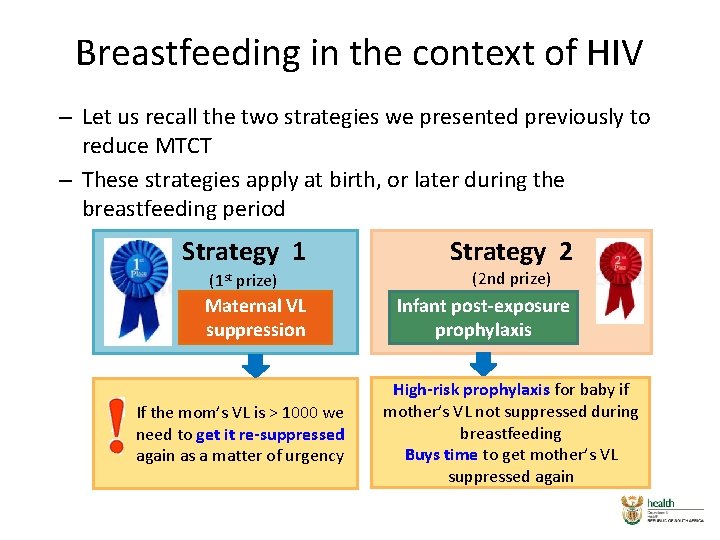
Overview of Recommended Interventions to Prevent MTCT to the Infant Strategy 1 Minimize infant exposure to the virus by Maternal VL suppression Strategy 2 Infant post-exposure prophylaxis If these steps fail/ are suboptimal, we need to identify infected children as soon as possible by providing: Early Infant Diagnosis and initiating ART Cotrimoxazole Preventative Therapy (CPT) At the same time we need to promote and protect breastfeeding HIV-free Survival Normal growth and development
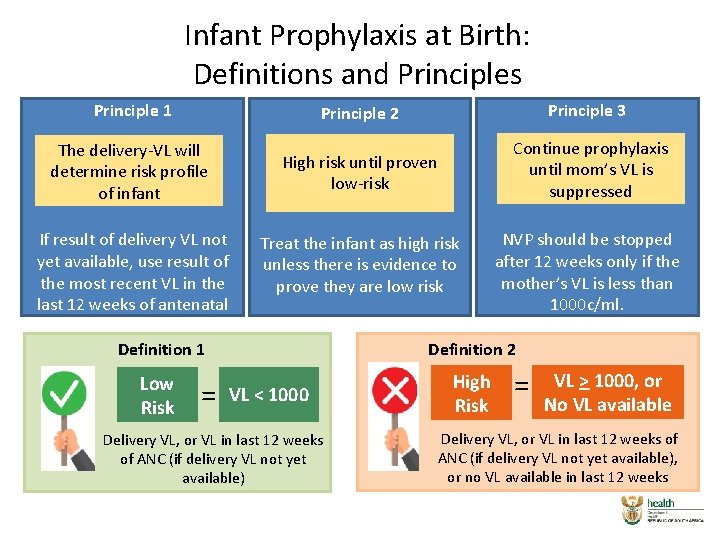
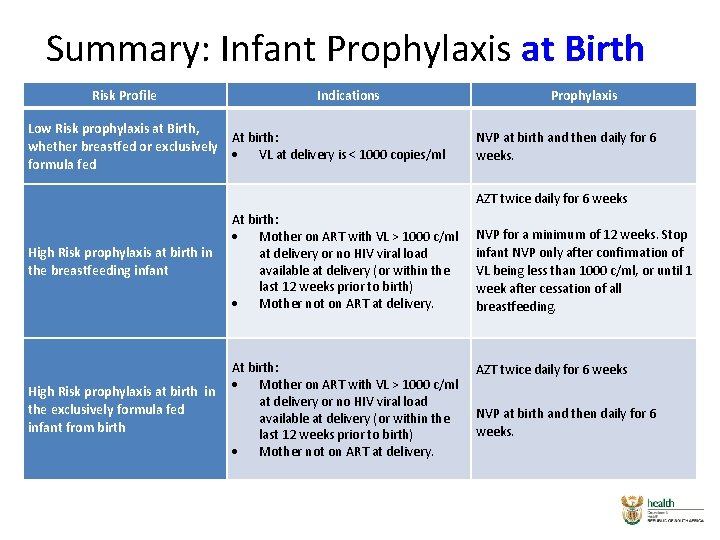
Infant Prophylaxis at Birth: Definitions and Principles Principle 3 Principle 1 Principle 2 The delivery-VL will determine risk profile of infant High risk until proven low-risk Continue prophylaxis until mom’s VL is suppressed Treat the infant as high risk unless there is evidence to prove they are low risk NVP should be stopped after 12 weeks only if the mother’s VL is less than 1000 c/ml. If result of delivery VL not yet available, use result of the most recent VL in the last 12 weeks of antenatal care Definition 1 Low Risk = VL < 1000 Delivery VL, or VL in last 12 weeks of ANC (if delivery VL not yet available) Definition 2 High Risk = VL > 1000, or No VL available Delivery VL, or VL in last 12 weeks of ANC (if delivery VL not yet available), or no VL available in last 12 weeks
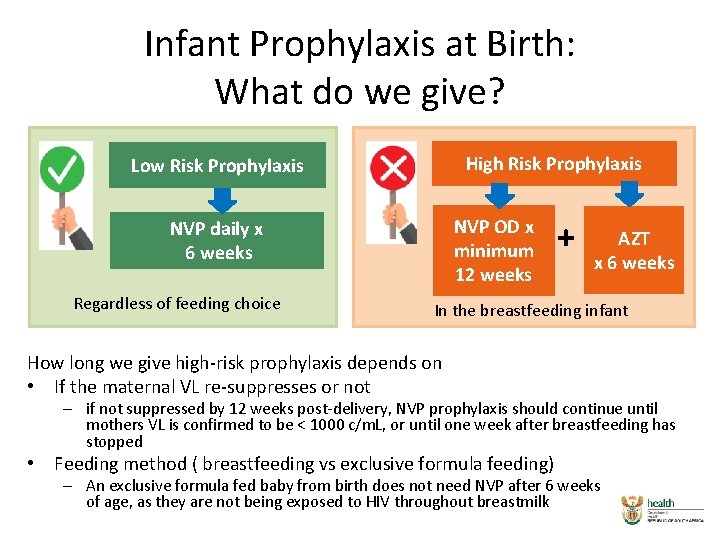
Infant Prophylaxis at Birth: What do we give? High Risk Prophylaxis Low Risk Prophylaxis NVP OD x minimum 12 weeks NVP daily x 6 weeks Regardless of feeding choice + AZT x 6 weeks In the breastfeeding infant How long we give high-risk prophylaxis depends on • If the maternal VL re-suppresses or not – if not suppressed by 12 weeks post-delivery, NVP prophylaxis should continue until mothers VL is confirmed to be < 1000 c/m. L, or until one week after breastfeeding has stopped • Feeding method ( breastfeeding vs exclusive formula feeding) – An exclusive formula fed baby from birth does not need NVP after 6 weeks of age, as they are not being exposed to HIV throughout breastmilk
Summary: Infant Prophylaxis at Birth Risk Profile Indications Low Risk prophylaxis at Birth, At birth: whether breastfed or exclusively VL at delivery is < 1000 copies/ml formula fed Prophylaxis NVP at birth and then daily for 6 weeks. AZT twice daily for 6 weeks High Risk prophylaxis at birth in the breastfeeding infant At birth: Mother on ART with VL > 1000 c/ml at delivery or no HIV viral load available at delivery (or within the last 12 weeks prior to birth) Mother not on ART at delivery. At birth: High Risk prophylaxis at birth in Mother on ART with VL > 1000 c/ml at delivery or no HIV viral load the exclusively formula fed available at delivery (or within the infant from birth last 12 weeks prior to birth) Mother not on ART at delivery. NVP for a minimum of 12 weeks. Stop infant NVP only after confirmation of VL being less than 1000 c/ml, or until 1 week after cessation of all breastfeeding. AZT twice daily for 6 weeks NVP at birth and then daily for 6 weeks.
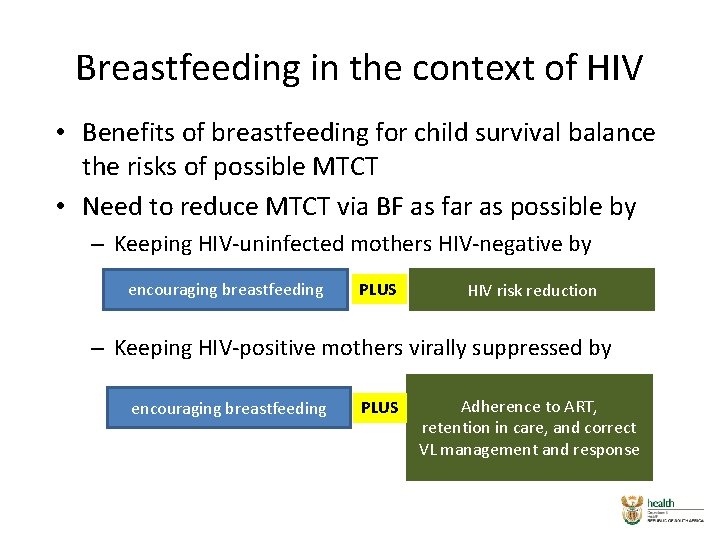
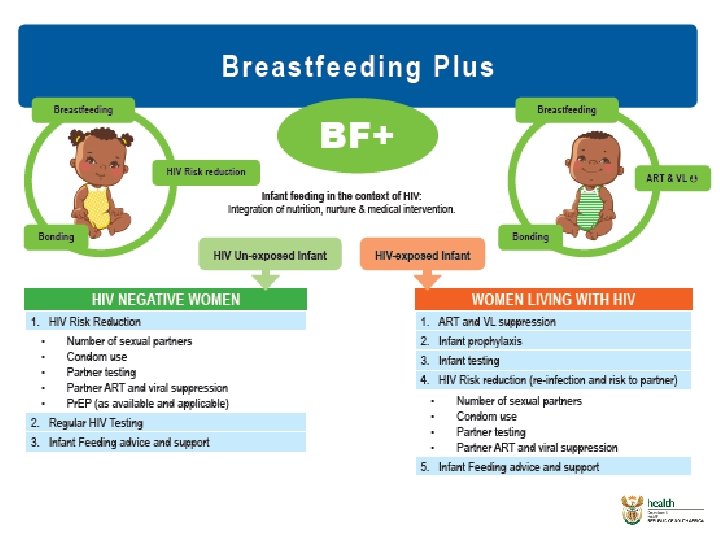
Breastfeeding in the context of HIV • Benefits of breastfeeding for child survival balance the risks of possible MTCT • Need to reduce MTCT via BF as far as possible by – Keeping HIV-uninfected mothers HIV-negative by encouraging breastfeeding PLUS HIV risk reduction – Keeping HIV-positive mothers virally suppressed by encouraging breastfeeding PLUS Adherence to ART, retention in care, and correct VL management and response
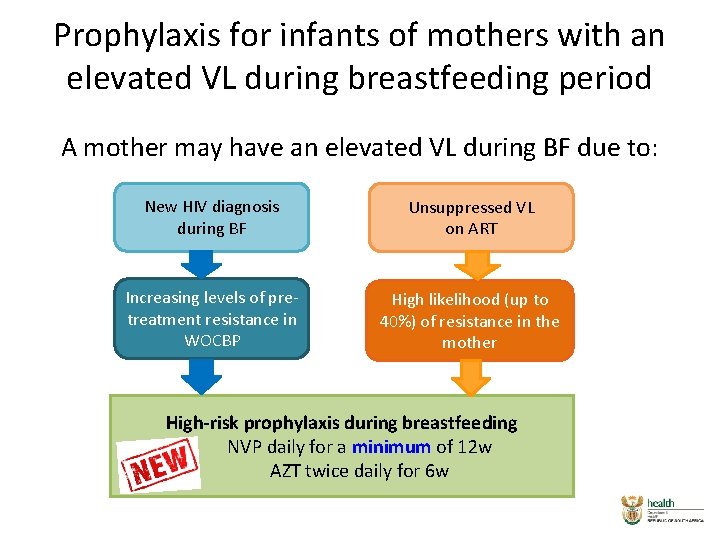
Breastfeeding in the context of HIV – Let us recall the two strategies we presented previously to reduce MTCT – These strategies apply at birth, or later during the breastfeeding period Strategy 1 (1 st prize) Maternal VL suppression If the mom’s VL is > 1000 we need to get it re-suppressed again as a matter of urgency Strategy 2 (2 nd prize) Infant post-exposure prophylaxis High-risk prophylaxis for baby if mother’s VL not suppressed during breastfeeding Buys time to get mother’s VL suppressed again
Prophylaxis for infants of mothers with an elevated VL during breastfeeding period A mother may have an elevated VL during BF due to: New HIV diagnosis during BF Unsuppressed VL on ART Increasing levels of pretreatment resistance in WOCBP High likelihood (up to 40%) of resistance in the mother High-risk prophylaxis during breastfeeding NVP daily for a minimum of 12 w AZT twice daily for 6 w
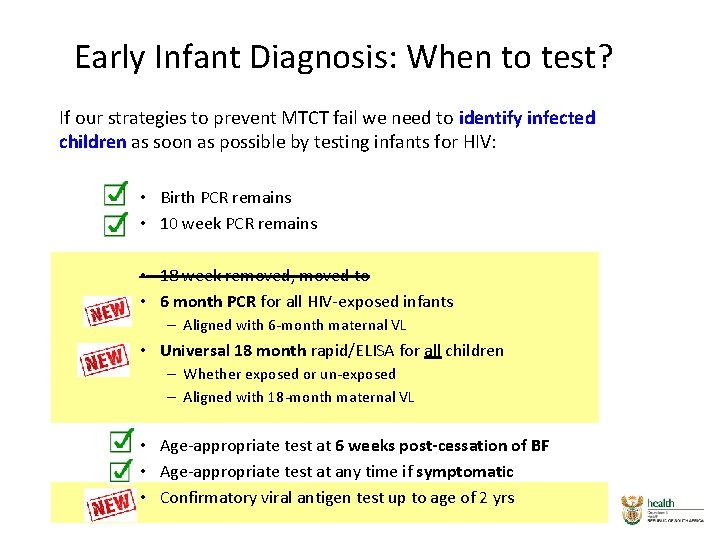
Early Infant Diagnosis: When to test? If our strategies to prevent MTCT fail we need to identify infected children as soon as possible by testing infants for HIV: • Birth PCR remains • 10 week PCR remains • 18 week removed, moved to • 6 month PCR for all HIV-exposed infants – Aligned with 6 -month maternal VL • Universal 18 month rapid/ELISA for all children – Whether exposed or un-exposed – Aligned with 18 -month maternal VL • Age-appropriate test at 6 weeks post-cessation of BF • Age-appropriate test at any time if symptomatic • Confirmatory viral antigen test up to age of 2 yrs
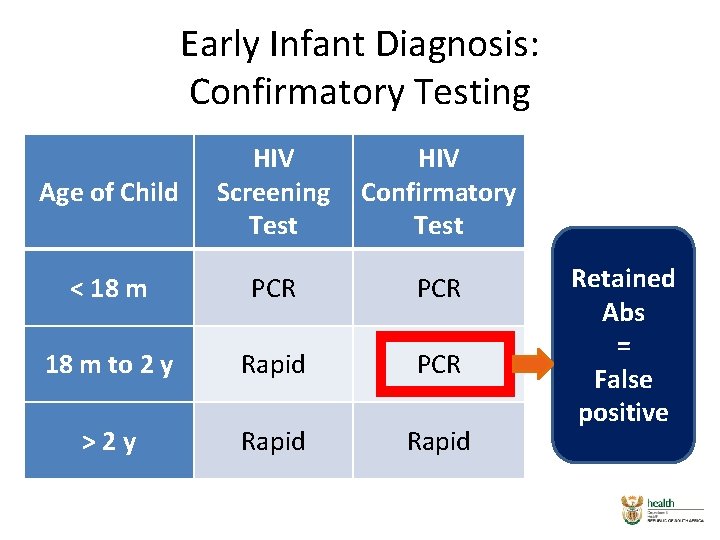
Early Infant Diagnosis: Confirmatory Testing Age of Child HIV Screening Confirmatory Test < 18 m PCR 18 m to 2 y Rapid PCR > 2 y Rapid Retained Abs = False positive
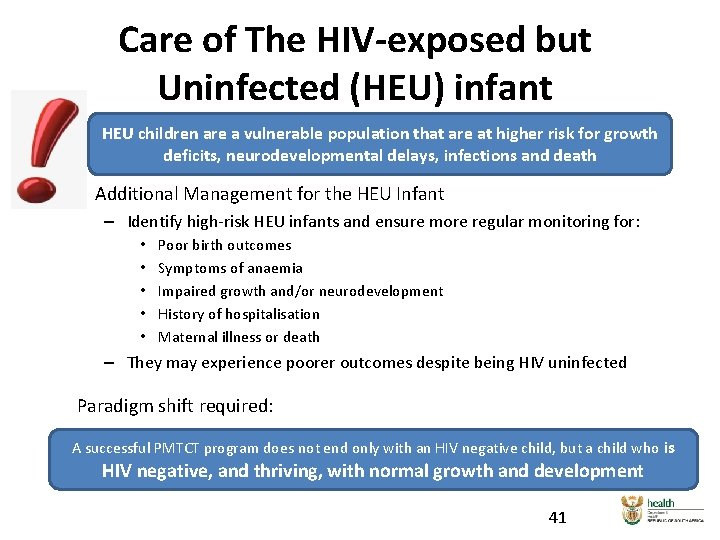
Care of The HIV-exposed but Uninfected (HEU) infant HEU children are a vulnerable population that are at higher risk for growth deficits, neurodevelopmental delays, infections and death • Additional Management for the HEU Infant – Identify high-risk HEU infants and ensure more regular monitoring for: • • • Poor birth outcomes Symptoms of anaemia Impaired growth and/or neurodevelopment History of hospitalisation Maternal illness or death – They may experience poorer outcomes despite being HIV uninfected Paradigm shift required: A successful PMTCT program does not end only with an HIV negative child, but a child who is HIV negative, and thriving, with normal growth and development 41
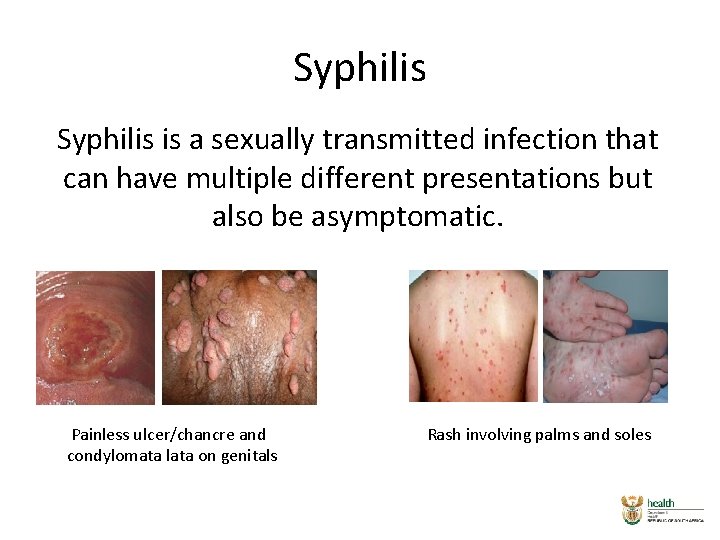
Syphilis is a sexually transmitted infection that can have multiple different presentations but also be asymptomatic. Painless ulcer/chancre and condylomata lata on genitals Rash involving palms and soles
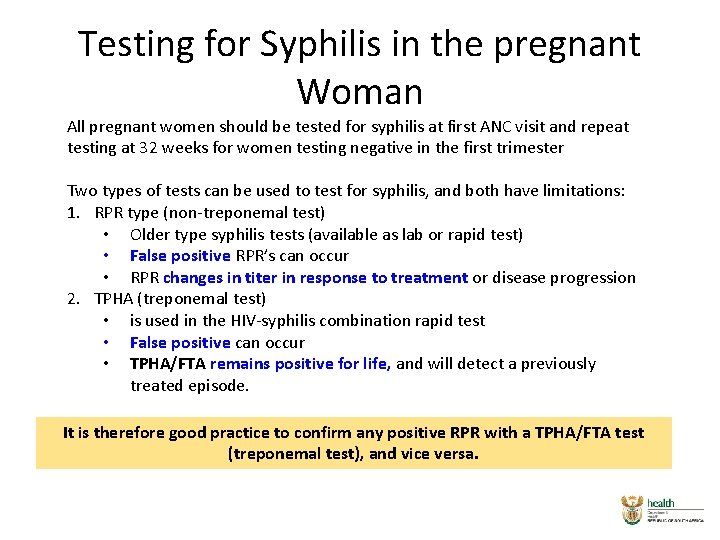
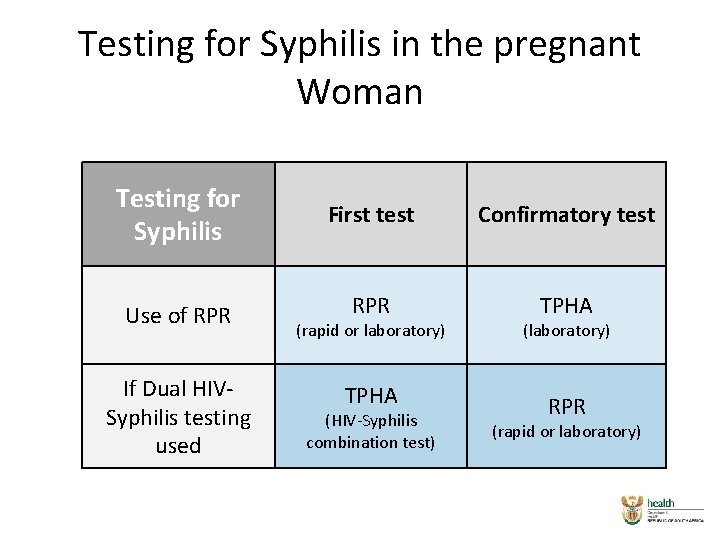
Testing for Syphilis in the pregnant Woman All pregnant women should be tested for syphilis at first ANC visit and repeat testing at 32 weeks for women testing negative in the first trimester Two types of tests can be used to test for syphilis, and both have limitations: 1. RPR type (non-treponemal test) • Older type syphilis tests (available as lab or rapid test) • False positive RPR’s can occur • RPR changes in titer in response to treatment or disease progression 2. TPHA (treponemal test) • is used in the HIV-syphilis combination rapid test • False positive can occur • TPHA/FTA remains positive for life, and will detect a previously treated episode. It is therefore good practice to confirm any positive RPR with a TPHA/FTA test (treponemal test), and vice versa.
Testing for Syphilis in the pregnant Woman Testing for Syphilis First test Confirmatory test Use of RPR TPHA If Dual HIVSyphilis testing used (rapid or laboratory) TPHA (HIV-Syphilis combination test) (laboratory) RPR (rapid or laboratory)
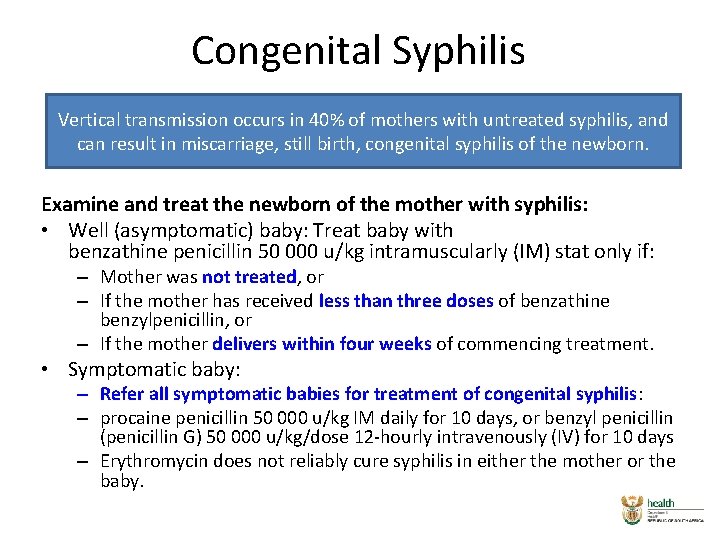
Congenital Syphilis Vertical transmission occurs in 40% of mothers with untreated syphilis, and can result in miscarriage, still birth, congenital syphilis of the newborn. Examine and treat the newborn of the mother with syphilis: • Well (asymptomatic) baby: Treat baby with benzathine penicillin 50 000 u/kg intramuscularly (IM) stat only if: – Mother was not treated, or – If the mother has received less than three doses of benzathine benzylpenicillin, or – If the mother delivers within four weeks of commencing treatment. • Symptomatic baby: – Refer all symptomatic babies for treatment of congenital syphilis: – procaine penicillin 50 000 u/kg IM daily for 10 days, or benzyl penicillin (penicillin G) 50 000 u/kg/dose 12 -hourly intravenously (IV) for 10 days – Erythromycin does not reliably cure syphilis in either the mother or the baby.
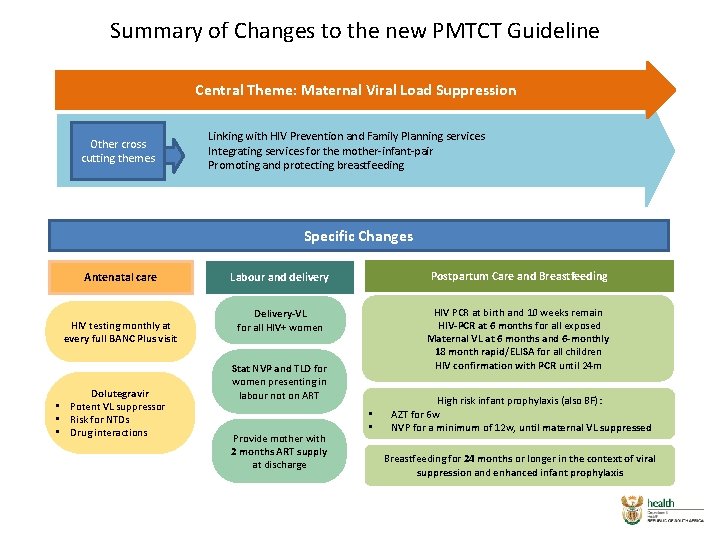
Summary of Changes to the new PMTCT Guideline Central Theme: Maternal Viral Load Suppression Other cross cutting themes Linking with HIV Prevention and Family Planning services Integrating services for the mother-infant-pair Promoting and protecting breastfeeding Specific Changes Antenatal care HIV testing monthly at every full BANC Plus visit Dolutegravir • Potent VL suppressor • Risk for NTDs • Drug interactions Labour and delivery Postpartum Care and Breastfeeding Delivery-VL for all HIV+ women HIV PCR at birth and 10 weeks remain HIV-PCR at 6 months for all exposed Maternal VL at 6 months and 6 -monthly 18 month rapid/ELISA for all children HIV confirmation with PCR until 24 m Stat NVP and TLD for women presenting in labour not on ART Provide mother with 2 months ART supply at discharge • • High risk infant prophylaxis (also BF): AZT for 6 w NVP for a minimum of 12 w, until maternal VL suppressed Breastfeeding for 24 months or longer in the context of viral suppression and enhanced infant prophylaxis
Questions?
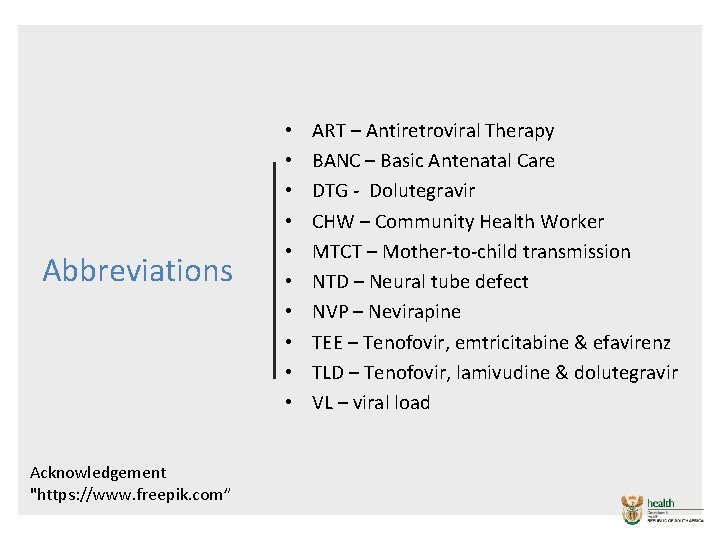
Abbreviations Acknowledgement "https: //www. freepik. com” • • • ART – Antiretroviral Therapy BANC – Basic Antenatal Care DTG - Dolutegravir CHW – Community Health Worker MTCT – Mother-to-child transmission NTD – Neural tube defect NVP – Nevirapine TEE – Tenofovir, emtricitabine & efavirenz TLD – Tenofovir, lamivudine & dolutegravir VL – viral load
The National Department of Health would like to thank the following partners for their valued assistance in developing Health Care Worker Training on the Introduction of DTG for the Treatment of HIV Infection: