
The s of Incoterms Finance Contract Administration Council



- Slides: 25
The ‘s of Incoterms Finance & Contract Administration Council Meeting May 17 -18, 2017 Chicago, Illinois
Founded in 1948 by Adrienne Coppersmith. Current leadership Jeff and Bud Coppersmith are third generation in the family business. Coppersmith Global Logistics is a licensed Customs Broker, International Freight Forwarder and NVOCC. Validated member of the C-TPAT program and a certified ACE participant. Coppersmith handles over 100, 000 shipments every year from large companies like Panasonic, Kia Motors , and Sunkist. No matter the volume you have the quality of our service will be consistent. Coppersmith Delivers a World of Confidence
Today’s Objectives To define the Incoterm options. To enhance your understanding of the forwarding process and the part that Incoterms play in smooth transactions. How Incoterms relate to contracts. To help you determine which Incoterm is best for your logistics circumstance.
What Does Incoterm Mean? INternational COmmercial TERMS What Are Incoterms? “INCOTERMS define the mutual obligations of seller and buyer arising from the movement of goods under an international contract from the standpoint of risks, costs and documents. ” -United Nations Conference on Trade and Development , 1990 Simply- A set of international rules for the interpretation of the most commonly used foreign trade terms.
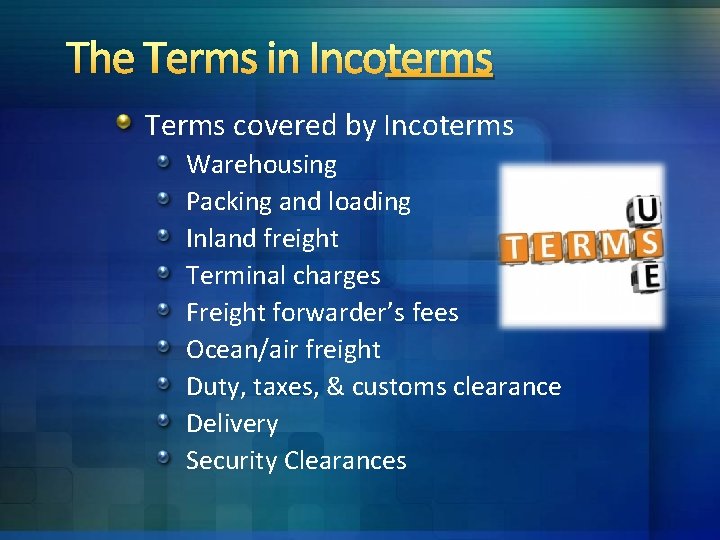
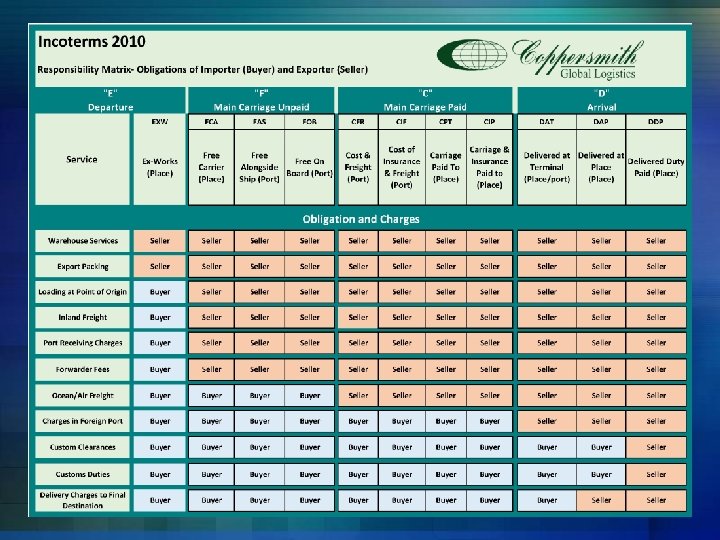
The Terms in Incoterms Terms covered by Incoterms Warehousing Packing and loading Inland freight Terminal charges Freight forwarder’s fees Ocean/air freight Duty, taxes, & customs clearance Delivery Security Clearances
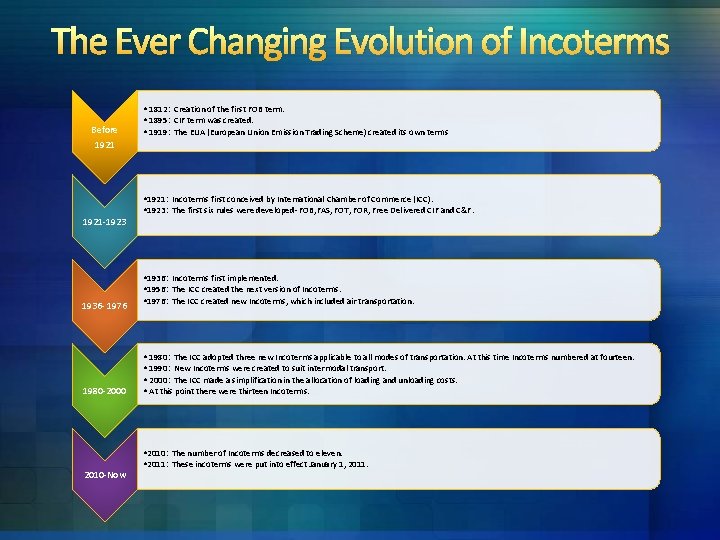
The Ever Changing Evolution of Incoterms Before • 1812: Creation of the first FOB term. • 1895: CIF term was created. • 1919: The EUA (European Union Emission Trading Scheme) created its own terms 1921 -1923 1936 - 1976 1980 -2000 2010 -Now • 1921: Incoterms first conceived by International Chamber of Commerce (ICC). • 1923: The first six rules were developed- FOB, FAS, FOT, FOR, Free Delivered CIF and C&F. • 1936: Incoterms first implemented. • 1956: The ICC created the next version of Incoterms. • 1976: The ICC created new Incoterms, which included air transportation. • 1980: The ICC adopted three new Incoterms applicable to all modes of transportation. At this time Incoterms numbered at fourteen. • 1990: New Incoterms were created to suit intermodal transport. • 2000: The ICC made a simplification in the allocation of loading and unloading costs. • At this point there were thirteen Incoterms. • 2010: The number of Incoterms decreased to eleven. • 2011: These incoterms were put into effect January 1, 2011.
The Importance of Incoterms Because they- Set international rules for commonly used terms in foreign trade. Define obligations of both parties involved in the transaction. Determine the distribution and transfer of risks regarding goods delivered from seller to buyer. State the clear sharing of expenses between the parties during transport. The Necessity of Updates The rapid expansion of world trade and new trends in global transportation means that the same rules cannot be applied effectively in any circumstance without considering the new factors and influences.
Packing Loading Preliminary Transportation 3 2 1 Customs Clearance for Export 4 Global Logistics Forwarding Process Final Transportation 11 Unloading 10 Customs Clearance Duties 9 8 International Transportation 5 Handling Outbound 6 Insurance 7 Handling Inbound
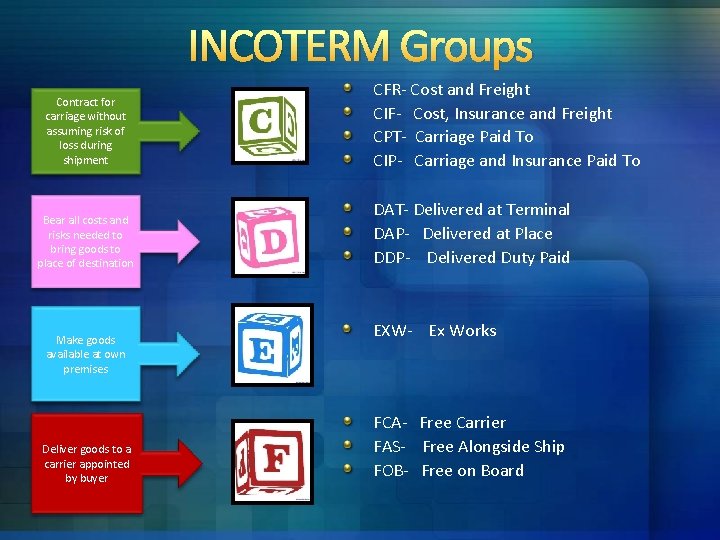
INCOTERM Groups Contract for carriage without assuming risk of loss during shipment Bear all costs and risks needed to bring goods to place of destination Make goods available at own premises Deliver goods to a carrier appointed by buyer CFR- Cost and Freight CIF- Cost, Insurance and Freight CPT- Carriage Paid To CIP- Carriage and Insurance Paid To DAT- Delivered at Terminal DAP- Delivered at Place DDP- Delivered Duty Paid EXW- Ex Works FCA- Free Carrier FAS- Free Alongside Ship FOB- Free on Board
Incoterm Categories Acronym reflect the mode and where lines are drawn. Service • EXW- Ex Works (…Named Place of Delivery) • FCA- Free Carrier (…Named Place of Delivery) Any Mode of transport including Multimodal • CPT- Carriage Paid To (…Named Place of Destination) • CIP- Carriage & Insurance Paid To (…Named Place of Destination) • DAT- Delivered at Terminal (Named Place/Port of Delivery) • DAP- Delivered at Place (…Named Place of Destination) • DDP- Delivered Duty Paid (…Named Place of Destination) Ocean • FAS- Free Alongside Ship (…Named Port of Shipment) • FOB- Free On Board (…Named Port of Shipment) • CFR- Cost and Freight (…Named Port of Destination) • CIF- Cost, Insurance and Freight (…Named Port of Destination)
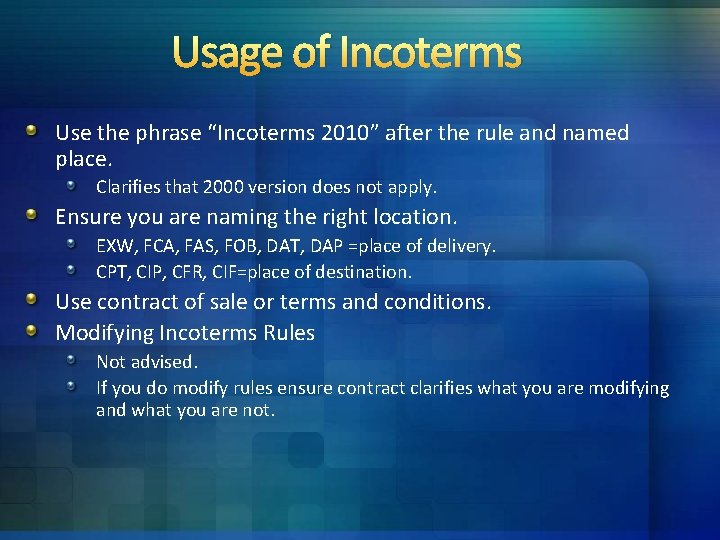
Usage of Incoterms Use the phrase “Incoterms 2010” after the rule and named place. Clarifies that 2000 version does not apply. Ensure you are naming the right location. EXW, FCA, FAS, FOB, DAT, DAP =place of delivery. CPT, CIP, CFR, CIF=place of destination. Use contract of sale or terms and conditions. Modifying Incoterms Rules Not advised. If you do modify rules ensure contract clarifies what you are modifying and what you are not.
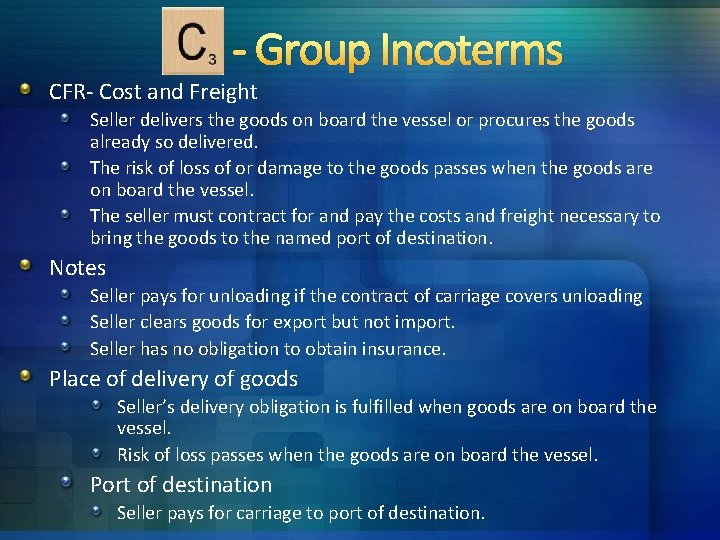
- Group Incoterms CFR- Cost and Freight Seller delivers the goods on board the vessel or procures the goods already so delivered. The risk of loss of or damage to the goods passes when the goods are on board the vessel. The seller must contract for and pay the costs and freight necessary to bring the goods to the named port of destination. Notes Seller pays for unloading if the contract of carriage covers unloading Seller clears goods for export but not import. Seller has no obligation to obtain insurance. Place of delivery of goods Seller’s delivery obligation is fulfilled when goods are on board the vessel. Risk of loss passes when the goods are on board the vessel. Port of destination Seller pays for carriage to port of destination.
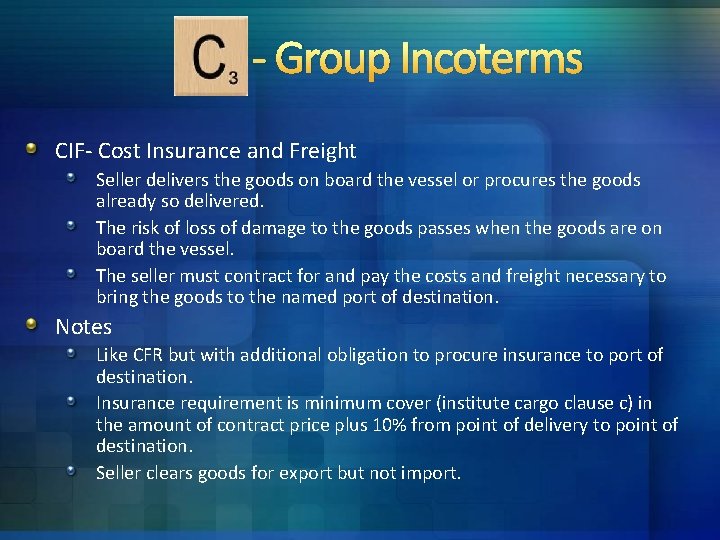
- Group Incoterms CIF- Cost Insurance and Freight Seller delivers the goods on board the vessel or procures the goods already so delivered. The risk of loss of damage to the goods passes when the goods are on board the vessel. The seller must contract for and pay the costs and freight necessary to bring the goods to the named port of destination. Notes Like CFR but with additional obligation to procure insurance to port of destination. Insurance requirement is minimum cover (institute cargo clause c) in the amount of contract price plus 10% from point of delivery to point of destination. Seller clears goods for export but not import.
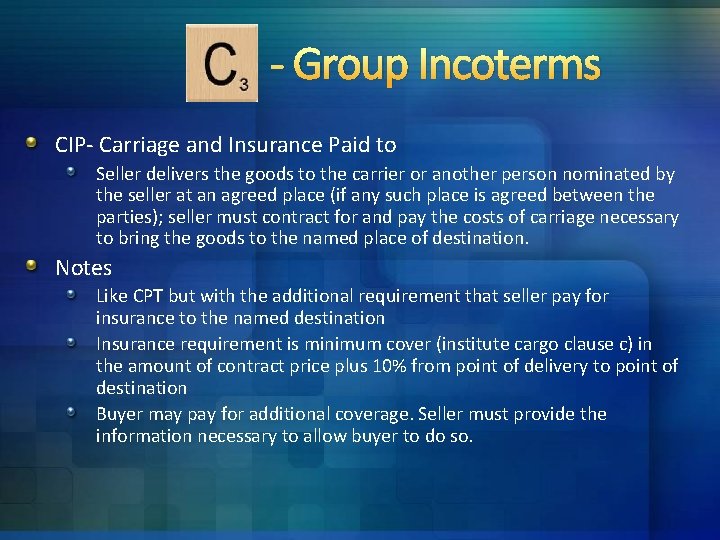
- Group Incoterms CIP- Carriage and Insurance Paid to Seller delivers the goods to the carrier or another person nominated by the seller at an agreed place (if any such place is agreed between the parties); seller must contract for and pay the costs of carriage necessary to bring the goods to the named place of destination. Notes Like CPT but with the additional requirement that seller pay for insurance to the named destination Insurance requirement is minimum cover (institute cargo clause c) in the amount of contract price plus 10% from point of delivery to point of destination Buyer may pay for additional coverage. Seller must provide the information necessary to allow buyer to do so.
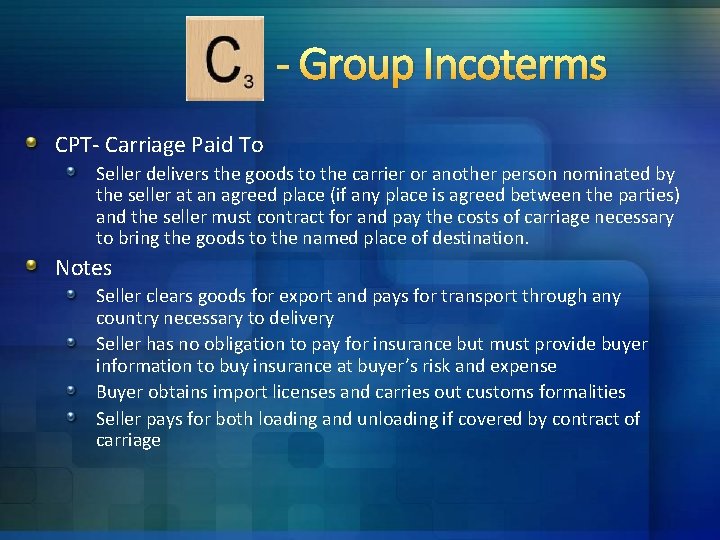
- Group Incoterms CPT- Carriage Paid To Seller delivers the goods to the carrier or another person nominated by the seller at an agreed place (if any place is agreed between the parties) and the seller must contract for and pay the costs of carriage necessary to bring the goods to the named place of destination. Notes Seller clears goods for export and pays for transport through any country necessary to delivery Seller has no obligation to pay for insurance but must provide buyer information to buy insurance at buyer’s risk and expense Buyer obtains import licenses and carries out customs formalities Seller pays for both loading and unloading if covered by contract of carriage
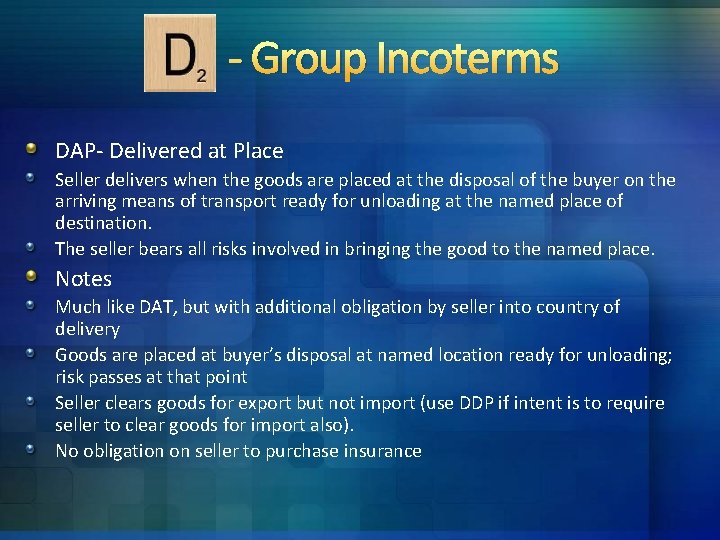
- Group Incoterms DAP- Delivered at Place Seller delivers when the goods are placed at the disposal of the buyer on the arriving means of transport ready for unloading at the named place of destination. The seller bears all risks involved in bringing the good to the named place. Notes Much like DAT, but with additional obligation by seller into country of delivery Goods are placed at buyer’s disposal at named location ready for unloading; risk passes at that point Seller clears goods for export but not import (use DDP if intent is to require seller to clear goods for import also). No obligation on seller to purchase insurance
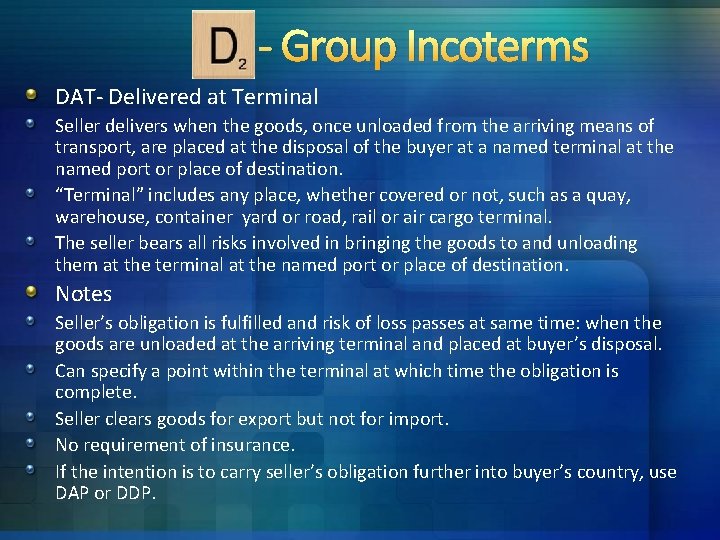
- Group Incoterms DAT- Delivered at Terminal Seller delivers when the goods, once unloaded from the arriving means of transport, are placed at the disposal of the buyer at a named terminal at the named port or place of destination. “Terminal” includes any place, whether covered or not, such as a quay, warehouse, container yard or road, rail or air cargo terminal. The seller bears all risks involved in bringing the goods to and unloading them at the terminal at the named port or place of destination. Notes Seller’s obligation is fulfilled and risk of loss passes at same time: when the goods are unloaded at the arriving terminal and placed at buyer’s disposal. Can specify a point within the terminal at which time the obligation is complete. Seller clears goods for export but not for import. No requirement of insurance. If the intention is to carry seller’s obligation further into buyer’s country, use DAP or DDP.
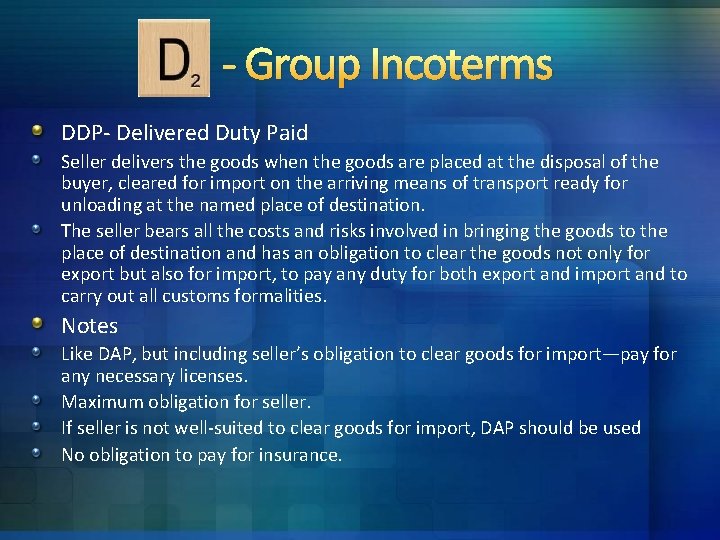
- Group Incoterms DDP- Delivered Duty Paid Seller delivers the goods when the goods are placed at the disposal of the buyer, cleared for import on the arriving means of transport ready for unloading at the named place of destination. The seller bears all the costs and risks involved in bringing the goods to the place of destination and has an obligation to clear the goods not only for export but also for import, to pay any duty for both export and import and to carry out all customs formalities. Notes Like DAP, but including seller’s obligation to clear goods for import—pay for any necessary licenses. Maximum obligation for seller. If seller is not well-suited to clear goods for import, DAP should be used No obligation to pay for insurance.
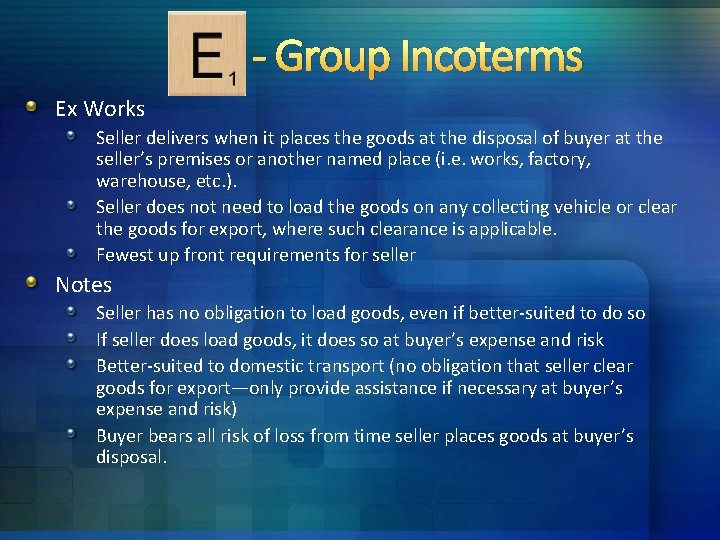
- Group Incoterms Ex Works Seller delivers when it places the goods at the disposal of buyer at the seller’s premises or another named place (i. e. works, factory, warehouse, etc. ). Seller does not need to load the goods on any collecting vehicle or clear the goods for export, where such clearance is applicable. Fewest up front requirements for seller Notes Seller has no obligation to load goods, even if better-suited to do so If seller does load goods, it does so at buyer’s expense and risk Better-suited to domestic transport (no obligation that seller clear goods for export—only provide assistance if necessary at buyer’s expense and risk) Buyer bears all risk of loss from time seller places goods at buyer’s disposal.
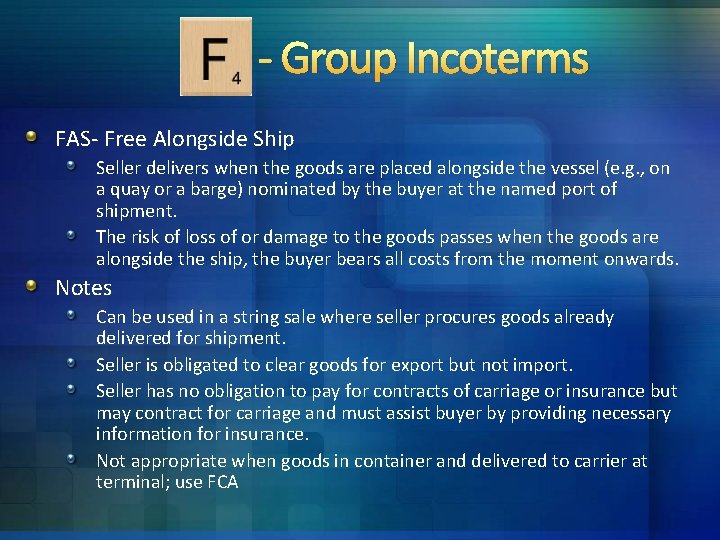
- Group Incoterms FAS- Free Alongside Ship Seller delivers when the goods are placed alongside the vessel (e. g. , on a quay or a barge) nominated by the buyer at the named port of shipment. The risk of loss of or damage to the goods passes when the goods are alongside the ship, the buyer bears all costs from the moment onwards. Notes Can be used in a string sale where seller procures goods already delivered for shipment. Seller is obligated to clear goods for export but not import. Seller has no obligation to pay for contracts of carriage or insurance but may contract for carriage and must assist buyer by providing necessary information for insurance. Not appropriate when goods in container and delivered to carrier at terminal; use FCA
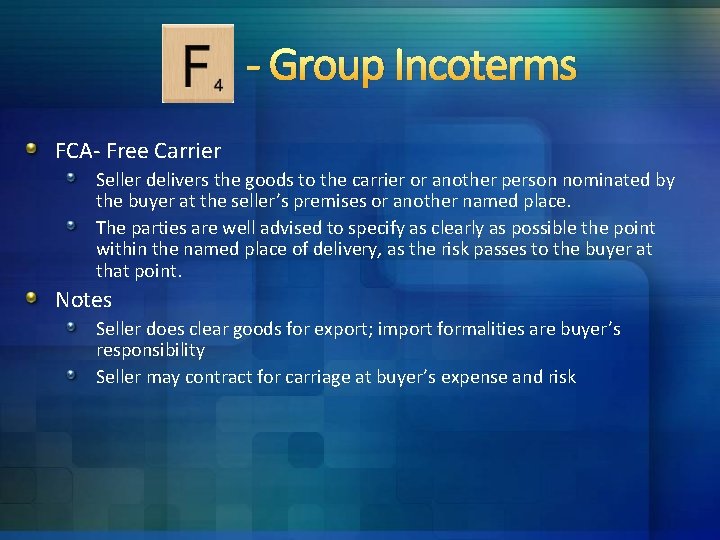
- Group Incoterms FCA- Free Carrier Seller delivers the goods to the carrier or another person nominated by the buyer at the seller’s premises or another named place. The parties are well advised to specify as clearly as possible the point within the named place of delivery, as the risk passes to the buyer at that point. Notes Seller does clear goods for export; import formalities are buyer’s responsibility Seller may contract for carriage at buyer’s expense and risk
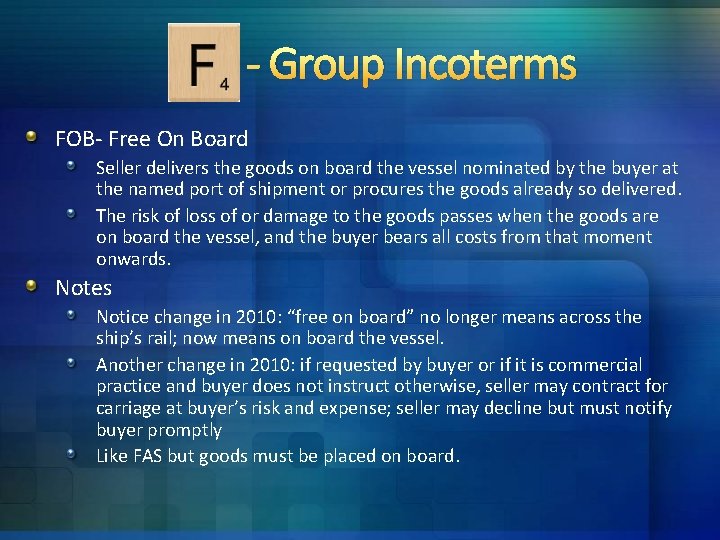
- Group Incoterms FOB- Free On Board Seller delivers the goods on board the vessel nominated by the buyer at the named port of shipment or procures the goods already so delivered. The risk of loss of or damage to the goods passes when the goods are on board the vessel, and the buyer bears all costs from that moment onwards. Notes Notice change in 2010: “free on board” no longer means across the ship’s rail; now means on board the vessel. Another change in 2010: if requested by buyer or if it is commercial practice and buyer does not instruct otherwise, seller may contract for carriage at buyer’s risk and expense; seller may decline but must notify buyer promptly Like FAS but goods must be placed on board.
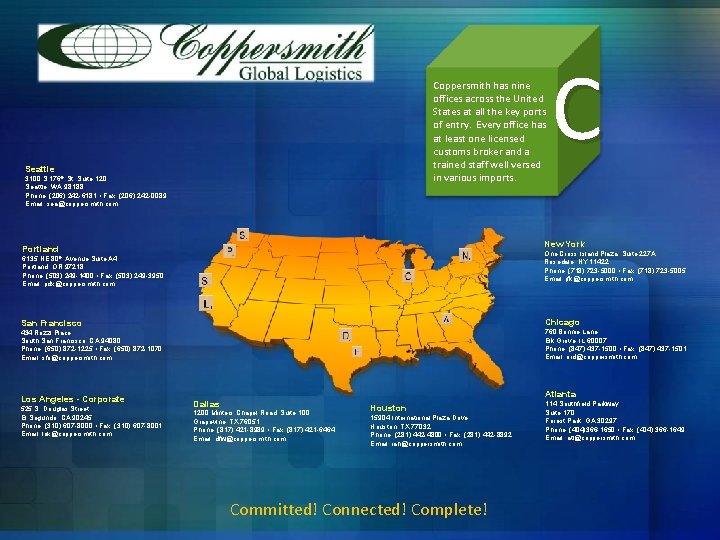
Coppersmith has nine offices across the United States at all the key ports of entry. Every office has at least one licensed customs broker and a trained staff well versed in various imports. Seattle 3100 S 176 th St. Suite 120 Seattle, WA 98188 Phone: (206) 242 -6181 • Fax: (206) 242 -0089 Email: sea@coppersmith. com C New York Portland One Cross Island Plaza, Suite 227 A Rosedale, NY 11422 Phone: (718) 723 -5000 • Fax: (718) 723 -5005 Email: jfk@coppersmith. com 80 th 6135 NE Avenue Suite A 4 Portland, OR 97218 Phone: (503) 249 -1400 • Fax: (503) 249 -3950 Email: pdx@coppersmith. com San Francisco Chicago 434 Rozzi Place South San Francisco, CA 94080 Phone: (650) 872 -1225 • Fax: (650) 872 -1070 Email: sfo@coppersmith. com 760 Bonnie Lane Elk Grove, IL 60007 Phone: (847) 437 -1500 • Fax: (847) 437 -1501 Email: ord@coppersmith. com Los Angeles - Corporate 525 S. Douglas Street El Segundo, CA 90245 Phone: (310) 607 -8000 • Fax: (310) 607 -8001 Email: lax@coppersmith. com Atlanta Dallas 1200 Minters Chapel Road. Suite 100 Grapevine, TX 76051 Phone: (817) 421 -8989 • Fax: (817) 421 -6464 Email: dfw@coppersmith. com Houston 15904 International Plaza Drive Houston, TX 77032 Phone: (281) 442 -4800 • Fax: (281) 442 -8892 Email: iah@coppersmith. com Committed! Connected! Complete! 114 Southfield Parkway Suite 170 Forest Park, GA 30297 Phone: (404)366 -1650 • Fax: (404) 366 -1649 Email: atl@coppersmith. com