
The Rules Of The Game Symbolizes the vacuum
The Rules Of The Game
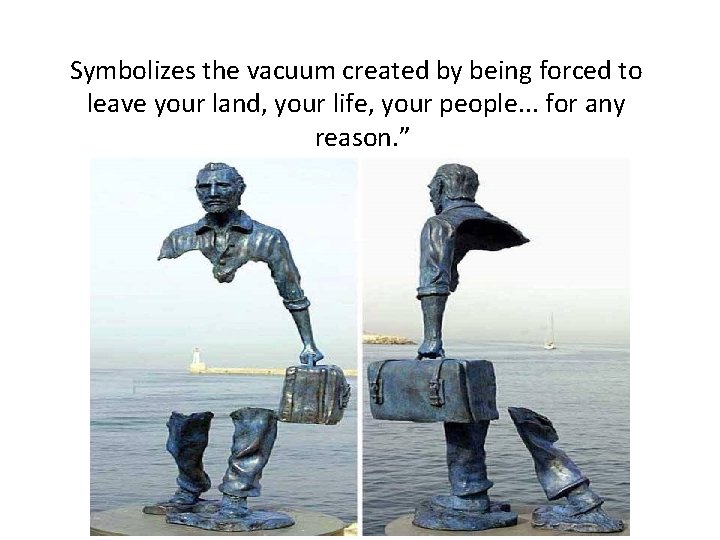
Symbolizes the vacuum created by being forced to leave your land, your life, your people. . . for any reason. ”
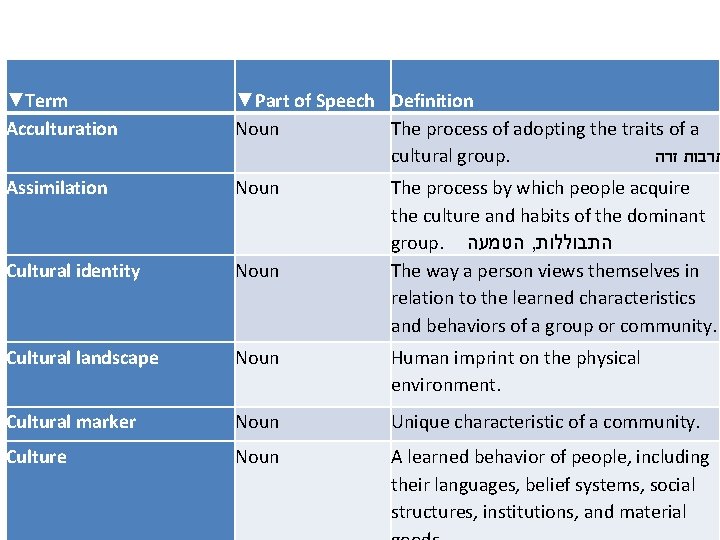
▼Term Acculturation ▼Part of Speech Definition Noun The process of adopting the traits of a cultural group. זרה תרבות Assimilation Noun Cultural identity Noun Cultural landscape Noun Human imprint on the physical environment. Cultural marker Noun Unique characteristic of a community. Culture Noun A learned behavior of people, including their languages, belief systems, social structures, institutions, and material The process by which people acquire the culture and habits of the dominant group. הטמעה , התבוללות The way a person views themselves in relation to the learned characteristics and behaviors of a group or community.
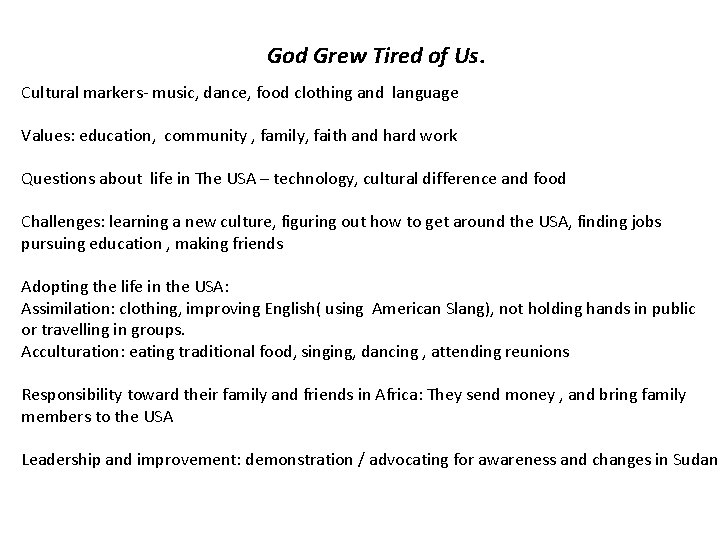
God Grew Tired of Us. Cultural markers music, dance, food clothing and language Values: education, community , family, faith and hard work Questions about life in The USA – technology, cultural difference and food Challenges: learning a new culture, figuring out how to get around the USA, finding jobs pursuing education , making friends Adopting the life in the USA: Assimilation: clothing, improving English( using American Slang), not holding hands in public or travelling in groups. Acculturation: eating traditional food, singing, dancing , attending reunions Responsibility toward their family and friends in Africa: They send money , and bring family members to the USA Leadership and improvement: demonstration / advocating for awareness and changes in Sudan
Setting: Place – San Francisco' Chinatown. Time: Waverly's childhood in the late 1950. life for a financially struggling immigrant family living in San Francisco's Chinatown. They live above a bakery and we see the neighborhood as the young girl sees it to her and her brothers it is a fascinating place that offers interest and adventure. She does not see herself as poor or deprived in any way Characters Major Characters: Waverly Jong Meimei, (her Chinese name "little sister") Lau Po the chess teacher, Waverly's mother Lindo. Minor characters: Waverly's brothers Vincent and Winston Waverly's
Compare And Contrast 1. Definition: Comparison and contrast are ways of looking at • objects and thinking about how they are alike and different. For instance all short stories are alike because they have the same structure yet they are different in their plots, narration etc. . . • 2. Purpose There are two main reasons that people use • comparison and contrast: A) . To Explain You might compare and contrast kinds of • narration for instance to explain when the narrator is objective or subjective B). To Evaluate You might compare and contrast reading • method to show why one kind of reading is better than another. For example, apples are a better snack than butter.
COMPARE AND CONTRAST A) make sure that you choose items that have similarities. . B) Comparison and contrast are used in your writing to organize an individual paragraph as well as to organize entire papers. For instance, you might write a paper that compares two characters. C) Similarities-to-Differences Strategy D) You may also use a Venn Diagram •
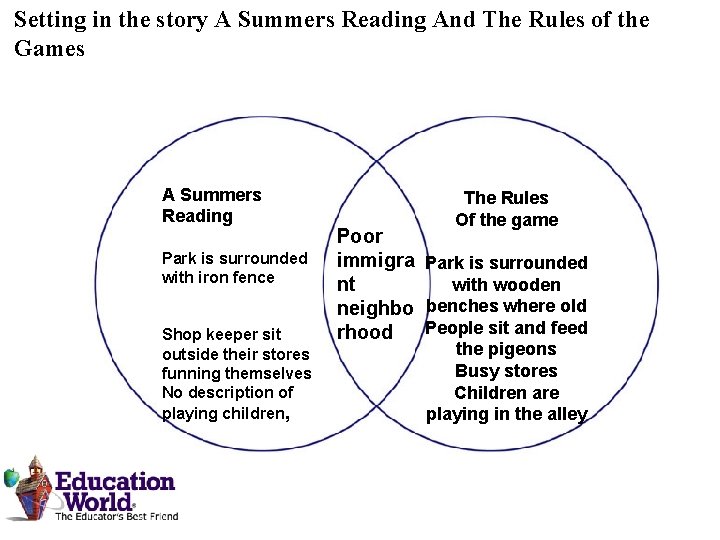
Setting in the story A Summers Reading And The Rules of the Games A Summers Reading Park is surrounded with iron fence Shop keeper sit outside their stores funning themselves No description of playing children, The Rules Of the game Poor immigra Park is surrounded with wooden nt neighbo benches where old People sit and feed rhood the pigeons Busy stores Children are playing in the alley
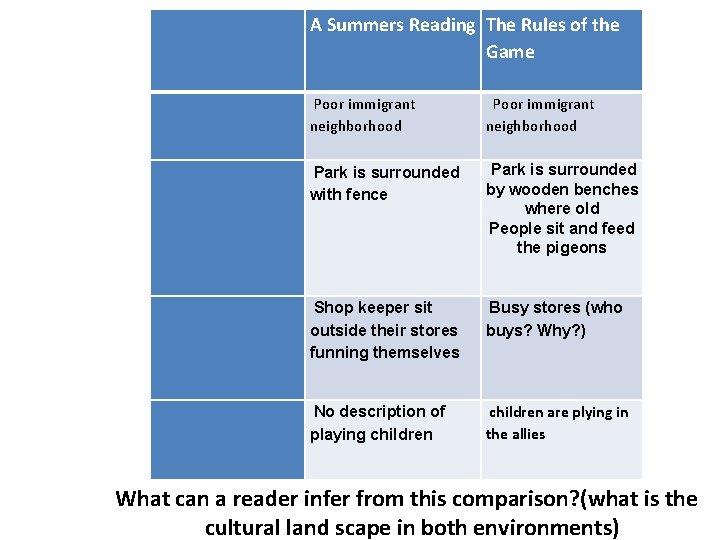
A Summers Reading The Rules of the Game Poor immigrant neighborhood Park is surrounded with fence Park is surrounded by wooden benches where old People sit and feed the pigeons Shop keeper sit outside their stores funning themselves Busy stores (who buys? Why? ) No description of playing children are plying in the allies What can a reader infer from this comparison? (what is the cultural land scape in both environments)
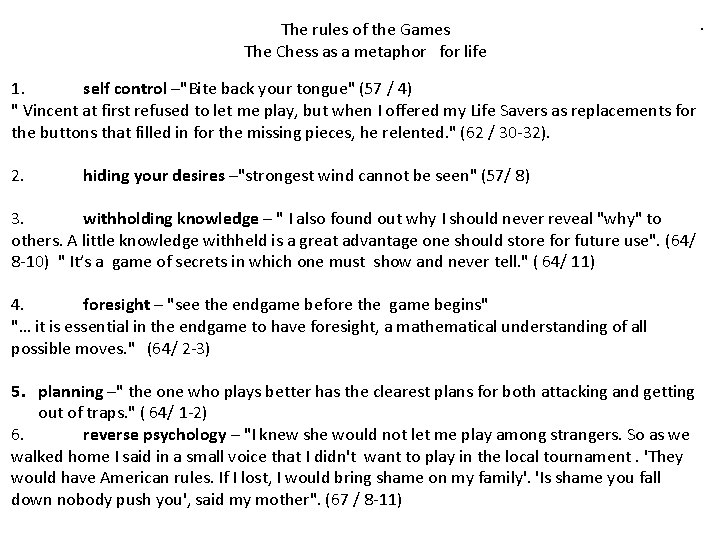
The rules of the Games The Chess as a metaphor for life . 1. self control –"Bite back your tongue" (57 / 4) " Vincent at first refused to let me play, but when I offered my Life Savers as replacements for the buttons that filled in for the missing pieces, he relented. " (62 / 30 32). 2. hiding your desires –"strongest wind cannot be seen" (57/ 8) 3. withholding knowledge – " I also found out why I should never reveal "why" to others. A little knowledge withheld is a great advantage one should store for future use". (64/ 8 10) " It’s a game of secrets in which one must show and never tell. " ( 64/ 11) 4. foresight – "see the endgame before the game begins" "… it is essential in the endgame to have foresight, a mathematical understanding of all possible moves. " (64/ 2 3) 5. planning –" the one who plays better has the clearest plans for both attacking and getting out of traps. " ( 64/ 1 2) 6. reverse psychology – "I knew she would not let me play among strangers. So as we walked home I said in a small voice that I didn't want to play in the local tournament. 'They would have American rules. If I lost, I would bring shame on my family'. 'Is shame you fall down nobody push you', said my mother". (67 / 8 11)
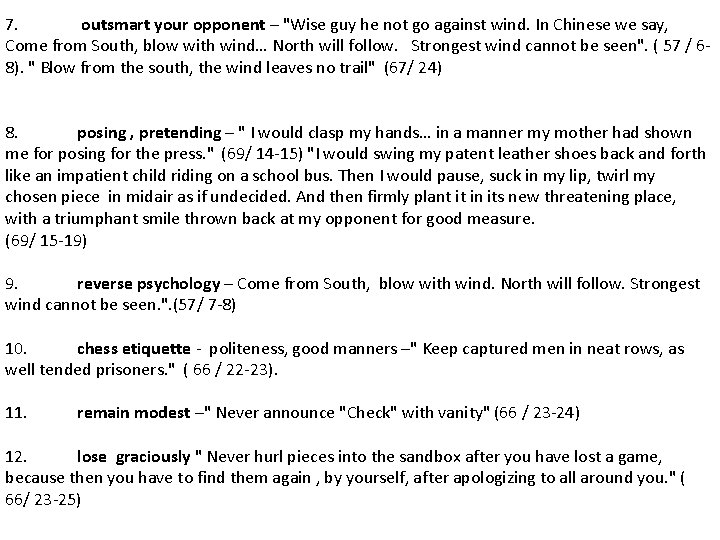
7. outsmart your opponent – "Wise guy he not go against wind. In Chinese we say, Come from South, blow with wind… North will follow. Strongest wind cannot be seen". ( 57 / 6 8). " Blow from the south, the wind leaves no trail" (67/ 24) 8. posing , pretending – " I would clasp my hands… in a manner my mother had shown me for posing for the press. " (69/ 14 15) "I would swing my patent leather shoes back and forth like an impatient child riding on a school bus. Then I would pause, suck in my lip, twirl my chosen piece in midair as if undecided. And then firmly plant it in its new threatening place, with a triumphant smile thrown back at my opponent for good measure. (69/ 15 19) 9. reverse psychology – Come from South, blow with wind. North will follow. Strongest wind cannot be seen. ". (57/ 7 8) 10. chess etiquette politeness, good manners –" Keep captured men in neat rows, as well tended prisoners. " ( 66 / 22 23). 11. remain modest –" Never announce "Check" with vanity" (66 / 23 24) 12. lose graciously " Never hurl pieces into the sandbox after you have lost a game, because then you have to find them again , by yourself, after apologizing to all around you. " ( 66/ 23 25)
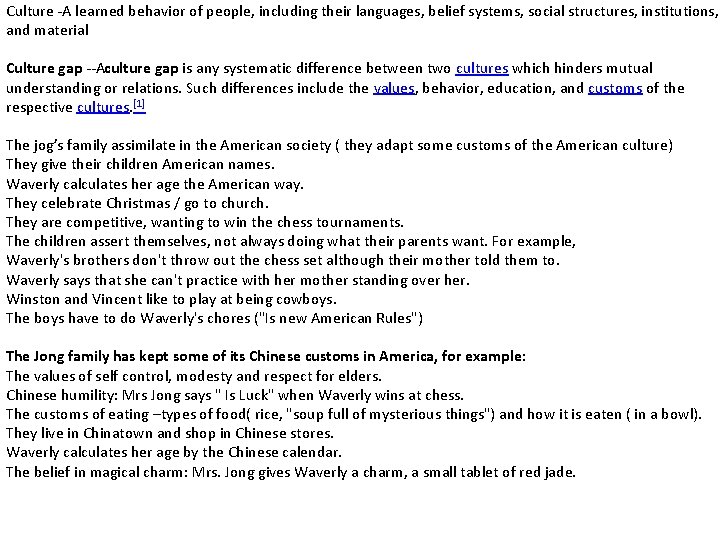
Culture A learned behavior of people, including their languages, belief systems, social structures, institutions, and material Culture gap A culture gap is any systematic difference between two cultures which hinders mutual understanding or relations. Such differences include the values, behavior, education, and customs of the respective cultures. [1] The jog’s family assimilate in the American society ( they adapt some customs of the American culture) They give their children American names. Waverly calculates her age the American way. They celebrate Christmas / go to church. They are competitive, wanting to win the chess tournaments. The children assert themselves, not always doing what their parents want. For example, Waverly's brothers don't throw out the chess set although their mother told them to. Waverly says that she can't practice with her mother standing over her. Winston and Vincent like to play at being cowboys. The boys have to do Waverly's chores ("Is new American Rules") The Jong family has kept some of its Chinese customs in America, for example: The values of self control, modesty and respect for elders. Chinese humility: Mrs Jong says " Is Luck" when Waverly wins at chess. The customs of eating –types of food( rice, "soup full of mysterious things") and how it is eaten ( in a bowl). They live in Chinatown and shop in Chinese stores. Waverly calculates her age by the Chinese calendar. The belief in magical charm: Mrs. Jong gives Waverly a charm, a small tablet of red jade.
American culture vs. Chinese culture mother vs. Daughter The narrative discourse of “Rules of the Game sways between Chinese and American cultures. As a child Living in Chinatown – not mingled into American society. In home Chinese tradition is kept (the food) Waverly’s mother teaches her the art of The invisible strength in order to enable her to live beyond her circumstances/ She imparts this through applying her concept of invisible strength to enter America Seeing American chess for the first time, Waverly is attracted more to it than the Chinese mysteries that she used to like Waverly is playing by the Chinese rules for the American way of playing chess. Waverly is modest as opposed to her American opponent “across from a fifteen year old boy from Oakland” to a boy whom she recalled, “He looked at me, wrinkling his nose. ”
As her behavior leads to what is termed as American successes, conflicts escalate between Waverly and her mother. She gives her daughter more advice to which Waverly resents She is sponsored – American by Chinese shops In her following torment Waverly discards Lau Po’s Chinese rules of etiquette, and begin to display the signs of her American influence in her own playing. Relying on her invisible strength while playing, she starts to boast, pausing with her “chosen piece in midair as if undecided, ” before she proceeds “in its new threatening place, with a triumphant smile thrown back at my opponent for good measure. ” She asks for more concession at home and received them = she starts to asses an American identity. The Invisible strength “the art of invisible strength” why art? Art is the product or process of deliberately arranging items (often with symbolic significance) in a way that influences and affects one or more of the senses, emotions, and intellect. From this definition we can see that art is also strong. It deliberately arranges item. ” ("Art, " 2011). is demonstrated by the. In its power and invisibility, it is the strongest of opponents. The "strongest wind cannot be seen, " Waverly's chess opponent tells her. Like the human will, it cannot be seen or traced In another sense, the "art of invisible strength" represents female power. Women who have been denied conventional paths to power traditionally use their ability to persuade, to shape,
In another sense, the "art of invisible strength" represents female power. Women who have been denied conventional paths to power traditionally use their ability to persuade, to shape, and even to control events The "art of invisible strength" is also the power of foreigners, those considered ignorant because they cannot communicate fluently and effectively in the dominant language. For example, Mrs. Jong's fractured English is amusing. When Waverly fears that she will lose a chess match and shame the family, Mrs. Jong says, "Is shame you fall down nobody push you. “ In another sense, the "art of invisible strength" represents female power. Women who have been denied conventional paths to power traditionally use their ability to persuade, to shape, and even to control events The "art of invisible strength" is also the power of foreigners, those considered ignorant because they cannot communicate fluently and effectively in the dominant language. For example, Mrs. Jong's fractured English is amusing. When Waverly fears that she will lose a chess match and shame the family, Mrs. Jong says, "Is shame you fall down nobody push you. If you fail or succeed this is your responsibility
Protagonist a person, institution, or country that supports someone or something, especially financially. Antagonist a person who actively opposes or is hostile to someone or something; an adversary Theme: troubled mother daughter relationship Characterization: Mrs. Jong – First thing we note about the mother is her luck of assimilation – mal use of English (Chinese sentence structure and the imagery in her speech) Invisible strength – educating her daughter by the Chinese tradition Very Proud, not wanting to keep a second hand, incomplete gift, but here she loses out to her children
She is smart –to raise her kids above their circumstances We are told explicitly that she cannot read English, but she is shrewd and understands how life is for an immigrant and how it is up to the immigrant to adapt. Every time people come out from foreign country, must know rules. . Better you take it, find out why yourself She is a control freak She is a feminist Waverly: She is only 8 She is very clever ( the way she picked her Christmas gifts, she masters chess skillfully) She knows how to manipulate he r mother ( she cannot concentrate when her mother is beside her, she uses reverse psychology, She is permitted not to take a part in the house chores but one) She is individualist ( she studies chess almost by herself)
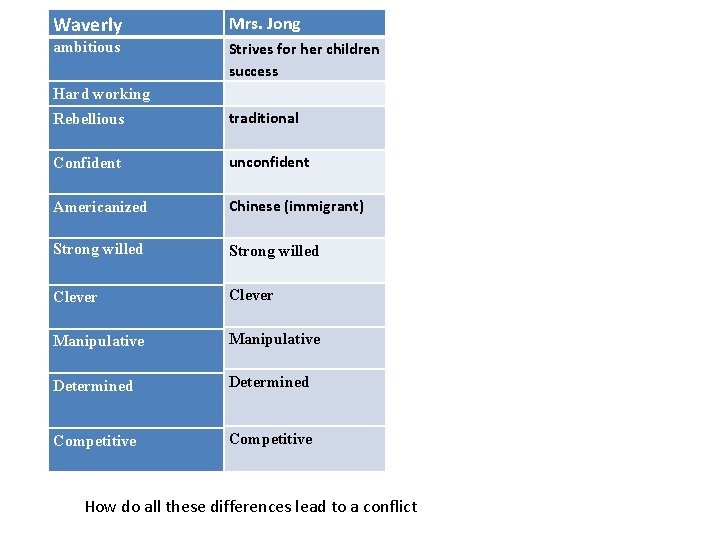
Waverly Mrs. Jong ambitious Strives for her children success Hard working Rebellious traditional Confident unconfident Americanized Chinese (immigrant) Strong willed Clever Manipulative Determined Competitive How do all these differences lead to a conflict
Conflict – is the struggle between opposing forces. There are different kinds of conflicts Between two people Between a person and society Between a person and his/her inner feelings Between a person and his nature. CULTURE CONFLICT - : the conflict of behavior patterns and values that results when different cultures are incompletely Generation Gap -
"I knew it was a mistake to say anything more, but I heard my voice speaking. 'Why do you have to use me to show off? '" This quote a turning point in the story, Its the first time that Waverly protests against her mother and against the Chinese culture. A conflict Which leads to Waverly seeing her mother as an opponent (Justify or not? Which thinking skill will you use to answer this question) there a way to solve the conflict?
The rules of the game is one story taken from Amy Tan’s book The Joy Luck Club It focuses on four Chinese American immigrant families in San Francisco who start a club known as The Joy Luck Club, playing the Chinese game. Following this book Amy Tan wrote an article titled as My Mother Tongue where shares her discoveries about language immigrants culture and relationship Below are some paragraphs that will demonstrate Mrs. Tan’s relationship with her mother I am a writer. And by that definition, I am someone who has always loved language. I am fascinated by language in daily life. I spend a great deal of my time thinking about the power of language the way it can evoke an emotion, a visual image, a complex idea, or a simple truth. Language is the tool of my trade. And I use them all the Englishes I grew up with.
“when I was growing up, my mother's "limited" English limited my perception of her. I was ashamed of her English. I believed that her English reflected the quality of what she had to say That is, because she expressed them imperfectly her thoughts were imperfect. And I had plenty of empirical evidence to support me: the fact that people in department stores, at banks, and at restaurants did not take her seriously, did not give her good service, pretended not to understand her, or even acted as if they did not hear her. ”
- Slides: 22