
The Rule of Law The Big Legal Lesson
The Rule of Law
The Big Legal Lesson objectives • Understand what the rule of law is, and who makes and changes the law in the UK; • Explore a number of new laws that are currently being debated and the impact these would have if they were passed; • Critically consider what influence you can have on the law. 2 © Young Citizens
The Big Legal Lesson Introduction What is the rule of law? 3 © Young Citizens
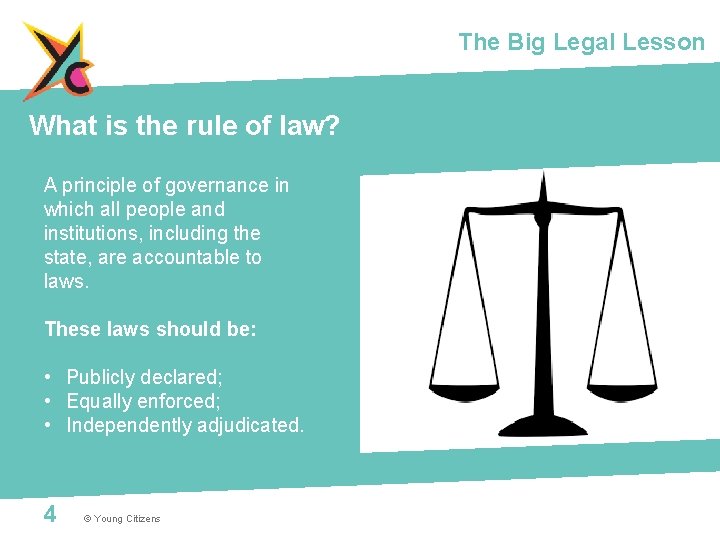
The Big Legal Lesson What is the rule of law? A principle of governance in which all people and institutions, including the state, are accountable to laws. These laws should be: • Publicly declared; • Equally enforced; • Independently adjudicated. 4 © Young Citizens
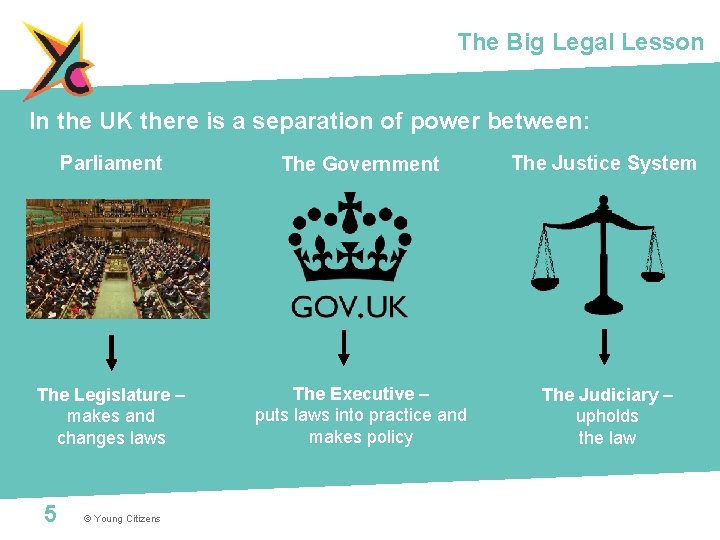
The Big Legal Lesson In the UK there is a separation of power between: Parliament The Government The Justice System The Legislature – makes and changes laws The Executive – puts laws into practice and makes policy The Judiciary – upholds the law 5 © Young Citizens
The Big Legal Lesson Why do we need laws? • To keep us safe; • To protect all citizens and ensure their human rights are upheld; • To keep order and prevent chaos; • To limit the power of those in charge and ensure they are held accountable. 6 © Young Citizens
The Big Legal Lesson Activity 1 In an ideal world 7 © Young Citizens
The Big Legal Lesson Activity 1: Q: What new law would you like to see introduced to improve the quality of life for all young people in the UK? Mind-map the steps you think you would need to take in order to get your new law passed. 8 © Young Citizens
The Big Legal Lesson Activity 2 How are laws made? 9 © Young Citizens
The Big Legal Lesson Activity 2: How are laws made? Watch the following video. Whilst watching, write down each of the steps that are described. 10 © Young Citizens
The Big Legal Lesson Green Papers are consultation documents produced by the Government. People both inside and outside Parliament can give feedback on the policy or legislative proposals they outline. White Papers are policy documents produced by the Government that set out its proposals for future legislation. They provide a basis for further consultation and discussion with interested or affected groups and allow final changes to be made before a Bill is formally presented to Parliament. 11 © Young Citizens
The Big Legal Lesson Bill A proposal or draft of a new law, or an edit to significantly change an existing law that Parliament scrutinises and votes on. House of Commons The UK public elects 650 Members of Parliament (MPs) to represent its different interests and concerns in the House of Commons. MPs consider new laws proposed by the Government and scrutinise policies by asking ministers questions about current issues either in the Commons Chamber or in Committees. House of Lords The House of Lords is the second chamber of the UK Parliament. It is independent from, and complements the work of, the elected House of Commons. The Lords shares the task of making and shaping laws and checking and challenging the work of the government. 12 © Young Citizens
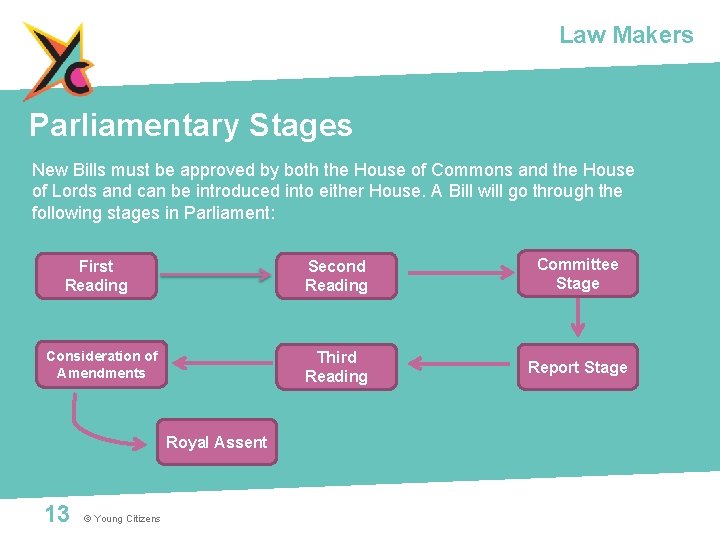
Law Makers Parliamentary Stages New Bills must be approved by both the House of Commons and the House of Lords and can be introduced into either House. A Bill will go through the following stages in Parliament: First Reading Consideration of Amendments Royal Assent 13 © Young Citizens Second Reading Committee Stage Third Reading Report Stage
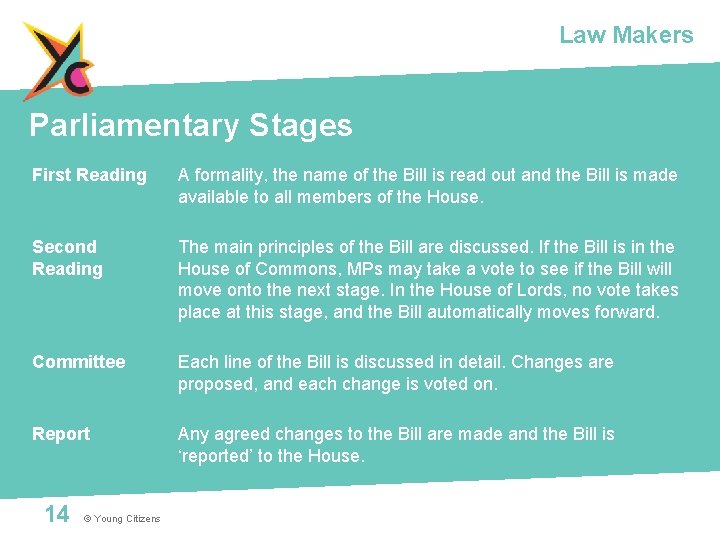
Law Makers Parliamentary Stages First Reading A formality, the name of the Bill is read out and the Bill is made available to all members of the House. Second Reading The main principles of the Bill are discussed. If the Bill is in the House of Commons, MPs may take a vote to see if the Bill will move onto the next stage. In the House of Lords, no vote takes place at this stage, and the Bill automatically moves forward. Committee Each line of the Bill is discussed in detail. Changes are proposed, and each change is voted on. Report Any agreed changes to the Bill are made and the Bill is ‘reported’ to the House. 14 © Young Citizens
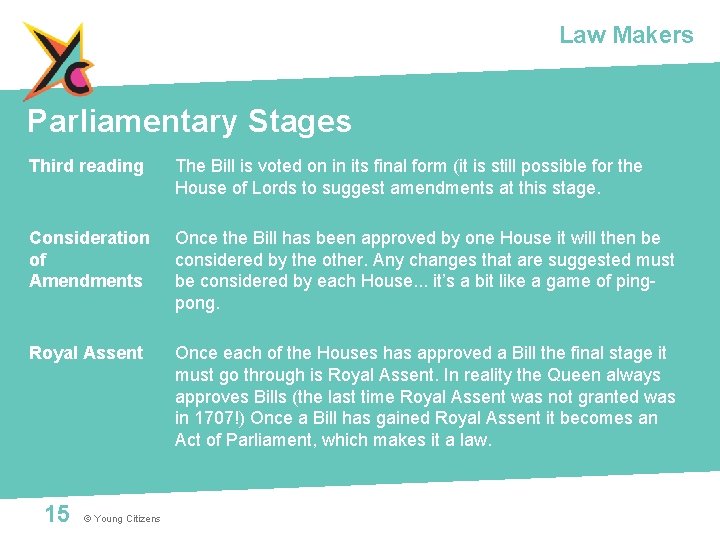
Law Makers Parliamentary Stages Third reading The Bill is voted on in its final form (it is still possible for the House of Lords to suggest amendments at this stage. Consideration of Amendments Once the Bill has been approved by one House it will then be considered by the other. Any changes that are suggested must be considered by each House. . . it’s a bit like a game of pingpong. Royal Assent Once each of the Houses has approved a Bill the final stage it must go through is Royal Assent. In reality the Queen always approves Bills (the last time Royal Assent was not granted was in 1707!) Once a Bill has gained Royal Assent it becomes an Act of Parliament, which makes it a law. 15 © Young Citizens
The Big Legal Lesson Activity 3 Changing the law 16 © Young Citizens
The Big Legal Lesson The case of Gina Martin Watch this video: https: //www. youtube. com/watch? v=O e. G-H 50 m. Fko Then familiarise yourself further with the story using Worksheet 3. 17 © Young Citizens
The Big Legal Lesson The case of Gina Martin Q: What impact do you think this new law will have? Q: What empowered Martin to think she could make a difference to the law? Q: What different campaigning strategies did Martin use? Q: Why do you think the campaign was successful in getting the law changed? 18 © Young Citizens
The Big Legal Lesson Plenary Q: List three groups of people that are influential in getting laws changed. Q: List three of the stages that a new law must go through before it is approved. Q: Describe three ways that you can influence the law. 19 © Young Citizens
- Slides: 19