
The Rotocopter Experiment You are now a helicopter
- Slides: 14
The Rotocopter Experiment You are now a helicopter engineer whose goal is to increase the amount of time a helicopter stays in the air. If a helicopter malfunctions and is going to crash, more time spent in the air means a less forceful and potentially dangerous crash.
Scientific Method � We will be using the scientific method when conducting this experiment. � The scientific method involves following six general steps in sequence. 1. 2. 3. 4. 5. 6. Problem Hypothesis Procedure Data Analysis Conclusion
The Rotocopter Experiment �In this experiment, we are going to make roto -copters out of paper to simulate helicopters and alter one variable of the rotocopter to change how long it takes to reach the ground.
Step 1 - Problem �Always in the form of a question �Tells you what the lab or experiment is trying to find out �Very specific “Will changing the length of the wings increase the amount of time a rotocopter stays in the air? ”
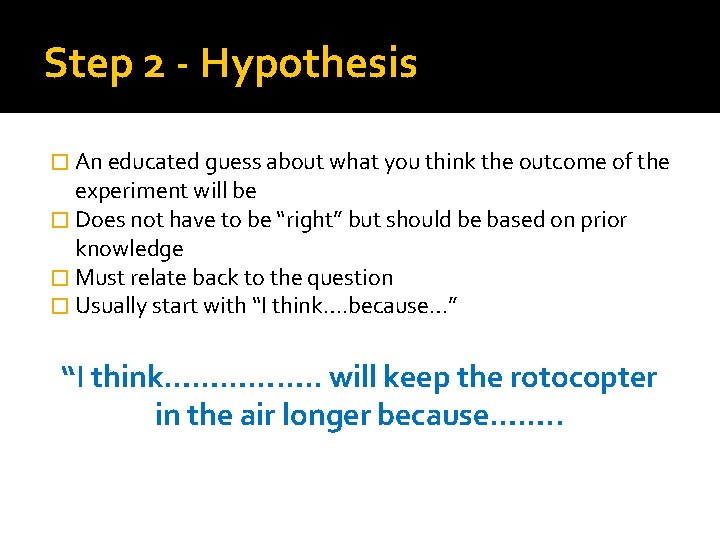
Step 2 - Hypothesis � An educated guess about what you think the outcome of the experiment will be � Does not have to be “right” but should be based on prior knowledge � Must relate back to the question � Usually start with “I think…. because…” “I think……………. . will keep the rotocopter in the air longer because……. .
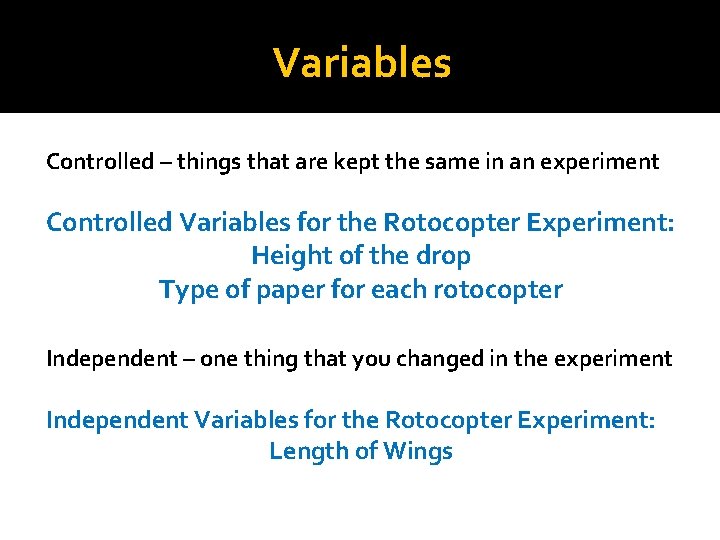
Variables Controlled – things that are kept the same in an experiment Controlled Variables for the Rotocopter Experiment: Height of the drop Type of paper for each rotocopter Independent – one thing that you changed in the experiment Independent Variables for the Rotocopter Experiment: Length of Wings
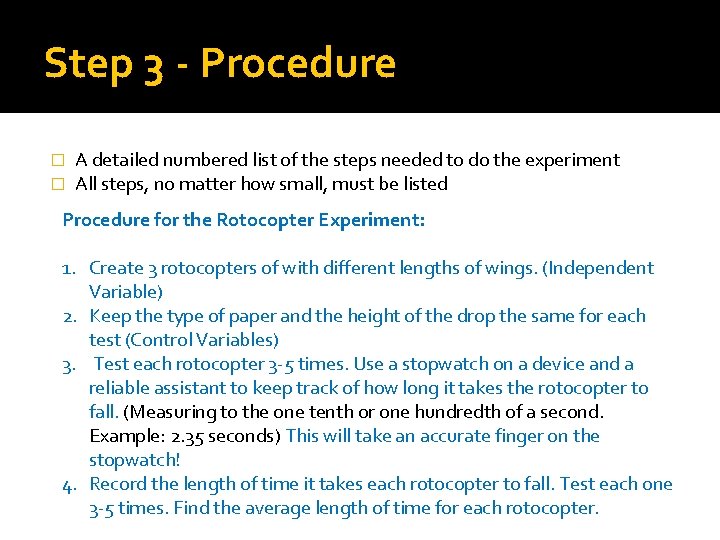
Step 3 - Procedure � � A detailed numbered list of the steps needed to do the experiment All steps, no matter how small, must be listed Procedure for the Rotocopter Experiment: 1. Create 3 rotocopters of with different lengths of wings. (Independent Variable) 2. Keep the type of paper and the height of the drop the same for each test (Control Variables) 3. Test each rotocopter 3 -5 times. Use a stopwatch on a device and a reliable assistant to keep track of how long it takes the rotocopter to fall. (Measuring to the one tenth or one hundredth of a second. Example: 2. 35 seconds) This will take an accurate finger on the stopwatch! 4. Record the length of time it takes each rotocopter to fall. Test each one 3 -5 times. Find the average length of time for each rotocopter.
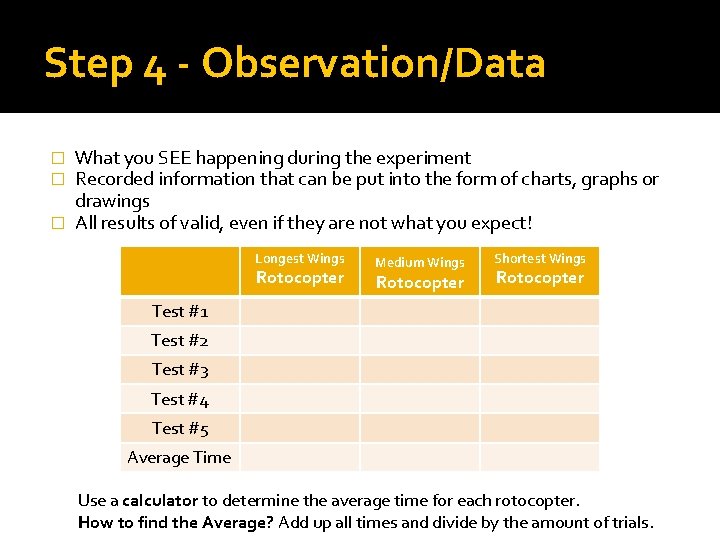
Step 4 - Observation/Data What you SEE happening during the experiment Recorded information that can be put into the form of charts, graphs or drawings � All results of valid, even if they are not what you expect! � � Longest Wings Rotocopter Medium Wings Rotocopter Shortest Wings Rotocopter Test #1 Test #2 Test #3 Test #4 Test #5 Average Time Use a calculator to determine the average time for each rotocopter. How to find the Average? Add up all times and divide by the amount of trials.
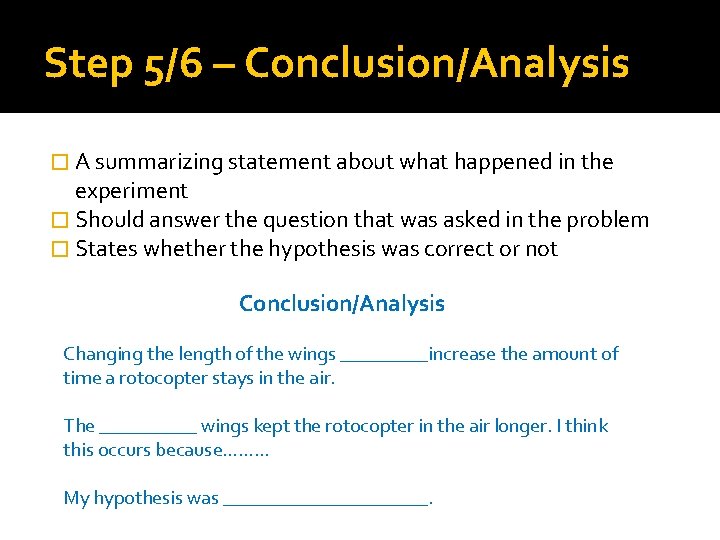
Step 5/6 – Conclusion/Analysis � A summarizing statement about what happened in the experiment � Should answer the question that was asked in the problem � States whether the hypothesis was correct or not Conclusion/Analysis Changing the length of the wings _____increase the amount of time a rotocopter stays in the air. The _____ wings kept the rotocopter in the air longer. I think this occurs because……… My hypothesis was ___________.
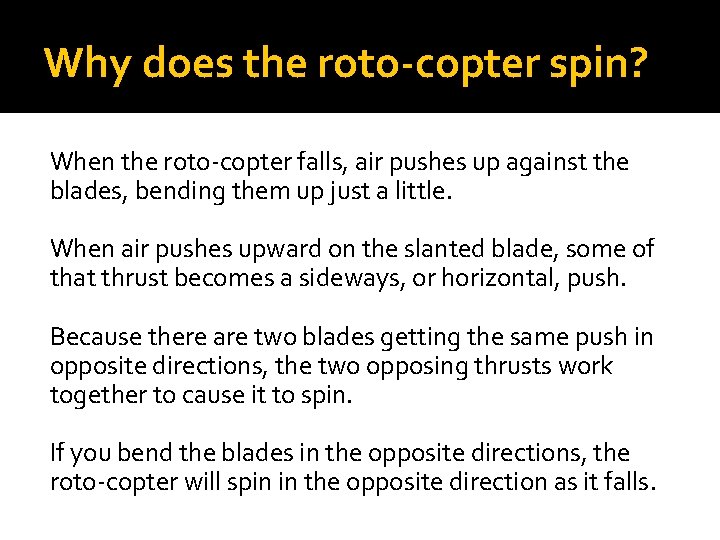
Why does the roto-copter spin? When the roto-copter falls, air pushes up against the blades, bending them up just a little. When air pushes upward on the slanted blade, some of that thrust becomes a sideways, or horizontal, push. Because there are two blades getting the same push in opposite directions, the two opposing thrusts work together to cause it to spin. If you bend the blades in the opposite directions, the roto-copter will spin in the opposite direction as it falls.
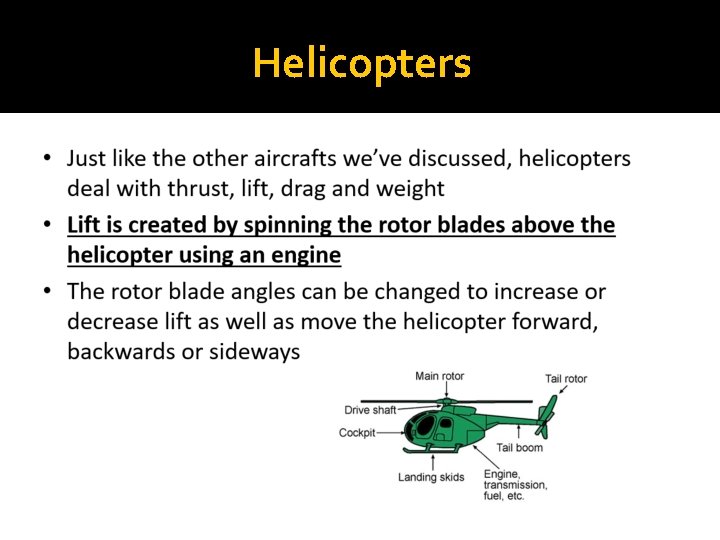
Helicopters
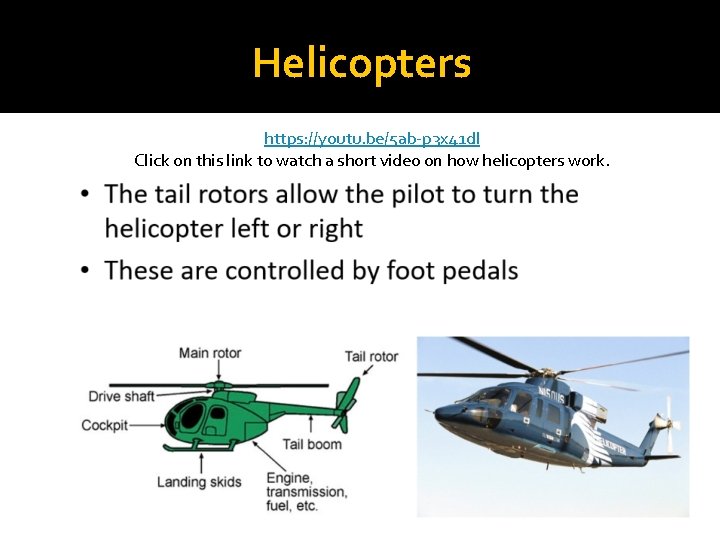
Helicopters https: //youtu. be/5 ab-p 3 x 41 d. I Click on this link to watch a short video on how helicopters work.
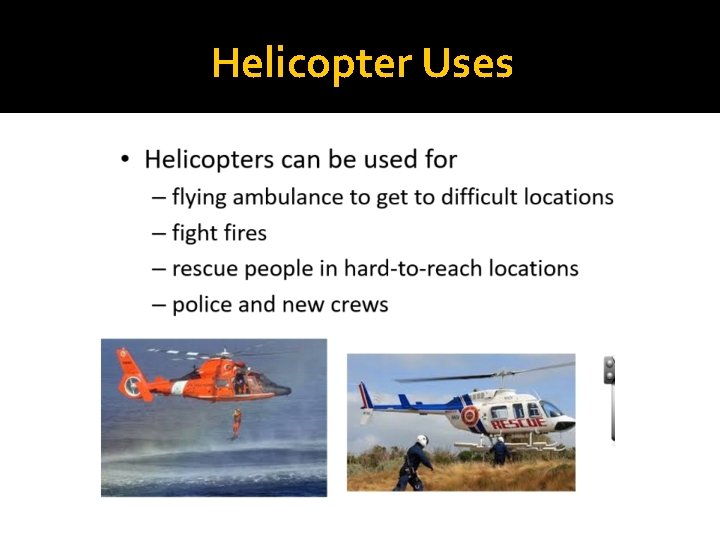
Helicopter Uses
Optional!! More about Helicopters! http: //www. learnalberta. ca/content/setf/html/S tudent. Resource/Welcome. html For more information and online simulations involving helicopters, click on the link above. On the Thrill of Flight site you can hover Hanger 4 where you will find more information about helicopters!