
The Roots of the Cold War CommunismEconomic and
- Slides: 17
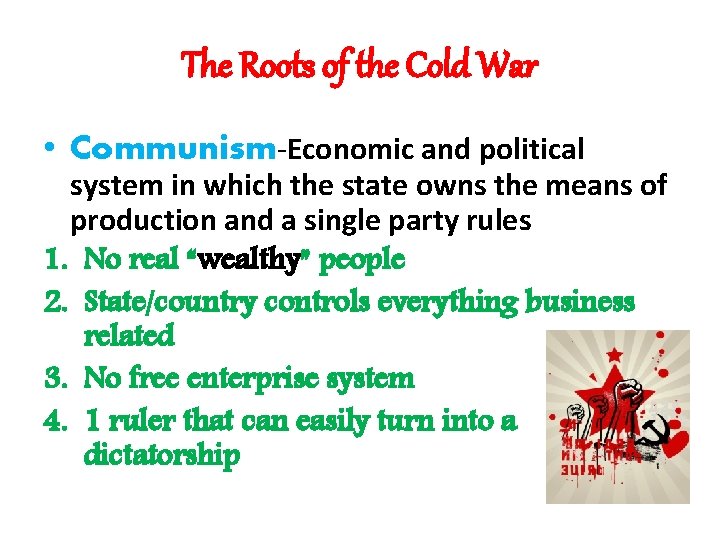
The Roots of the Cold War • Communism-Economic and political system in which the state owns the means of production and a single party rules 1. No real “wealthy” people 2. State/country controls everything business related 3. No free enterprise system 4. 1 ruler that can easily turn into a dictatorship
Roots of the Cold War…Continued • Democracy-Government by the people, exercised either directly or through elected representatives and using those people as the primary source of political power. 1. Citizens elect representatives to serve in government 2. Free enterprise system 3. Multiparty free elections
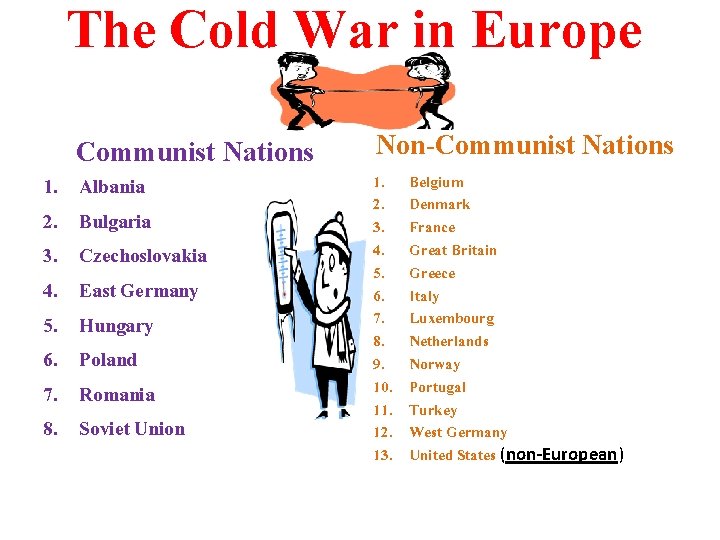
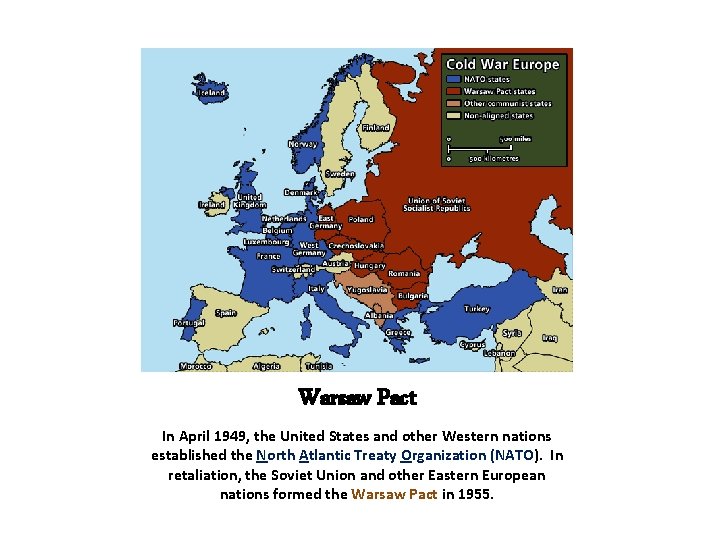
The Cold War in Europe 1. 2. 3. 4. 5. 6. 7. 8. Communist Nations Non-Communist Nations Albania Bulgaria Czechoslovakia East Germany Hungary Poland Romania Soviet Union 1. 2. 3. 4. 5. 6. 7. 8. 9. 10. 11. 12. 13. Belgium Denmark France Great Britain Greece Italy Luxembourg Netherlands Norway Portugal Turkey West Germany United States (non-European)
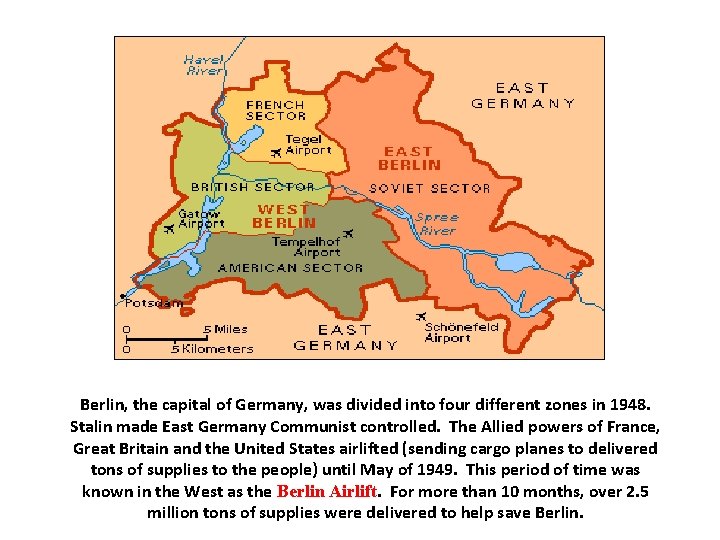
Berlin, the capital of Germany, was divided into four different zones in 1948. Stalin made East Germany Communist controlled. The Allied powers of France, Great Britain and the United States airlifted (sending cargo planes to delivered tons of supplies to the people) until May of 1949. This period of time was known in the West as the Berlin Airlift. For more than 10 months, over 2. 5 million tons of supplies were delivered to help save Berlin.
The NATO Nations vs. The NATO vs. The Warsaw Pact In April 1949, the United States and other Western nations established the North Atlantic Treaty Organization (NATO). In retaliation, the Soviet Union and other Eastern European nations formed the Warsaw Pact in 1955.
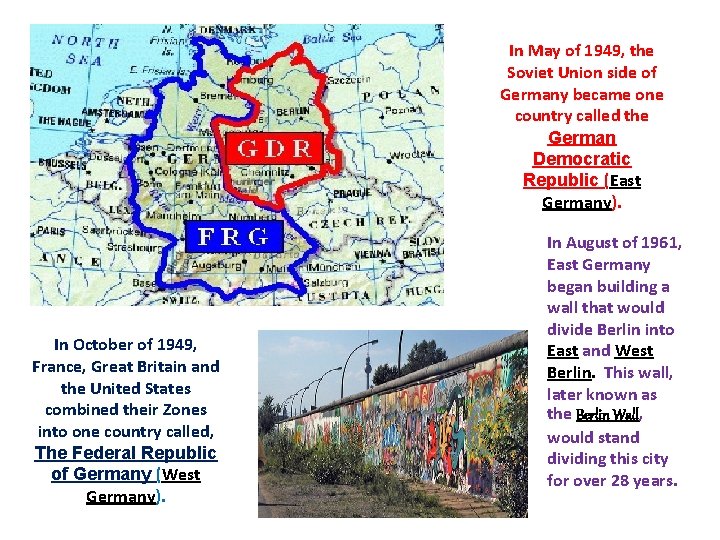
In May of 1949, the Soviet Union side of Germany became one country called the German Democratic Republic (East Germany). In October of 1949, France, Great Britain and the United States combined their Zones into one country called, The Federal Republic of Germany (West Germany). In August of 1961, East Germany began building a wall that would divide Berlin into East and West Berlin. This wall, later known as the Berlin Wall, would stand dividing this city for over 28 years.
East Against West • Facts about the “Iron Curtain” 1. Political differences divided the Soviet (Communist) controlled countries of Eastern Europe from those of Western Europe 2. Differences caused an Iron Curtain (not an actual curtain) that split Europe into 2 different parts. 3. People living in the Eastern part could not travel outside of their country. 4. Westerners who wanted to visited the Eastern part also faced restriction.
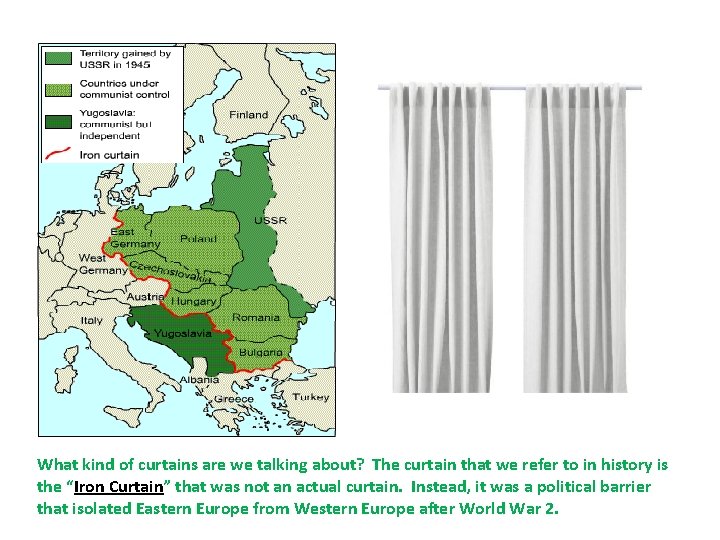
What kind of curtains are we talking about? The curtain that we refer to in history is the “Iron Curtain” that was not an actual curtain. Instead, it was a political barrier that isolated Eastern Europe from Western Europe after World War 2.
The Cold War…and the Rest of Europe • The daily lives of citizens of the Soviet Union and Eastern European countries was difficult. 1. Many people had little, if anything to say, in their governments 2. Soviet leaders tried to create a strong national identity 3. In Latvia, a Communist take-over, people were to think of themselves as “Soviets” and not as “Latvians”
The Soviet Union and TOTAL Control Soviet Control of Daily Life 1. 2. 3. 4. 5. Soviet Union outlawed many celebrations Destroyed churches and religious buildings Religious leaders were killed Other ethnic group members were not allowed to speak their native languages Government controlled communications media (newspapers, books and radio) Control of Literature and Arts 1. 2. 3. 4. Writers, poets and other artists work was banned or censored Artists forced to join government run unions Unions told artists what to create If artists refused or disobeyed, they were jailed or killed.
The Cold War Continues in Eastern Asia • Underlying reason for the Korean War: It remained a continuing saga in the ongoing Cold War between the United States and the Soviet Union • The Surface reason for the Korean War: It seemed to be a war between North Korea and South Korea • The Real reason for the Korean War: The United States and the Soviet Union were using the war as a front to combat each other without actually going to war with each other
The Korean War-Reason #1 (The U. S. Perspective) • The “Domino Theory” (The Communists were coming to power not only in Eastern Europe but also in the far East) • China became Communist in 1949 • President Harry Truman believed that if one country fell to Communism then another country would follow like a line of “dominoes”
The Korean War-Reason #2 (The U. S. PERSPECTIVE) • Undermining Communism • • • Capitalism and Freedom were in jeopardy of being overrun by Communism Truman Doctrine-containing Communism by keeping the Soviet Union from gaining more territory President Truman wanted to drive the Communists out of North Korea
The Korean War-Reason #3 (Still the U. S. PERSPECTIVE) • The United States was in a competition for world domination with the Soviet Union • While “helping” South Korea, the United States was able to fight off Communism without directly attacking Russia
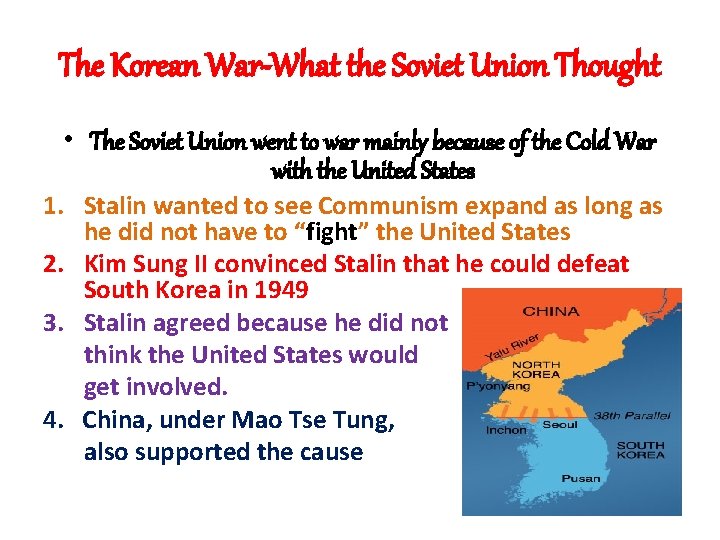
The Korean War-What the Soviet Union Thought • The Soviet Union went to war mainly because of the Cold War with the United States 1. Stalin wanted to see Communism expand as long as he did not have to “fight” the United States 2. Kim Sung II convinced Stalin that he could defeat South Korea in 1949 3. Stalin agreed because he did not think the United States would get involved. 4. China, under Mao Tse Tung, also supported the cause
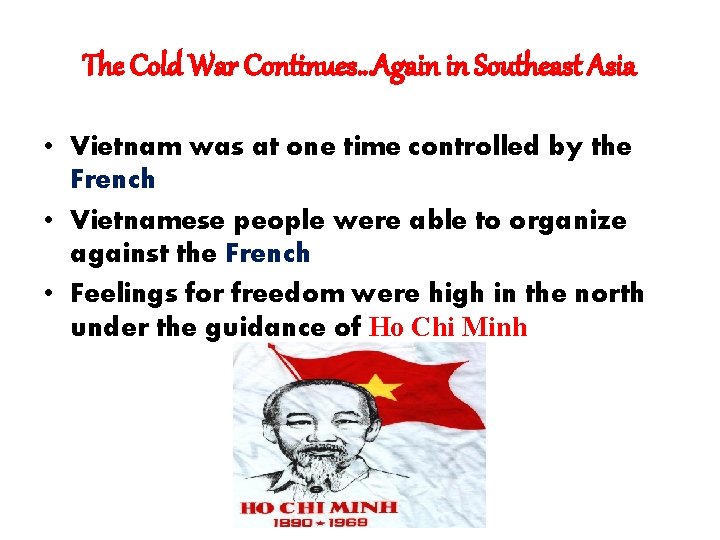
The Cold War Continues…Again in Southeast Asia • Vietnam was at one time controlled by the French • Vietnamese people were able to organize against the French • Feelings for freedom were high in the north under the guidance of Ho Chi Minh
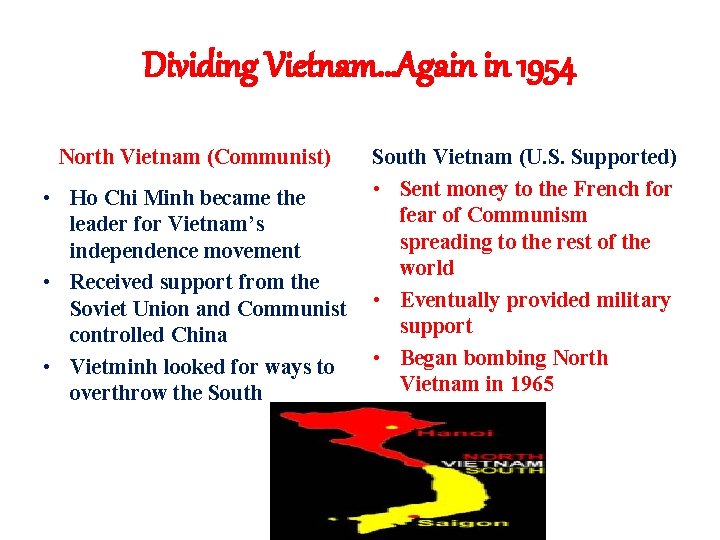
Dividing Vietnam…Again in 1954 North Vietnam (Communist) • Ho Chi Minh became the leader for Vietnam’s independence movement • Received support from the Soviet Union and Communist controlled China • Vietminh looked for ways to overthrow the South Vietnam (U. S. Supported) • Sent money to the French for fear of Communism spreading to the rest of the world • Eventually provided military support • Began bombing North Vietnam in 1965