
The Root System Chapter 7 Functions of Roots

- Slides: 40
The Root System Chapter 7
Functions of Roots • • Absorption of water and minerals Anchor plant in soil or to a surface Storage of foods Conduction of food and water from soil and from storage reserves into the shoot
Root System • Becomes more complex as plant grows • Balance between shoot and root systems – Root system – supplies shoot with enough water and minerals – Shoot system – manufactures enough food for root system
Root System • Rhizosphere – Contact zone between root surface and soil – Few mm thick – Bacteria and fungi nearer roots richer and more diverse than in soil farther away • Competition among plants – Competition for water, minerals, light energy by plants in close proximity to each other – Reduce competition by using different parts of soil
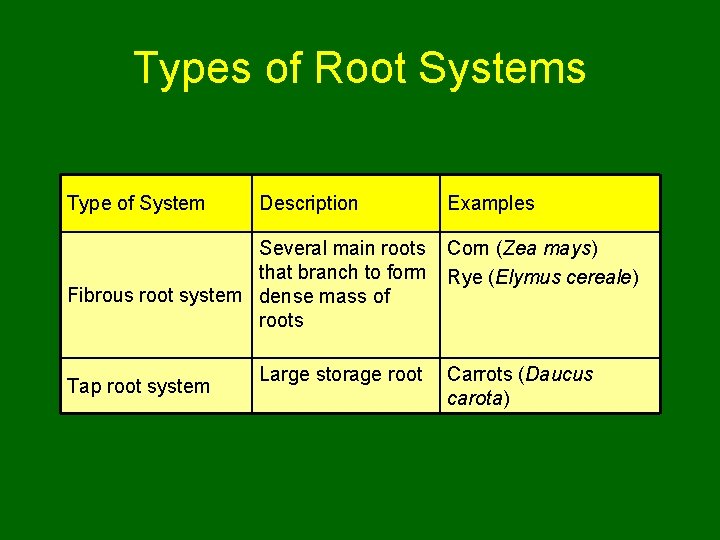
Types of Root Systems Type of System Description Several main roots that branch to form Fibrous root system dense mass of roots Tap root system Large storage root Examples Corn (Zea mays) Rye (Elymus cereale) Carrots (Daucus carota)
Different Types of Roots • Radicle – Embryonic root – Forms primary root • Tap root system – Develops from one primary root that forms lateral roots
Different Types of Roots • Grasses – Seminal roots – Embryonic roots just above radicle – Emerge after radicle – Radicle and seminal roots form fibrous root system
Different Types of Roots • Adventitious roots – Originate on leaves and stems – Examples • Prop roots – – Develop on stem just above soil Absorb water and minerals Support plant in soil Example: corn • Aerial roots • Pneumatophores
Different Types of Roots • Aerial roots – – Formed by branches of tree Absorb water and minerals Most important function is to hold up tree Example: banyan tree • Pneumatophores – – Small, adventitious roots Stick up from mud Absorb oxygen to supply submerged roots Example: mangrove tree
Root Propagation • Place stem of plants such as blackberry or willow in moist soil to induce root formation • Leaves of plants such as Begonia can be rooted by soaking them in water
Root Tip • Organized into three regions – Root apical meristem (RAM) – Region of elongation – Region of maturation
Root Tip • Root cap – Protects RAM – Site of gravity perception – Cells constantly sloughed off and replaced • Sloughed cells called border cells • Border cells remain alive in soil for short period of time • Provide nutrients for soil bacteria and fungi in rhizosphere
Root Tip • RAM – Regularly shaped cells – Organized into two areas • Quiescenter (QC) – – Small, centrally located portion Slow rate of cell division Seems to be activated in times of stress May be site where hormones controlling root development are synthesized • Cells apical to QC – Divide to produce cells that form root cap
Root Tip • Region of elongation – Cells elongate • Region of maturation – Site of root hair formation – Site of maturation of other cell types
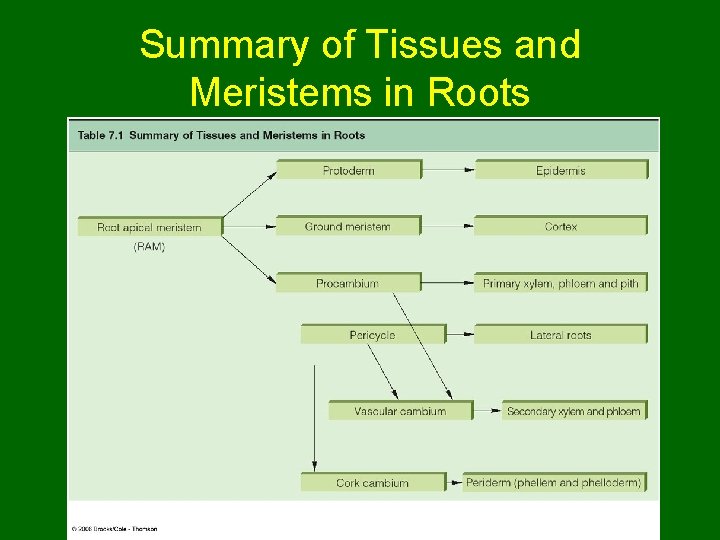
Primary Meristems of Root • RAM differentiates into – Protoderm – Ground meristem – procambium
Summary of Tissues and Meristems in Roots
Epidermis • Formed by differentiation of protoderm cells • Root hairs – Epidermal cell extension into surrounding soil – Thin cell walls composed of pectin and cellulose – Sticky • soil particles cling to root hairs – Short life • Function only a few days or weeks
Epidermis • Root hairs – Not formed by all plants • Some gymnosperms (Example: firs) • Many aquatic plants – Usually one cell layer thick • In aerial roots of plants like orchids can be multilayered
Cortex • Derived from ground meristem • Mainly composed of parenchyma cells • Endodermis – Innermost layer of cortex
Cortex – Casparian strip • Waxy material embedded in upper, lower, and side walls of endodermal cells • Function – Guarantee minerals that reach vascular cylinder do so by first passing through at least one plasma membrane – Provides mechanism to increase concentration of needed minerals through pumps in endodermis cell membrane
Cortex • Exodermis – Present in many grass roots and aerial roots of orchids – Occurs at outer layer of cortex – Functions to regulate ion absorption and accumulation
Vascular Cylinder • Composed of tissue differentiated from procambium cells • Dicot roots – Central core of primary xylem elements organized into two or more radiating points • Monocot roots – Center of root composed of parenchyma (sometimes called pith) – Primary xylem and phloem form in a ring
Vascular Cylinder • Protoxylem – First xylem element to mature – Develops at outer points of xylem – Transports water while root is elongating – Secondary cell wall in shape of annular rings or spirals • Provides both strength and elasticity
Vascular Cylinder • Metaxylem – Last primary xylem to mature – Differentiates in center of vascular cylinder – Mature in regions of root where elongation is completed – Forms thick secondary cell walls with pits for lateral exchange of water and nutrients
Vascular Cylinder • Xylem cell types in roots – Vessel elements – Tracheids – Parenchyma – Fibers
Vascular Cylinder • Phloem – Forms in areas between protoxylem arms – Protophloem • First part of vascular cylinder to become functional • Cells form at periphery of phloem • Function mainly during root elongation – Metaphloem • Develops toward inside • Functions during plant’s adult life
Vascular Cylinder • Phloem cell types – Parenchyma – Fibers – Sieve-tube members – Companion cells
Vascular Cylinder • Pericycle – Outermost boundary of vascular cylinder – Remains capable of dividing for long period of time – Functions in dicot roots • Site where lateral root development is initiated • Contributes to formation of vascular cylinder • Contributes to formation of cork cambium
Vascular Cylinder • Pericycle – Function in monocot roots • Lateral root initiation
Lateral Roots • Chemical regulators cause pericycle cells to begin dividing at specific sites • Lateral root primordia result • Lateral root pushes through and destroys cortical cells and outer epidermis – Digestive enzymes released from lateral root primordia probably aid in process • Emerging lateral root organized into root cap and RAM
Lateral Roots • Site where lateral root emerges is healed by secretion of mucilage and waxy substances from cortical cells • Vascular system of lateral root connected to vascular system of main root axis
Secondary Vascular Tissues • Formed by activation of vascular cambium • Initiated by activation of pericycle cells and residual procambium cells located between arcs of xylem and phloem • Forms secondary xylem toward inside • Forms secondary phloem toward outside
Secondary Vascular Tissues • Secondary xylem – continued growth expands root – Causes splitting, sloughing off, destruction of cortex and epidermis – Pressure stimulates pericycle to divide again • Converts secondary xylem into cork cambium which forms periderm
Secondary Vascular Tissues • Secondary xylem – Bark on woody roots • Includes all cells from vascular cambium outward • Appears similar to bark in stems • Has thinner, smoother outer surface Only monocot plant with secondary growth in roots is dragon’s blood tree (Dracaena draco)
Special Functions of Roots • Haustorial roots – Parasitic roots – Grow into vascular tissue of host stem – Obtain water and nutrients from host
Special Functions of Roots • Root nodules – Formed by leguminous plants – Bacteria associated with nodules fix atmospheric nitrogen to form usable by plants
Special Functions of Roots • Mycorrhizae – Association between roots and a fungus found in the soil – Short, forked roots – Common to about 90% of seed plants – Not essential for growth of host plant – Functions • Make roots more efficient in mineral absorption • May secrete hormones or antibiotics that reduce potential for plant diseases
Special Functions of Roots • Mycorrhizae – Two types – Ectotrophic mycorrhizae • Causes changes in root shape • Fungus does not penetrate root cells – Penetrates between cell walls of cortex forming sheath of fungal hyphae around root • These mycorrhizal roots lack root cap and have simple vascular cylinder – Endotrophic mycorrhizae
Special Functions of Roots – Endotrophic mycorrhizae • Fungus enters cortex cells
Special Functions of Roots • Dandelion roots – Capable of contracting • Accomplished by radial expansion of cells in root cortex – Keeps aboveground parts near soil surface