
The Roosevelt Corollary By Liz Time Frame Of
The Roosevelt Corollary By, Liz
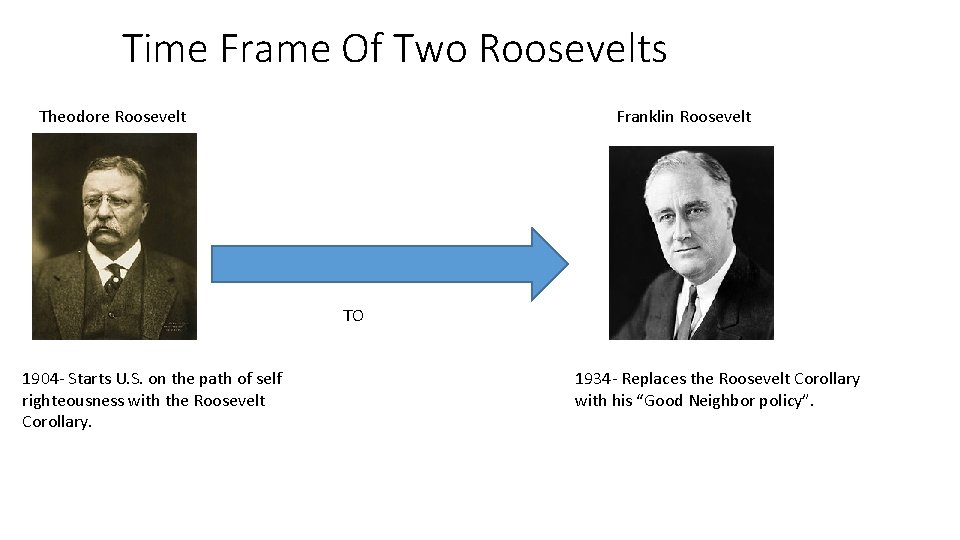
Time Frame Of Two Roosevelts Theodore Roosevelt Franklin Roosevelt TO 1904 - Starts U. S. on the path of self righteousness with the Roosevelt Corollary. 1934 - Replaces the Roosevelt Corollary with his “Good Neighbor policy”.
Causes of the Interaction Regions involved; Latin America Continental U. S. Europe Motives; • The U. S. was still in the process of proving that it was not a force to be trifled with • It was an opportunity for the U. S. to show that it backs up it’s words with actions • The people of the U. S. seemed to be interested in Latin America • Roosevelt was just a very pugnacious man and these were fights that could be justified • We felt the need to be the world police (and still continue to) and thought we had the right to be the world police
Effects of the Interaction • Latin American countries started to resent the U. S. • European countries started to get annoyed with the U. S. , particularly Britain since we threated them when they were in the right/were right • More then a dozen instances of U. S. troop being sent in and used in Latin America • Including interfering in Cuba from 1906 -1909, Nicaragua from 19091910, 1912 -1925, and 1926 -1933, Haiti from 1915 -1934, and the Dominican Republic from 1916 -1924
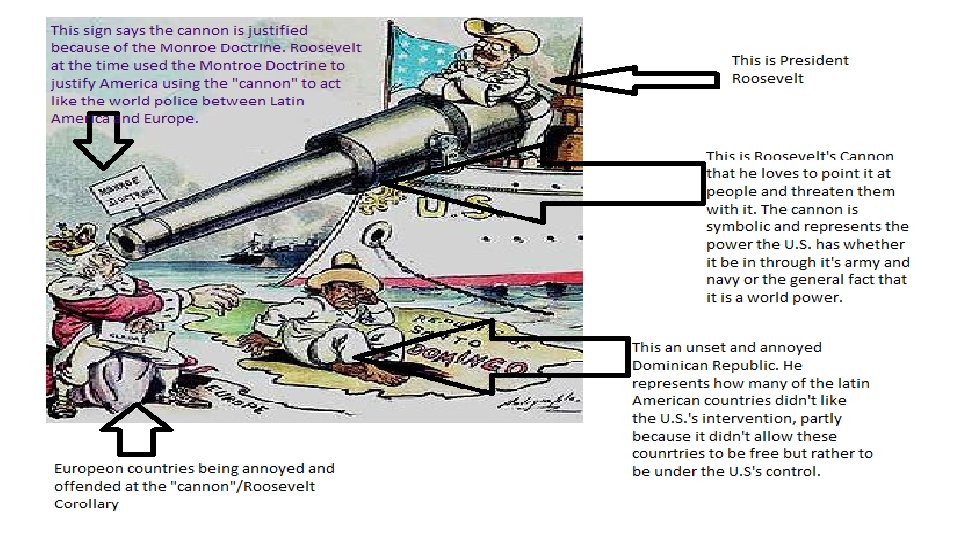
Value of the Document • What it helps us understand about the subject is that people noticed how much T. Roosevelt used the Monroe Doctrine and his Roosevelt Corollary to get (in some people’s opinions over) involved in affairs between Latin America and Europe. • The source has value in that it is a simple and kind of funny representation of how T. Roosevelt used his Roosevelt Corollary and the Monroe Doctrine to justify said corollary in order to keep European countries at “arm’s or cannon’s length” from Latin America • It shows how some people even back then in society thought that T. Roosevelt kind of over used his Roosevelt Corollary policy to keep Europe away from Latin America
Limitations of the Document • It doesn’t really show U. S. interference was occasionally necessary in Latin America-European affairs • It doesn’t make it clear that the U. S. was backing up what they had said to the world previously about handling all European claims when it came to Latin America • But I don’t think the source is corrupted or mistranslated overall.
According to this cartoon U. S. territorial expansion was not so much a proper and legitimate policy for the United States to follow, as it was T. Roosevelt making sure Europe brought it’s claims having to do with Latin America to the United States government and not Latin America directly.
- Slides: 8