
The Romanian educational system is organized in 4
- Slides: 18
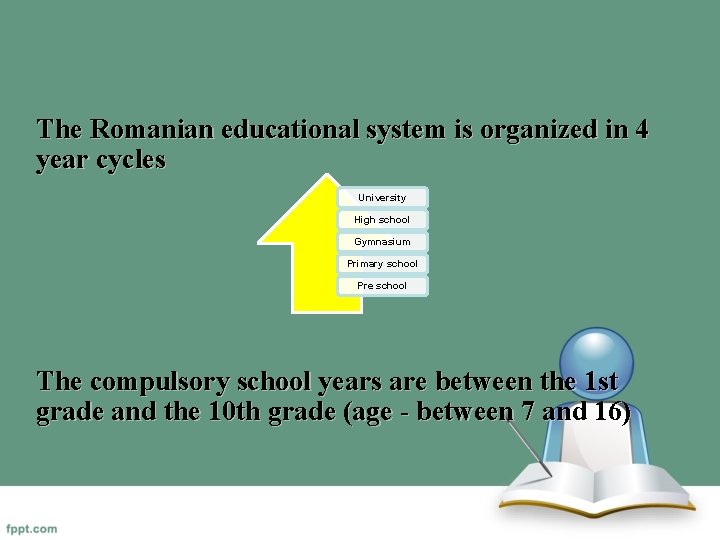
The Romanian educational system is organized in 4 year cycles University High school Gymnasium Primary school Pre school The compulsory school years are between the 1 st grade and the 10 th grade (age - between 7 and 16)
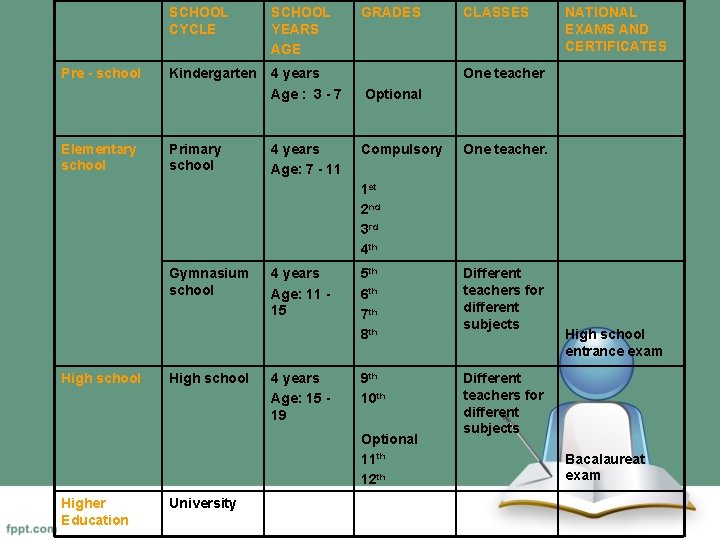
Pre - school Elementary school SCHOOL CYCLE SCHOOL YEARS AGE Kindergarten 4 years Age : 3 - 7 Primary school 4 years Age: 7 - 11 GRADES CLASSES NATIONAL EXAMS AND CERTIFICATES One teacher Optional Compulsory One teacher. 1 st 2 nd 3 rd 4 th Gymnasium school High school 4 years Age: 11 15 4 years Age: 15 19 5 th 6 th 7 th 8 th Different teachers for different subjects 9 th 10 th Different teachers for different subjects Optional 11 th 12 th Higher Education University High school entrance exam Bacalaureat exam
THE SCHOOL YEAR School starts in the middle of September and ends in the middle of June the following year. It is divided into two semesters: September to January February to June There are four holiday seasons Christmas Holiday— 2 weeks in December; Inter-Semestrial Holiday— 1 week in February; Easter Holiday — 1 week in April or May; Summer Holiday - June 15 th to September 15 th
SCHOOL SUBJECTS • During primary education in Romania, school subjects are Romanian, Mathematics, Music, Physical Education, Religion, Art, Practical Abilities, Geography, History, Biology, English or other foreign language • During gymnasium , students learn new subjects like Physics, Chemistry, another foreign language, which is French , German or Spanish, and Latin.
DURING HIGH SCHOOL THE SUBJECTS STUDIED DEPEND TO A GREAT EXTENT ON THE ACADEMIC PROGRAMME OFFERED – THE PROFILE OF THE HIGH SCHOOL. STUDENTS CAN CHOOSE BETWEEN: Theoretical program Sciences — mathematics and computer programming Humanities — social studies or languages Technical programs qualification in a technical field such as electrician, industrial machine operator, train driver and mechanic etc. A lot of subjects are technically based • Vocational programs qualification in a non-technical field, such as kindergarten educator , assistant architect, or pedagogue • Services and Economics programs qualification in the fields of services, such as waiter, chef, tourism operator •
CLASSES In primary schools students have between 18 -20 classes a week (about 4 classes daily) In the gymnasium they have between 25 -30 classes a week In the high school they have between 28 -33 classes a week (about 6 hours daily)
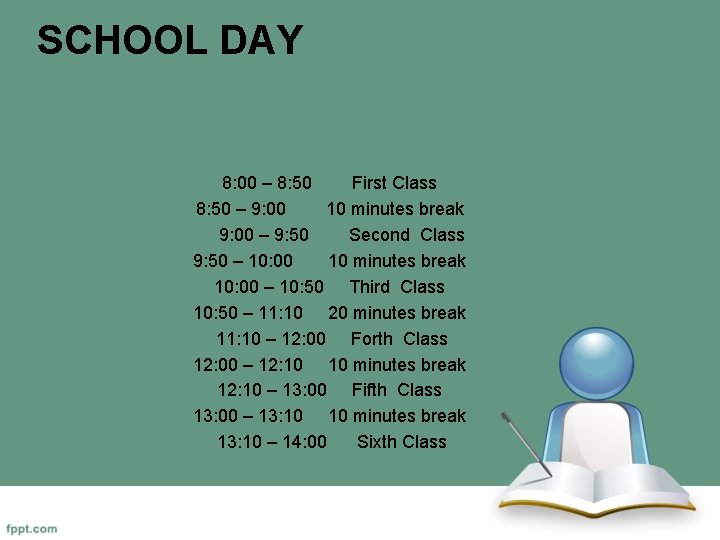
THE SCHOOL DAY The classes begin at 8 o’clock in the morning and finish between 12 o’clock and 3 pm One class lasts for 50 minutes and is followed by a 10 minutes break In high schools there is a 20 minute break after three classes, from 10: 50 to 11: 10 – this being usually the middle of the school day
SCHOOL DAY 8: 00 – 8: 50 First Class 8: 50 – 9: 00 10 minutes break 9: 00 – 9: 50 Second Class 9: 50 – 10: 00 10 minutes break 10: 00 – 10: 50 Third Class 10: 50 – 11: 10 20 minutes break 11: 10 – 12: 00 Forth Class 12: 00 – 12: 10 10 minutes break 12: 10 – 13: 00 Fifth Class 13: 00 – 13: 10 10 minutes break 13: 10 – 14: 00 Sixth Class
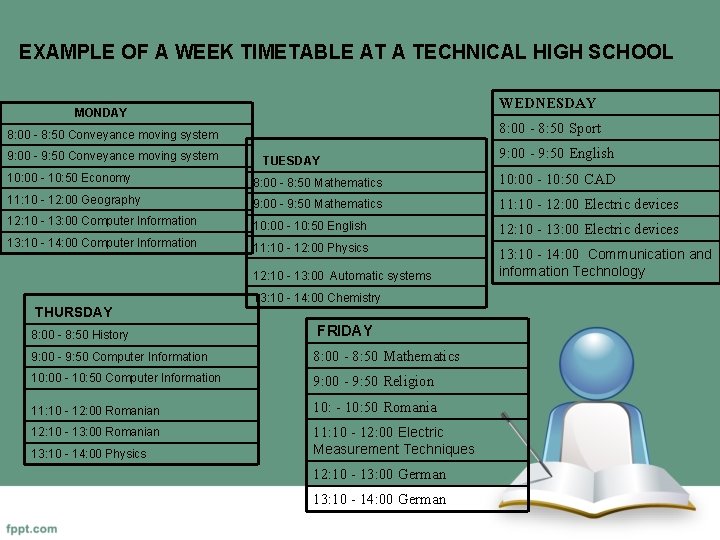
EXAMPLE OF A WEEK TIMETABLE AT A TECHNICAL HIGH SCHOOL WEDNESDAY MONDAY 8: 00 - 8: 50 Sport 8: 00 - 8: 50 Conveyance moving system 9: 00 - 9: 50 Conveyance moving system TUESDAY 9: 00 - 9: 50 English 10: 00 - 10: 50 Economy 8: 00 - 8: 50 Mathematics 10: 00 - 10: 50 CAD 11: 10 - 12: 00 Geography 9: 00 - 9: 50 Mathematics 11: 10 - 12: 00 Electric devices 12: 10 - 13: 00 Computer Information 10: 00 - 10: 50 English 13: 10 - 14: 00 Computer Information 12: 10 - 13: 00 Electric devices 11: 10 - 12: 00 Physics 13: 10 - 14: 00 Communication and 12: 10 - 13: 00 Automatic systems information Technology 13: 10 - 14: 00 Chemistry THURSDAY 8: 00 - 8: 50 History FRIDAY 9: 00 - 9: 50 Computer Information 8: 00 - 8: 50 Mathematics 10: 00 - 10: 50 Computer Information 9: 00 - 9: 50 Religion 11: 10 - 12: 00 Romanian 10: - 10: 50 Romania 12: 10 - 13: 00 Romanian 11: 10 - 12: 00 Electric 13: 10 - 14: 00 Physics Measurement Techniques 12: 10 - 13: 00 German 13: 10 - 14: 00 German
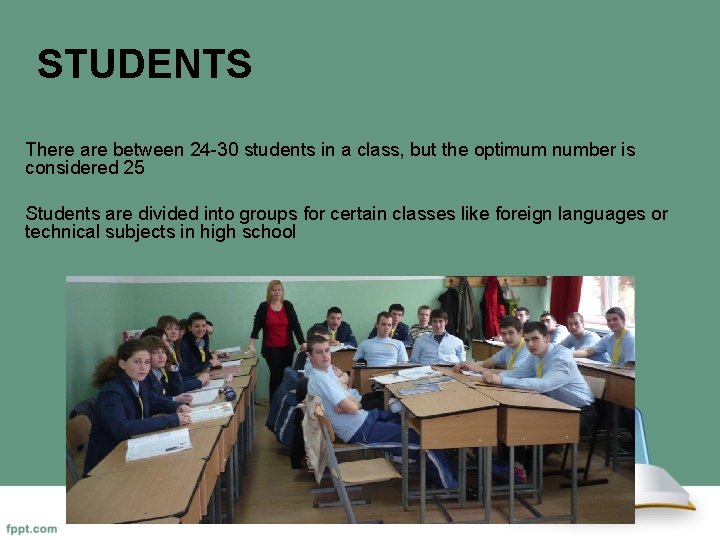
STUDENTS There are between 24 -30 students in a class, but the optimum number is considered 25 Students are divided into groups for certain classes like foreign languages or technical subjects in high school
TEACHERS Starting with the 5 th grade, students have a different teacher for each subject. Each class has a teacher designated to be the form teacher (diriginte) besides teaching his or her usual subject If the students have a problem they talk to the class principal who is responsible for the class and has to manage all the problems encountered by the students or the other teachers who teach at that class The class principal keeps contact with the students’ parents and organizes the teacher – parents meetings.
EVALUATION The continuous assessment system is used for the evaluation of students Students get marks throughout the year There must be at least as many marks for a subject as the number of weekly classes for that subject plus one. The students get marks from Tests Oral examination Class work Project work Homework
GRADING SYSTEM For the first four years the grading systems consists of the following grades : Excellent, Good, Satisfactory, Insufficient For grade 5 to 12, a 1 to 10 grading system is used with 10 being the best and 1 being the worst and 5 is the minimum passing grade. At the end of each semester, a semestrial average is made from the marks at each subject. At the end of the school year the yearly average is made from the semestrial marks If the Yearly Average is below 5 for a maximum of two subjects, then the student must take a special exam at the failed subject in August, in front of a school board. If he fails this exam, he must repeat the entire year (If the Yearly Average is below 5 for three subjects or more, the student is no longer entitled to the special exam and must repeat the year.
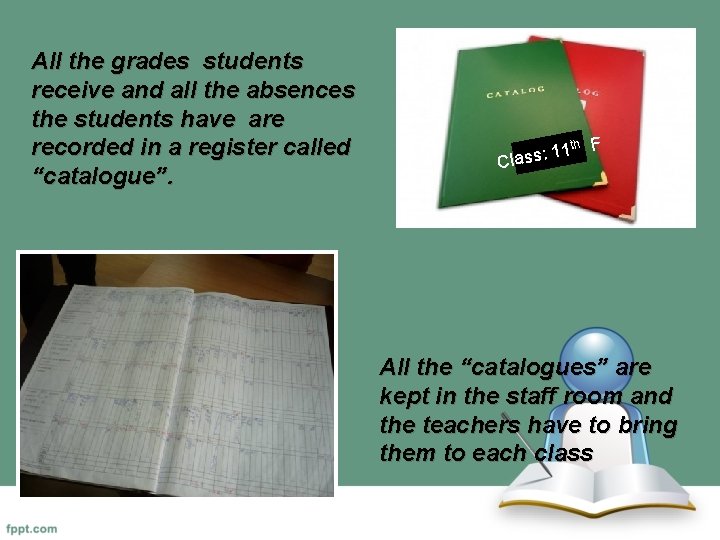
All the grades students receive and all the absences the students have are recorded in a register called “catalogue”. th 11 Class: F All the “catalogues” are kept in the staff room and the teachers have to bring them to each class
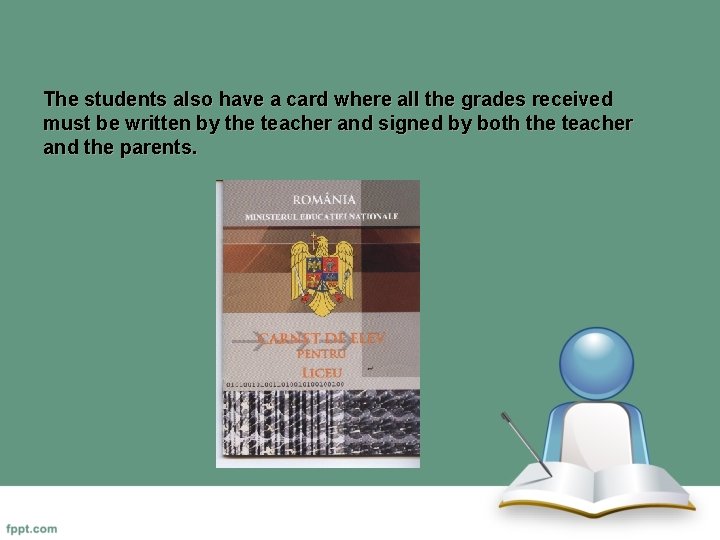
The students also have a card where all the grades received must be written by the teacher and signed by both the teacher and the parents.
EXAMS There are two important national exams The exam at the end of the gymnasium, after the 8 th grade, the high school entrance exam. The students are tested in Romanian, Mathematics, History The “BACALAUREAT” – the graduation exam that students must pass at the end of the 4 years of high school if they want to go to university This exam consists of: Romanian - written and oral examination Mathematics / History - written examination English- oral examination Computer Science – practical examination For the last paper the students can choose between the subjects connected with the program they have studied during high school
THE ROMANIAN EDUCATIONAL SYSTEM Since the Romanian Revolution of 1989, the Romanian education system has been in a continuous process of reformation that has been both praised and criticised and it has not finished yet. In conclusion in the future there might be some changes