
The Roman World Takes Shape Ch 6 Sec





- Slides: 86
The Roman World Takes Shape Ch. 6, Sec. 1 1. How did geography shape the early development of Rome? 2. What were the major characteristics of government and society in the Roman republic? 3. Why was Rome’s expansion in Italy successful?
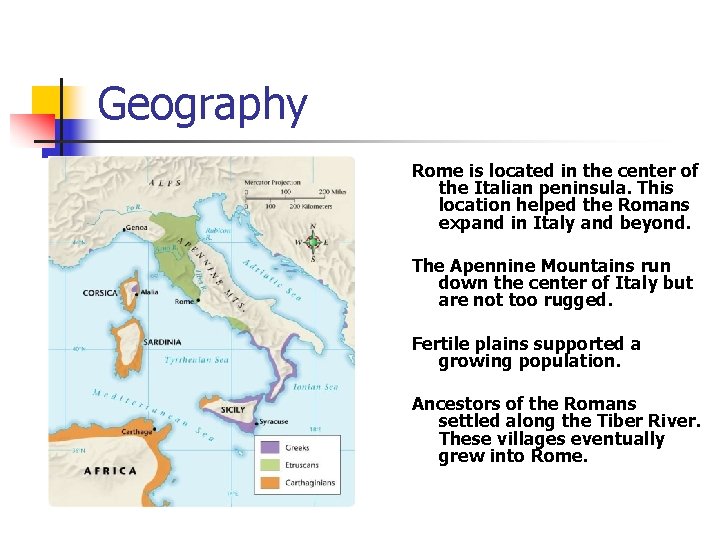
Geography Rome is located in the center of the Italian peninsula. This location helped the Romans expand in Italy and beyond. The Apennine Mountains run down the center of Italy but are not too rugged. Fertile plains supported a growing population. Ancestors of the Romans settled along the Tiber River. These villages eventually grew into Rome.
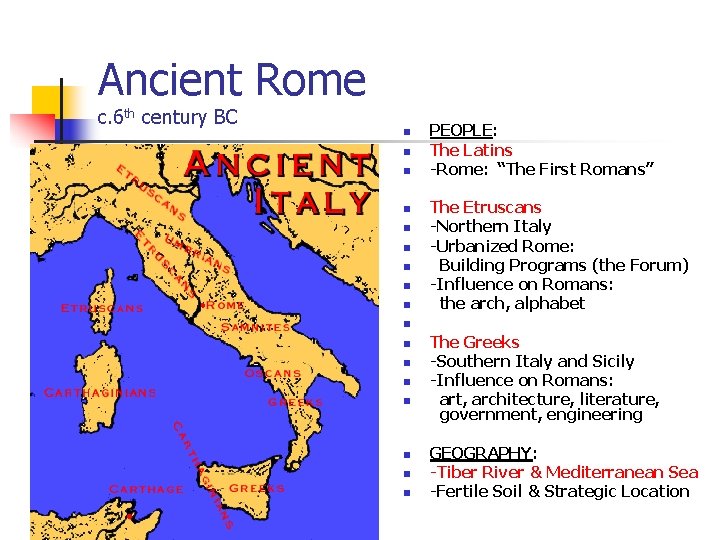
Ancient Rome c. 6 th century BC n n n n n PEOPLE: The Latins -Rome: “The First Romans” The Etruscans -Northern Italy -Urbanized Rome: Building Programs (the Forum) -Influence on Romans: the arch, alphabet The Greeks -Southern Italy and Sicily -Influence on Romans: art, architecture, literature, . . government, engineering GEOGRAPHY: -Tiber River & Mediterranean Sea -Fertile Soil & Strategic Location
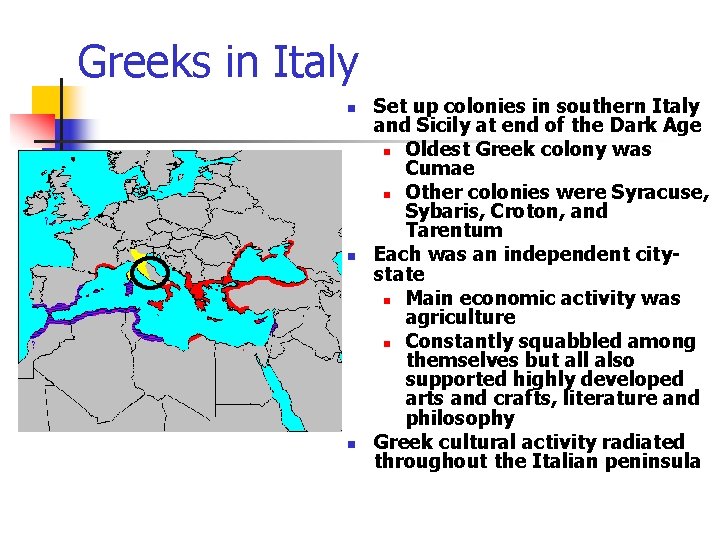
Greeks in Italy n n n Set up colonies in southern Italy and Sicily at end of the Dark Age n Oldest Greek colony was Cumae n Other colonies were Syracuse, Sybaris, Croton, and Tarentum Each was an independent citystate n Main economic activity was agriculture n Constantly squabbled among themselves but all also supported highly developed arts and crafts, literature and philosophy Greek cultural activity radiated throughout the Italian peninsula
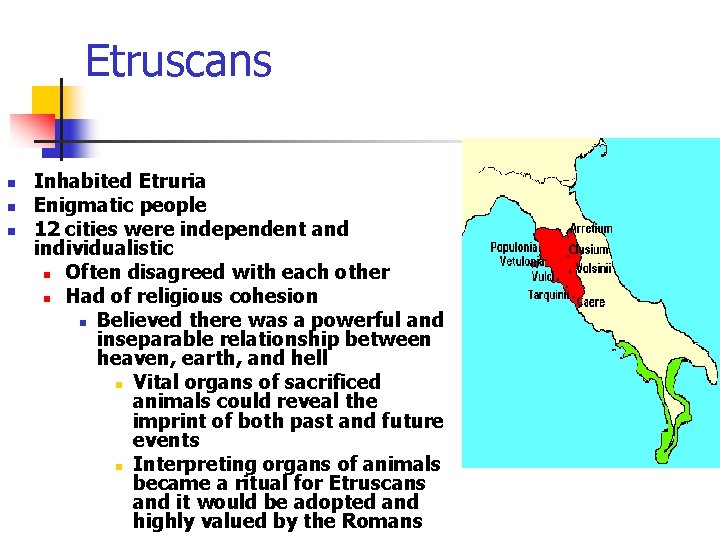
Etruscans n n n Inhabited Etruria Enigmatic people 12 cities were independent and individualistic n Often disagreed with each other n Had of religious cohesion n Believed there was a powerful and inseparable relationship between heaven, earth, and hell n Vital organs of sacrificed animals could reveal the imprint of both past and future events n Interpreting organs of animals became a ritual for Etruscans and it would be adopted and highly valued by the Romans
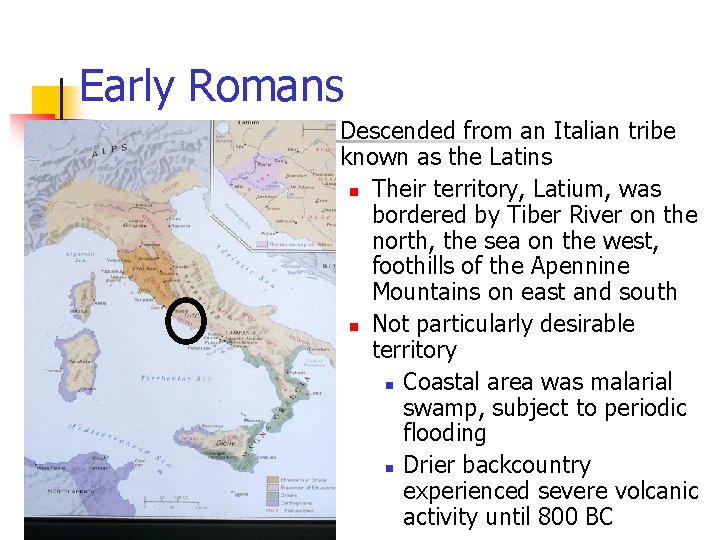
Early Romans n Descended from an Italian tribe known as the Latins n Their territory, Latium, was bordered by Tiber River on the north, the sea on the west, foothills of the Apennine Mountains on east and south n Not particularly desirable territory n Coastal area was malarial swamp, subject to periodic flooding n Drier backcountry experienced severe volcanic activity until 800 BC
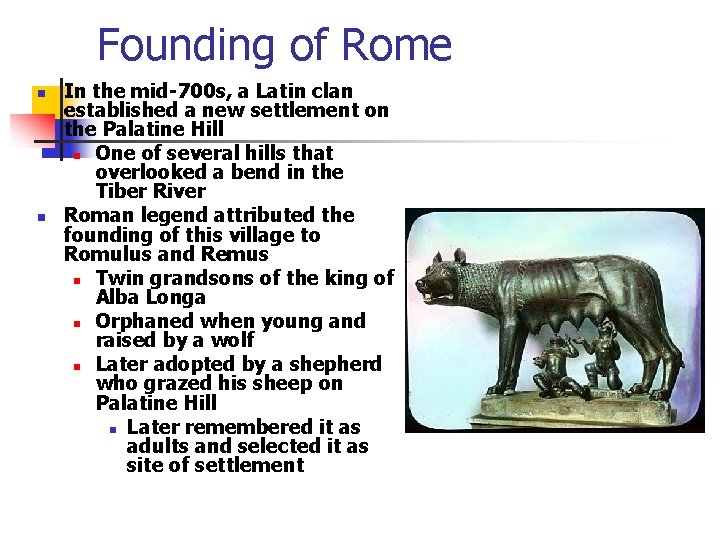
Founding of Rome n n In the mid-700 s, a Latin clan established a new settlement on the Palatine Hill n One of several hills that overlooked a bend in the Tiber River Roman legend attributed the founding of this village to Romulus and Remus n Twin grandsons of the king of Alba Longa n Orphaned when young and raised by a wolf n Later adopted by a shepherd who grazed his sheep on Palatine Hill n Later remembered it as adults and selected it as site of settlement
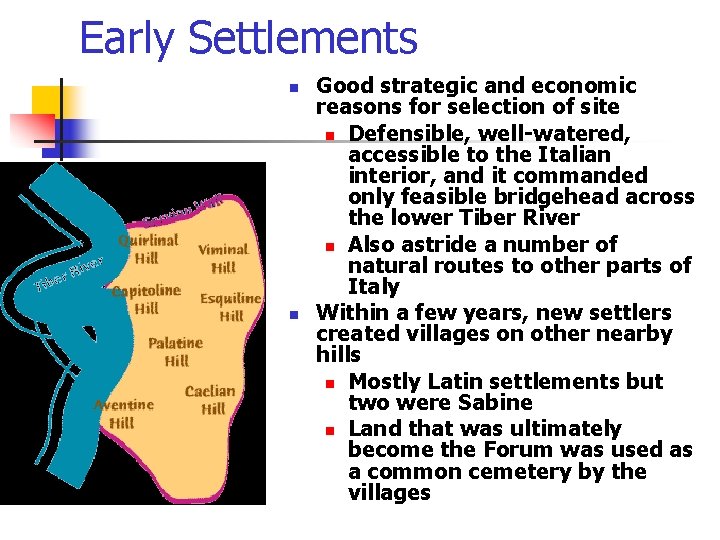
Early Settlements n n Good strategic and economic reasons for selection of site n Defensible, well-watered, accessible to the Italian interior, and it commanded only feasible bridgehead across the lower Tiber River n Also astride a number of natural routes to other parts of Italy Within a few years, new settlers created villages on other nearby hills n Mostly Latin settlements but two were Sabine n Land that was ultimately become the Forum was used as a common cemetery by the villages
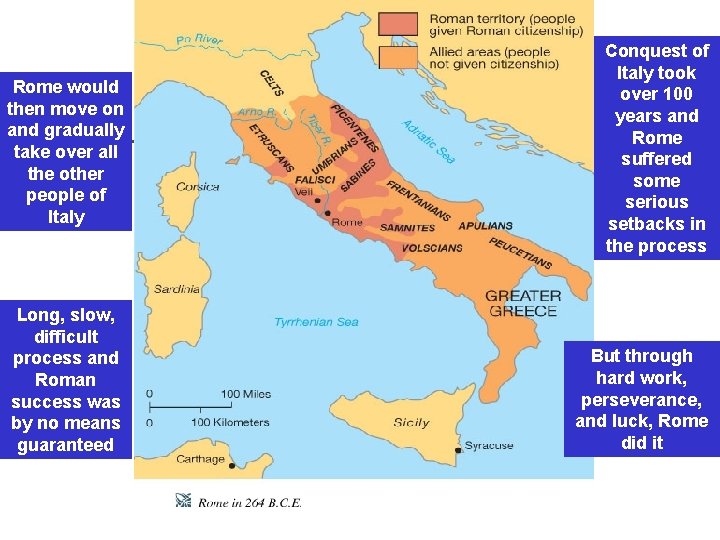
Rome would then move on and gradually take over all the other people of Italy Long, slow, difficult process and Roman success was by no means guaranteed Conquest of Italy took over 100 years and Rome suffered some serious setbacks in the process But through hard work, perseverance, and luck, Rome did it
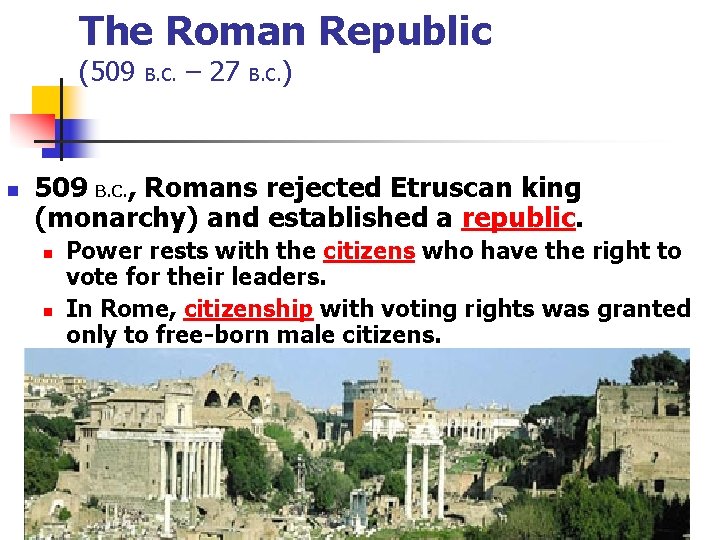
The Roman Republic (509 n B. C. – 27 B. C. ) 509 B. C. , Romans rejected Etruscan king (monarchy) and established a republic. n n Power rests with the citizens who have the right to vote for their leaders. In Rome, citizenship with voting rights was granted only to free-born male citizens.
The Roman Republic (509 n n n B. C. – 27 B. C. ) The new government of the Roman Republic ordered the letters SPQR to be chiseled on public buildings, armor, coins, and even park benches. The letters SPQR were chiseled on anything that belonged to the state. Under the Republic, the state was composed of the Senate and the People of Rome. That's what SPQR stood for - ‘Senatus Populus Que Romanus’ - the Senate and the People of Rome. It was a publicity campaign, and it worked! Every time the people saw the letters SPQR, they were reassured that things had changed. The kings were gone. It was a time of new leadership and new government. It was the time of the Roman Republic.
Creating a Republic
The Roman Republic (509 B. C. – 27 B. C. ) STRUGGLE FOR POWER: CLASS CONFLICT n n Patricians- wealthy landowners who held most of the power: inherited power and social status Plebeians- (Plebs) common farmers, artisans and merchants who made up the majority of the population: can vote, but can’t rule n Tribunes- elected representatives who protect plebeians’ political rights.
The Roman Republic (509 n n B. C. – 27 B. C. ) A “Balanced” Government Rome elects two consuls– one to lead army, one to direct government Senate- chosen from patricians (Roman upper class), make foreign and domestic policy Popular assemblies elect tribunes, make laws for plebeians (commoners) Dictators- leaders appointed briefly in times of crisis (appt. by consuls and senate)
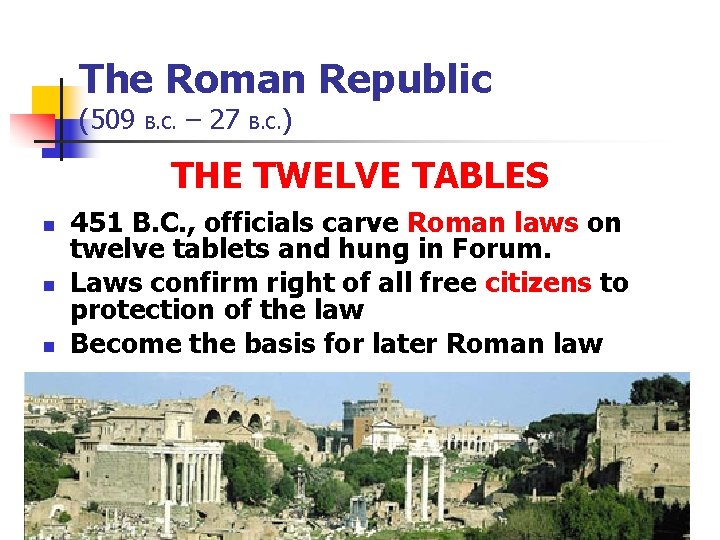
The Roman Republic (509 B. C. – 27 B. C. ) THE TWELVE TABLES n n n 451 B. C. , officials carve Roman laws on twelve tablets and hung in Forum. Laws confirm right of all free citizens to protection of the law Become the basis for later Roman law
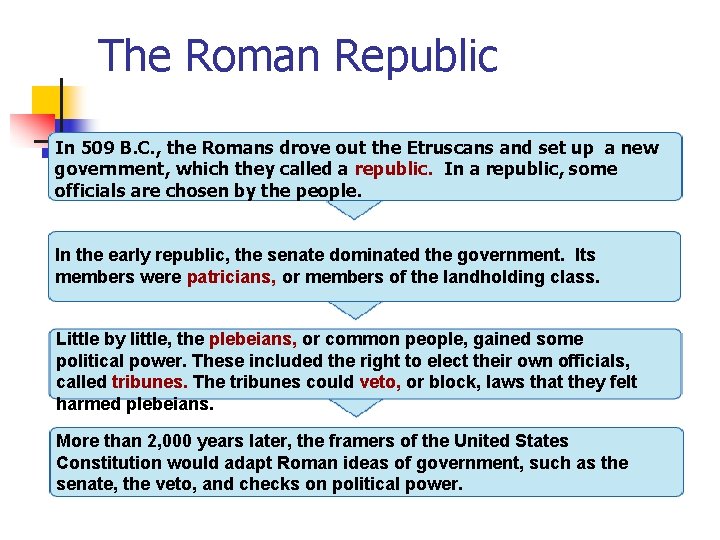
The Roman Republic In 509 B. C. , the Romans drove out the Etruscans and set up a new government, which they called a republic. In a republic, some officials are chosen by the people. In the early republic, the senate dominated the government. Its members were patricians, or members of the landholding class. Little by little, the plebeians, or common people, gained some political power. These included the right to elect their own officials, called tribunes. The tribunes could veto, or block, laws that they felt harmed plebeians. More than 2, 000 years later, the framers of the United States Constitution would adapt Roman ideas of government, such as the senate, the veto, and checks on political power.
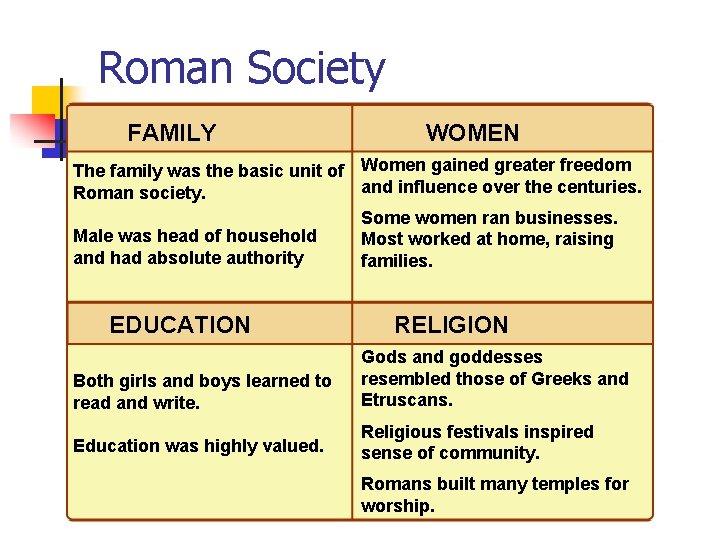
Roman Society FAMILY WOMEN The family was the basic unit of Women gained greater freedom and influence over the centuries. Roman society. Some women ran businesses. Male was head of household Most worked at home, raising and had absolute authority families. EDUCATION RELIGION Both girls and boys learned to read and write. Gods and goddesses resembled those of Greeks and Etruscans. Education was highly valued. Religious festivals inspired sense of community. Romans built many temples for worship.
Expansion in Italy By about 270 B. C. , Rome controlled most of the Italian peninsula. Why was Rome’s expansion in Italy successful? • Skilled diplomacy • Loyal, well-trained army • Treated defeated enemies fairly • Gave rights to conquered people
From Republic to Empire Chapter 6, Section 2 - How did Rome win an empire? - Why did the Roman Republic decline? - How did Roman emperors promote peace and stability in the empire?
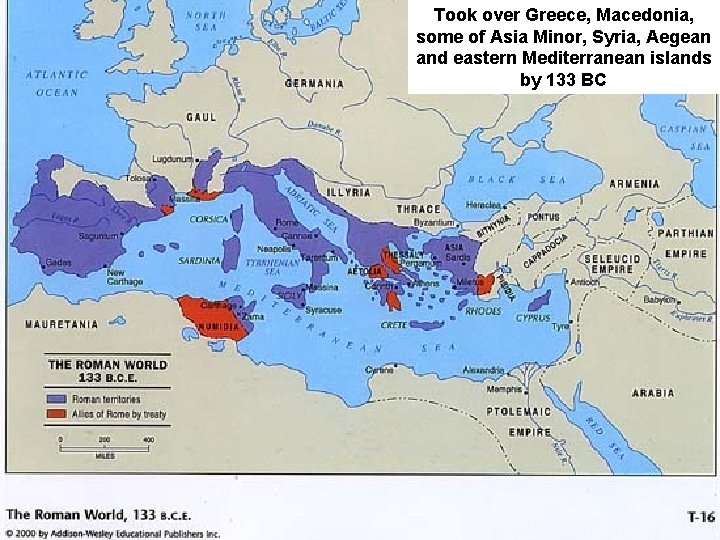
Winning an Empire After gaining control of the Italian peninsula, Rome began to build an empire around the Mediterranean Sea. n n The Romans followed a policy of imperialism, establishing control over foreign lands and peoples. Carthage, Macedonia, Greece, and parts of Asia Minor became Roman provinces, or lands under Roman rule.
Took over Greece, Macedonia, some of Asia Minor, Syria, Aegean and eastern Mediterranean islands by 133 BC
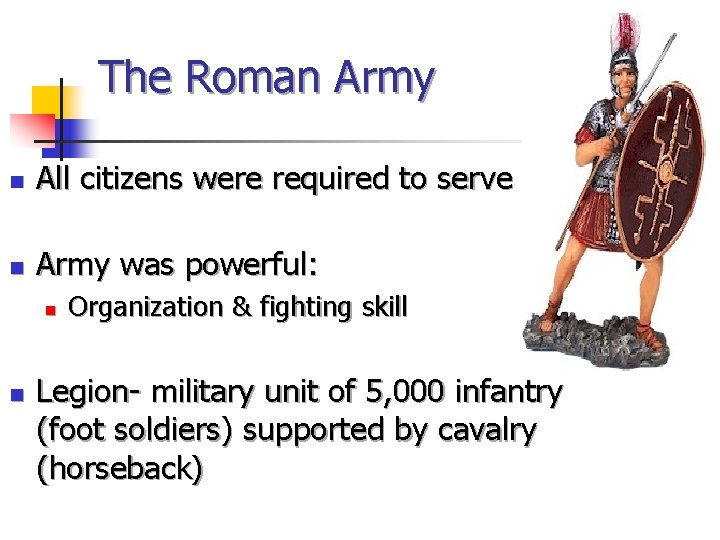
The Roman Army n All citizens were required to serve n Army was powerful: n n Organization & fighting skill Legion- military unit of 5, 000 infantry (foot soldiers) supported by cavalry (horseback)
Wars With Carthage: The Punic Wars n n Between 264 and 146 BC, Rome and Carthage fought 3 wars Called the Punic Wars from Punicus, the Latin word for Phoenician
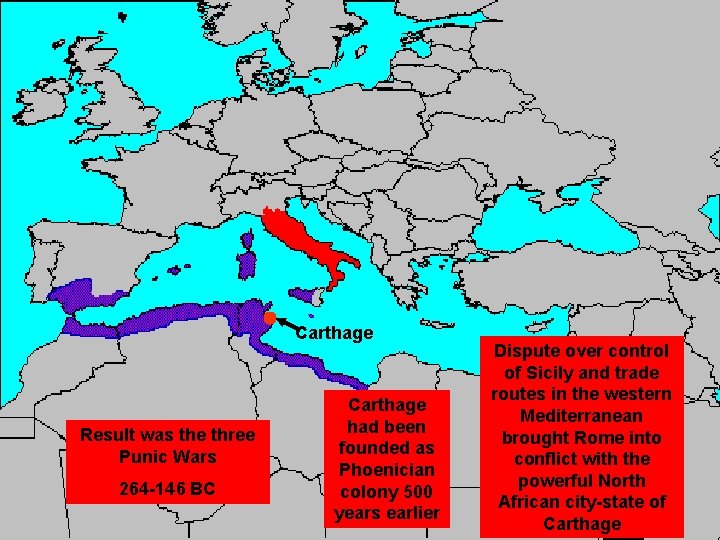
Carthage Result was the three Punic Wars 264 -146 BC Carthage had been founded as Phoenician colony 500 years earlier Dispute over control of Sicily and trade routes in the western Mediterranean brought Rome into conflict with the powerful North African city-state of Carthage
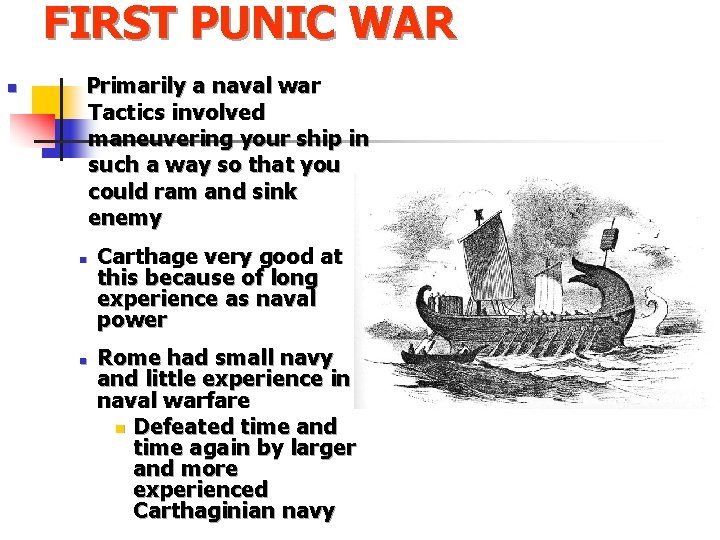
FIRST PUNIC WAR n Primarily a naval war Tactics involved maneuvering your ship in such a way so that you could ram and sink enemy n n Carthage very good at this because of long experience as naval power Rome had small navy and little experience in naval warfare n Defeated time and time again by larger and more experienced Carthaginian navy
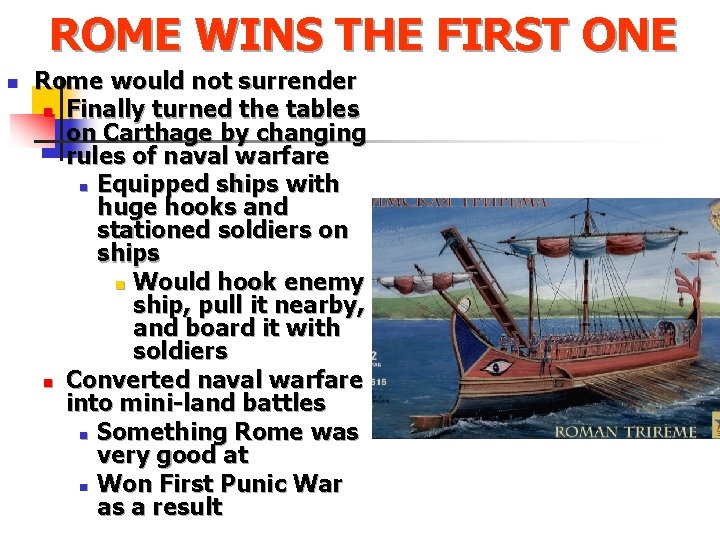
ROME WINS THE FIRST ONE n Rome would not surrender n Finally turned the tables on Carthage by changing rules of naval warfare n Equipped ships with huge hooks and stationed soldiers on ships n Would hook enemy ship, pull it nearby, and board it with soldiers n Converted naval warfare into mini-land battles n Something Rome was very good at n Won First Punic War as a result
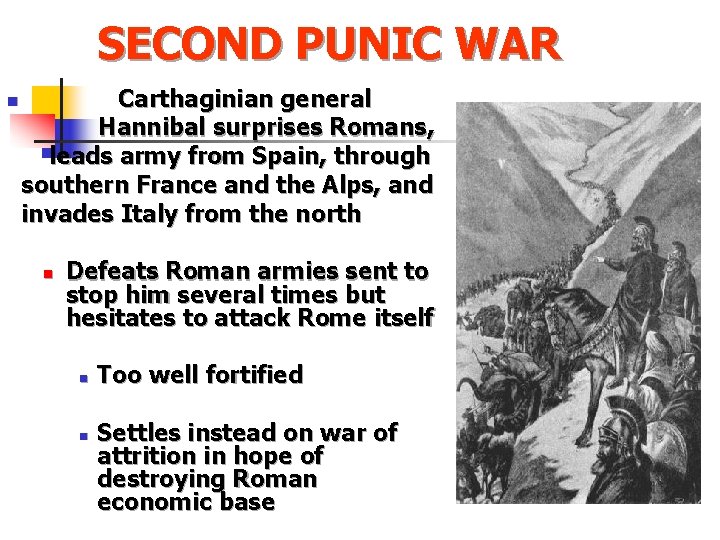
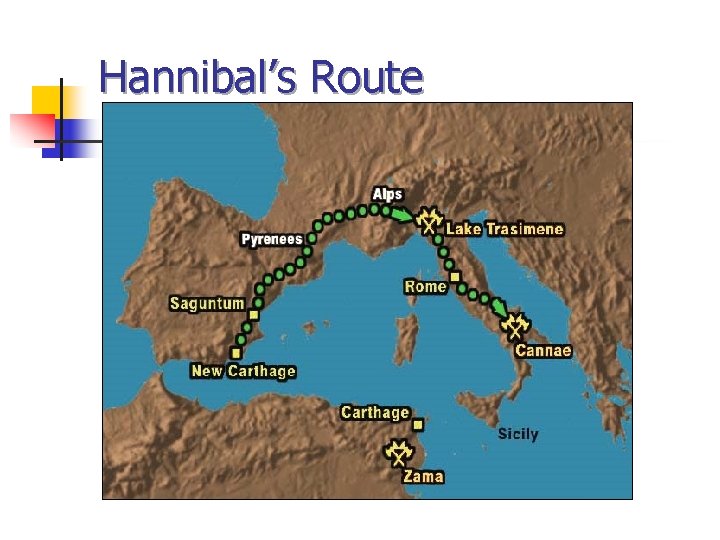
SECOND PUNIC WAR Carthaginian general Hannibal surprises Romans, leads army from Spain, through southern France and the Alps, and invades Italy from the north n n Defeats Roman armies sent to stop him several times but hesitates to attack Rome itself n n Too well fortified Settles instead on war of attrition in hope of destroying Roman economic base
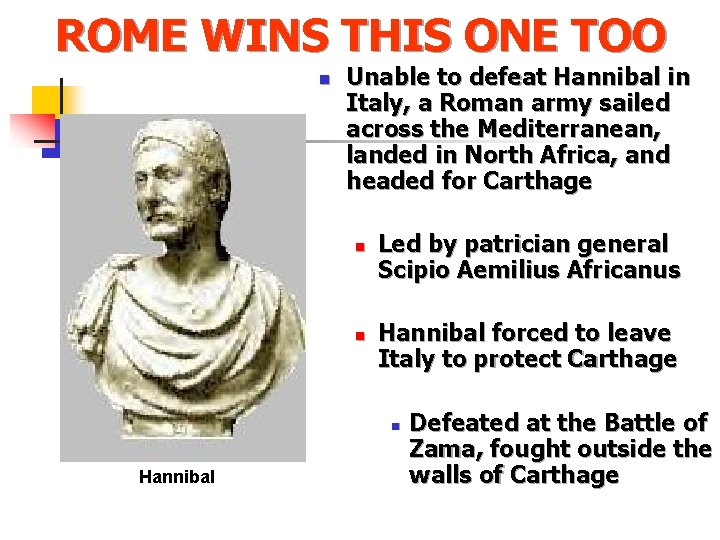
ROME WINS THIS ONE TOO n Unable to defeat Hannibal in Italy, a Roman army sailed across the Mediterranean, landed in North Africa, and headed for Carthage n n Led by patrician general Scipio Aemilius Africanus Hannibal forced to leave Italy to protect Carthage n Hannibal Defeated at the Battle of Zama, fought outside the walls of Carthage
Hannibal’s Route
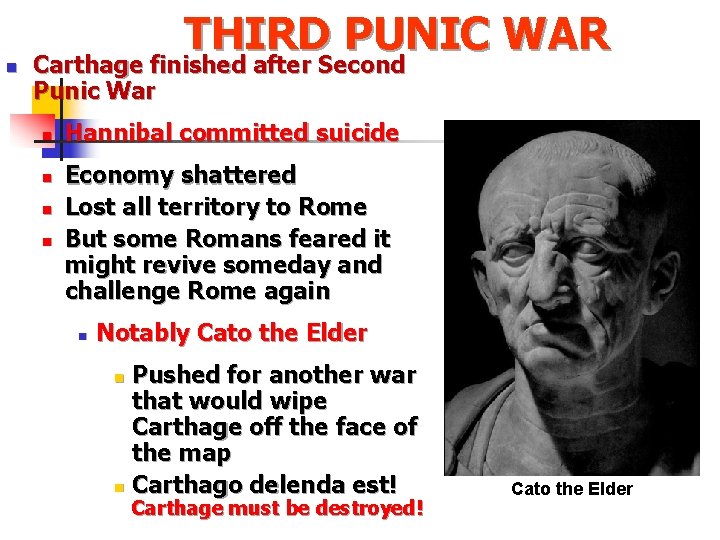
THIRD PUNIC WAR n Carthage finished after Second Punic War n n Hannibal committed suicide Economy shattered Lost all territory to Rome But some Romans feared it might revive someday and challenge Rome again n Notably Cato the Elder n n Pushed for another war that would wipe Carthage off the face of the map Carthago delenda est! Carthage must be destroyed! Cato the Elder
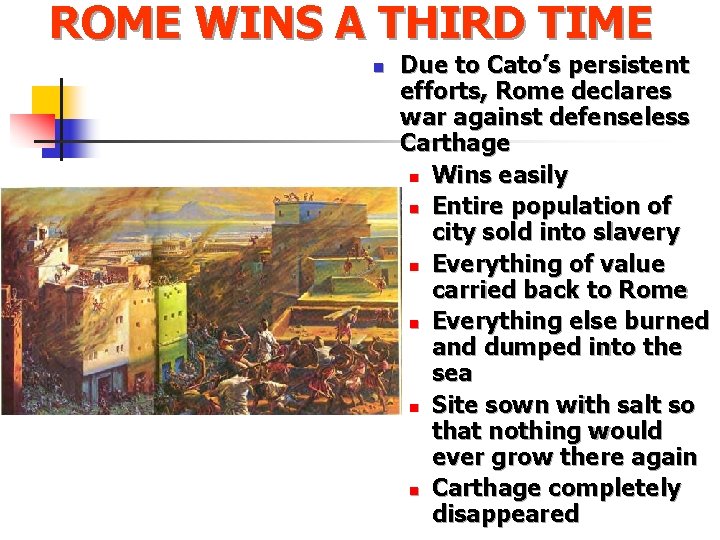
ROME WINS A THIRD TIME n Due to Cato’s persistent efforts, Rome declares war against defenseless Carthage n Wins easily n Entire population of city sold into slavery n Everything of value carried back to Rome n Everything else burned and dumped into the sea n Site sown with salt so that nothing would ever grow there again n Carthage completely disappeared
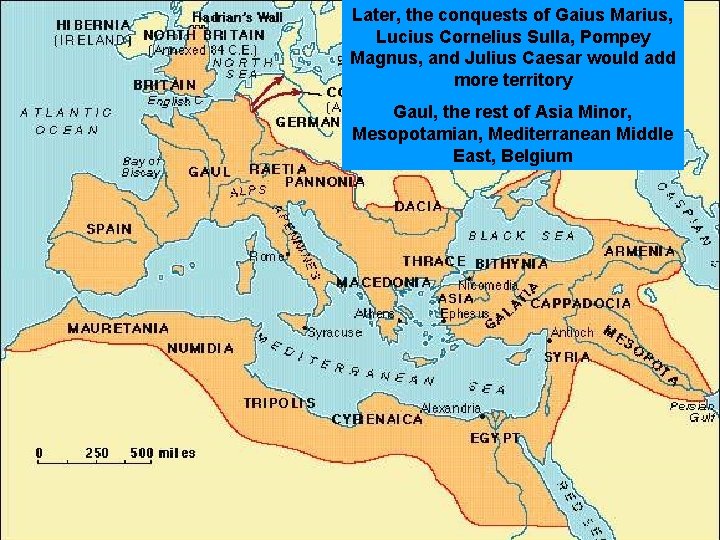
Later, the conquests of Gaius Marius, Lucius Cornelius Sulla, Pompey Magnus, and Julius Caesar would add more territory Gaul, the rest of Asia Minor, Mesopotamian, Mediterranean Middle East, Belgium
Reform Due to the growing wealthy class, and the use of slave labor, poor Romans became even poorer. Many flocked to cities and caused riots. A reform was needed. n n Tiberius and Gaius Gracchus (The Gracchi Brothers): two patricians who spearheaded reform. Tiberius was elected tribune in 133 BC. He wanted land distributed to poor farmers. Gaius, elected in 123 BC, sought wider reforms, including a program to provide grain for the poor. These reforms angered the Senate. The brothers were killed by the Senate’s hired thugs.
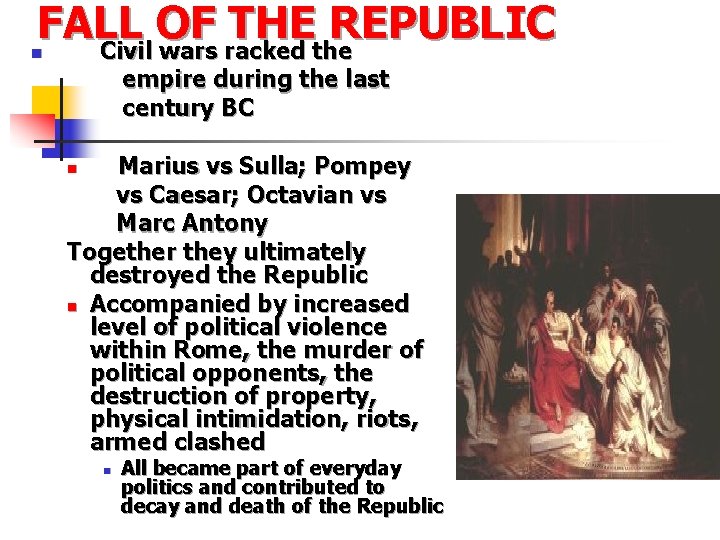
FALL OF THE REPUBLIC Civil wars racked the n empire during the last century BC Marius vs Sulla; Pompey vs Caesar; Octavian vs Marc Antony Together they ultimately destroyed the Republic n Accompanied by increased level of political violence within Rome, the murder of political opponents, the destruction of property, physical intimidation, riots, armed clashed n n All became part of everyday politics and contributed to decay and death of the Republic
The First Triumvirate n Julius Caesar n Marcus Licinius Crassus n Gaius Magnus Pompey These 3 come to power during the chaos near the end of the Republic.
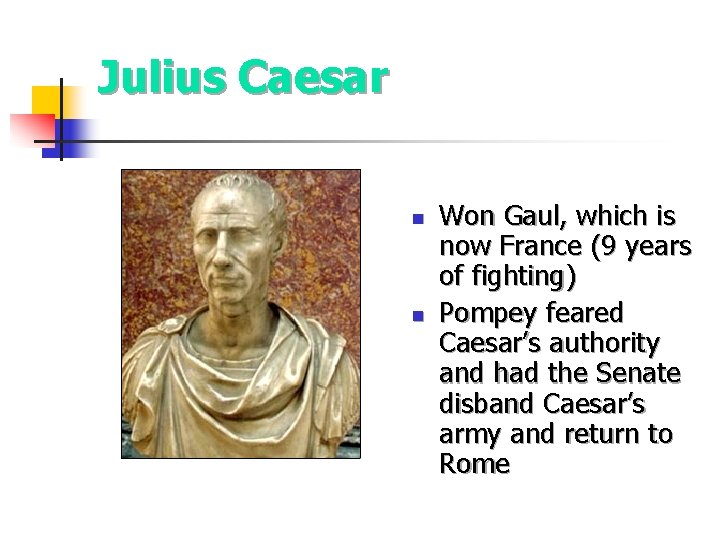
Julius Caesar n n Won Gaul, which is now France (9 years of fighting) Pompey feared Caesar’s authority and had the Senate disband Caesar’s army and return to Rome
Julius Caesar n n n “Alea iacta est!” THE DIE IS CAST! Caesar defies the Senate’s orders He swiftly and secretly leads his army across the Rubicon River into northern Italy Civil war erupts Caesar crushes Pompey and his supporters “Veni, Vidi, Vici!” I CAME, I SAW, I CONQUERED!
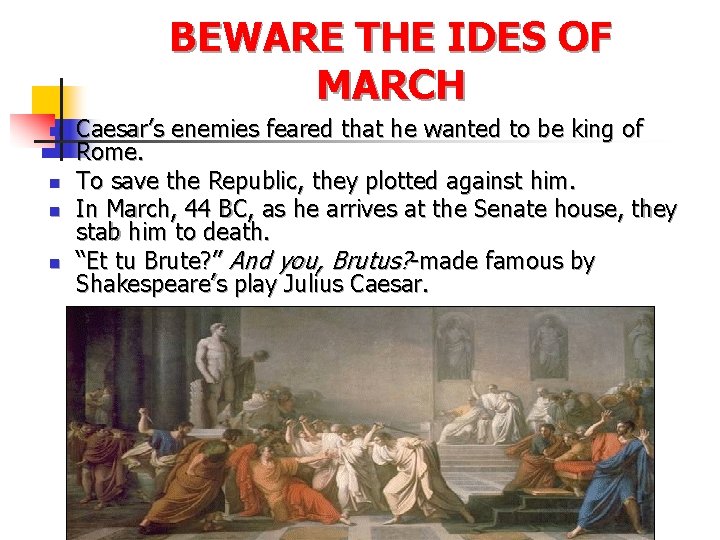
BEWARE THE IDES OF MARCH n n Caesar’s enemies feared that he wanted to be king of Rome. To save the Republic, they plotted against him. In March, 44 BC, as he arrives at the Senate house, they stab him to death. “Et tu Brute? ” And you, Brutus? -made famous by Shakespeare’s play Julius Caesar.
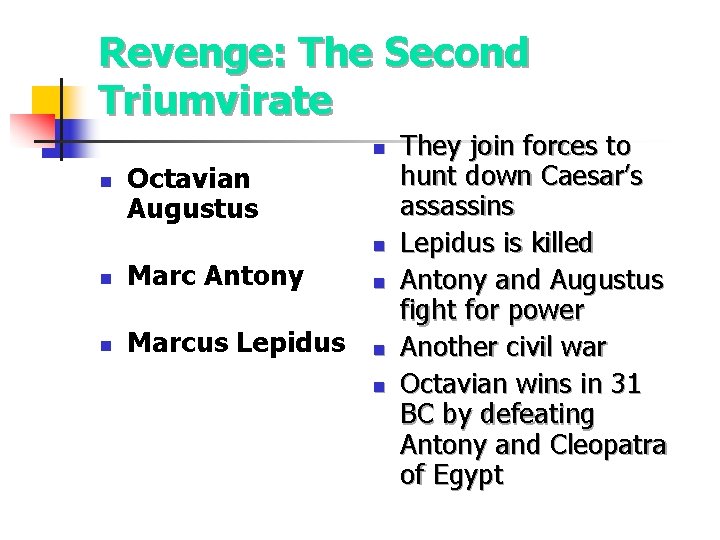
Revenge: The Second Triumvirate n n Octavian Augustus n n Marc Antony n n Marcus Lepidus n n They join forces to hunt down Caesar’s assassins Lepidus is killed Antony and Augustus fight for power Another civil war Octavian wins in 31 BC by defeating Antony and Cleopatra of Egypt
Fall of the Republic
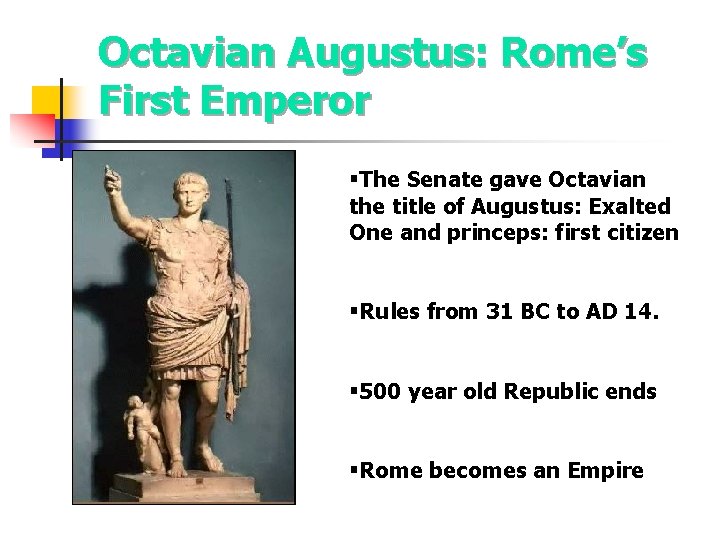
Octavian Augustus: Rome’s First Emperor §The Senate gave Octavian the title of Augustus: Exalted One and princeps: first citizen §Rules from 31 BC to AD 14. § 500 year old Republic ends §Rome becomes an Empire
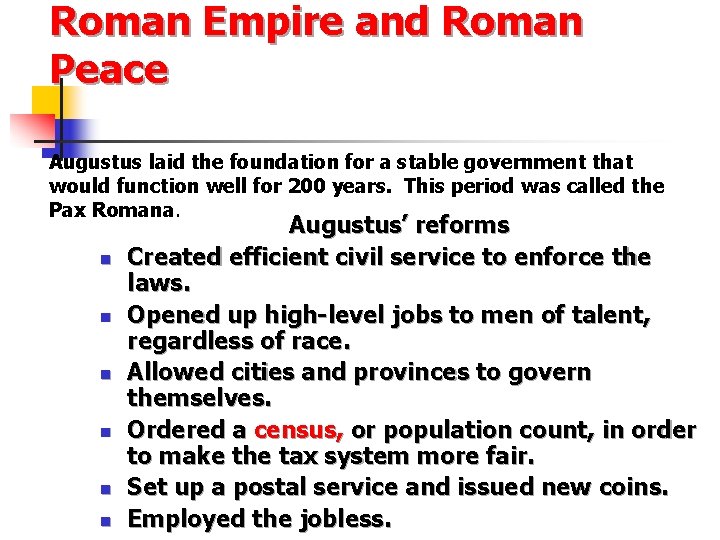
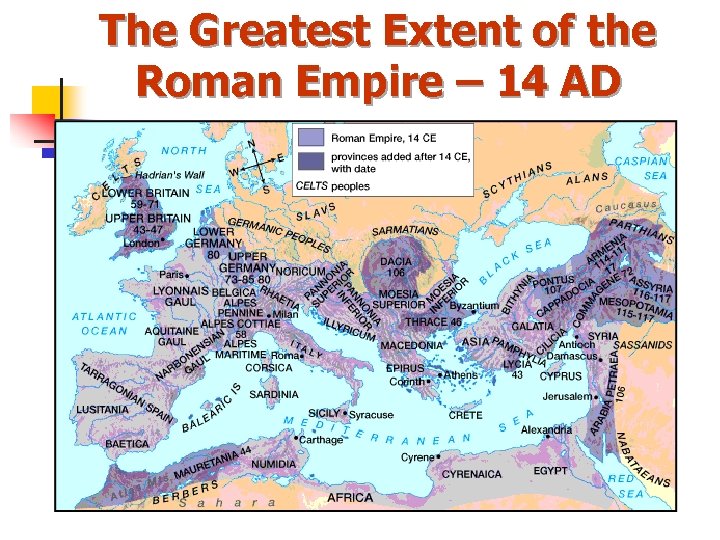
Roman Empire and Roman Peace Augustus laid the foundation for a stable government that would function well for 200 years. This period was called the Pax Romana. n n n Augustus’ reforms Created efficient civil service to enforce the laws. Opened up high-level jobs to men of talent, regardless of race. Allowed cities and provinces to govern themselves. Ordered a census, or population count, in order to make the tax system more fair. Set up a postal service and issued new coins. Employed the jobless.
The Greatest Extent of the Roman Empire – 14 AD
Pax Romana: Roman Peace
Leaders of Ancient Rome
The Roman Achievement Chapter 6, Section 3
n n n How was Greco-Roman civilization formed? What were some Roman contributions to literature, the arts, and technology? What principles of laws did Romans develop?
How was Greco-Roman civilization formed? The Romans borrowed heavily from Greek culture after they conquered Greece. At the same time, Roman generals carried achievements of Roman civilization to conquered lands. The blending of Roman, Hellenistic, and Greek traditions produced Greco-Roman civilization. Trade and travel during the Pax Romana helped spread this new civilization.
History n n Roman writers wrote about Roman historical events. Livy and Tacitus-most famous Roman historians. Livy includes ‘stories’ in his accounts. Sallust-sarcastic, biased approach to history Caesar-wrote about his own conquests
Poetry n n n Writers imitated Greek styles in prose and poetry. Virgil praised Rome’s heroic past in the Aeneid. Mirrors the Iliad & Odyssey. Ties Augustus to the gods and the Trojans. Poets used verse to satirize, or make fun of, Roman society.
Philosophy n n n Roman philosophers borrowed heavily from the Greeks. Stoics emphasized acceptance of one’s fate and concern for the well-being of others. One famous emperor, Marcus Aurelius, was a Stoic philosopher.
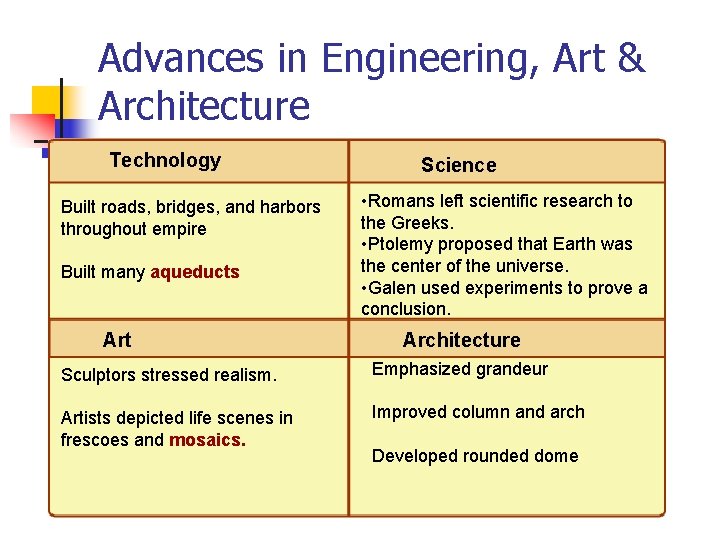
Advances in Engineering, Art & Architecture Technology Built roads, bridges, and harbors throughout empire Built many aqueducts Art Science • Romans left scientific research to the Greeks. • Ptolemy proposed that Earth was the center of the universe. • Galen used experiments to prove a conclusion. Architecture Sculptors stressed realism. Emphasized grandeur Artists depicted life scenes in frescoes and mosaics. Improved column and arch Developed rounded dome
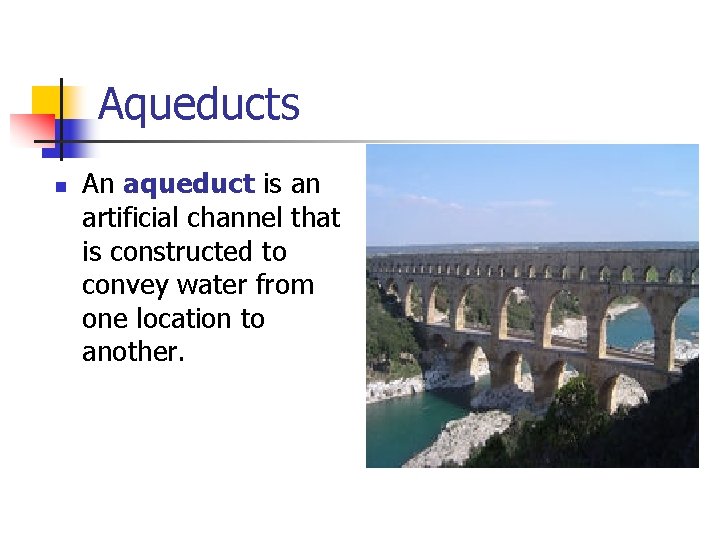
Aqueducts n An aqueduct is an artificial channel that is constructed to convey water from one location to another.
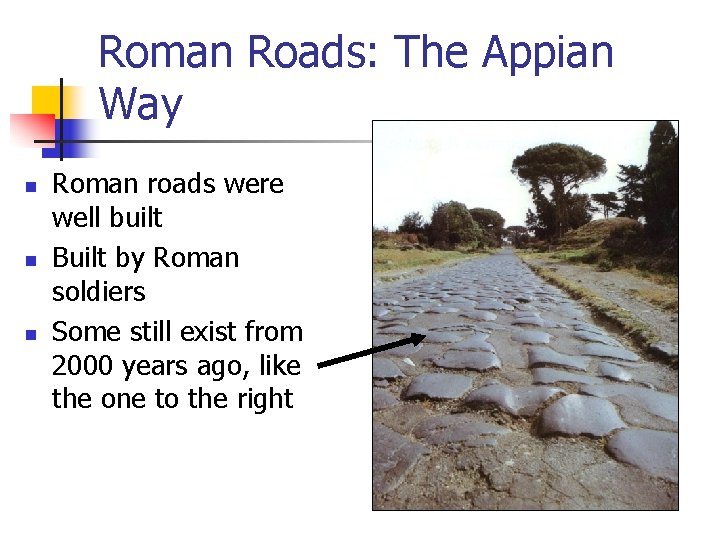
Roman Roads: The Appian Way n n n Roman roads were well built Built by Roman soldiers Some still exist from 2000 years ago, like the one to the right
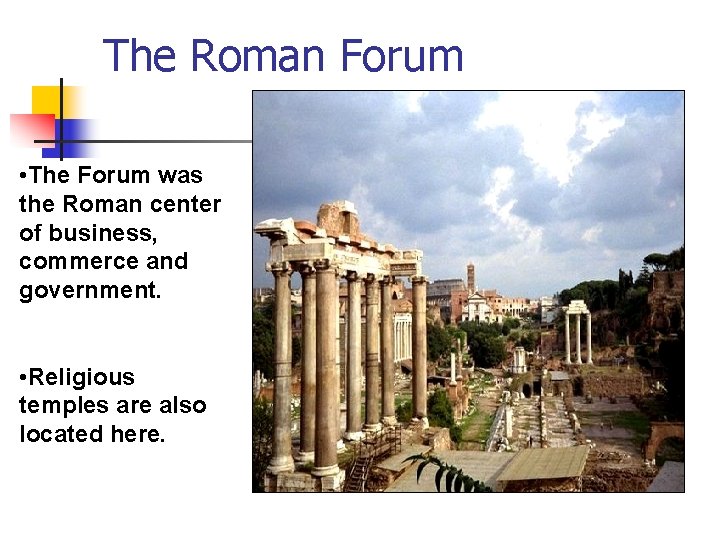
The Roman Forum • The Forum was the Roman center of business, commerce and government. • Religious temples are also located here.
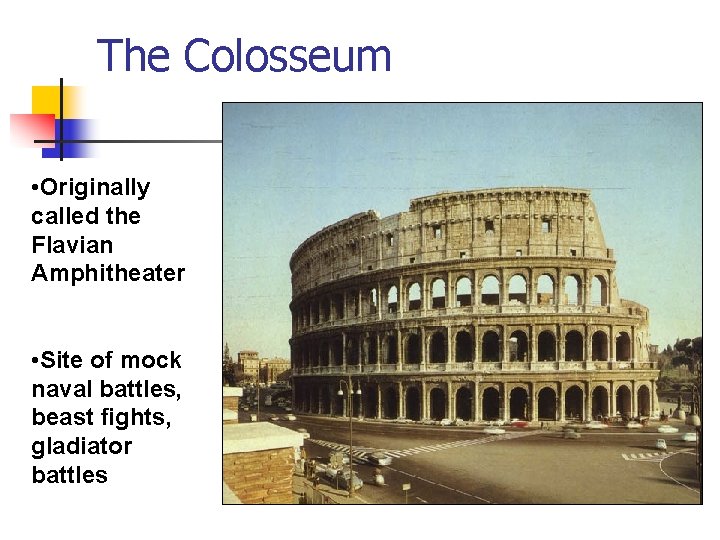
The Colosseum • Originally called the Flavian Amphitheater • Site of mock naval battles, beast fights, gladiator battles
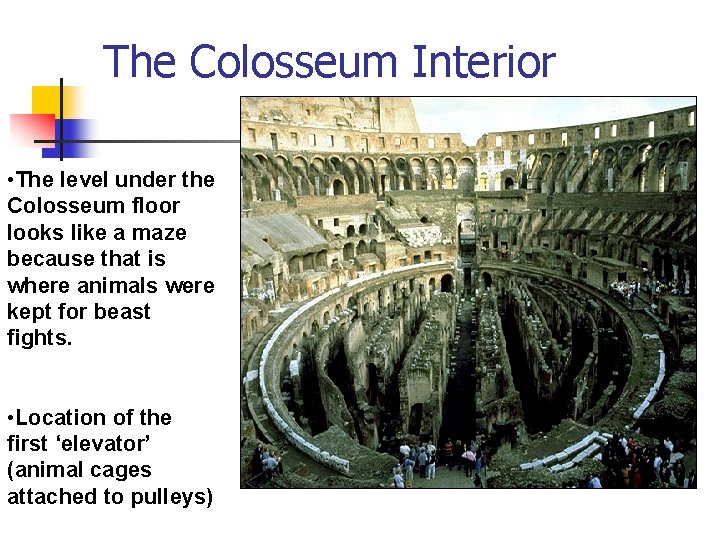
The Colosseum Interior • The level under the Colosseum floor looks like a maze because that is where animals were kept for beast fights. • Location of the first ‘elevator’ (animal cages attached to pulleys)
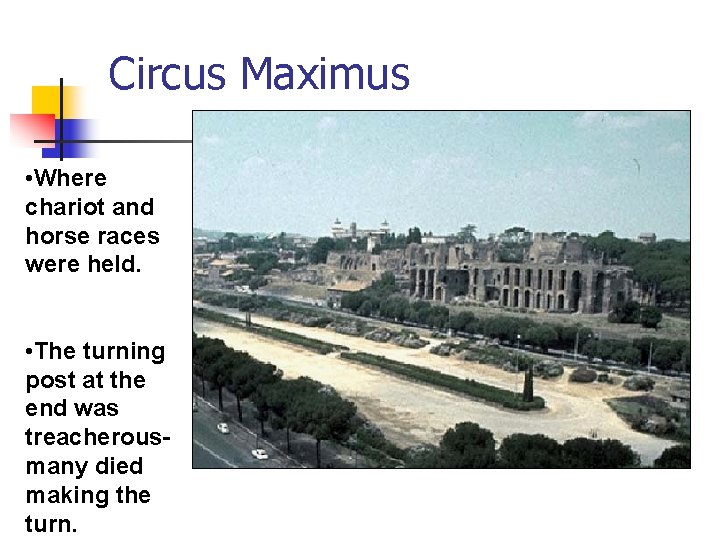
Circus Maximus • Where chariot and horse races were held. • The turning post at the end was treacherousmany died making the turn.
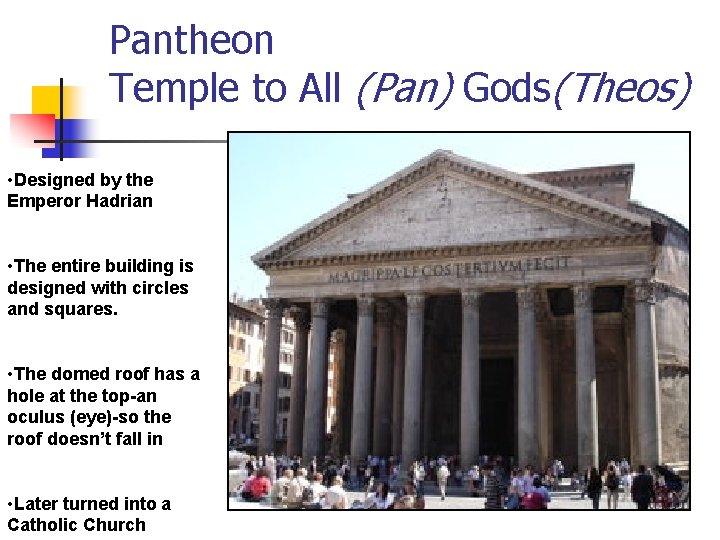
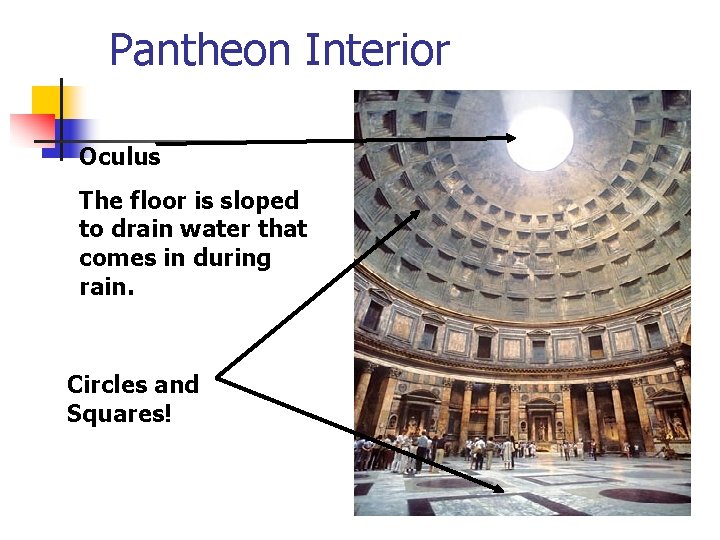
Pantheon Temple to All (Pan) Gods(Theos) • Designed by the Emperor Hadrian • The entire building is designed with circles and squares. • The domed roof has a hole at the top-an oculus (eye)-so the roof doesn’t fall in • Later turned into a Catholic Church
Pantheon Interior Oculus The floor is sloped to drain water that comes in during rain. Circles and Squares!
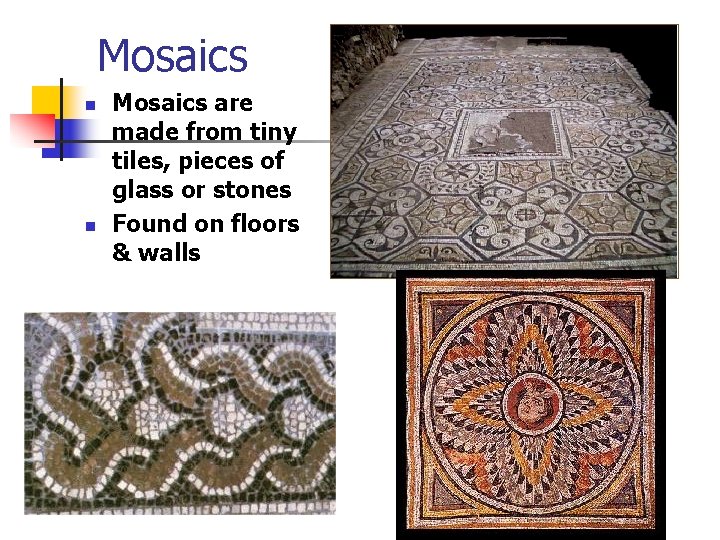
Mosaics n n Mosaics are made from tiny tiles, pieces of glass or stones Found on floors & walls
Roman Law During the Roman empire, these principles of law fostered unity and stability: n n An accused person was presumed to be innocent until proven guilty. The accused was permitted to face the accuser and offer a defense. Guilt had to be established through evidence. Judges were expected to interpret the laws and make fair decisions. Centuries later, these principles would become the basis for legal systems in Europe and the Americas.
Rome
The Rise of Christianity Chapter 6, Section 4 • What was Rome’s policy toward different religions in the early empire? • What were the major teachings of Jesus, and how were they spread? • How did the early Christian Church develop?
Early Roman Religion n n Augustus revived early Roman religious festivals and ceremonies to bring back religion Roman religion focused on worship of a number of gods and goddesses Beginning with Augustus, emperors were often declared gods Romans believed that observing proper rituals brought them into a proper relationship with the gods in order to guarantee peace and prosperity
Religious Diversity in the Early Empire As long as people honored Roman gods and acknowledged the divine spirit of the emperor, they were allowed to worship other gods as they pleased. After the Romans conquered Judea, they excused the monotheistic Jews from worshiping the Roman gods. Rome mistrusted Christians because they refused to make sacrifices to the emperor or honor the Roman gods. Roman officials persecuted the Christians. Many Christians became martyrs, people who suffer or die for their beliefs.
Jewish Background n n n Judaea was a Roman province/ Unrest was common among all, even Jews Sadducees(Jews) cooperated with the Romans/ Essenes (Jews) awaited a messiah who could save Israel from oppression and establish paradise on Earth/ Zealots(Jews) advocated overthrowing Roman rule Revolt begun in 66 BC was crushed by the Romans destroyed the temple in Jerusalem Jesus (Jew) began to teach during the midst of the conflict
Jesus and His Message Some of Jesus’ teachings were rooted in Judaism: n Belief in one God n Ten Commandments n Mercy and sympathy for the poor and helpless n Obedience to the laws of Moses Jesus also preached new beliefs: 1. Called himself the Son of God 2. Proclaimed that he brought salvation and eternal life to anyone who would believe in him 3. Jesus also emphasized God’s love and taught the need for justice, morality, and service to others.
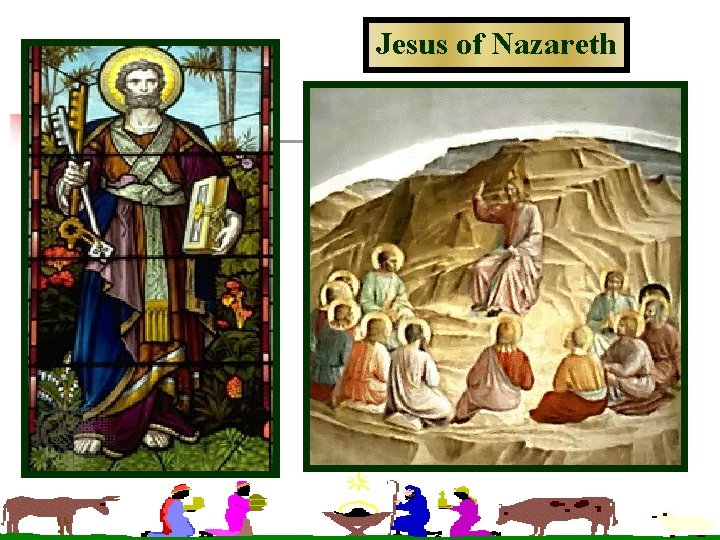
Jesus of Nazareth
Christians and Chaos
Rise of Christianity Jesus taught inner transformation was most important, taught Golden Rule, taught humility, charity, and love for others n Judaeans turned Jesus over to the Romans because they thought he might cause people to revolt against Romans n Pontius Pilate ordered his crucifixion n Followers of Jesus believed that he overcame death and was the Messiah n Simon Peter and the disciples taught that Jesus was the savior and son of God n
Rise of Christianity n n n Disciples taught that Jesus came to earth to save all people After word spread that Jesus had overcome death, there were many converts/ Only 60 days after crucifixion Jerusalem had 10, 000 converts Disciples wrote down Jesus’ sayings and stories about him = became known as New Testament of the Bible Romans paid little attention to Christianity at first then began to see it as a threat to society Persecution of Christians began under Nero
Rise of Christianity n n n Nero blamed Christians for the fire that burned Rome/ He subjected them to cruel deaths Persecution strengthened Christianity forcing it to become more organized Christianity grew because it was more appealing to the poor because it viewed everyone as equal Diocletian was the last major emperor to enforce persecution of Christians/ he soon realized that Christianity was too powerful to be destroyed by force Constantine =first Christian Emperor/ issued Edict of Milan that tolerated Christianity in Rome Theodosius the Great = adopted Christianity as official religion
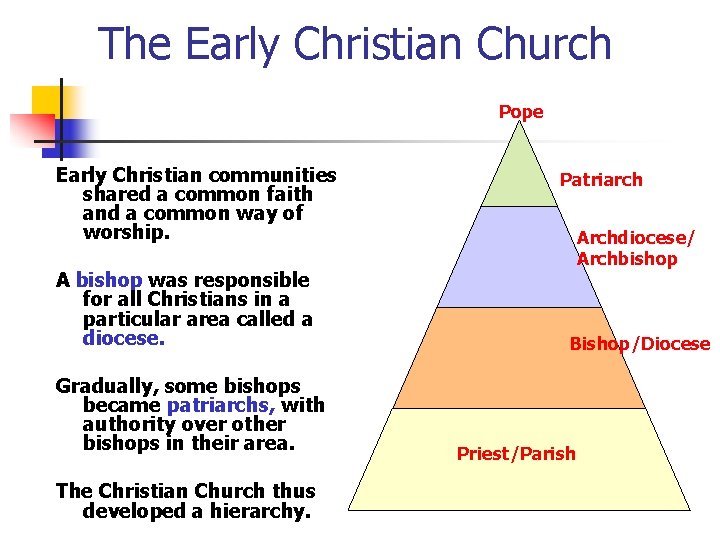
The Early Christian Church Pope Early Christian communities shared a common faith and a common way of worship. A bishop was responsible for all Christians in a particular area called a diocese. Gradually, some bishops became patriarchs, with authority over other bishops in their area. The Christian Church thus developed a hierarchy. Patriarch Archdiocese/ Archbishop Bishop/Diocese Priest/Parish
A Christian Ruler
The Long Decline Chapter 6, Section 5
n n n How did Roman emperors try to end the crisis in the empire? How did Hun invasions contribute to the decline of Rome? How did economic and social problems lead to the Fall of Rome?
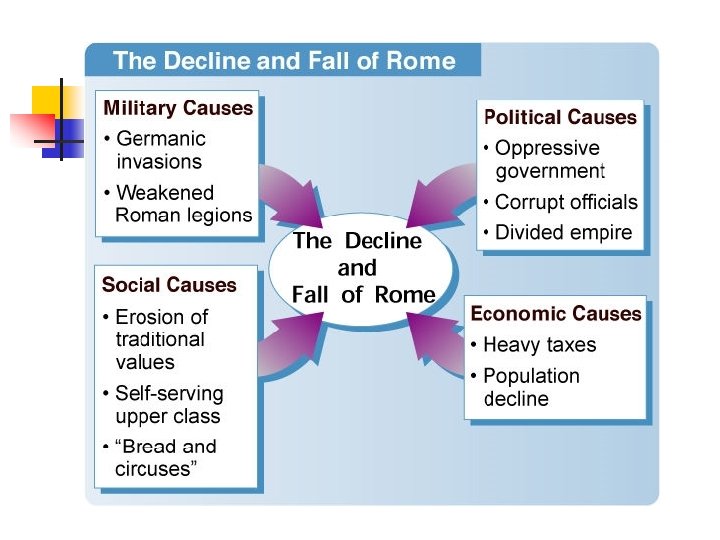
Empire in Crisis With the end of the Pax Romana, political and economic turmoil rocked the Roman empire. Political Problems • • Emperors were repeatedly overthrown or assassinated. In one 50 -year period, 26 emperors ruled, and only one died of natural causes. Economic & Social Problems • • • High taxes to support the army burdened business people and farmers. Poor farmers were forced to work and live on wealthy estates. Over-cultivated farmland lost its productivity.
Decline of Rome n n n Long period of unrest followed the death of Marcus Aurelius= last good emperor Rome was ruled by Severans who totally concentrated on the army for several years After Severans rule ended, Rome was ruled by whoever had the army to seize it 22 emperors over a 50 year period, 20 died violently During this time, Rome was invaded by Persians and Germans Civil war and plague almost caused empire to collapse
Decline of Rome n n Trade and industry declined/ labor shortage due to the plague/ farm production declined due to war torn fields Money became short and soldiers were scarce/ Had to hire Germanic soldiers = who had no loyalty to Rome and did not understand tradition Diocletian and Constantine revived Rome and founded the late Roman empire Policies of Diocletian were controlling and stifled Rome’s vitality
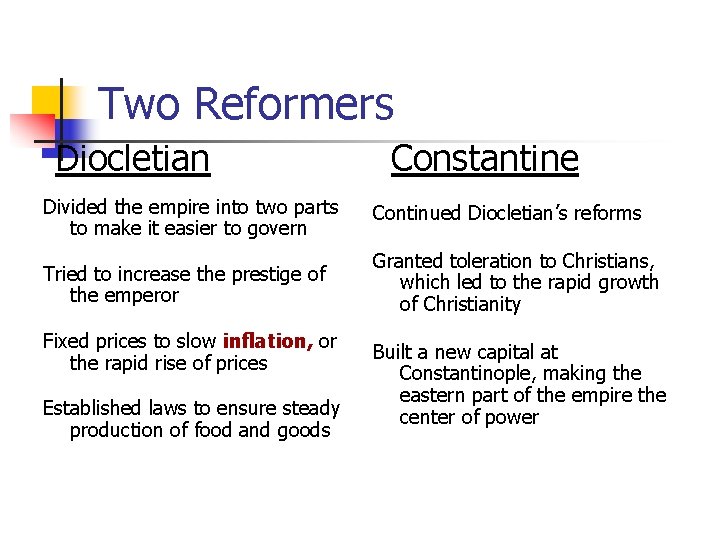
Two Reformers Diocletian Constantine Divided the empire into two parts to make it easier to govern Continued Diocletian’s reforms Tried to increase the prestige of the emperor Granted toleration to Christians, which led to the rapid growth of Christianity Fixed prices to slow inflation, or the rapid rise of prices Established laws to ensure steady production of food and goods Built a new capital at Constantinople, making the eastern part of the empire the center of power
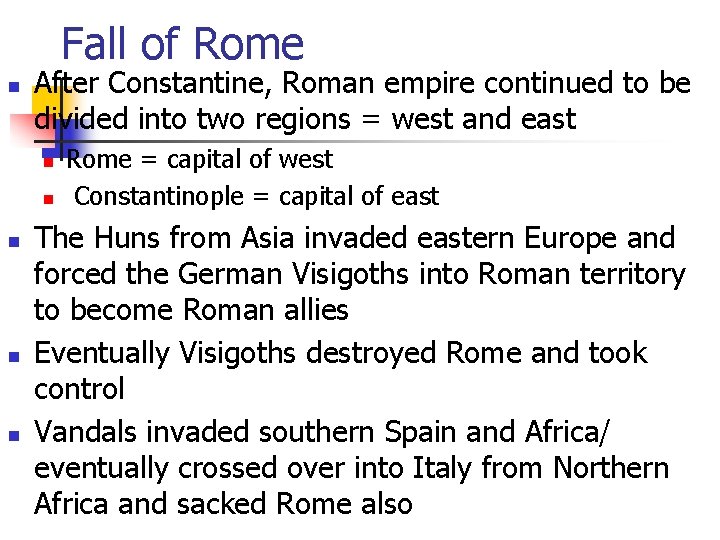
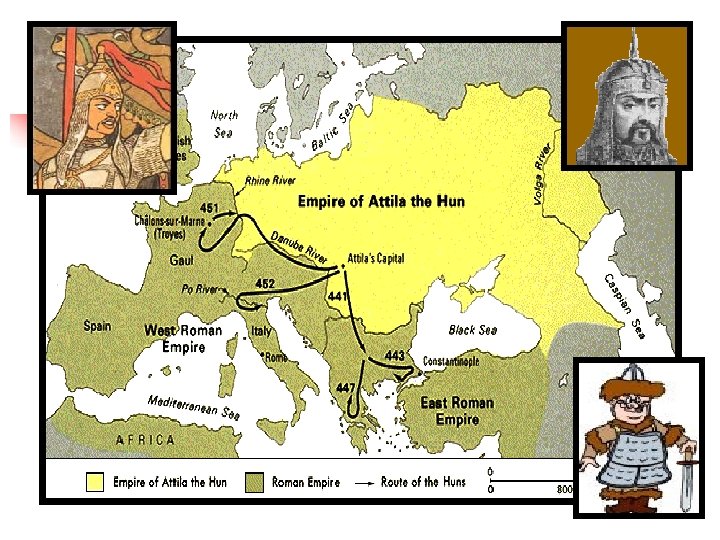
Fall of Rome n After Constantine, Roman empire continued to be divided into two regions = west and east n n n Rome = capital of west Constantinople = capital of east The Huns from Asia invaded eastern Europe and forced the German Visigoths into Roman territory to become Roman allies Eventually Visigoths destroyed Rome and took control Vandals invaded southern Spain and Africa/ eventually crossed over into Italy from Northern Africa and sacked Rome also
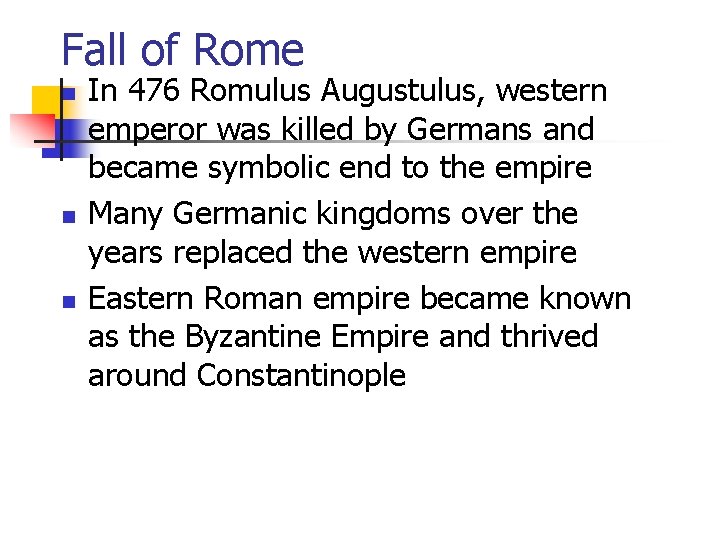
Fall of Rome n n n In 476 Romulus Augustulus, western emperor was killed by Germans and became symbolic end to the empire Many Germanic kingdoms over the years replaced the western empire Eastern Roman empire became known as the Byzantine Empire and thrived around Constantinople