
The Roman Toga Construction and Cultural Implications Natalie
- Slides: 1
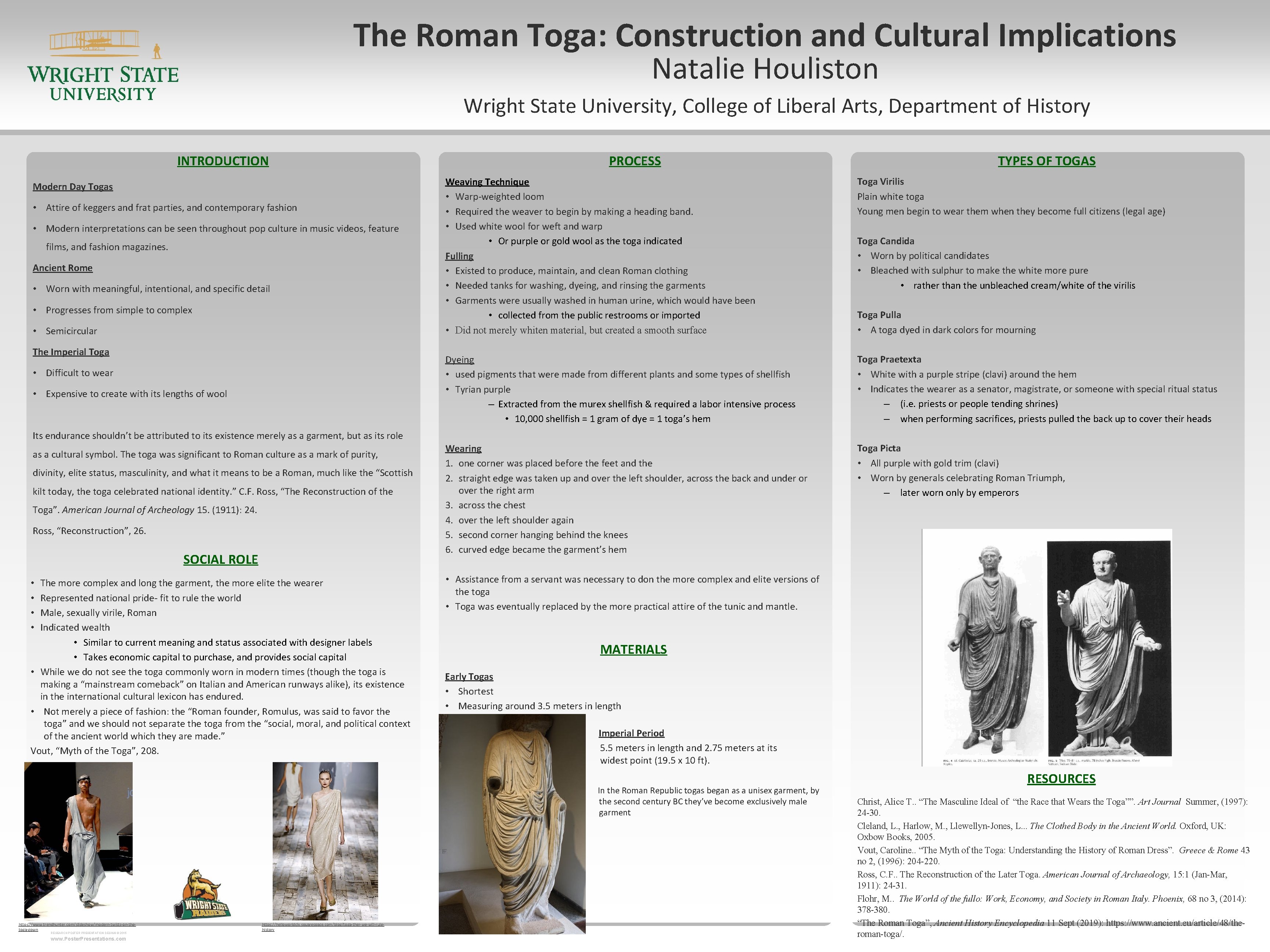
The Roman Toga: Construction and Cultural Implications Natalie Houliston Wright State University, College of Liberal Arts, Department of History INTRODUCTION Modern Day Togas • Attire of keggers and frat parties, and contemporary fashion • Modern interpretations can be seen throughout pop culture in music videos, feature films, and fashion magazines. Ancient Rome • Worn with meaningful, intentional, and specific detail • Progresses from simple to complex • Semicircular The Imperial Toga • Difficult to wear • Expensive to create with its lengths of wool PROCESS Weaving Technique • Warp-weighted loom • Required the weaver to begin by making a heading band. • Used white wool for weft and warp • Or purple or gold wool as the toga indicated Fulling • Existed to produce, maintain, and clean Roman clothing • Needed tanks for washing, dyeing, and rinsing the garments • Garments were usually washed in human urine, which would have been • collected from the public restrooms or imported • Did not merely whiten material, but created a smooth surface Toga Virilis Plain white toga Young men begin to wear them when they become full citizens (legal age) Dyeing • used pigments that were made from different plants and some types of shellfish • Tyrian purple – Extracted from the murex shellfish & required a labor intensive process • 10, 000 shellfish = 1 gram of dye = 1 toga’s hem Toga Praetexta • White with a purple stripe (clavi) around the hem • Indicates the wearer as a senator, magistrate, or someone with special ritual status – (i. e. priests or people tending shrines) – when performing sacrifices, priests pulled the back up to cover their heads Wearing 1. one corner was placed before the feet and the 2. straight edge was taken up and over the left shoulder, across the back and under or over the right arm 3. across the chest 4. over the left shoulder again 5. second corner hanging behind the knees 6. curved edge became the garment’s hem Toga Picta • All purple with gold trim (clavi) • Worn by generals celebrating Roman Triumph, – later worn only by emperors Its endurance shouldn’t be attributed to its existence merely as a garment, but as its role as a cultural symbol. The toga was significant to Roman culture as a mark of purity, divinity, elite status, masculinity, and what it means to be a Roman, much like the “Scottish kilt today, the toga celebrated national identity. ” C. F. Ross, “The Reconstruction of the Toga”. American Journal of Archeology 15. (1911): 24. Ross, “Reconstruction”, 26. SOCIAL ROLE The more complex and long the garment, the more elite the wearer Represented national pride- fit to rule the world Male, sexually virile, Roman Indicated wealth • Similar to current meaning and status associated with designer labels • Takes economic capital to purchase, and provides social capital • While we do not see the toga commonly worn in modern times (though the toga is making a “mainstream comeback” on Italian and American runways alike), its existence in the international cultural lexicon has endured. • Not merely a piece of fashion: the “Roman founder, Romulus, was said to favor the toga” and we should not separate the toga from the “social, moral, and political context of the ancient world which they are made. ” Vout, “Myth of the Toga”, 208. • • RESEARCH POSTER PRESENTATION DESIGN © 2015 www. Poster. Presentations. com https: //helloworldciv. squarespace. com/blog/toga-ther-we-will-rulehistory Toga Candida • Worn by political candidates • Bleached with sulphur to make the white more pure • rather than the unbleached cream/white of the virilis Toga Pulla • A toga dyed in dark colors for mourning • Assistance from a servant was necessary to don the more complex and elite versions of the toga • Toga was eventually replaced by the more practical attire of the tunic and mantle. MATERIALS Early Togas • Shortest • Measuring around 3. 5 meters in length • • • https: //www. trendhunter. com/slideshow/modern-twists-on-thetoga-gown TYPES OF TOGAS Imperial Period 5. 5 meters in length and 2. 75 meters at its widest point (19. 5 x 10 ft). In the Roman Republic togas began as a unisex garment, by the second century BC they’ve become exclusively male garment RESOURCES Christ, Alice T. . “The Masculine Ideal of “the Race that Wears the Toga””. Art Journal Summer, (1997): 24 -30. Cleland, L. , Harlow, M. , Llewellyn-Jones, L. . . The Clothed Body in the Ancient World. Oxford, UK: Oxbow Books, 2005. Vout, Caroline. . “The Myth of the Toga: Understanding the History of Roman Dress”. Greece & Rome 43 no 2, (1996): 204 -220. Ross, C. F. . The Reconstruction of the Later Toga. American Journal of Archaeology, 15: 1 (Jan-Mar, 1911): 24 -31. Flohr, M. . The World of the fullo: Work, Economy, and Society in Roman Italy. Phoenix, 68 no 3, (2014): 378 -380. “The Roman Toga”, Ancient History Encyclopedia 11 Sept (2019): https: //www. ancient. eu/article/48/theroman-toga/.