
The Roman Republic Res publica in Ancient Rome

The Roman Republic • Res publica in Ancient Rome meant: – Public property (thing) – citizens elect leaders to run their government – Public affairs • state organization system • politics The Senate and People of Rome 1

Nobles who owned large amounts of land They governed the city. Served for one year only. Had to agree with each other. Led army in wars. The 2 classes met in the ASSEMBLY to vote for the following: Officials appointed to be judges. Looked after money and served as CENSORS Lower class farmers and craftsmen Picked by Plebs. They were to protect the poor and could VETO laws. Patricians only who served for life. Magistrates joined when they retired from service. They made the decisions in Rome including declaring WAR, making PEACE, and picking governors of provinces


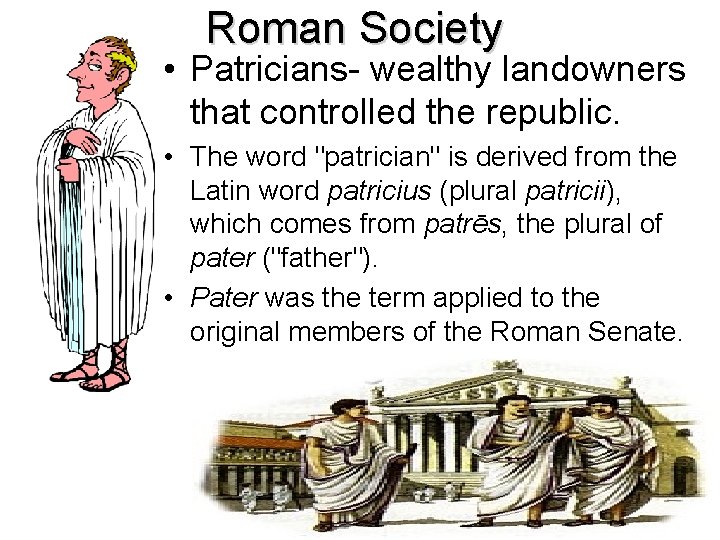
Roman Society • Patricians- wealthy landowners that controlled the republic. • The word "patrician" is derived from the Latin word patricius (plural patricii), which comes from patrēs, the plural of pater ("father"). • Pater was the term applied to the original members of the Roman Senate. 6

The Plebeians • The common people. • Had no say in govt. • Allowed to take part in the assembly, but had less power than the Senate. • Over time they demanded more say in the government 7

Twelve Tables- 451 BCE v 12 laws written on bronze tablets v Hung in the Forum so all Romans could see them v This gave plebeians greater power allowing them to become priests & members of the Senate, but not to marry patricians v The laws passed by the patrician senate applied to everyone. However, the laws passed by the plebian assembly applied only to plebeians.


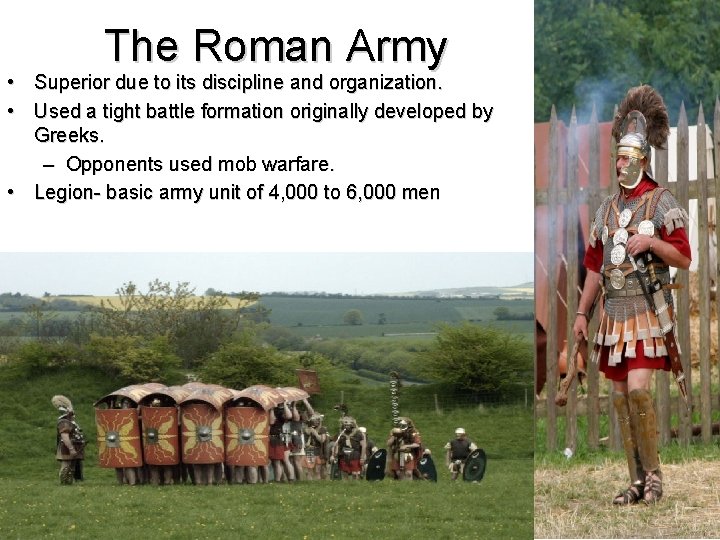
The Roman Army • Superior due to its discipline and organization. • Used a tight battle formation originally developed by Greeks. – Opponents used mob warfare. • Legion- basic army unit of 4, 000 to 6, 000 men 11

Roman Alliances • How did Rome maintain its alliances with former enemies? 1. Granted Roman citizenship to allies. 2. Allowed allies to keep local govt. 3. Gave protection and maintained order in Italy. ██ Roman republic 510 BC-40 BC ██ Roman Empire 20 AD-360 AD 12 ██ Western Roman Empire 405 AD-480 AD ██ Eastern Roman Empire 405 AD-480 AD
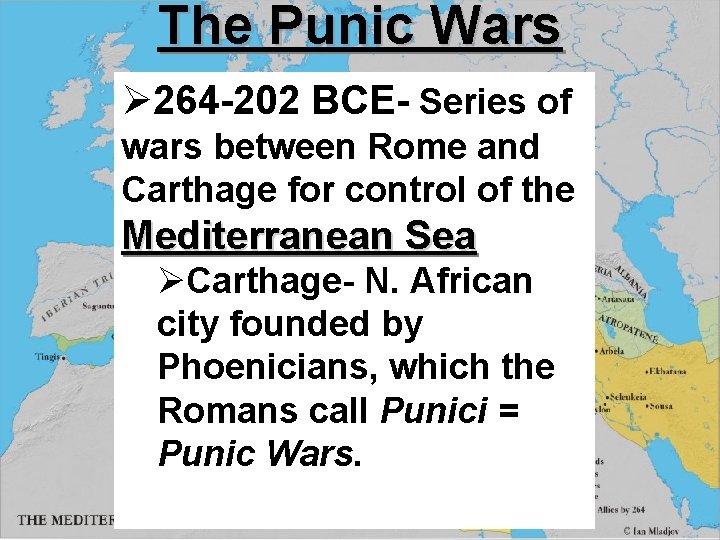
The Punic Wars Ø 264 -202 BCE- Series of wars between Rome and Carthage for control of the Mediterranean Sea ØCarthage- N. African city founded by Phoenicians, which the Romans call Punici = Punic Wars.

The Roman World Grows “Who is so thoughtless and lazy that he does not want to know in what way and with what kind of government the Romans, in less than 53 years, conquered nearly the entire inhabited world and brought it under their rule – an achievement previously unheard of? ” • Polybius, Greek historian, watched as Rome became a world power
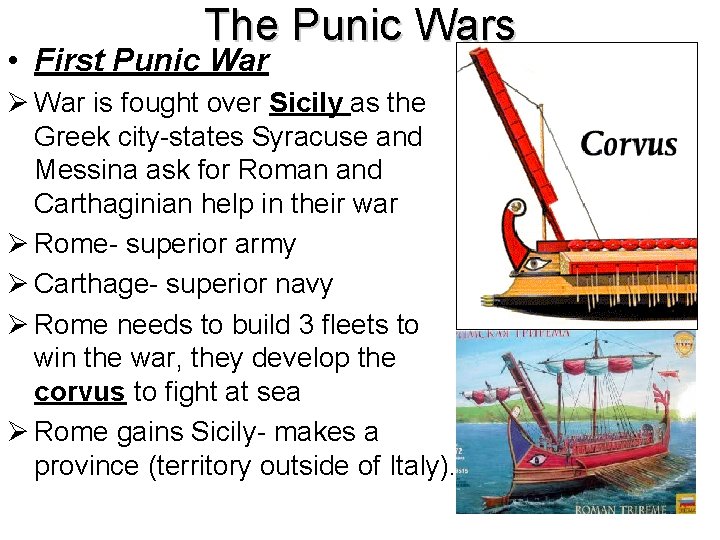
The Punic Wars • First Punic War Ø War is fought over Sicily as the Greek city-states Syracuse and Messina ask for Roman and Carthaginian help in their war Ø Rome- superior army Ø Carthage- superior navy Ø Rome needs to build 3 fleets to win the war, they develop the corvus to fight at sea Ø Rome gains Sicily- makes a province (territory outside of Italy). 15




The Punic Wars • Second Punic War Ø Hannibal, a Carthaginian general invades Italy from Spain using elephants. He crosses the Alps Mountains with the elephants! Ø At the battle of Cannae, Hannibal completely destroys 16 legions Ø Hannibal spends 17 years in Italy marching up and down the country, but the Romans won’t leave the city to fight




The Punic Wars Ø The Romans decide to attack Carthaginian lands while Hannibal is in Italy ØScipio launches an invasion into Carthage and beats Hannibal at the battle of Zama ØHannibal leaves for Greece, where the Romans track him down and conquer the Greeks, Hannibal commits suicide rather than being captured 23
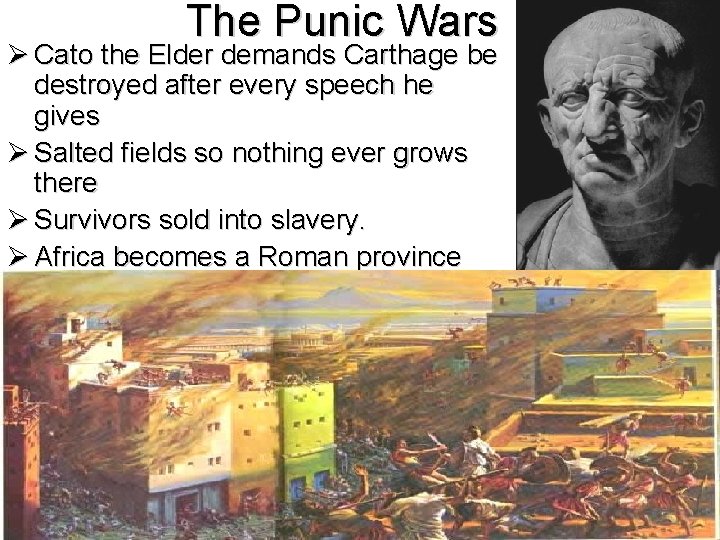
The Punic Wars Ø Cato the Elder demands Carthage be destroyed after every speech he gives Ø Salted fields so nothing ever grows there Ø Survivors sold into slavery. Ø Africa becomes a Roman province 24

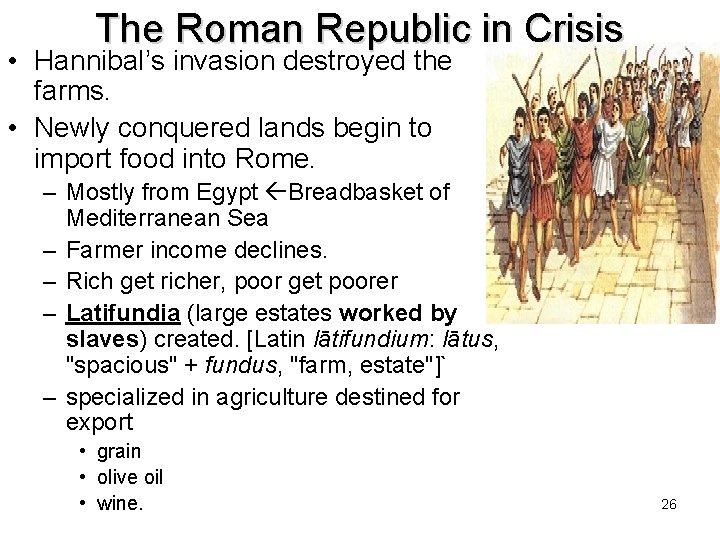
The Roman Republic in Crisis • Hannibal’s invasion destroyed the farms. • Newly conquered lands begin to import food into Rome. – Mostly from Egypt Breadbasket of Mediterranean Sea – Farmer income declines. – Rich get richer, poor get poorer – Latifundia (large estates worked by slaves) created. [Latin lātifundium: lātus, "spacious" + fundus, "farm, estate"]` – specialized in agriculture destined for export • grain • olive oil • wine. 26
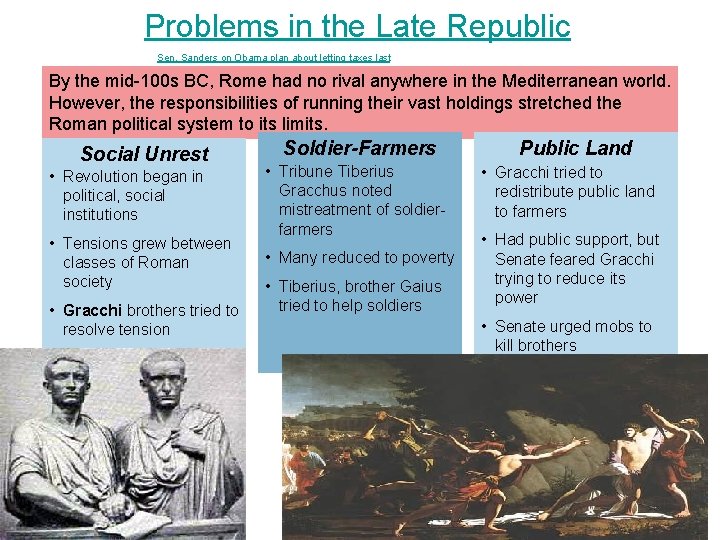
Problems in the Late Republic Sen. Sanders on Obama plan about letting taxes last By the mid-100 s BC, Rome had no rival anywhere in the Mediterranean world. However, the responsibilities of running their vast holdings stretched the Roman political system to its limits. Social Unrest • Revolution began in political, social institutions • Tensions grew between classes of Roman society • Gracchi brothers tried to resolve tension Soldier-Farmers • Tribune Tiberius Gracchus noted mistreatment of soldierfarmers • Many reduced to poverty • Tiberius, brother Gaius tried to help soldiers Public Land • Gracchi tried to redistribute public land to farmers • Had public support, but Senate feared Gracchi trying to reduce its power • Senate urged mobs to kill brothers


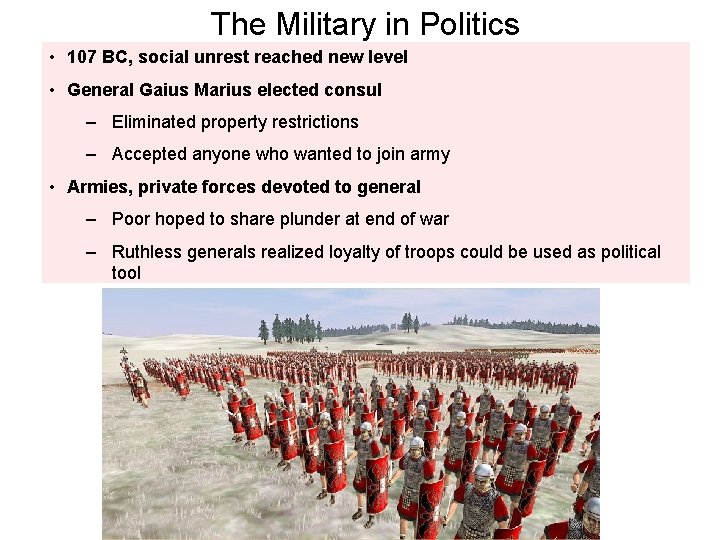
The Military in Politics • 107 BC, social unrest reached new level • General Gaius Marius elected consul – Eliminated property restrictions – Accepted anyone who wanted to join army • Armies, private forces devoted to general – Poor hoped to share plunder at end of war – Ruthless generals realized loyalty of troops could be used as political tool

Social and Civil Wars The Social War Civil War • Rome’s Italian allies had been trying to obtain Roman citizenship • Senate wanted to maintain monopoly on power, refused • Social War revealed talent of General Lucius Cornelius Sulla • Sulla became consul, 88 BC; after consulship ended, Marius tried to prevent Sulla from taking military command • 90 BC, Social War broke out • Italian rebels were defeated, but Senate agreed to give them citizenship • Sulla marched on Rome, won civil war, became dictator • Carried out program of reforms to protect power of Senate Sulla (nicknamed “Felix” = lucky)

The rise of dictators • • • Dictator- one person with absolute power. Gaius Marius – Standardized Legionnaire's pack – “Marius’ mules” – Troops swore oath of loyalty to commander, not Rome. – Paid by commander, not Rome Lucius Sulla – Rival to Marius – Bloody wars over power. – Defeats Marius and becomes dictator of Rome. • Posted “Proscriptions” lists of citizens whose death would be rewarded with deceased’s property. – Marius The soldiers of the Roman army would carry with them a considerable amount of kit. When on the march they carried over their shoulder a contraption (sometimes described as a forked stick) which would help them to carry some of their equipment. Here is a re-enactor of a legionary bearing this item over his shoulder together with his pilum. So weighed down were the soldiers by all their stuff, that they were nicknamed 'Marius' mules' 32 (after the famous Roman general to whom the invention of the very forked stick is ascribed).
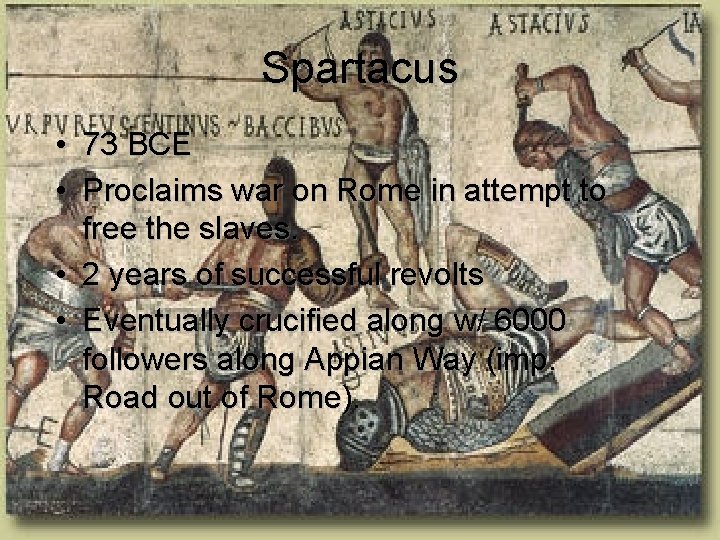
Spartacus • 73 BCE • Proclaims war on Rome in attempt to free the slaves. • 2 years of successful revolts • Eventually crucified along w/ 6000 followers along Appian Way (imp. Road out of Rome). 34
Summarize What challenges faced Rome in the late Republic? Answer(s): soldiers and poor not treated fairly, Gracchi brothers killed, slave revolts, social unrest, the Social War, and a civil war in which Sulla became dictator
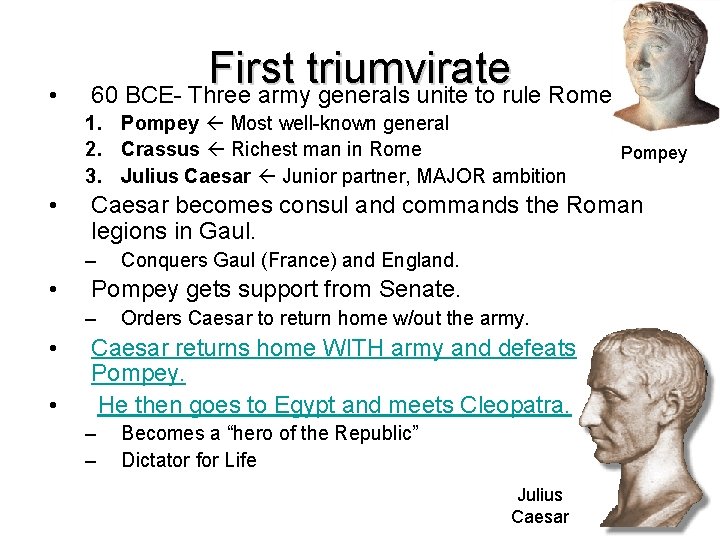
• First triumvirate 60 BCE- Three army generals unite to rule Rome. 1. Pompey Most well-known general 2. Crassus Richest man in Rome 3. Julius Caesar Junior partner, MAJOR ambition • Caesar becomes consul and commands the Roman legions in Gaul. – • • Conquers Gaul (France) and England. Pompey gets support from Senate. – • Pompey Orders Caesar to return home w/out the army. Caesar returns home WITH army and defeats Pompey. He then goes to Egypt and meets Cleopatra. – – Becomes a “hero of the Republic” Dictator for Life Julius Caesar 36

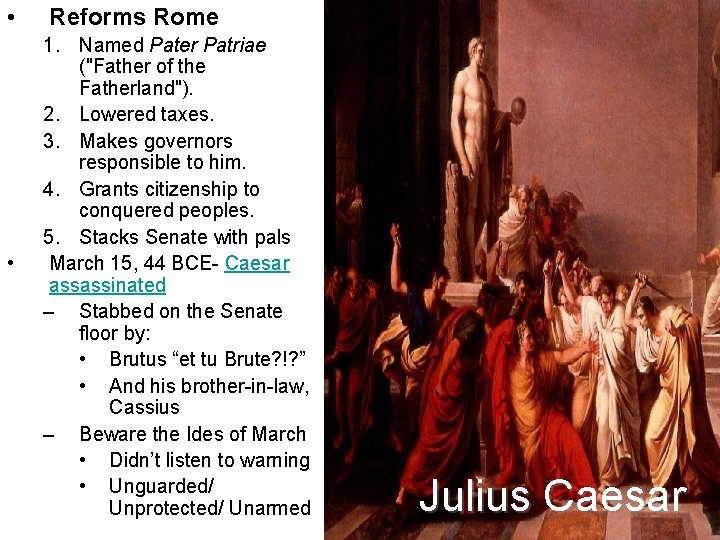
• • Reforms Rome 1. Named Pater Patriae ("Father of the Fatherland"). 2. Lowered taxes. 3. Makes governors responsible to him. 4. Grants citizenship to conquered peoples. 5. Stacks Senate with pals March 15, 44 BCE- Caesar assassinated – Stabbed on the Senate floor by: • Brutus “et tu Brute? !? ” • And his brother-in-law, Cassius – Beware the Ides of March • Didn’t listen to warning • Unguarded/ Unprotected/ Unarmed Julius Caesar 38
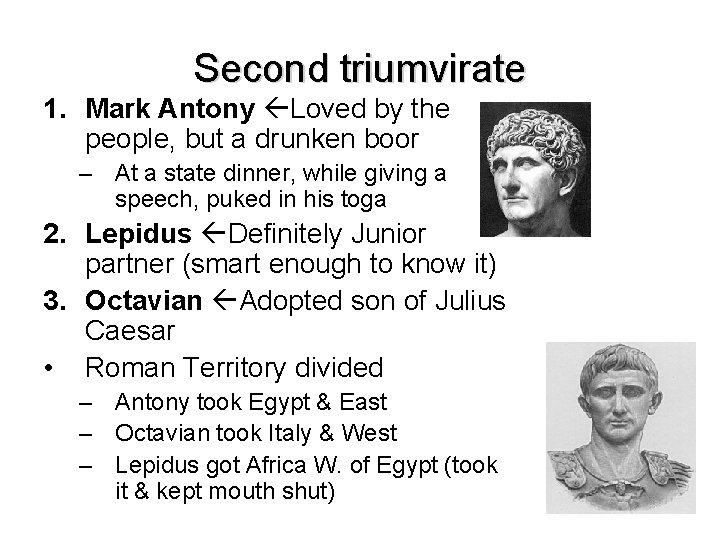
Second triumvirate 1. Mark Antony Loved by the people, but a drunken boor – At a state dinner, while giving a speech, puked in his toga 2. Lepidus Definitely Junior partner (smart enough to know it) 3. Octavian Adopted son of Julius Caesar • Roman Territory divided – Antony took Egypt & East – Octavian took Italy & West – Lepidus got Africa W. of Egypt (took it & kept mouth shut) 39
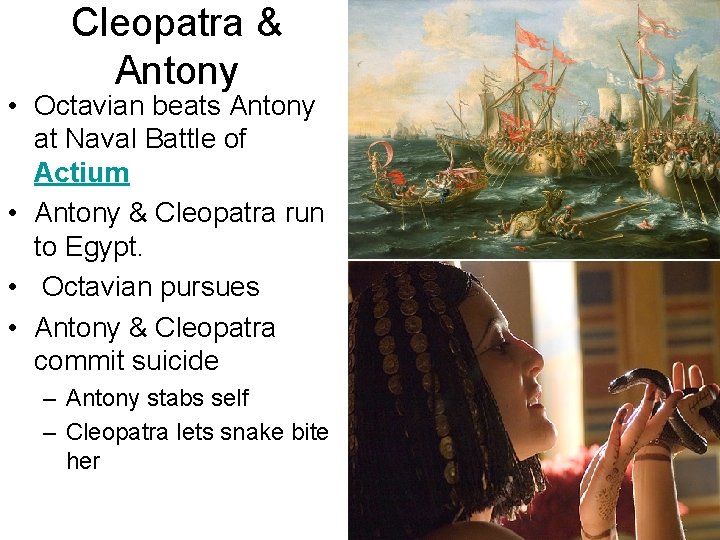
Cleopatra & Antony • Octavian beats Antony at Naval Battle of Actium • Antony & Cleopatra run to Egypt. • Octavian pursues • Antony & Cleopatra commit suicide – Antony stabs self – Cleopatra lets snake bite her
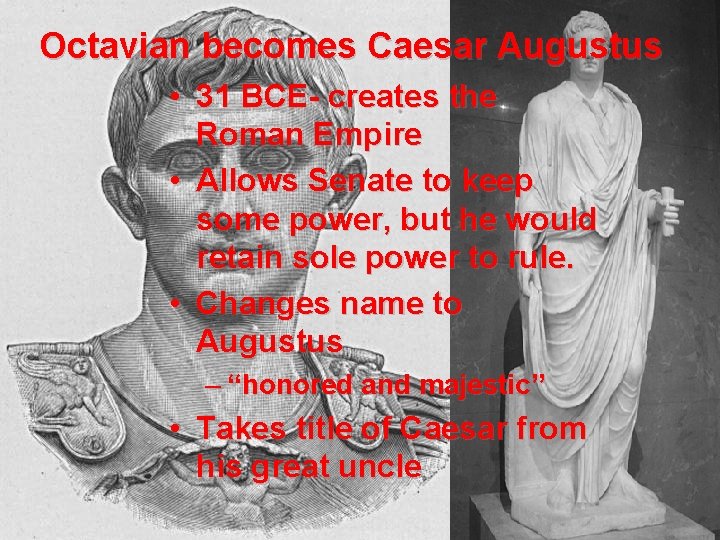
Octavian becomes Caesar Augustus • 31 BCE- creates the Roman Empire • Allows Senate to keep some power, but he would retain sole power to rule. • Changes name to Augustus – “honored and majestic” • Takes title of Caesar from his great uncle 41
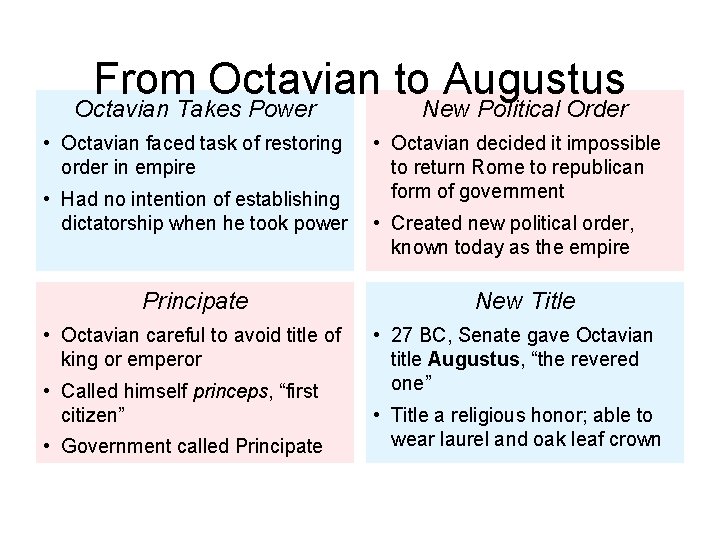
From Octavian to Augustus Octavian Takes Power • Octavian faced task of restoring order in empire • Had no intention of establishing dictatorship when he took power Principate • Octavian careful to avoid title of king or emperor • Called himself princeps, “first citizen” • Government called Principate New Political Order • Octavian decided it impossible to return Rome to republican form of government • Created new political order, known today as the empire New Title • 27 BC, Senate gave Octavian title Augustus, “the revered one” • Title a religious honor; able to wear laurel and oak leaf crown
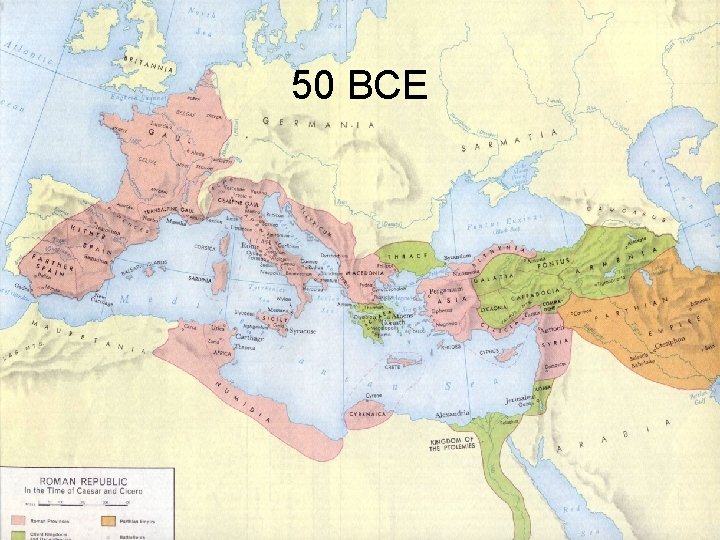
50 BCE
- Slides: 43