
The Roman Republic Ancient Rome was Next to
The Roman Republic
Ancient Rome was…. Next to the Mediterranean Sea n It covered parts of Europe, Asia and Africa n A peninsula n Rocky and mountainous n Built on hills n Next to the Tiber River n
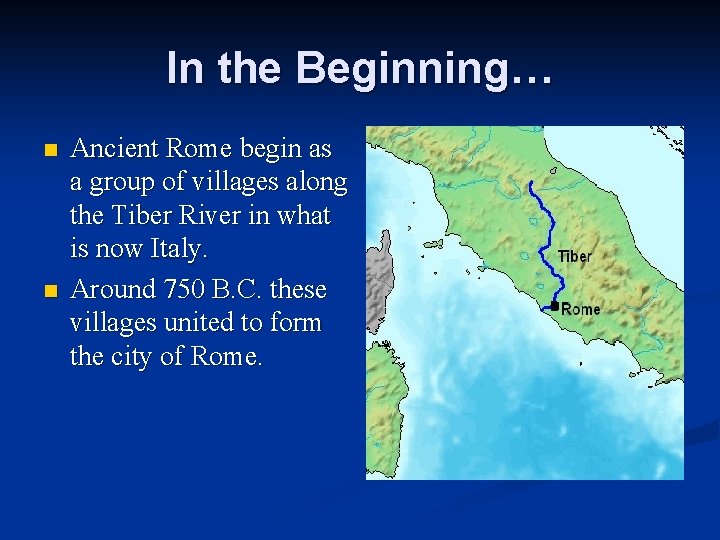
In the Beginning… n n Ancient Rome begin as a group of villages along the Tiber River in what is now Italy. Around 750 B. C. these villages united to form the city of Rome.
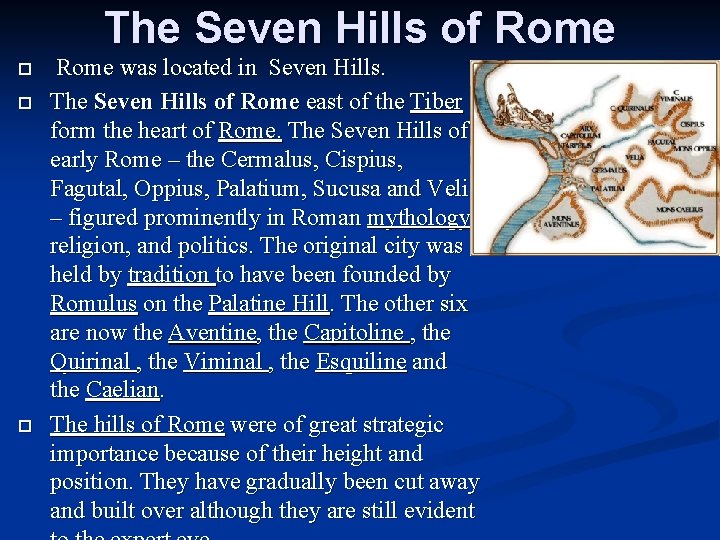
The Seven Hills of Rome was located in Seven Hills. The Seven Hills of Rome east of the Tiber form the heart of Rome. The Seven Hills of early Rome – the Cermalus, Cispius, Fagutal, Oppius, Palatium, Sucusa and Velia – figured prominently in Roman mythology, religion, and politics. The original city was held by tradition to have been founded by Romulus on the Palatine Hill. The other six are now the Aventine, the Capitoline , the Quirinal , the Viminal , the Esquiline and the Caelian. The hills of Rome were of great strategic importance because of their height and position. They have gradually been cut away and built over although they are still evident
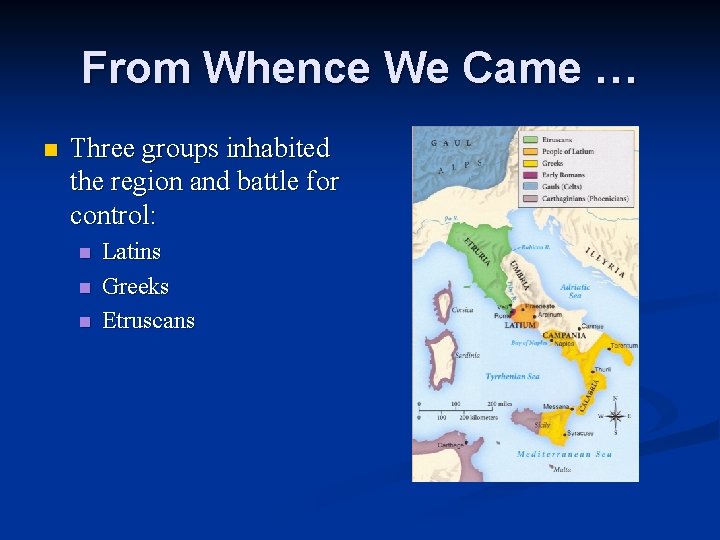
From Whence We Came … n Three groups inhabited the region and battle for control: n n n Latins Greeks Etruscans
The Origins of Rome n Rome’s Geography n n Site of Rome chosen for its fertile soil and strategic location Located on Italian Peninsula in the center of the Mediterranean Sea. Built on seven hills ( Seven Hills of Rome (Italian: Sette colli di Roma, Latin: Septem montes Romae) east of the river Tiber form the geographical heart of Rome, within the walls of the ancient city. ) along Tiber River The First Romans n n n Latins, Greeks, and Etruscans compete for control of the region. Latins found original settlement of Rome between 1000 B. C. and 500 B. C. Etruscans native to northern Italy influence Roman
The Early Republic n Early Rulers Around 600 B. C. Etruscan kings begin to rule Rome. n Kings built Rome’s first temples and public centers n Romans overthrow cruel Etruscan kings in 509 B. C. n Romans found a republic—a government in which citizens elect leaders. n
The Early Republic n Patricians and Plebeians Different groups struggle for power in early Roman Republic n Patricians—wealthy landowning class that holds most of the power n Plebeians—artisans, merchants and farmers; can vote, but cannot rule n n Tribunes—elected Plebeians’ rights representatives who protect
The Early Republic n Twelve Tables In 451 B. C. officials carve Roman laws on twelve tablets. n Called the Twelve Tables, they become the basis for later Roman law. n Laws confirm the right of all free citizens to the protection of the law. n Citizenship is limited to adult male landowners. n The Twelve Tables are hung in the Forum n
The Early Republic n Government Under the Republic Rome elects two consuls—one to lead the army and one to direct government. n Senate—chosen from Roman upper class; makes foreign and domestic policy. n Democratic assemblies elect tribunes and makes laws for common people. n Dictators are leaders appointed briefly in times of crisis. n
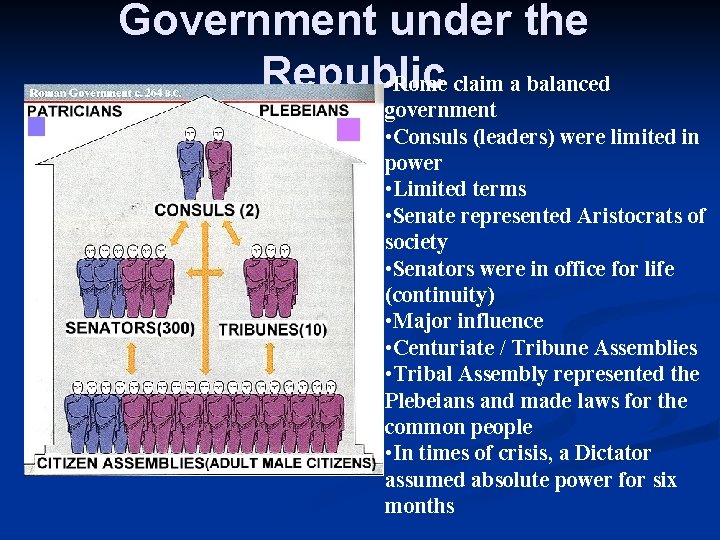
Government under the Republic • Rome claim a balanced government • Consuls (leaders) were limited in power • Limited terms • Senate represented Aristocrats of society • Senators were in office for life (continuity) • Major influence • Centuriate / Tribune Assemblies • Tribal Assembly represented the Plebeians and made laws for the common people • In times of crisis, a Dictator assumed absolute power for six months
The Early Republic n The Roman Army n n Roman legion—military unit of 5, 000 infantry, supported by cavalry. Army is powerful and a key factor in Rome’s rise to greatness.
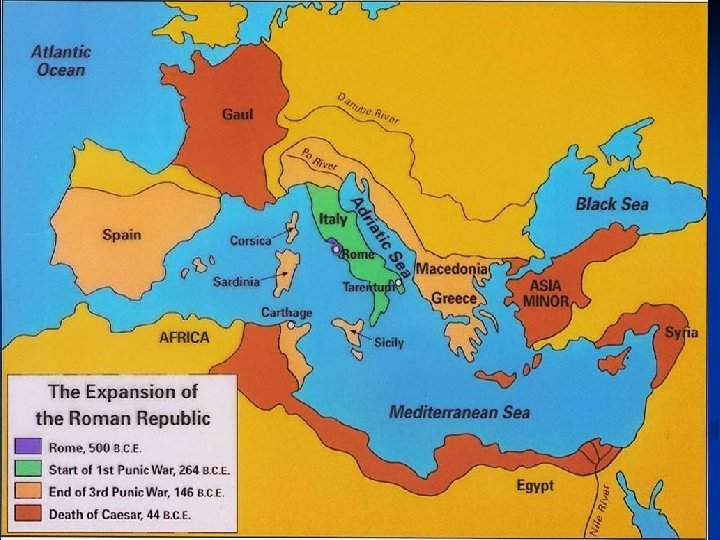
Rome Spreads Its Power n Rome Conquers Italy The Romans defeat the Etruscans in the north and the Greek city-states in the south. n By 265 B. C. , Rome controls the entire Italian peninsula. n Rome treats the conquered peoples justly. This enables Rome to grow. n
Rome Spreads Its Power n Rome’s Commercial Network Rome establishes a large trading network. n Access to the Mediterranean Sea provides many trade routes. n Carthage, a powerful city-state in North Africa, soon rivals Rome. n
Rome Spreads Its Power n War with Carthage n n n Rome and Carthage begin the Punic Wars—three wars between 264 through 146 B. C. Rome defeats Carthage and wins Sicily in the first 23 year war. Hannibal, the Carthaginian general, avenges this defeat in the Second Punic War. n n He attacks Italy through Spain and France, but doesn’t take Rome Triumphs n n Roman general Scipio defeats Hannibal in 202 B. C. Rome destroys Carthage and enslaves its people in the Third Punic War from 149 -146 B. C.
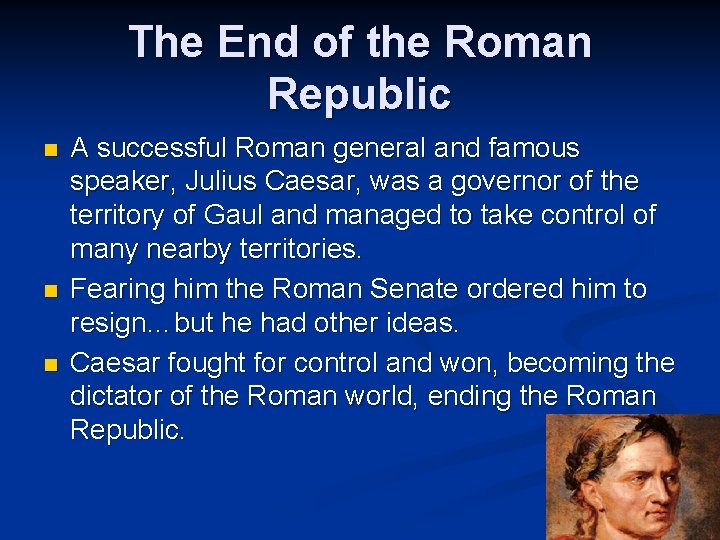
The End of the Roman Republic n n n A successful Roman general and famous speaker, Julius Caesar, was a governor of the territory of Gaul and managed to take control of many nearby territories. Fearing him the Roman Senate ordered him to resign…but he had other ideas. Caesar fought for control and won, becoming the dictator of the Roman world, ending the Roman Republic.
The Roman Empire Less than a year after gaining power a group of angered Senators stabbed Caesar to death on the floor of the Roman Senate. (March 15, 44 B. C. ) n This caused a civil war that lasted several years. n In 27 B. C. , Caesar’s adopted son, Octavian was named the first emperor of Rome. n
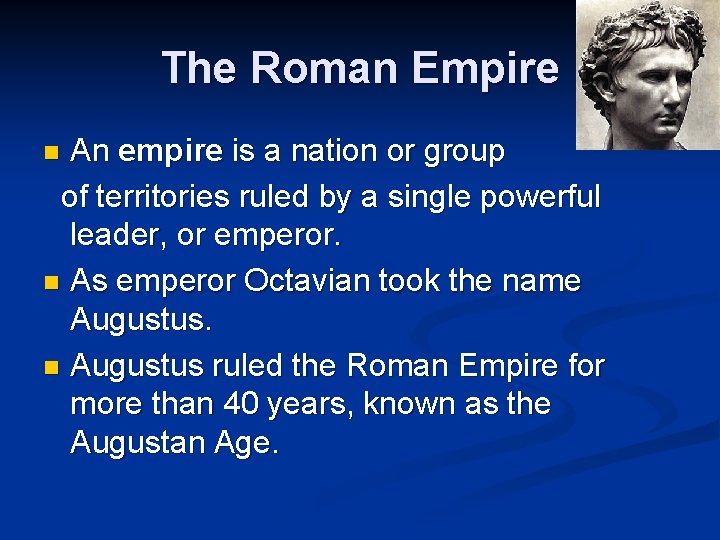
The Roman Empire An empire is a nation or group of territories ruled by a single powerful leader, or emperor. n As emperor Octavian took the name Augustus. n Augustus ruled the Roman Empire for more than 40 years, known as the Augustan Age. n
The Augustan Age n n n During the rule of Augustus the Roman empire continued to expand. Augustus kept soldiers along all the borders to keep peace in the Roman world. During this time architects and engineers built many new public buildings. Augustus, the first Roman emperor, ruled for 45 years. It was during the reign of Augustus that people got used to being ruled by one leader. Rome went on to greatness under the Empire, but the Roman Republic was no more. For 45 years, Rome was at peace. This period is the beginning of the Pax Romana, or Roman Peace. The phrase "Roman Peace" is a bit misleading. The Romans continued to expand their empire during this period. They did not always do so peacefully. Things were not always peaceful in the city of Rome did not always have the best leadership. Some emperors were very cruel. Some were insane. But the empire continued to be stable. For around 200 years, the Roman Empire was united. The Romans were great builders. Many of their incredible buildings and engineering projects were constructed during this period of relative peace. Culture and literature flourished. Much of Greek culture was adopted during
The Augustan Age During this time trade increased with olive oil, wine, pottery, marble, and grain being shipped all across the Mediterranean. n Lighthouses were constructed to guide ships into port. n This was also a time of great Roman literature. n
The Rise of Christianity After the death of Augustus in 14 A. D. a new religion begin to spread: Christianity. n At first it took hold in the eastern half of the Roman Empire. n By 200 A. D. this religion had spread throughout the empire. n
The Rise of Christianity Christians were viewed with suspicion and suffered persecution and many were punished or killed for their beliefs. n Things changed when Constantine became emperor of Rome in 306 A. D. During his reign Christianity became the official religion of the Roman Empire. n
The Rise of Christianity Christians were viewed with suspicion and suffered persecution and many were punished or killed for their beliefs. n Things changed when Constantine became emperor of Rome in 306 A. D. During his reign Christianity became the official religion of the Roman Empire. n
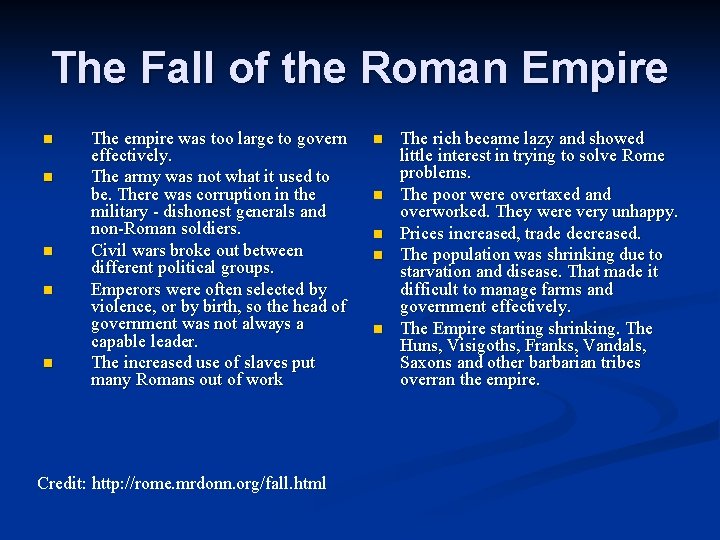
The Fall of the Roman Empire n n n The empire was too large to govern effectively. The army was not what it used to be. There was corruption in the military - dishonest generals and non-Roman soldiers. Civil wars broke out between different political groups. Emperors were often selected by violence, or by birth, so the head of government was not always a capable leader. The increased use of slaves put many Romans out of work Credit: http: //rome. mrdonn. org/fall. html n n n The rich became lazy and showed little interest in trying to solve Rome problems. The poor were overtaxed and overworked. They were very unhappy. Prices increased, trade decreased. The population was shrinking due to starvation and disease. That made it difficult to manage farms and government effectively. The Empire starting shrinking. The Huns, Visigoths, Franks, Vandals, Saxons and other barbarian tribes overran the empire.

The Fall of the Roman Empire n n The ancient Romans tried to solve some of their problems by splitting the Roman Empire in half, hoping that would make the empire easier to manage. Each side had an emperor, but the emperor in charge was the emperor of the western half, the half that included the city of Rome. The Western Roman Empire did not do well. Instead of getting stronger, they became weaker. By 400 AD, it was pretty much over. The Huns, Franks, Vandals, Saxons, Visigoths – any of these barbarian tribes might have been the group that finally brought Rome down. They were all attacking various pieces of the Western Roman Empire. In 476 AD, the Visigoths sacked Rome. Europe entered the Dark Ages. The eastern half of the Roman Empire received a new name – the Byzantine Empire. The Byzantine Empire did fine. It lasted for another 1000 years! Credit: http: //rome. mrdonn. org/fall. html

- Slides: 27