
The Role of Workload for Work Organisation in
![Introduction Workload Concept Def. Workload: [Goper & Donchin 86] Limitation on the capacity of](https://slidetodoc.com/presentation_image_h2/f1b5d4b239262eeda835d9cb7261d8c2/image-6.jpg "Introduction Workload Concept Def. Workload: [Goper & Donchin 86] Limitation on the capacity of")
![Method Sample: 12 controllers Deutsche Flugsicherung (DFS) Age: mean=34. 6 [25, 60] years valide](https://slidetodoc.com/presentation_image_h2/f1b5d4b239262eeda835d9cb7261d8c2/image-16.jpg "Method Sample: 12 controllers Deutsche Flugsicherung (DFS) Age: mean=34. 6 [25, 60] years valide")
- Slides: 27
The Role of Workload for Work Organisation in a Remote Tower Control Center Institute for Flight Guidance, German Aerospace Center (DLR) C. Möhlenbrink, A. Papenfuss, J. Jakobi
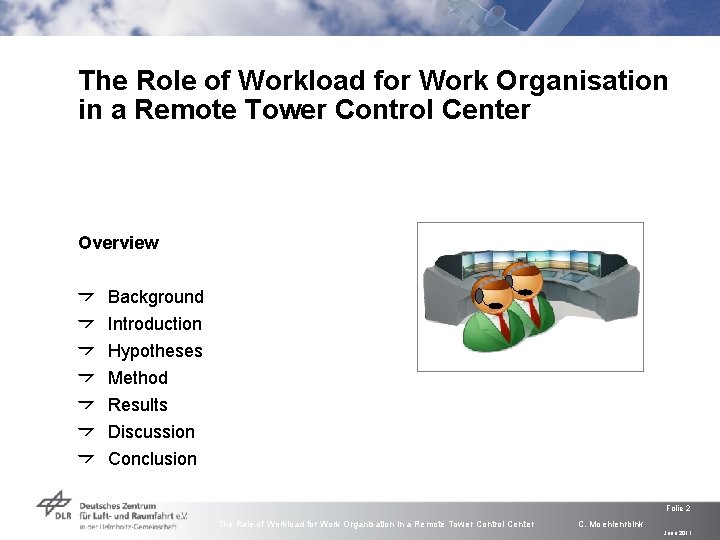
The Role of Workload for Work Organisation in a Remote Tower Control Center Overview Background Introduction Hypotheses Method Results Discussion Conclusion Folie 2 The Role of Workload for Work Organisation in a Remote Tower Control Center C. Moehlenrbink June 2011
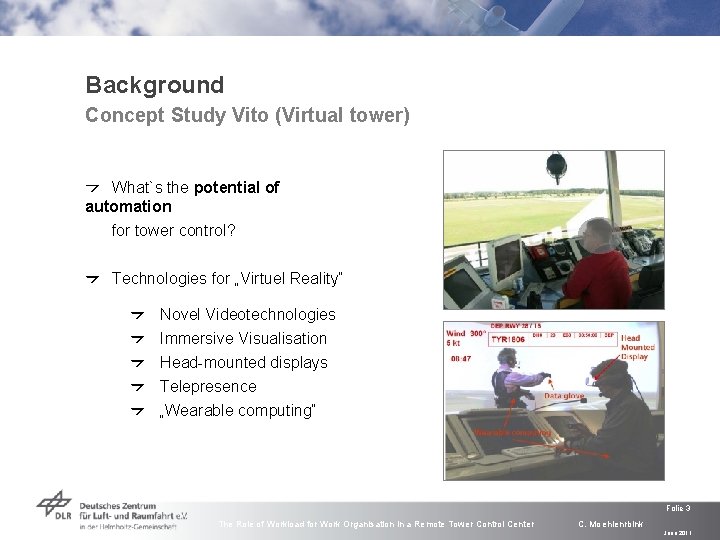
Background Concept Study Vito (Virtual tower) What`s the potential of automation for tower control? Technologies for „Virtuel Reality“ Novel Videotechnologies Immersive Visualisation Head-mounted displays Telepresence „Wearable computing“ Folie 3 The Role of Workload for Work Organisation in a Remote Tower Control Center C. Moehlenrbink June 2011
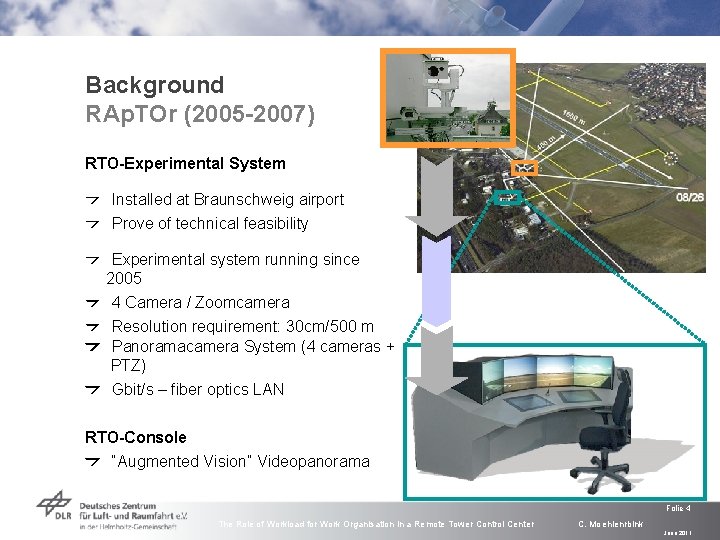
Background RAp. TOr (2005 -2007) RTO-Experimental System Installed at Braunschweig airport Prove of technical feasibility Experimental system running since 2005 4 Camera / Zoomcamera Resolution requirement: 30 cm/500 m Panoramacamera System (4 cameras + PTZ) Gbit/s – fiber optics LAN RTO-Console “Augmented Vision” Videopanorama Folie 4 The Role of Workload for Work Organisation in a Remote Tower Control Center C. Moehlenrbink June 2011
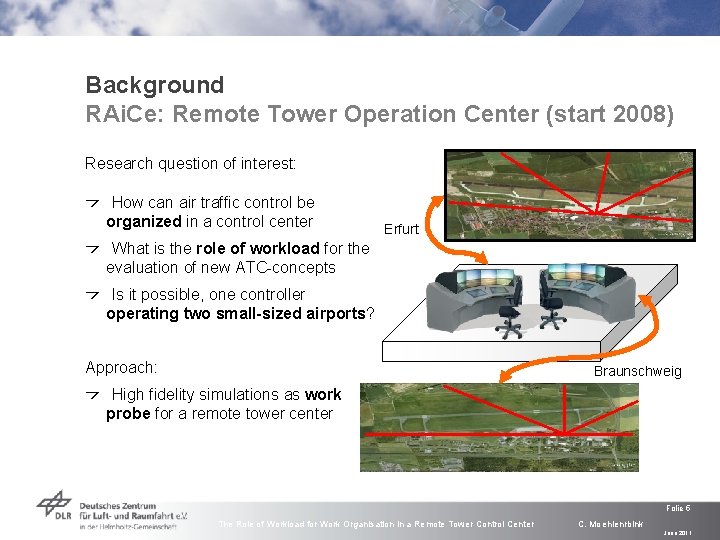
Background RAi. Ce: Remote Tower Operation Center (start 2008) Research question of interest: How can air traffic control be organized in a control center Erfurt What is the role of workload for the evaluation of new ATC-concepts Is it possible, one controller operating two small-sized airports? Approach: Braunschweig High fidelity simulations as work probe for a remote tower center Folie 5 The Role of Workload for Work Organisation in a Remote Tower Control Center C. Moehlenrbink June 2011
Introduction Workload Concept Def. Workload: [Goper & Donchin 86] Limitation on the capacity of an information processing system. taskload versus workload timeline models strategy shifs Influencing factors in aerodrome control: [Vogt et al. 2006] Aerodrome complexity VFR traffic Calculated take-off times Staffing Technological support Folie 6 The Role of Workload for Work Organisation in a Remote Tower Control Center C. Moehlenrbink June 2011
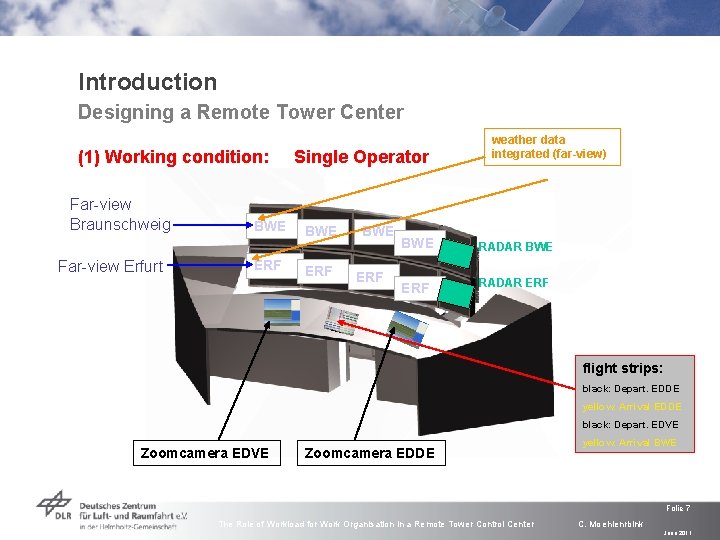
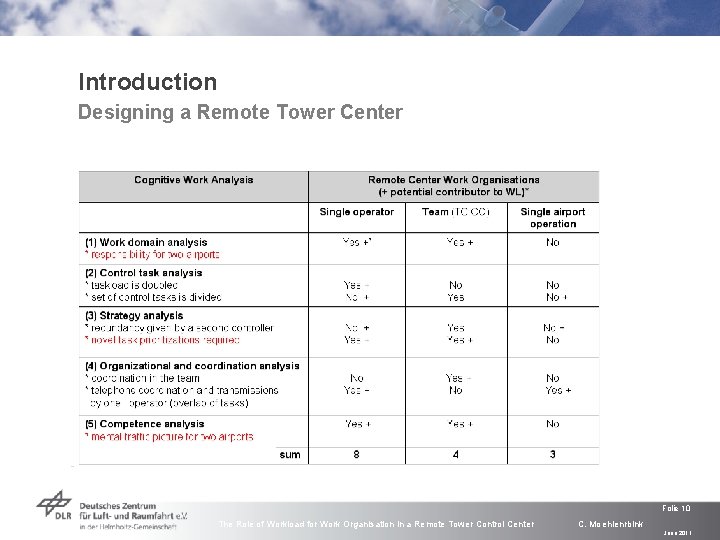
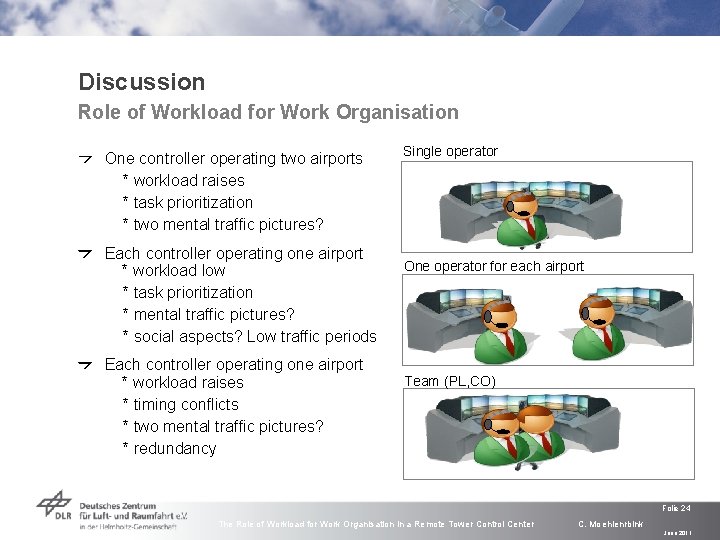
Introduction Designing a Remote Tower Center (1) Working condition: Far-view Braunschweig Far-view Erfurt BWE ERF Single Operator BWE ERF weather data integrated (far-view) BWE RADAR BWE ERF RADAR ERF flight strips: black: Depart. EDDE yellow: Arrival EDDE black: Depart. EDVE Zoomcamera EDDE yellow: Arrival BWE Folie 7 The Role of Workload for Work Organisation in a Remote Tower Control Center C. Moehlenrbink June 2011
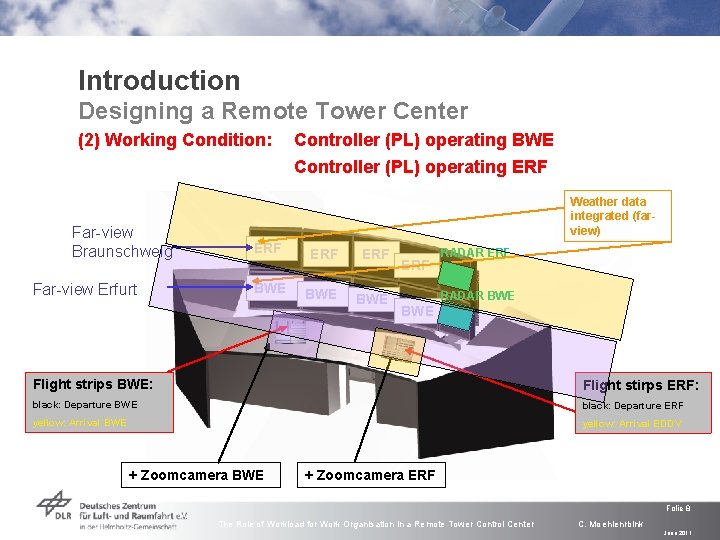
Introduction Designing a Remote Tower Center (2) Working Condition: Controller (PL) operating BWE Controller (PL) operating ERF Far-view Braunschweig Far-view Erfurt Weather data integrated (farview) ERF BWE ERF RADAR BWE Flight strips BWE: Flight stirps ERF: black: Departure BWE black: Departure ERF yellow: Arrival BWE yellow: Arrival EDDV + Zoomcamera BWE + Zoomcamera ERF Folie 8 The Role of Workload for Work Organisation in a Remote Tower Control Center C. Moehlenrbink June 2011
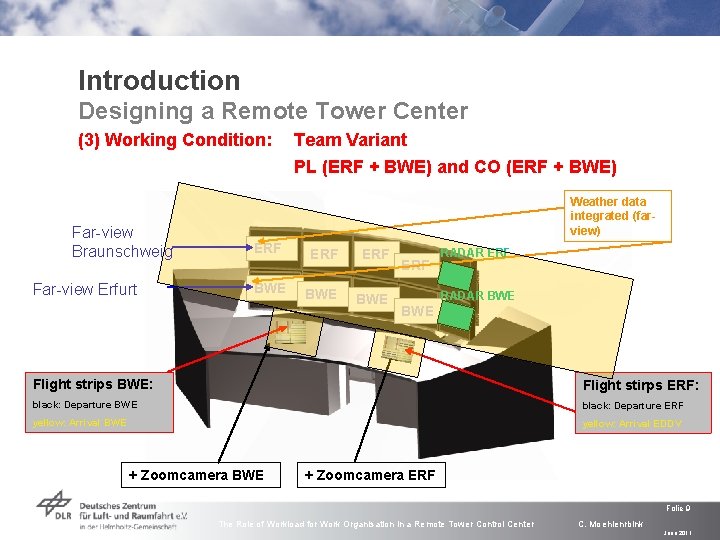
Introduction Designing a Remote Tower Center (3) Working Condition: Team Variant PL (ERF + BWE) and CO (ERF + BWE) Far-view Braunschweig Far-view Erfurt Weather data integrated (farview) ERF BWE ERF RADAR BWE Flight strips BWE: Flight stirps ERF: black: Departure BWE black: Departure ERF yellow: Arrival BWE yellow: Arrival EDDV + Zoomcamera BWE + Zoomcamera ERF Folie 9 The Role of Workload for Work Organisation in a Remote Tower Control Center C. Moehlenrbink June 2011
Introduction Designing a Remote Tower Center Folie 10 The Role of Workload for Work Organisation in a Remote Tower Control Center C. Moehlenrbink June 2011
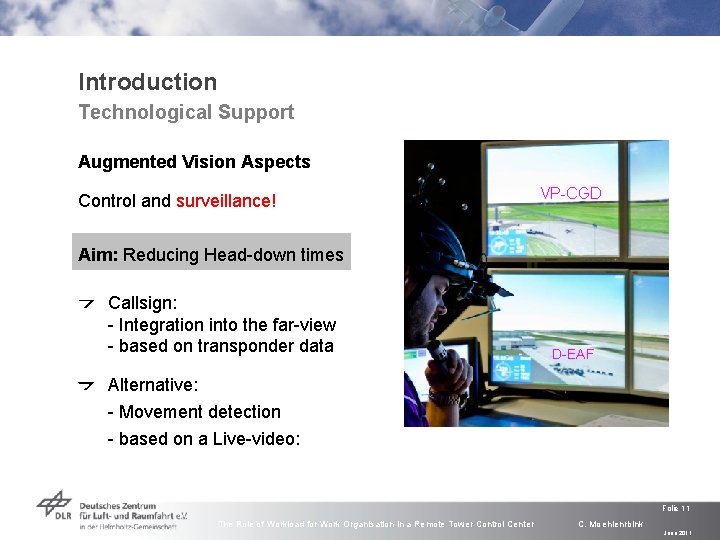
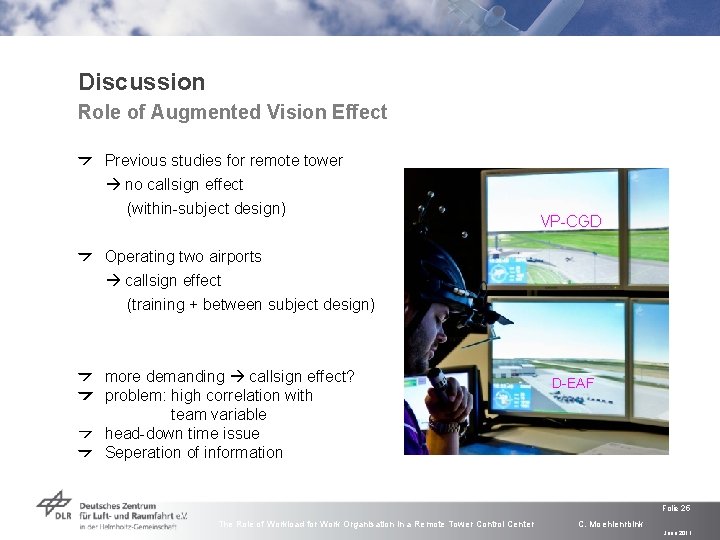
Introduction Technological Support Augmented Vision Aspects Control and surveillance! VP-CGD Aim: Reducing Head-down times Callsign: - Integration into the far-view - based on transponder data D-EAF Alternative: - Movement detection - based on a Live-video: Folie 11 The Role of Workload for Work Organisation in a Remote Tower Control Center C. Moehlenrbink June 2011
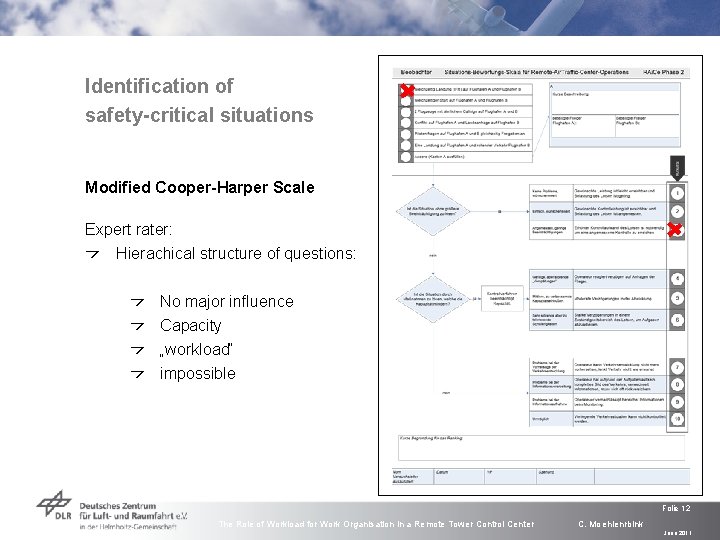
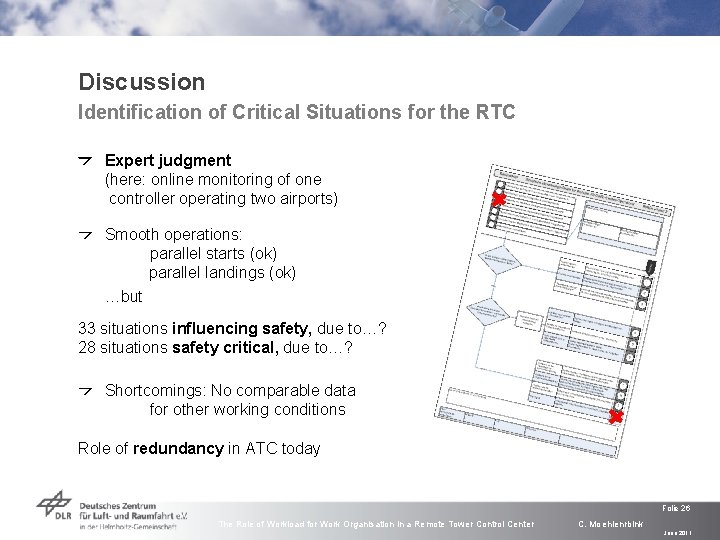
Identification of safety-critical situations Modified Cooper-Harper Scale Expert rater: Hierachical structure of questions: No major influence Capacity „workload“ impossible Folie 12 The Role of Workload for Work Organisation in a Remote Tower Control Center C. Moehlenrbink June 2011
Hypotheses traffic hypotheses H 1 a: For ISA workload ratings (2 min interval) it is expected that the workload ratings are higher for the heavy traffic than for low traffic. H 1 b: Under low traffic, the single operator has significantly higher workload ratings compared to all other working conditions. The same assumption is made for heavy traffic. H 1 c: From a theoretical point of view it is predicted that the workload of the single controller operating two airports under low traffic load is not significantly higher, than the workload of controllers operating one airport with low traffic. Folie 13 The Role of Workload for Work Organisation in a Remote Tower Control Center C. Moehlenrbink June 2011
Hypotheses augmented vision hypotheses and expert ratings H 2 Augmented vision hypotheses For the between-subject-factor it is predicted that working with the callsign displayed on the video, workload is significantly lower compared to working without the callsign in the video. It is assumed that this effect is independent of the working positions or traffic load. Expert Ratings Identifying crucial constraints for the Remote Tower Center Concepts safety critical situation, when one controller is operating two airports Folie 14 The Role of Workload for Work Organisation in a Remote Tower Control Center C. Moehlenrbink June 2011
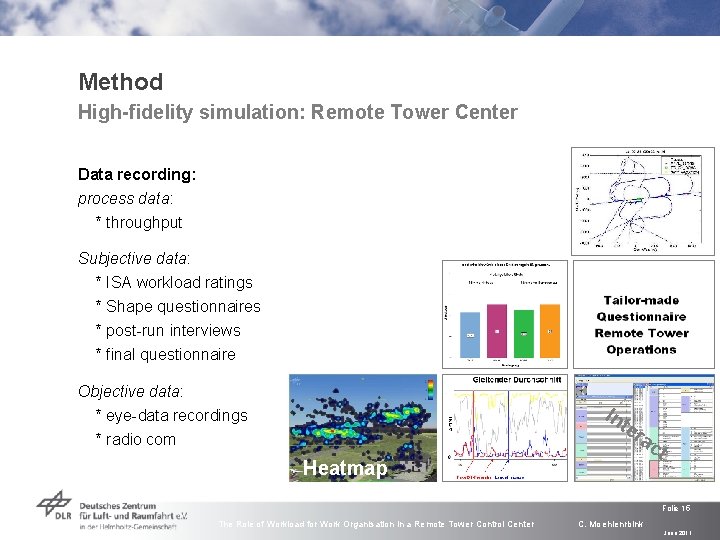
Method High-fidelity simulation: Remote Tower Center Data recording: process data: * throughput Subjective data: * ISA workload ratings * Shape questionnaires * post-run interviews * final questionnaire Objective data: * eye-data recordings * radio com In te ra Heatmap ct Folie 15 The Role of Workload for Work Organisation in a Remote Tower Control Center C. Moehlenrbink June 2011
Method Sample: 12 controllers Deutsche Flugsicherung (DFS) Age: mean=34. 6 [25, 60] years valide controller license Movements < 15. 000 IFR movements < 35. 000 IFR movements > 100. 000 IFR movements n 2 6 4 Folie 16 The Role of Workload for Work Organisation in a Remote Tower Control Center C. Moehlenrbink June 2011
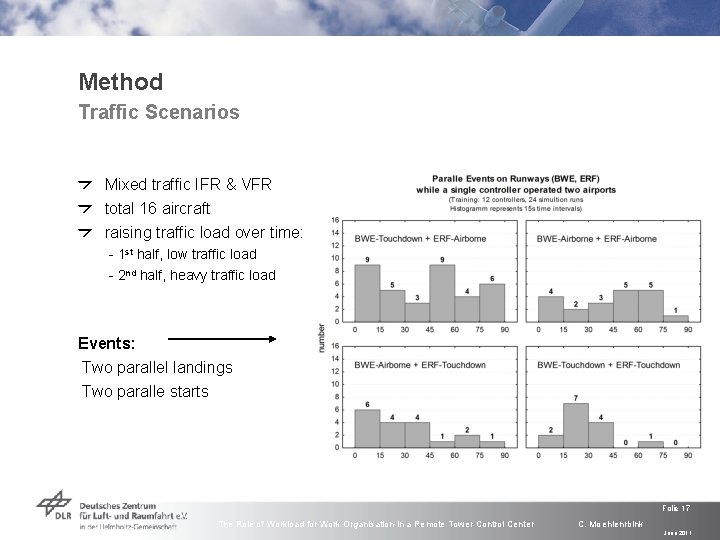
Method Traffic Scenarios Mixed traffic IFR & VFR total 16 aircraft raising traffic load over time: - 1 st half, low traffic load - 2 nd half, heavy traffic load Events: Two parallel landings Two paralle starts Folie 17 The Role of Workload for Work Organisation in a Remote Tower Control Center C. Moehlenrbink June 2011
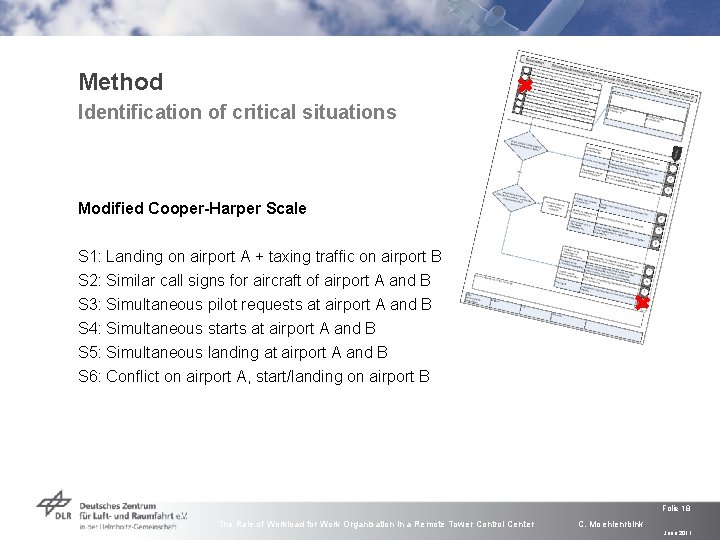
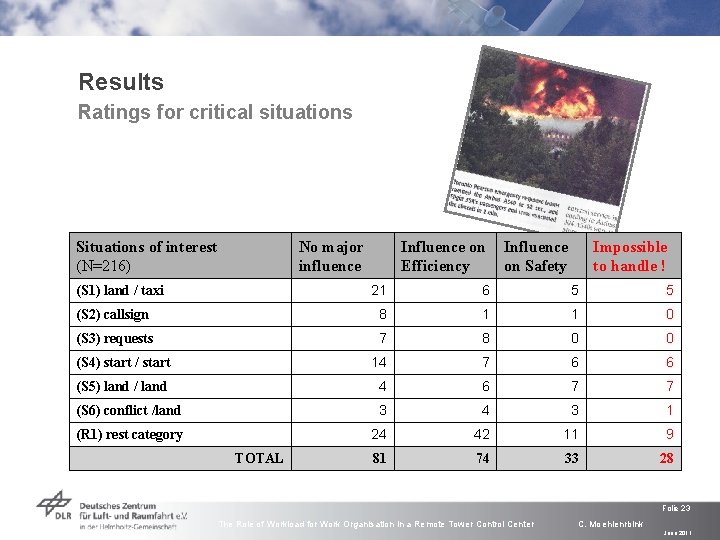
Method Identification of critical situations Modified Cooper-Harper Scale S 1: Landing on airport A + taxing traffic on airport B S 2: Similar call signs for aircraft of airport A and B S 3: Simultaneous pilot requests at airport A and B S 4: Simultaneous starts at airport A and B S 5: Simultaneous landing at airport A and B S 6: Conflict on airport A, start/landing on airport B Folie 18 The Role of Workload for Work Organisation in a Remote Tower Control Center C. Moehlenrbink June 2011
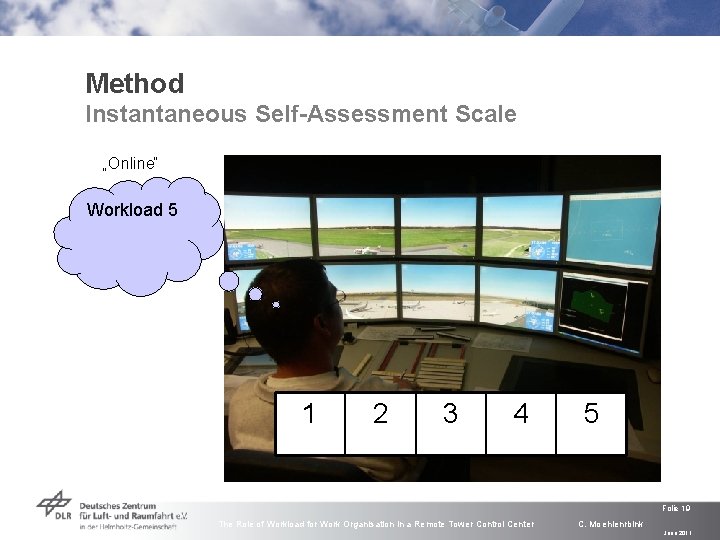
Method Instantaneous Self-Assessment Scale „Online“ Workload 5 1 2 3 4 5 Folie 19 The Role of Workload for Work Organisation in a Remote Tower Control Center C. Moehlenrbink June 2011
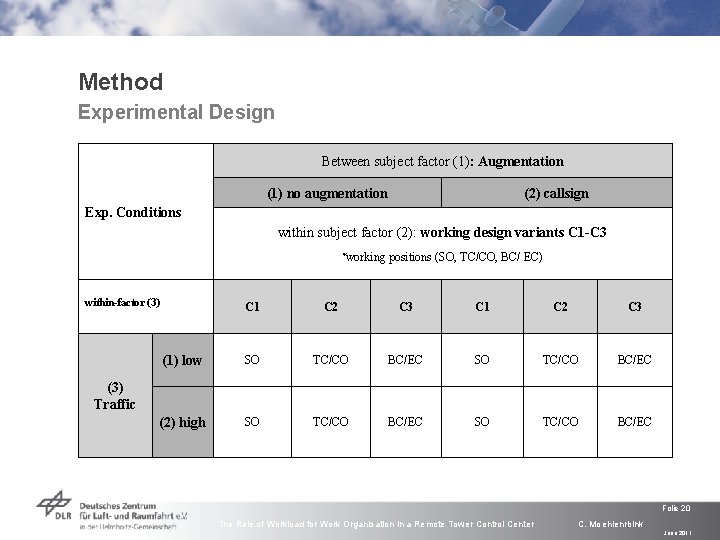
Method Experimental Design Between subject factor (1): Augmentation (1) no augmentation (2) callsign Exp. Conditions within subject factor (2): working design variants C 1 -C 3 *working within-factor (3) positions (SO, TC/CO, BC/ EC) C 1 C 2 C 3 (1) low SO TC/CO BC/EC (2) high SO TC/CO BC/EC (3) Traffic Folie 20 The Role of Workload for Work Organisation in a Remote Tower Control Center C. Moehlenrbink June 2011
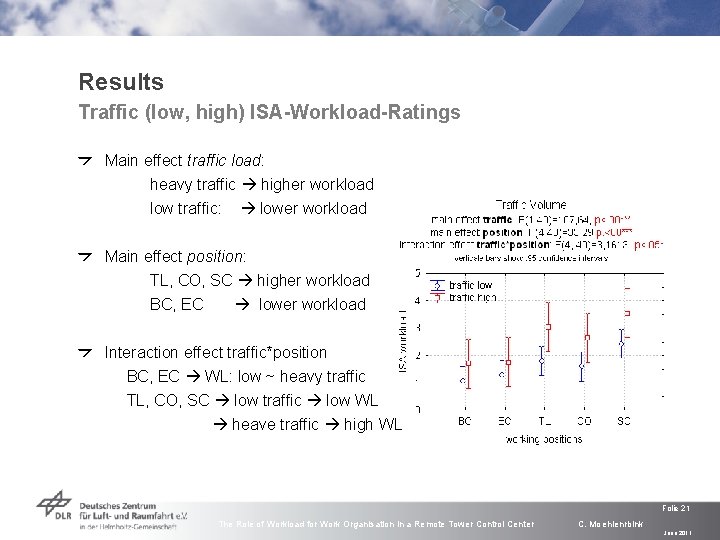
Results Traffic (low, high) ISA-Workload-Ratings Main effect traffic load: heavy traffic higher workload low traffic: lower workload Main effect position: TL, CO, SC higher workload BC, EC lower workload Interaction effect traffic*position BC, EC WL: low ~ heavy traffic TL, CO, SC low traffic low WL heave traffic high WL Folie 21 The Role of Workload for Work Organisation in a Remote Tower Control Center C. Moehlenrbink June 2011
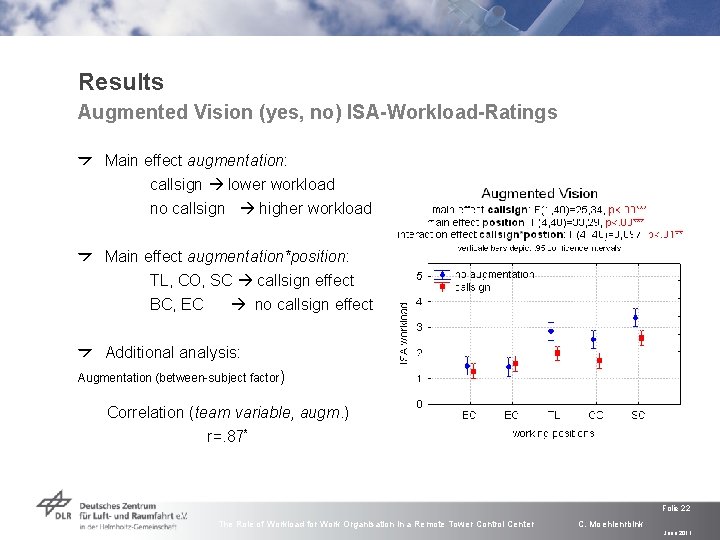
Results Augmented Vision (yes, no) ISA-Workload-Ratings Main effect augmentation: callsign lower workload no callsign higher workload Main effect augmentation*position: TL, CO, SC callsign effect BC, EC no callsign effect Additional analysis: Augmentation (between-subject factor) Correlation (team variable, augm. ) r=. 87* Folie 22 The Role of Workload for Work Organisation in a Remote Tower Control Center C. Moehlenrbink June 2011
Results Ratings for critical situations Situations of interest (N=216) No major influence Influence on Efficiency Influence on Safety Impossible to handle ! 21 6 5 5 (S 2) callsign 8 1 1 0 (S 3) requests 7 8 0 0 (S 4) start / start 14 7 6 6 (S 5) land / land 4 6 7 7 (S 6) conflict /land 3 4 3 1 (R 1) rest category 24 42 11 9 81 74 33 28 (S 1) land / taxi TOTAL Folie 23 The Role of Workload for Work Organisation in a Remote Tower Control Center C. Moehlenrbink June 2011
Discussion Role of Workload for Work Organisation One controller operating two airports * workload raises * task prioritization * two mental traffic pictures? Each controller operating one airport * workload low * task prioritization * mental traffic pictures? * social aspects? Low traffic periods Each controller operating one airport * workload raises * timing conflicts * two mental traffic pictures? * redundancy Single operator One operator for each airport Team (PL, CO) Folie 24 The Role of Workload for Work Organisation in a Remote Tower Control Center C. Moehlenrbink June 2011
Discussion Role of Augmented Vision Effect Previous studies for remote tower no callsign effect (within-subject design) VP-CGD Operating two airports callsign effect (training + between subject design) more demanding callsign effect? problem: high correlation with team variable head-down time issue Seperation of information D-EAF Folie 25 The Role of Workload for Work Organisation in a Remote Tower Control Center C. Moehlenrbink June 2011
Discussion Identification of Critical Situations for the RTC Expert judgment (here: online monitoring of one controller operating two airports) Smooth operations: parallel starts (ok) parallel landings (ok) …but 33 situations influencing safety, due to…? 28 situations safety critical, due to…? Shortcomings: No comparable data for other working conditions Role of redundancy in ATC today Folie 26 The Role of Workload for Work Organisation in a Remote Tower Control Center C. Moehlenrbink June 2011
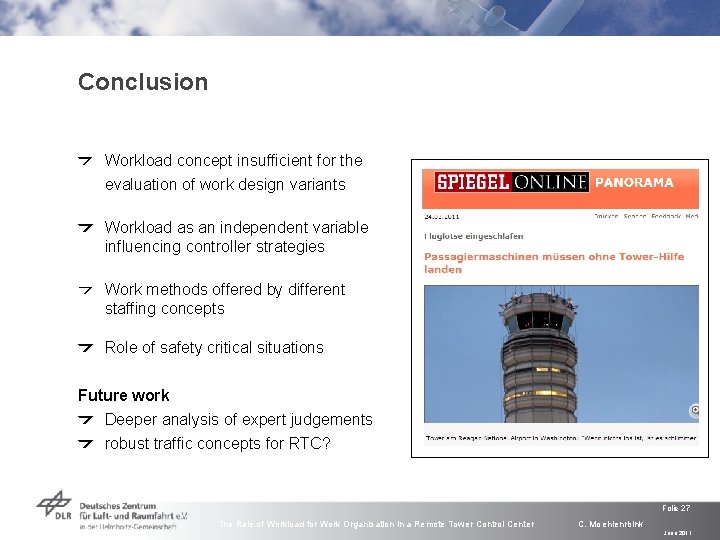
Conclusion Workload concept insufficient for the evaluation of work design variants Workload as an independent variable influencing controller strategies Work methods offered by different staffing concepts Role of safety critical situations Future work Deeper analysis of expert judgements robust traffic concepts for RTC? Folie 27 The Role of Workload for Work Organisation in a Remote Tower Control Center C. Moehlenrbink June 2011