
The Role of Water Quality Modeling in Watershed

- Slides: 29
The Role of Water Quality Modeling in Watershed Management for the Clark Fork and Bitterroot Rivers Missoula, Montana April 1, 2005 Dave Clark and Michael Kasch
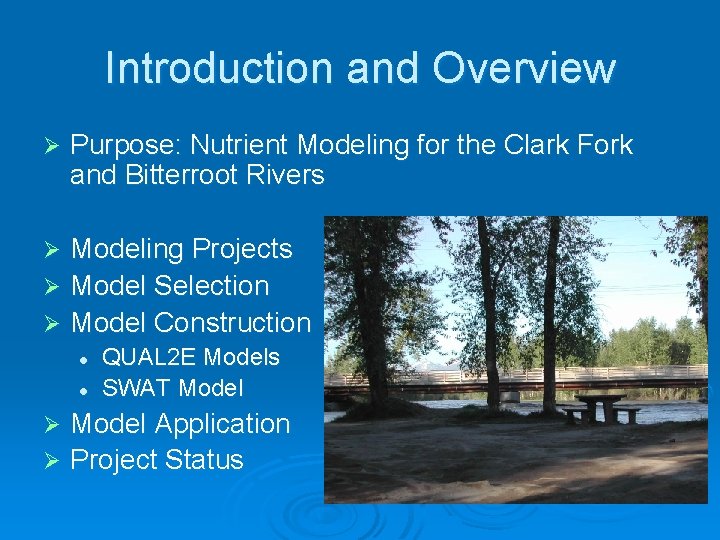
Introduction and Overview Ø Purpose: Nutrient Modeling for the Clark Fork and Bitterroot Rivers Modeling Projects Ø Model Selection Ø Model Construction Ø l l QUAL 2 E Models SWAT Model Application Ø Project Status Ø
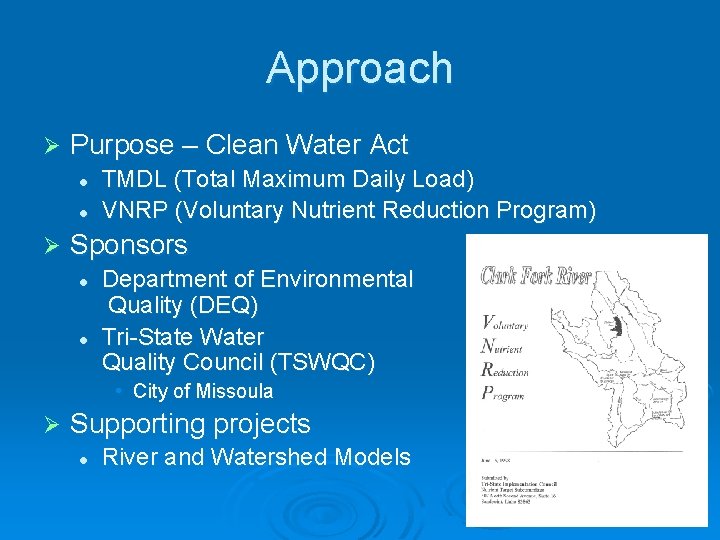
Approach Ø Purpose – Clean Water Act l l Ø TMDL (Total Maximum Daily Load) VNRP (Voluntary Nutrient Reduction Program) Sponsors l l Department of Environmental Quality (DEQ) Tri-State Water Quality Council (TSWQC) • City of Missoula Ø Supporting projects l River and Watershed Models
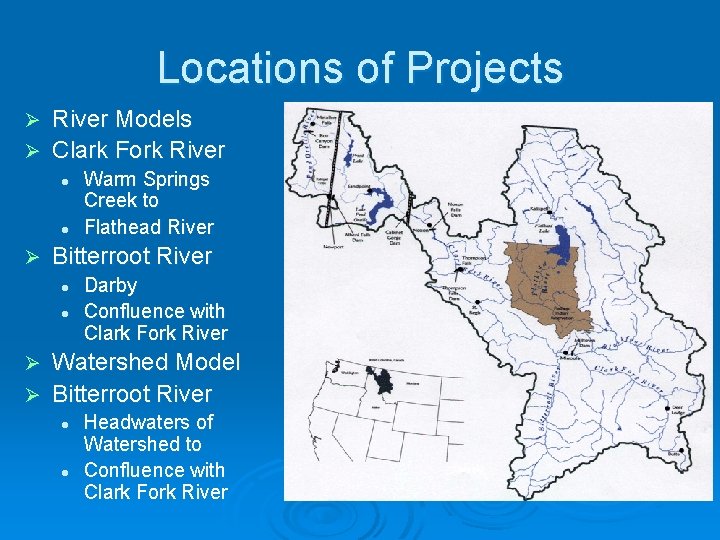
Locations of Projects River Models Ø Clark Fork River Ø l l Ø Warm Springs Creek to Flathead River Bitterroot River l l Darby Confluence with Clark Fork River Watershed Model Ø Bitterroot River Ø l l Headwaters of Watershed to Confluence with Clark Fork River
Models
Model Selection A model selection process was completed for the Clark Fork River with direction by TSWQC Ø Bitterroot River model selected to correspond with modeling on the Clark Fork River Ø Watershed model selected by DEQ Ø Models used to…. Ø l l l Assimilate monitoring data Assess the river system Prediction of response to drivers
Models Ø River Model – QUAL 2 E (Enhanced Stream Water Quality Model) l Ø Watershed Model – SWAT (Soil and Water Assessment Tool) l Ø Application funded by TSWQC & City of Missoula Application funded by DEQ Public Domain Software l QUAL 2 E developed by EPA l SWAT developed by USDA-ARS
Model Capabilities Ø QUAL 2 E is a one-dimensional river model capable of steady flow simulations of multiple water quality parameters l l Ø QUAL 2 E complexity is low to moderate Computer simulation time is minutes SWAT is a watershed-scale hydrologic and water-quality model developed to predict the effects of alternative land use management operations on water, sediment, and chemical yields l l SWAT complexity is high Computer simulation time is hours (days)
QUAL 2 E - SWAT Models Ø Results from QUAL 2 E and SWAT may be entered into the other model Ø Model results may indicate key areas and land uses to focus on Ø SWAT l l Ability to model non-point land use reductions May be used to model development and land use conversion impacts
Model Parameters Ø Model parameters may include: l l l Flow Water temperature Dissolved oxygen Sediment Nutrients (phosphorus and nitrogen forms)
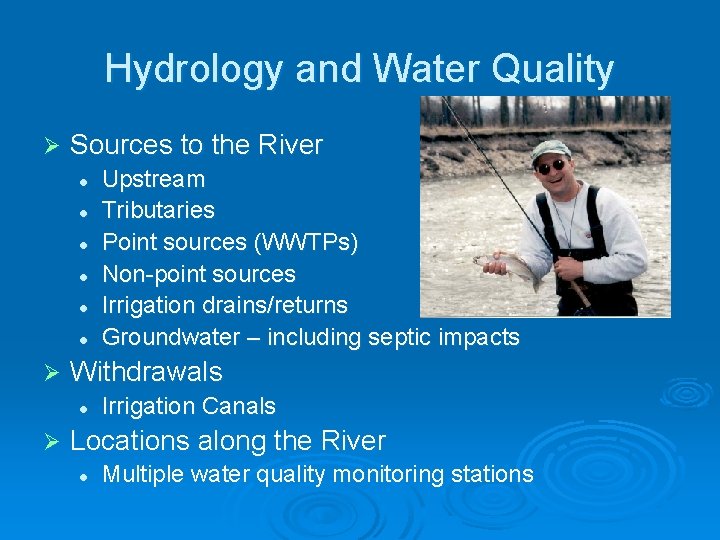
Hydrology and Water Quality Ø Sources to the River l l l Ø Withdrawals l Ø Upstream Tributaries Point sources (WWTPs) Non-point sources Irrigation drains/returns Groundwater – including septic impacts Irrigation Canals Locations along the River l Multiple water quality monitoring stations
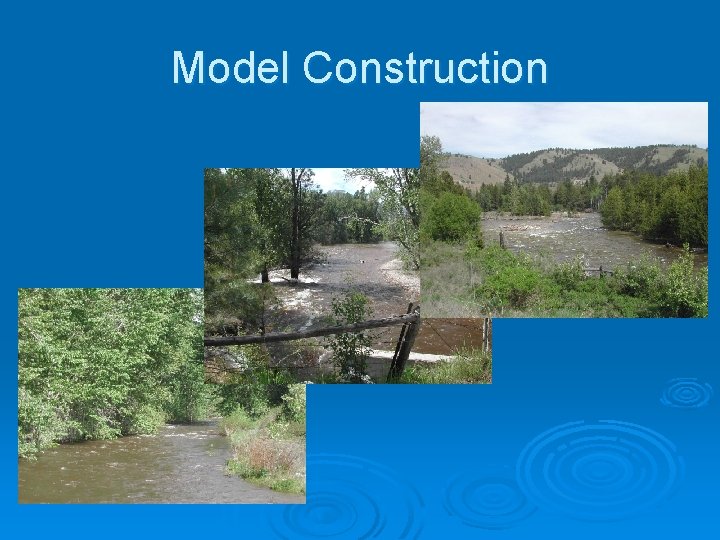
Model Construction
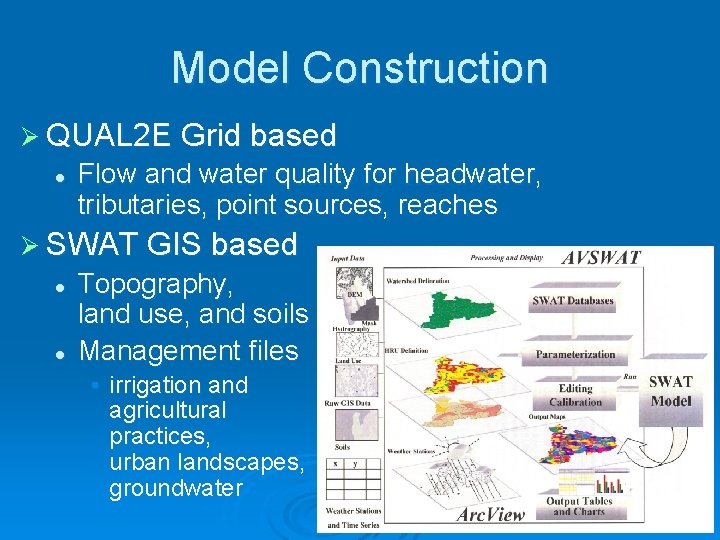
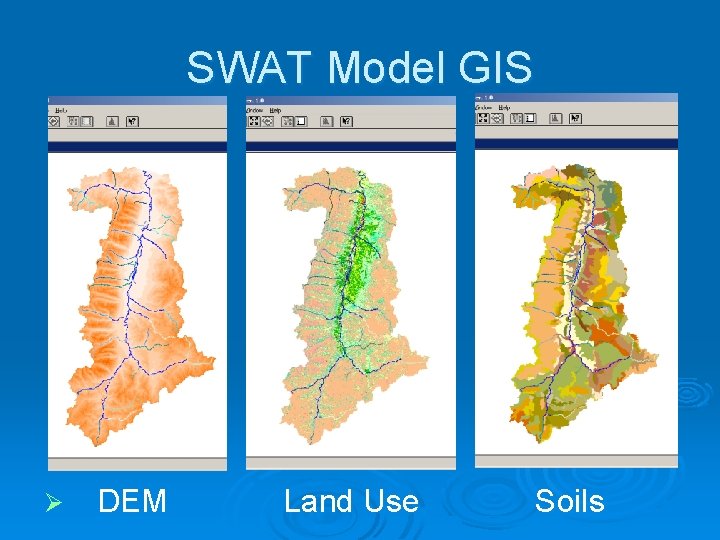
Model Construction Ø QUAL 2 E Grid based l Flow and water quality for headwater, tributaries, point sources, reaches Ø SWAT GIS based l l Topography, land use, and soils Management files • irrigation and agricultural practices, urban landscapes, groundwater
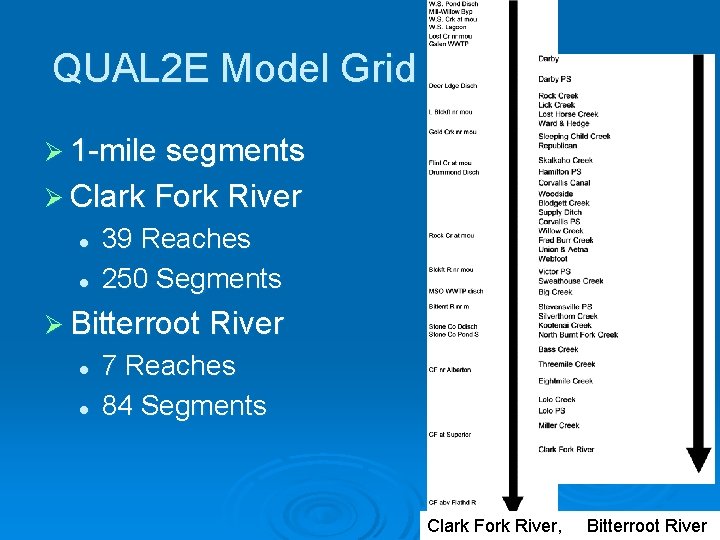
QUAL 2 E Model Grid Ø 1 -mile segments Ø Clark Fork River l l 39 Reaches 250 Segments Ø Bitterroot River l l 7 Reaches 84 Segments Clark Fork River, Bitterroot River
SWAT Model GIS Ø DEM Land Use Soils
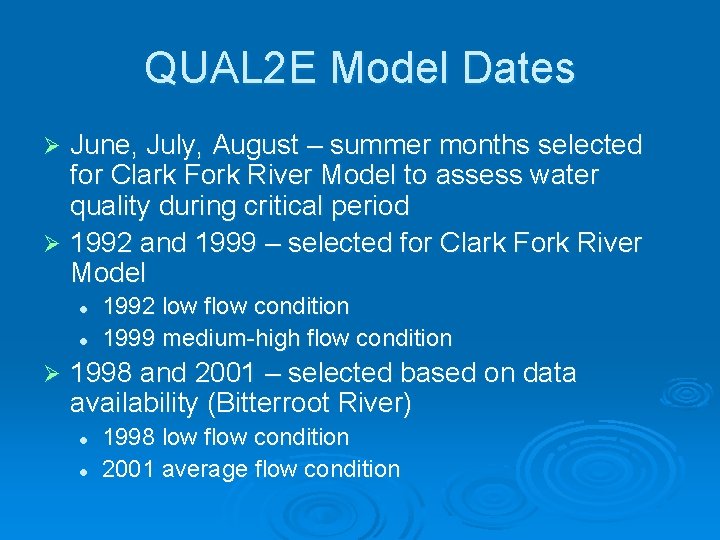
QUAL 2 E Model Dates June, July, August – summer months selected for Clark Fork River Model to assess water quality during critical period Ø 1992 and 1999 – selected for Clark Fork River Model Ø l l Ø 1992 low flow condition 1999 medium-high flow condition 1998 and 2001 – selected based on data availability (Bitterroot River) l l 1998 low flow condition 2001 average flow condition
SWAT Model Dates Ø September 2000 through September 2003 Ø Incorporate 2000 fire information into GIS land use data Ø Model 2004 and 2005 after model construction
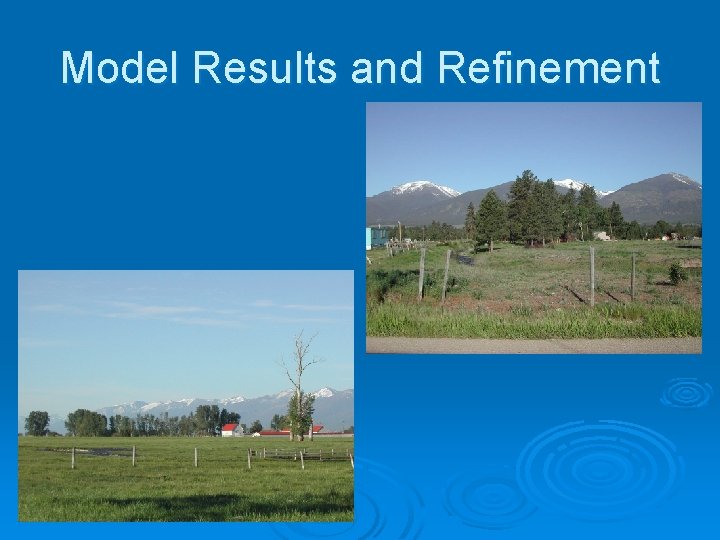
Model Results and Refinement
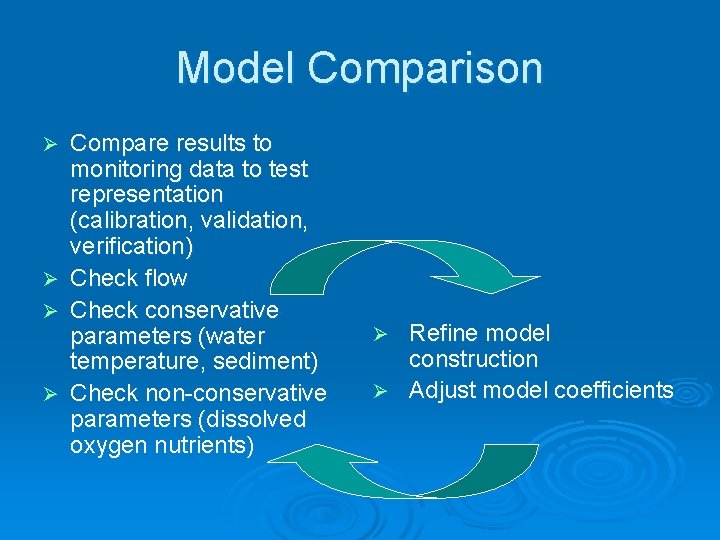
Model Comparison Compare results to monitoring data to test representation (calibration, validation, verification) Ø Check flow Ø Check conservative parameters (water temperature, sediment) Ø Check non-conservative parameters (dissolved oxygen nutrients) Ø Refine model construction Ø Adjust model coefficients Ø
Results Clark Fork River August 1992 Total Nitrogen
Results Clark Fork River August 1992 Total Phosphorus
Results Bitterroot River August 1992 Total Nitrogen
Results Bitterroot River August 1992 Total Phosphorus
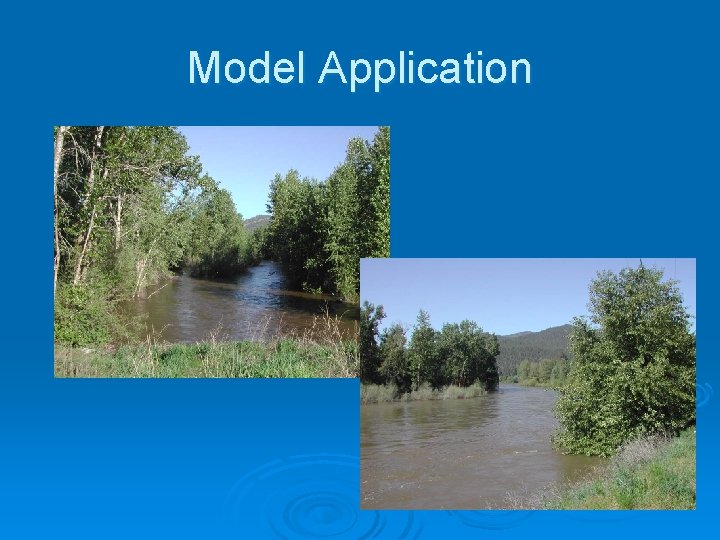
Model Application
Model Use Ø Sensitivity Analysis l Investigate drivers of water quality Ø Scenarios (What if’s) l Assess potential changes to water quality • Development • Land use management
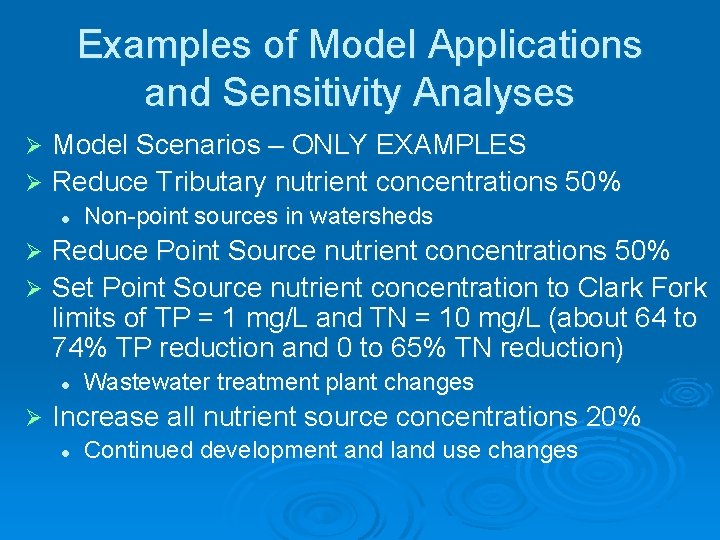
Examples of Model Applications and Sensitivity Analyses Model Scenarios – ONLY EXAMPLES Ø Reduce Tributary nutrient concentrations 50% Ø l Non-point sources in watersheds Reduce Point Source nutrient concentrations 50% Ø Set Point Source nutrient concentration to Clark Fork limits of TP = 1 mg/L and TN = 10 mg/L (about 64 to 74% TP reduction and 0 to 65% TN reduction) Ø l Ø Wastewater treatment plant changes Increase all nutrient source concentrations 20% l Continued development and land use changes
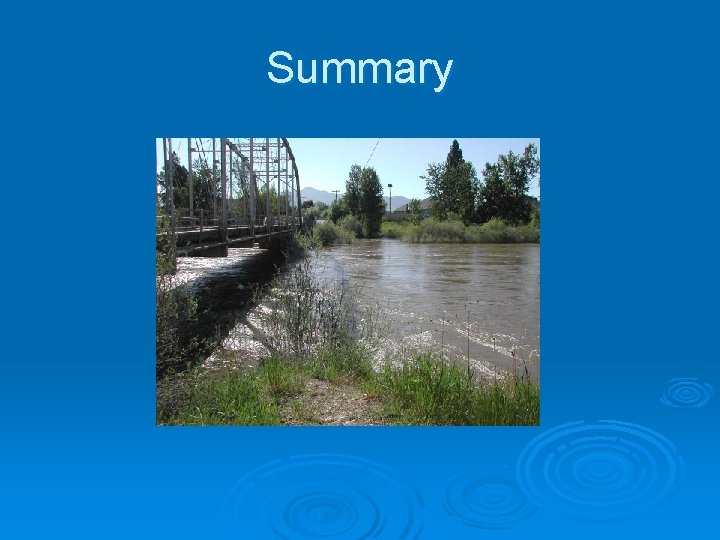
Summary
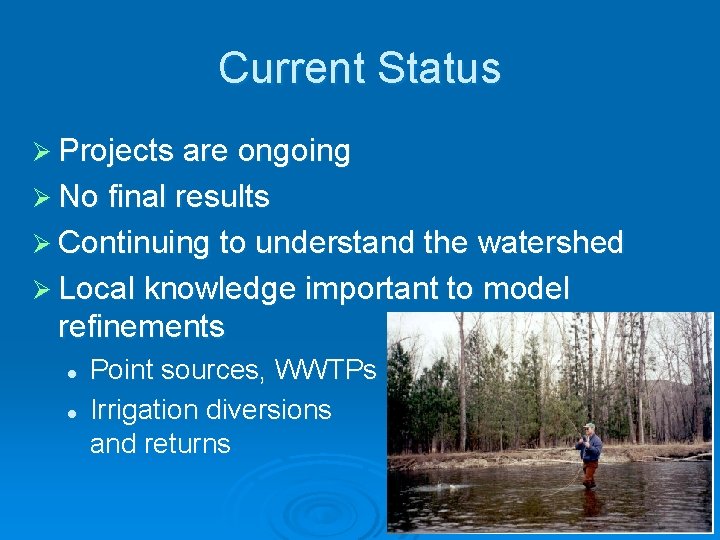
Current Status Ø Projects are ongoing Ø No final results Ø Continuing to understand the watershed Ø Local knowledge important to model refinements l l Point sources, WWTPs Irrigation diversions and returns
Future Ø Contact Will Mc. Dowell, TSWQC Michael Pipp or Kyle Flynn, DEQ Michael Kasch or David Clark, HDR