
The Role of University Education in Fostering Sustainable
The Role of University Education in Fostering Sustainable Development in Africa: The Case for The African University Model Baiyee-Mbi Agbor-Baiyee, Ph. D President & CEO African University Foundation
The Problem n n n The perpetual state of underdevelopment in Sub-Saharan Africa (Africa) is evident by the endemic social, economic, political, & Health related problems that are pervasive in the region. Since independence, there has been repeated calls to revitalize Africa’s private, state, & public-private institutions to provide effective leadership & governance that can translate into socioeconomic development. However, the persistence of those problems is an indication that the national economic and social systems and the existing developmental models are not bringing about the desired change.
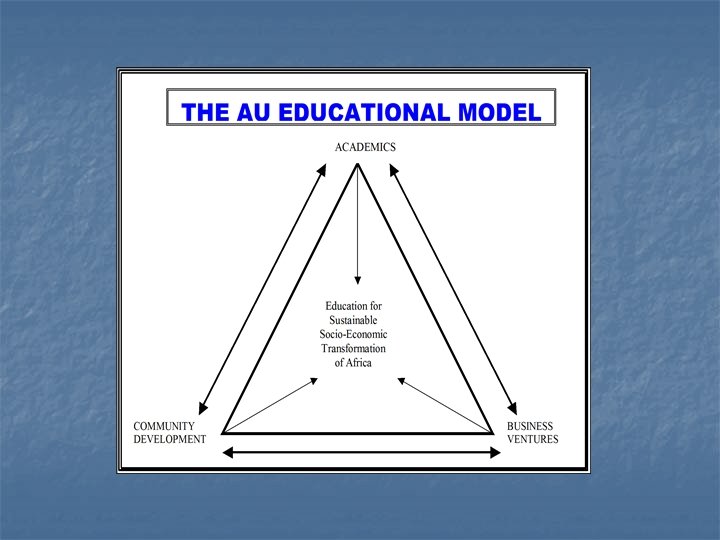
The Problem Continues n This underscores the need to re-conceptualize new developmental models in Africa within the missions of university education systems. n An effective university education in Africa should translate into an enduring culture that builds critical leadership and management skills that is creative, responsive, & adaptable to the changing needs of society, and n Ultimately, can pilot sustainable development in African societies. n The African University proposes a new university education model that would make a contribution to this regard.
Introduction n n Africa and Globalization was hailed as an opportunity for African Development in that: Real-time global information would facilitate coordination of: n Capital & Raw material flows, n Commodity markets, n Labor markets, n Management of production at a global scale, & n Flexible manufacturing technology to satisfy global niche markets. n Would facilitate development through increase in: n Foreign investments, n Employment opportunities, n Tax revenues, n Transfer of technology, knowledge, and skills, & n Import and export oriented industrialization in Africa through flexible manufacturing n
An over-optimistic Assumption That proposition assumed that: Africa had the human, Physical, & financial capacity to absorb advanced technologies and to respond to change similar to developed countries. n Macro-economic policies that are conducive for risky foreign and domestic investments. n Foreign investment is intended for social engineering that would lead to foreign development rather than profit maximization. n African economies can compete at global levels. n
Impact of Globalization on Africa Compared to other regions n n n 1990 to 2003 growth in living standard (Average GDP per capita) (Mc. Kenzie, 2005) n East Asia increased by 5. 9% / year n South Asia increased by 3. 6% / year n South America increased by 1. 1% / year n Sub-Saharan Africa unchanged / year. 1990 to 2001 reduction in extreme poverty reduction (number of people living on less than $1 a day) due to trade (Mc. Kenzie, 2005) n Total in developing countries fell by 130 million from 1. 22 billion to 1. 09 billion. n East Asia decreased from 30% to 15% n South Asia decreased from 41% to 31% n Latin America decreased from 13% to 9% n Sub-Saharan Africa increased from 44% to 46%. Combined Value of African global trade contribution to world export dropped from 3. 3% to 1. 6% from 1980 to 2005 (France Ministry of Agriculture Website).
Reaction to Africa’s Poor Performance n Much attentions directed at the selfish motives of the globalization stakeholders. n The term neocolonialism used to describe Western activities of the post colonial period is now used to label globalization. n n The argument: Globalization is overt neocolonialism because: n it infringes on the social, economic, cultural, and political autonomy and the self determination of developing nations. n Globalization is dictated by international labor, economic, trade, and financial institutions that are controlled by the developed countries and are also the home countries of multinational conglomerates. The Argument is an exercise in futility n n A comprehensive solution to the development challenges in Africa must hold African institutional missions, visionary leadership, & policy outcomes accountable to the destiny of Africa. Otherwise, the arguments are intended to justify the continued need foreign assistance, which is not sustainable.
The Role of University Education in Community Development n University education systems in Africa are modeled from those of the colonial period. n n n Models designed to train civil servants to perform routine functions for colonial institutions. Graduates of post colonial education depend on employment with the government. Deficiency of the System n Does not provide a context that facilitates the development of creative thoughts, ideas, values, leadership, entrepreneurship, risk taking, and other necessary skills that can be channeled into sustainable development in Africa.
The Role of University Education in Community Development Some Recent calls for new University Education in Africa n n n Saint (1992): - argued that it is time to rethink, reform, and renew African higher education in order to build the necessary capacity for the 21 st century. Celestine Juma (2005) in the final report of the UN’s Millennium Task Force on the Project on Science, Technology, and Innovation: - argued that a new generation of universities that focus on solving community problems are required to address Africa’s development challenges. Experience in the Far East can serve as example to Africa. n (Stiglitz, 1999) noted that the strong economic development in the Far East results from closing the knowledge gap with the West in the transformation of inputs into outputs. n Also that World Bank is shifting its developmental emphasis from the accumulation of physical assets as the main indicators of development to the intangibles of knowledge, institutions, and culture that forges a more comprehensive framework for development.
Initiatives to Revitalize University Education in Africa n n n Partnership to Strengthen Higher Education in Africa formed by Carnegie, Ford, & Mac. Arthur Foundations in April 2000, pooled together 150 million U. S. dollars to support universities in seven African countries: Nigeria, Mozambique, Tanzania, Uganda, Ghana, & South Africa, and. In September 16 th 2005, the William and Flora Hewlett and Andrew W. Mellon Foundations joined the partnership and the six foundation pledged an additional 200 million dollars to be spent over a 10 year-period. The objectives of the partnership are to: n improve access to, and utilization of, information and communication technology; n Train institutional leaders and managers, and n Promote gender equity. Two concerns n Close ties of the universities with their governments n Sustainability
- Slides: 11