
The role of university college counseling centers in
- Slides: 23
The role of university/ college counseling centers in the management of students’ mental health issues as they impacts student academic progression and retention Rosa B. Ament, Ph. D. , Pace University Westchester, Director, Counseling Center Wendy Freedman, Ph. D. , Vassar, Director, Psychological Services Jaclyn Friedman-Lombardo, Ph. D. , Montclair State University, Director, Counseling Center
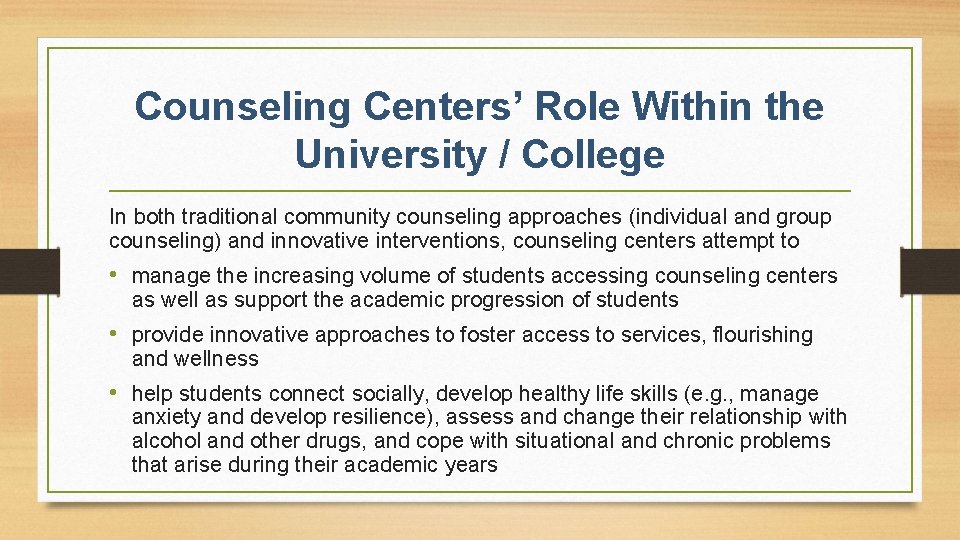
Counseling Centers’ Role Within the University / College In both traditional community counseling approaches (individual and group counseling) and innovative interventions, counseling centers attempt to • manage the increasing volume of students accessing counseling centers as well as support the academic progression of students • provide innovative approaches to foster access to services, flourishing and wellness • help students connect socially, develop healthy life skills (e. g. , manage anxiety and develop resilience), assess and change their relationship with alcohol and other drugs, and cope with situational and chronic problems that arise during their academic years
Overall Contextual Information National Trends as reported by the Association of University and College Counseling Center Directors Research reported by the Center for Collegiate Mental Health, Penn State
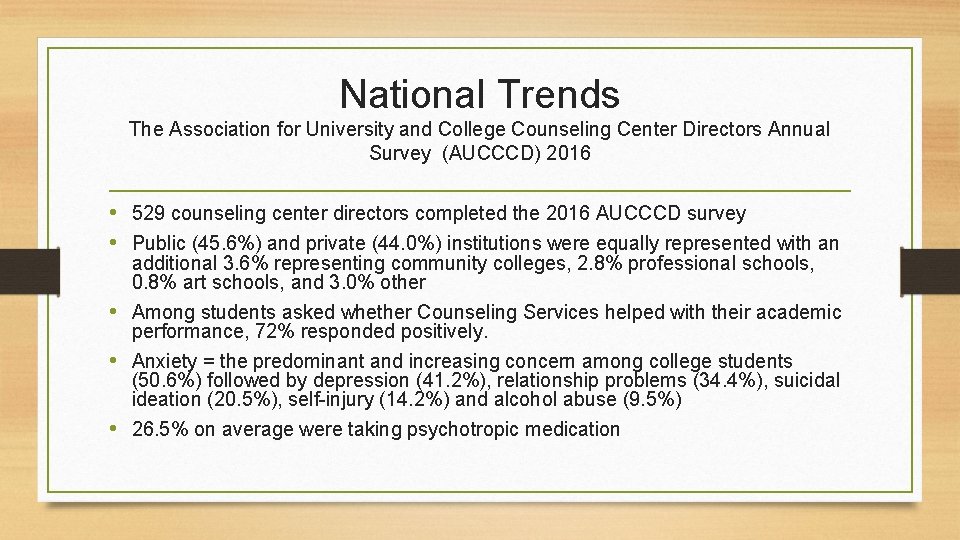
National Trends The Association for University and College Counseling Center Directors Annual Survey (AUCCCD) 2016 • 529 counseling center directors completed the 2016 AUCCCD survey • Public (45. 6%) and private (44. 0%) institutions were equally represented with an additional 3. 6% representing community colleges, 2. 8% professional schools, 0. 8% art schools, and 3. 0% other • Among students asked whether Counseling Services helped with their academic performance, 72% responded positively. • Anxiety = the predominant and increasing concern among college students (50. 6%) followed by depression (41. 2%), relationship problems (34. 4%), suicidal ideation (20. 5%), self-injury (14. 2%) and alcohol abuse (9. 5%) • 26. 5% on average were taking psychotropic medication
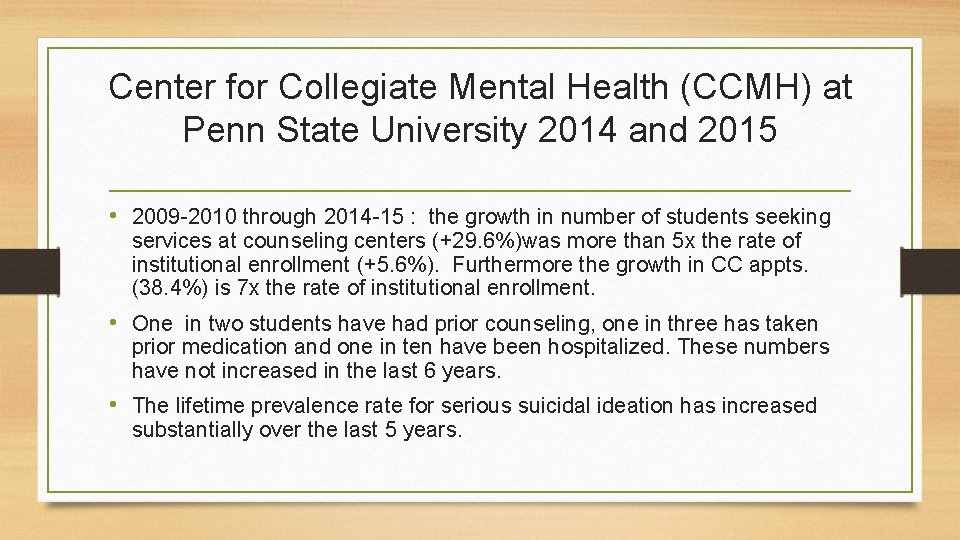
Center for Collegiate Mental Health (CCMH) at Penn State University 2014 and 2015 • 2009 -2010 through 2014 -15 : the growth in number of students seeking services at counseling centers (+29. 6%)was more than 5 x the rate of institutional enrollment (+5. 6%). Furthermore the growth in CC appts. (38. 4%) is 7 x the rate of institutional enrollment. • One in two students have had prior counseling, one in three has taken prior medication and one in ten have been hospitalized. These numbers have not increased in the last 6 years. • The lifetime prevalence rate for serious suicidal ideation has increased substantially over the last 5 years.
Programs That Promote Student Progression and Retention
Pace University, Westchester Campuses Stress Management & Wellness Promotion Rosa B. Ament, Ph. D. , Director
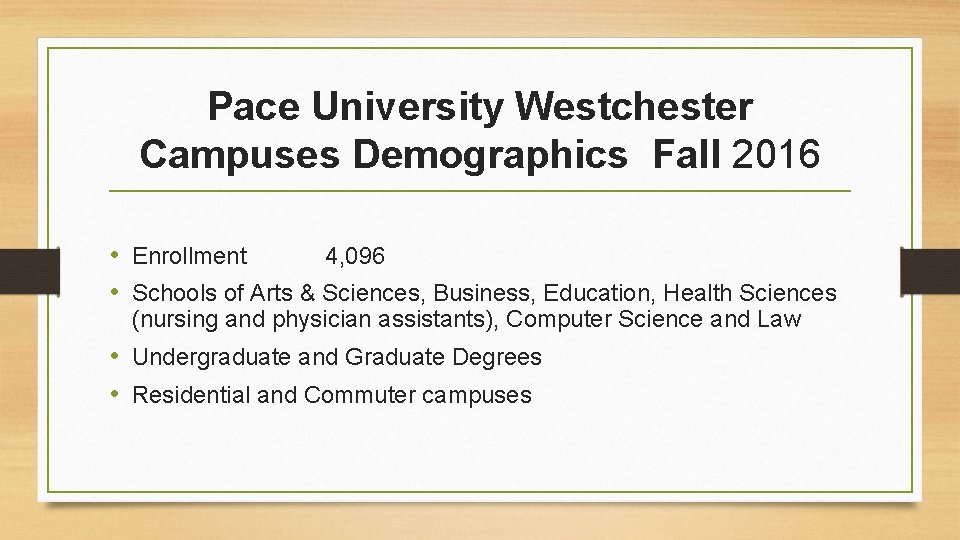
Pace University Westchester Campuses Demographics Fall 2016 • Enrollment 4, 096 • Schools of Arts & Sciences, Business, Education, Health Sciences (nursing and physician assistants), Computer Science and Law • Undergraduate and Graduate Degrees • Residential and Commuter campuses
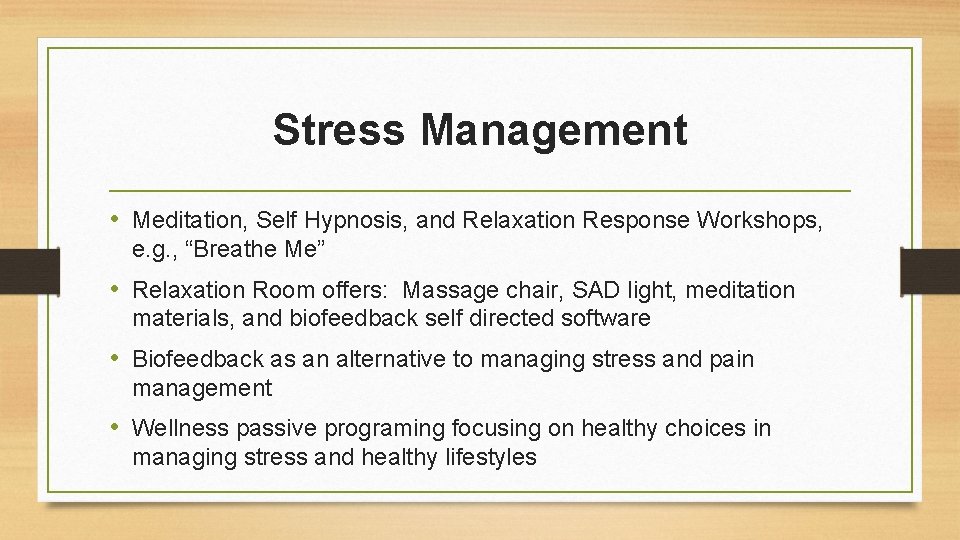
Stress Management • Meditation, Self Hypnosis, and Relaxation Response Workshops, e. g. , “Breathe Me” • Relaxation Room offers: Massage chair, SAD light, meditation materials, and biofeedback self directed software • Biofeedback as an alternative to managing stress and pain management • Wellness passive programing focusing on healthy choices in managing stress and healthy lifestyles
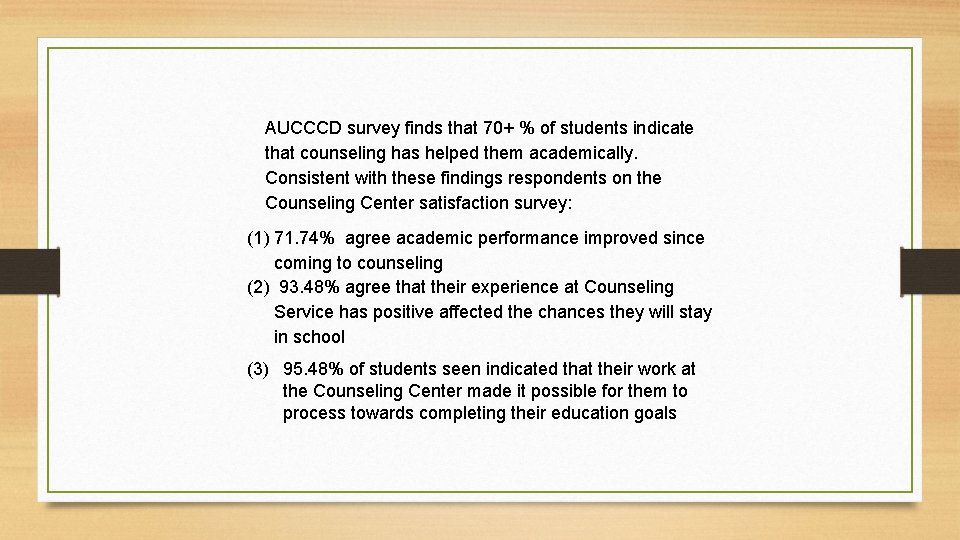
AUCCCD survey finds that 70+ % of students indicate that counseling has helped them academically. Consistent with these findings respondents on the Counseling Center satisfaction survey: (1) 71. 74% agree academic performance improved since coming to counseling (2) 93. 48% agree that their experience at Counseling Service has positive affected the chances they will stay in school (3) 95. 48% of students seen indicated that their work at the Counseling Center made it possible for them to process towards completing their education goals
Vassar College Group Therapy, A Path to Belonging Wendy Freedman, Ph. D. , CGP, Director
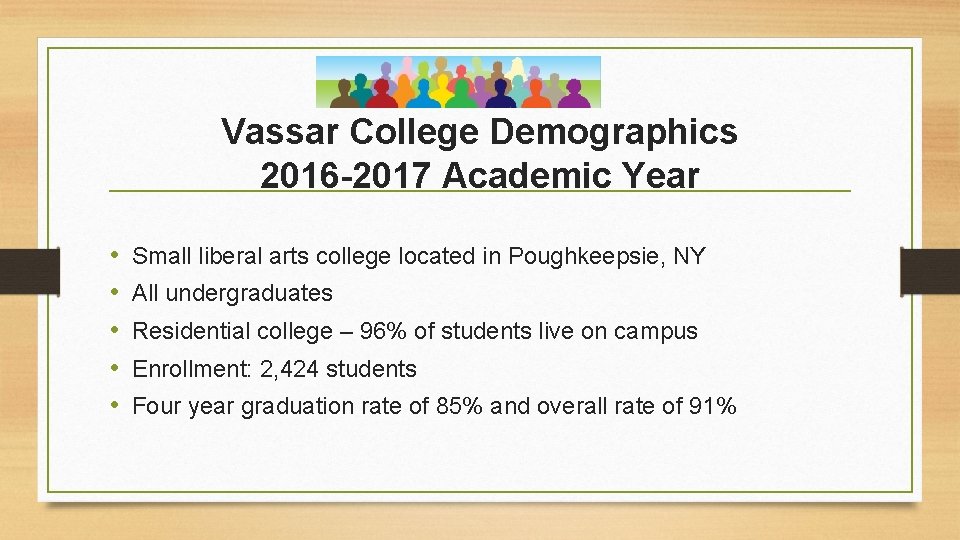
Vassar College Demographics 2016 -2017 Academic Year • • • Small liberal arts college located in Poughkeepsie, NY All undergraduates Residential college – 96% of students live on campus Enrollment: 2, 424 students Four year graduation rate of 85% and overall rate of 91%
Group Therapy • Designed to support students in improving capacity to form meaningful • • relationships and in working through their current life struggles. 8 -12 weekly therapy groups per semester Many are general process groups focused on building interpersonal skills and resiliencies Some are topical based: anxiety, loss, survivors of sexual assault Some are designed for students with minority identities to find support and community –Students of color, LGBTQIAA, Students with chronic health issues, First generation students
Group Therapy as a Path to Social Connection • For students who struggle interpersonally, group therapy is an ideal model to support growth and connection. • Interpersonal benefits of group therapy: • • Reduces isolation and alienation. Insight into the specific behaviors that are barriers to connection Learning new ways of relating to others through supported practice Deeper understanding of why others act the way they do
Group Therapy Outcome Data • Counseling Service end of semester Student Satisfaction Survey 2016/2017 (% of students who selected Strongly Agree or Agree) • Group counseling helped me to better understand myself and improve my relationships with others. 91% • Group counseling helped me learn that I can connect with others and that I am not alone. 91% • Counseling was helpful to my continued enrollment in school. 58%
Let’s Talk Program Jaclyn Friedman-Lombardo, Ph. D. , Director
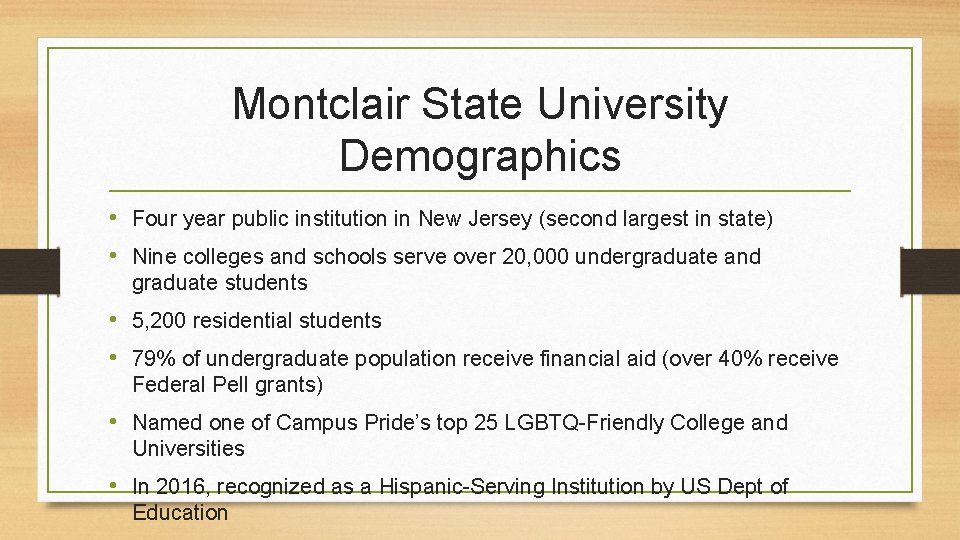
Montclair State University Demographics • Four year public institution in New Jersey (second largest in state) • Nine colleges and schools serve over 20, 000 undergraduate and graduate students • 5, 200 residential students • 79% of undergraduate population receive financial aid (over 40% receive Federal Pell grants) • Named one of Campus Pride’s top 25 LGBTQ-Friendly College and Universities • In 2016, recognized as a Hispanic-Serving Institution by US Dept of Education
Let’s Talk Program • Easy access to one-on-one consultation and support hours • Locations outside of Counseling Center (5 days a week in 8 locations) • All sites open to all students • Confidential • Started at Cornell University
What’s great about Let’s Talk? • • • Increases rapid-access which decreases emergencies Increases accessibility for ALL students Meets students where they are Provides another referral option for faculty/staff In some cases, provides a bridge to the Counseling Center
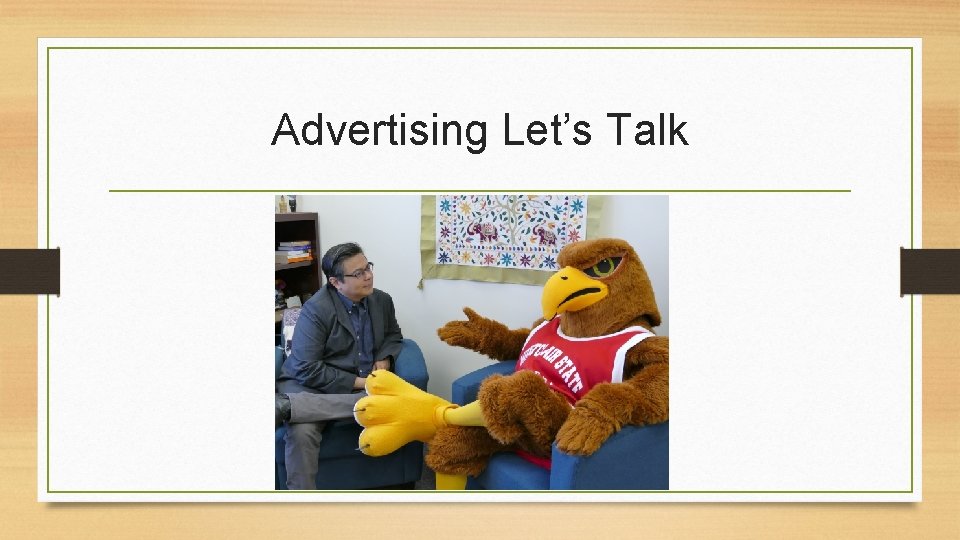
Advertising Let’s Talk
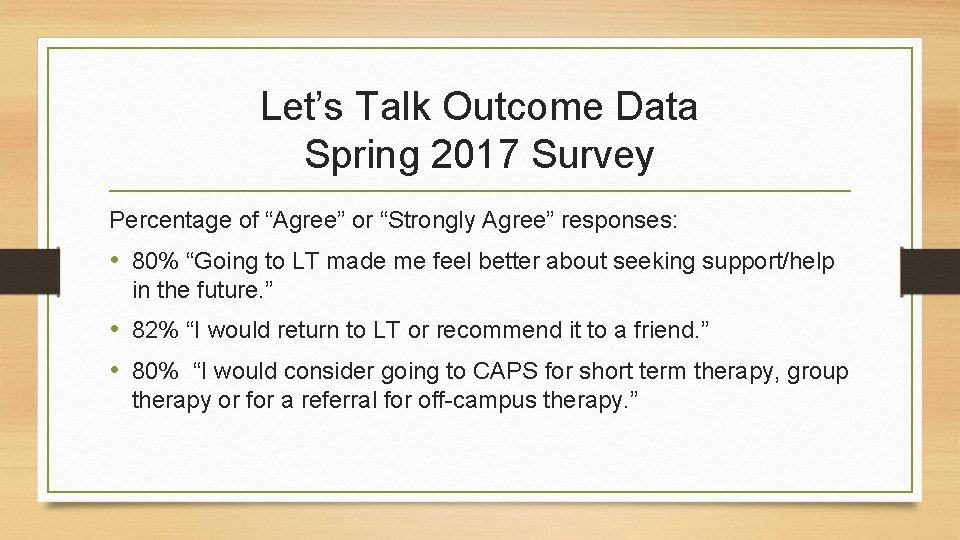
Let’s Talk Outcome Data Spring 2017 Survey Percentage of “Agree” or “Strongly Agree” responses: • 80% “Going to LT made me feel better about seeking support/help in the future. ” • 82% “I would return to LT or recommend it to a friend. ” • 80% “I would consider going to CAPS for short term therapy, group therapy or for a referral for off-campus therapy. ”
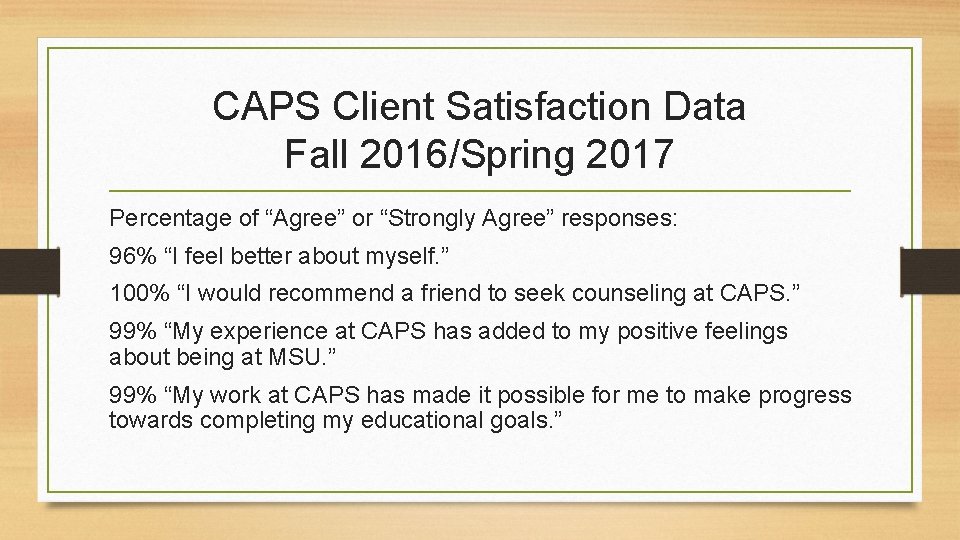
CAPS Client Satisfaction Data Fall 2016/Spring 2017 Percentage of “Agree” or “Strongly Agree” responses: 96% “I feel better about myself. ” 100% “I would recommend a friend to seek counseling at CAPS. ” 99% “My experience at CAPS has added to my positive feelings about being at MSU. ” 99% “My work at CAPS has made it possible for me to make progress towards completing my educational goals. ”
Questions For additional information contact Ament, Dr. Rosa B <rament@pace. edu> Wendy Freedman wefreedman@vassar. edu Jaclyn Friedman-Lombardo, Ph. D. (friedmanlj@mail. montclair. edu)