
The Role of Universities in Regional Innovation Ecosystems
- Slides: 23
The Role of Universities in Regional Innovation Ecosystems Dr. Sybille Reichert EUA Annual Conference Sorbonne University, Paris 11 April 2019
Overview I: Focus and Methodology of the Study II: Drivers & Concepts of Innovation III: Transformation of Roles IV: Emerging Forms of Co-creation V: Nurturing Innovation Culture – Success Factors for Central Role of Universities _______________________________________________ The Role of Universities in Regional Innovation Ecosystems - Dr. Sybille Reichert 2
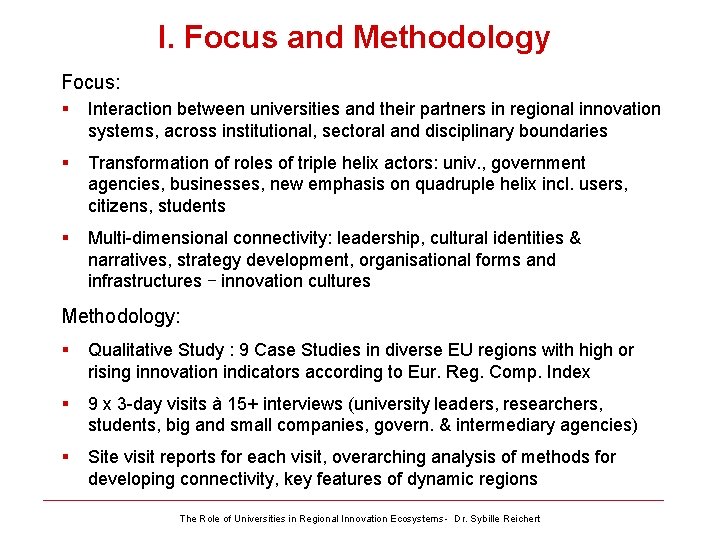
I. Focus and Methodology Focus: § Interaction between universities and their partners in regional innovation systems, across institutional, sectoral and disciplinary boundaries § Transformation of roles of triple helix actors: univ. , government agencies, businesses, new emphasis on quadruple helix incl. users, citizens, students § Multi-dimensional connectivity: leadership, cultural identities & narratives, strategy development, organisational forms and infrastructures – innovation cultures Methodology: § Qualitative Study : 9 Case Studies in diverse EU regions with high or rising innovation indicators according to Eur. Reg. Comp. Index § 9 x 3 -day visits à 15+ interviews (university leaders, researchers, students, big and small companies, govern. & intermediary agencies) § Site visit reports for each visit, overarching analysis of methods for developing connectivity, key features of dynamic regions _______________________________________________ The Role of Universities in Regional Innovation Ecosystems - Dr. Sybille Reichert
_______________________________________________ EUA: Aalborg Validation Workshop 1 Feb 2019 - Sybille Reichert – Role of University in Regional Innovation Systems 5
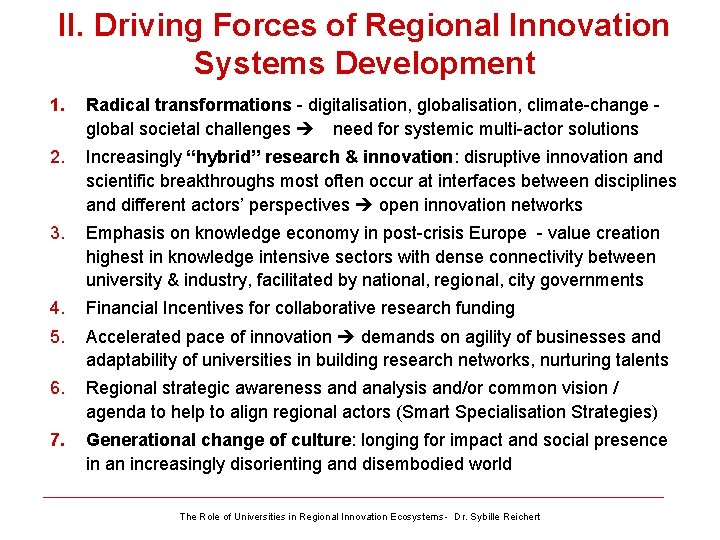
II. Driving Forces of Regional Innovation Systems Development 1. Radical transformations - digitalisation, globalisation, climate-change global societal challenges need for systemic multi-actor solutions 2. Increasingly “hybrid” research & innovation: disruptive innovation and scientific breakthroughs most often occur at interfaces between disciplines and different actors’ perspectives open innovation networks 3. Emphasis on knowledge economy in post-crisis Europe - value creation highest in knowledge intensive sectors with dense connectivity between university & industry, facilitated by national, regional, city governments 4. Financial Incentives for collaborative research funding 5. Accelerated pace of innovation demands on agility of businesses and adaptability of universities in building research networks, nurturing talents 6. Regional strategic awareness and analysis and/or common vision / agenda to help to align regional actors (Smart Specialisation Strategies) 7. Generational change of culture: longing for impact and social presence in an increasingly disorienting and disembodied world _______________________________________________ The Role of Universities in Regional Innovation Ecosystems - Dr. Sybille Reichert
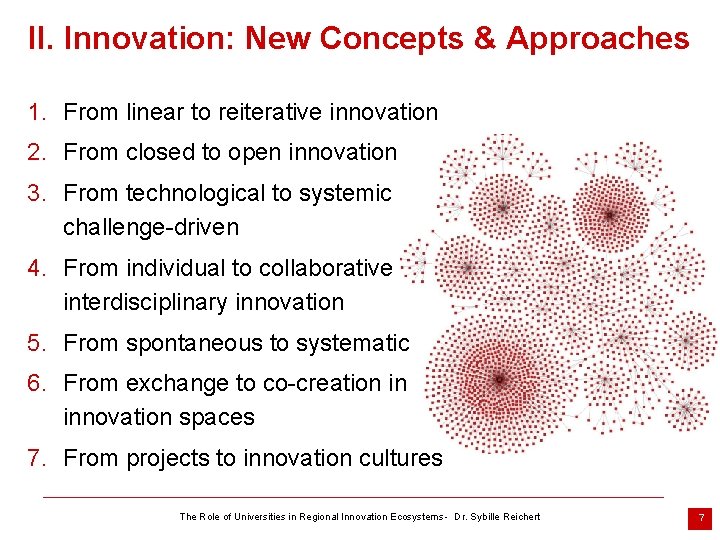
II. Innovation: New Concepts & Approaches 1. From linear to reiterative innovation 2. From closed to open innovation 3. From technological to systemic challenge-driven 4. From individual to collaborative interdisciplinary innovation 5. From spontaneous to systematic 6. From exchange to co-creation in innovation spaces 7. From projects to innovation cultures _______________________________________________ The Role of Universities in Regional Innovation Ecosystems - Dr. Sybille Reichert 7
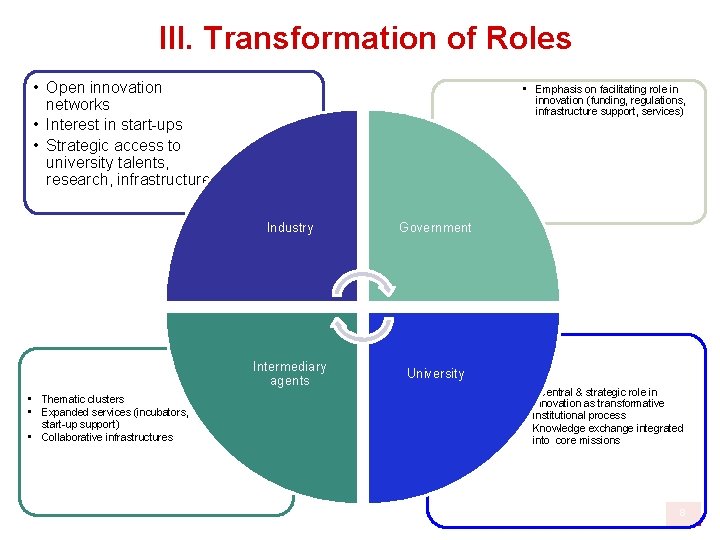
III. Transformation of Roles • Open innovation networks • Interest in start-ups • Strategic access to university talents, research, infrastructures • Thematic clusters • Expanded services (incubators, start-up support) • Collaborative infrastructures • Emphasis on facilitating role in innovation (funding, regulations, infrastructure support, services) Industry Government Intermediary agents University • Central & strategic role in innovation as transformative institutional process • Knowledge exchange integrated into core missions 8
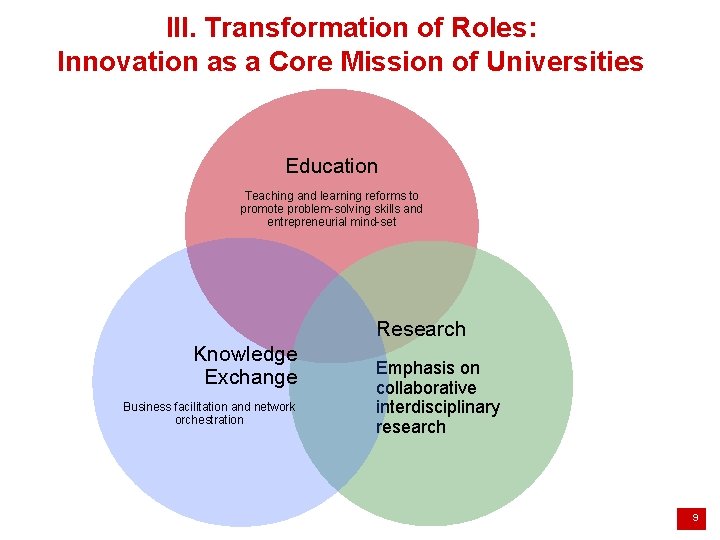
III. Transformation of Roles: Innovation as a Core Mission of Universities Education Teaching and learning reforms to promote problem-solving skills and entrepreneurial mind-set Research Knowledge Exchange Business facilitation and network orchestration Emphasis on collaborative interdisciplinary research 9
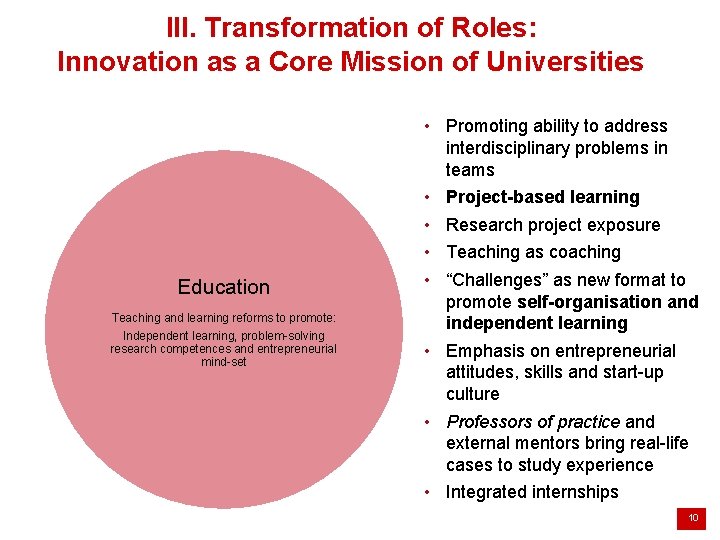
III. Transformation of Roles: Innovation as a Core Mission of Universities Education Teaching and learning reforms to promote: Independent learning, problem-solving research competences and entrepreneurial mind-set • Promoting ability to address interdisciplinary problems in teams • Project-based learning • Research project exposure • Teaching as coaching • “Challenges” as new format to promote self-organisation and independent learning • Emphasis on entrepreneurial attitudes, skills and start-up culture • Professors of practice and external mentors bring real-life cases to study experience • Integrated internships 10
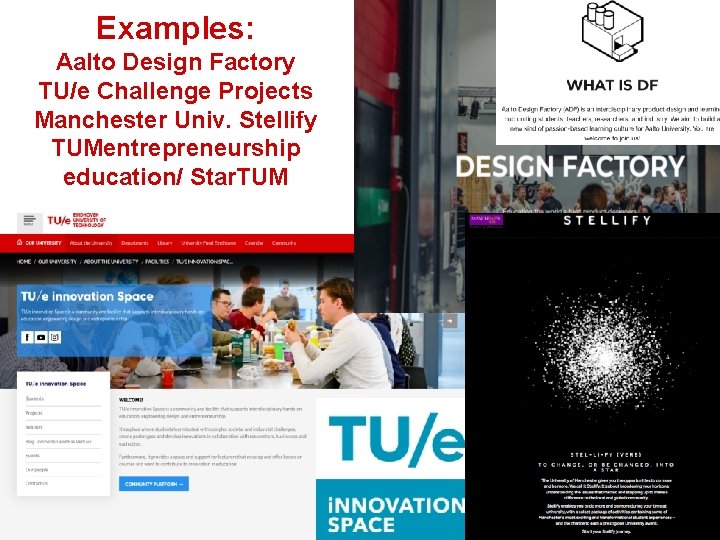
Examples: Aalto Design Factory TU/e Challenge Projects Manchester Univ. Stellify TUMentrepreneurship education/ Star. TUM 11
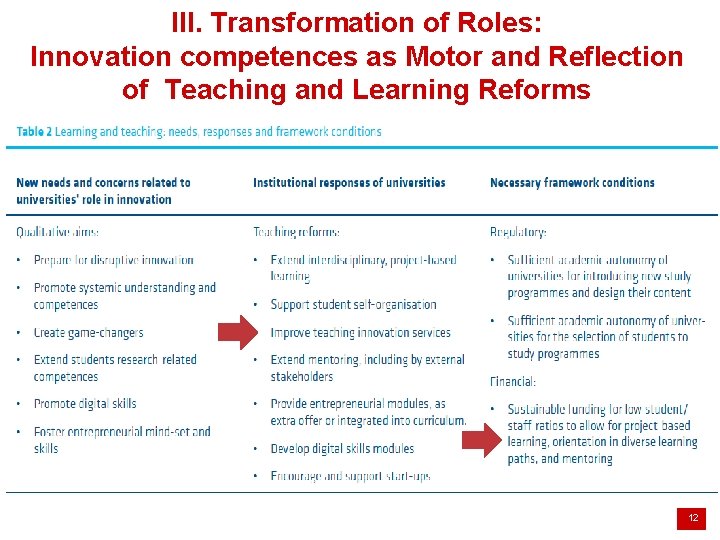
III. Transformation of Roles: Innovation competences as Motor and Reflection of Teaching and Learning Reforms 12
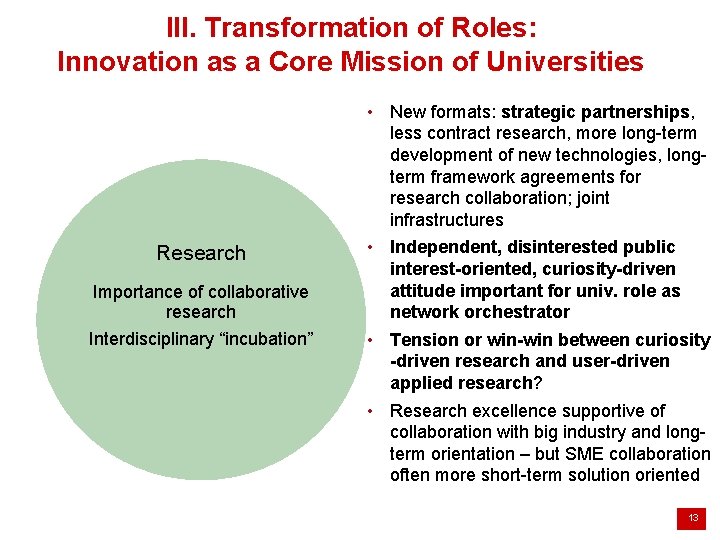
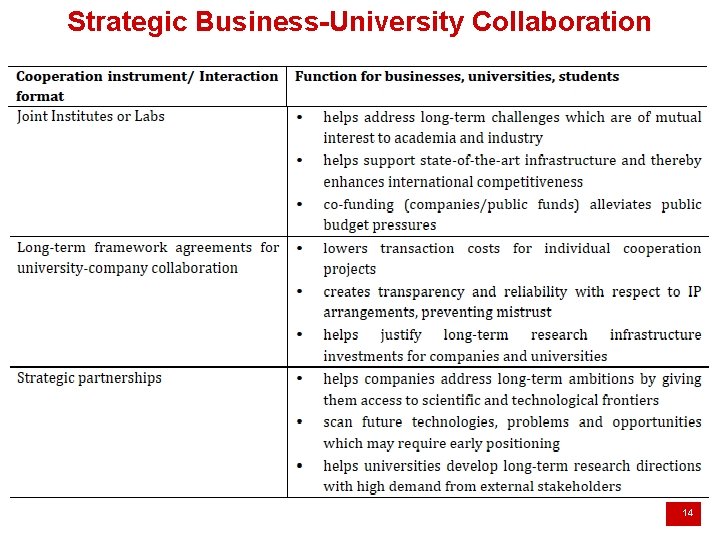
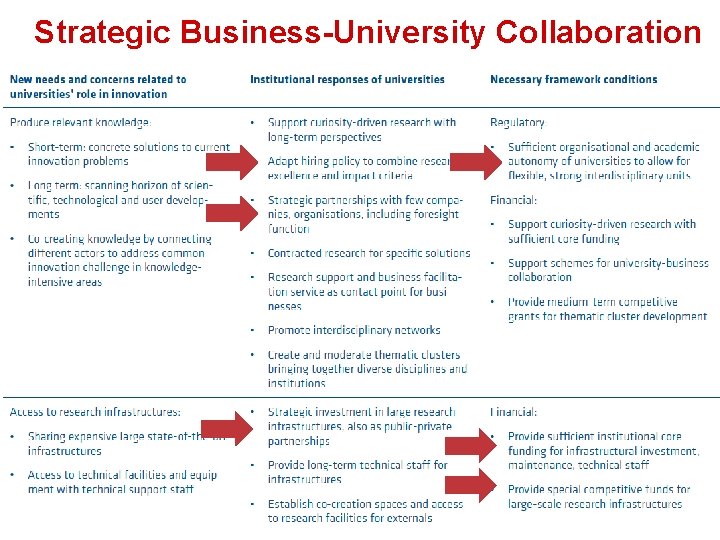
III. Transformation of Roles: Innovation as a Core Mission of Universities Research Importance of collaborative research Interdisciplinary “incubation” • New formats: strategic partnerships, less contract research, more long-term development of new technologies, longterm framework agreements for research collaboration; joint infrastructures • Independent, disinterested public interest-oriented, curiosity-driven attitude important for univ. role as network orchestrator • Tension or win-win between curiosity -driven research and user-driven applied research? • Research excellence supportive of collaboration with big industry and longterm orientation – but SME collaboration often more short-term solution oriented 13
Strategic Business-University Collaboration 14
Strategic Business-University Collaboration 15
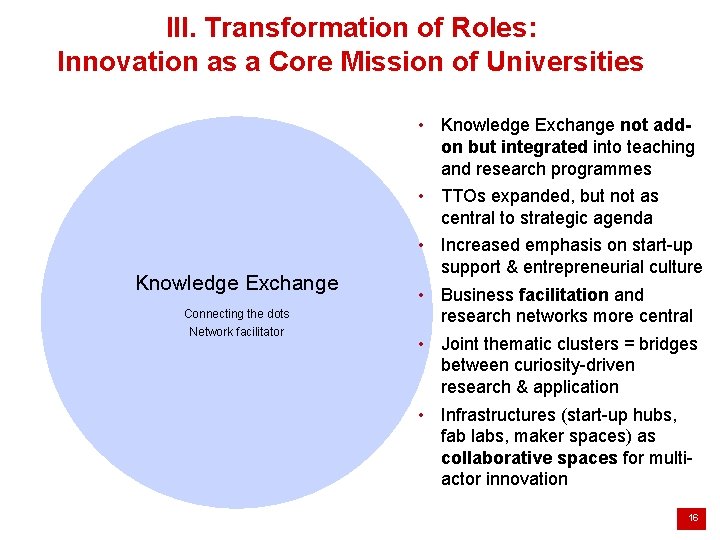
III. Transformation of Roles: Innovation as a Core Mission of Universities Knowledge Exchange Connecting the dots Network facilitator • Knowledge Exchange not addon but integrated into teaching and research programmes • TTOs expanded, but not as central to strategic agenda • Increased emphasis on start-up support & entrepreneurial culture • Business facilitation and research networks more central • Joint thematic clusters = bridges between curiosity-driven research & application • Infrastructures (start-up hubs, fab labs, maker spaces) as collaborative spaces for multiactor innovation 16
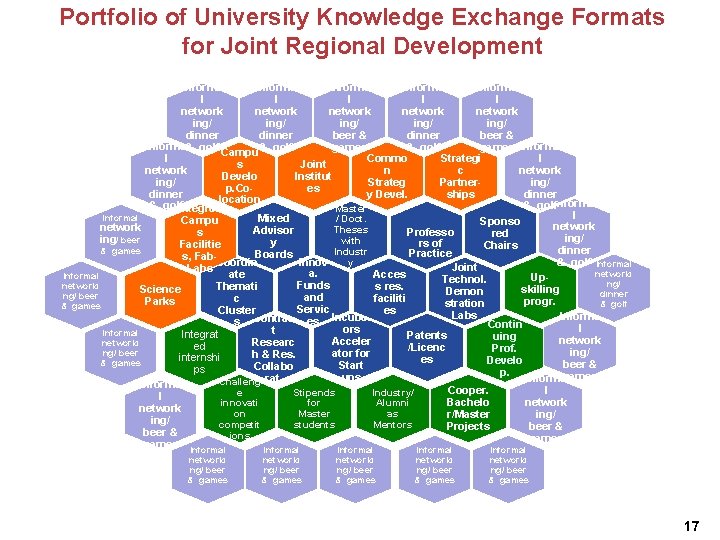
Portfolio of University Knowledge Exchange Formats for Joint Regional Development Informa Informa l l l network network ing/ ing/ dinner beer & Informa& golf games Informa Campu & golf l Commo Strategi l Joint s network n c network Institut Develo ing/ Strateg Partnerp. Coes dinner y Devel. ships location & golf. Integrat. & golf. Informa Master l Informal Mixed / Doct. Campu Sponso network Theses Advisor Professo s red ing/ beer with y rs of Facilitie Chairs & games dinner Industr Practice Boards s, Fab. Innov y Coordin & golf Informal Joint Labs networki a. ate Acces Informal Up. Technol. ng/ networki Sponso Funds Themati s res. Science skilling Demon dinner ng/ beer ring and c faciliti Parks progr. & golf stration & games Servic Cluster es Labs Informa s Contrac es Incubat Contin l ors t Informal Integrat Patents uing network Acceler networki Researc ed /Licenc Prof. ng/ beer ing/ ator for h & Res. internshi es Develo & games beer & Start Collabo ps p. games ups Informa Challeng rat. Informa Cooper. l Stipends Industry/ e l Bachelo network for Alumni innovati network Master as on ing/ r/Master ing/ competit students Mentors beer & Projects beer & ions games Informal networki ng/ beer & games Informal networki ng/ beer & games 17
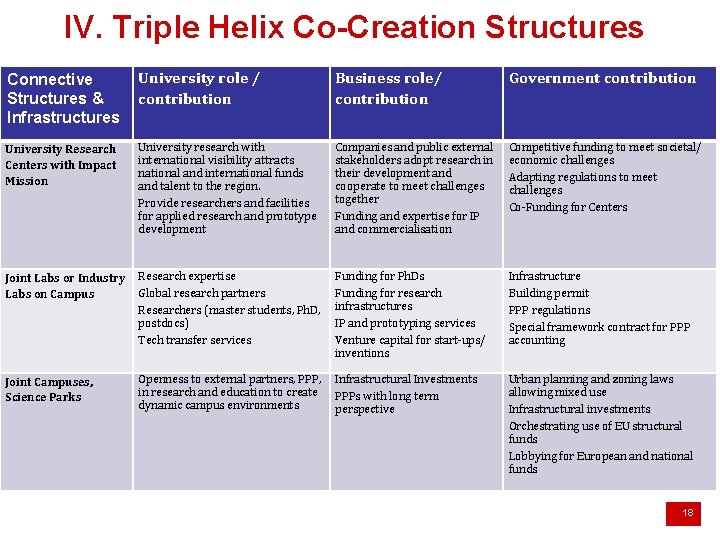
IV. Triple Helix Co-Creation Structures Connective Structures & Infrastructures University role / contribution Business role/ contribution Government contribution University Research Centers with Impact Mission University research with international visibility attracts national and international funds and talent to the region. Provide researchers and facilities for applied research and prototype development Companies and public external stakeholders adopt research in their development and cooperate to meet challenges together Funding and expertise for IP and commercialisation Competitive funding to meet societal/ economic challenges Adapting regulations to meet challenges Co-Funding for Centers Joint Labs or Industry Labs on Campus Research expertise Global research partners Researchers (master students, Ph. D, postdocs) Tech transfer services Funding for Ph. Ds Funding for research infrastructures IP and prototyping services Venture capital for start-ups/ inventions Infrastructure Building permit PPP regulations Special framework contract for PPP accounting Joint Campuses, Science Parks Openness to external partners, PPP, in research and education to create dynamic campus environments Infrastructural Investments PPPs with long term perspective Urban planning and zoning laws allowing mixed use Infrastructural investments Orchestrating use of EU structural funds Lobbying for European and national funds 18
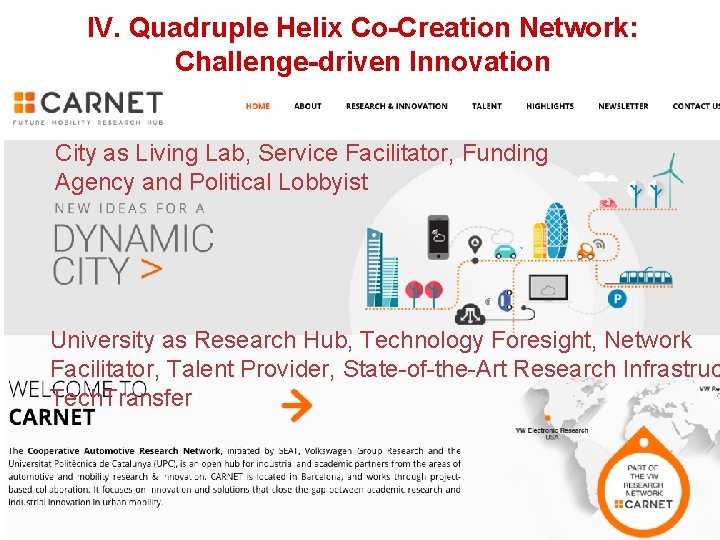
IV. Quadruple Helix Co-Creation Network: Challenge-driven Innovation City as Living Lab, Service Facilitator, Funding Agency and Political Lobbyist University as Research Hub, Technology Foresight, Network Facilitator, Talent Provider, State-of-the-Art Research Infrastruc Tech. Transfer 19
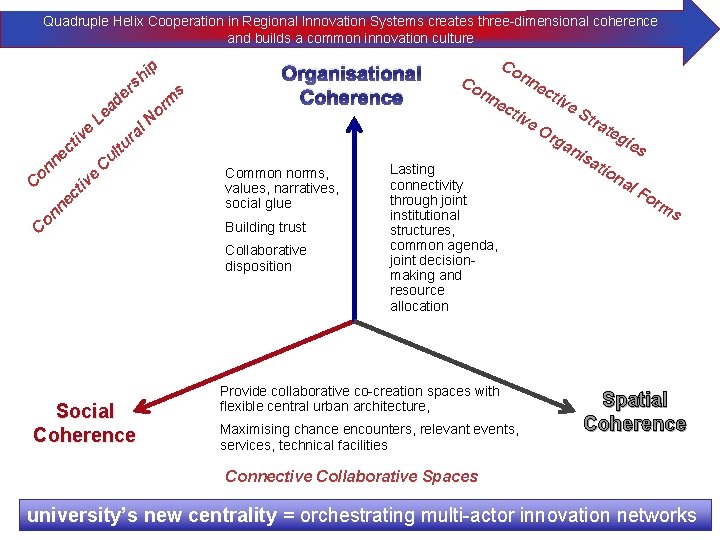
Quadruple Helix Cooperation in Regional Innovation Systems creates three-dimensional coherence and builds a common innovation culture p i sh r de ve a Le i ct e nn o C ve C l. N o s rm Organisational Coherence Co Co n nn ec ra tu ul ti c ne on C Common norms, values, narratives, social glue Building trust Collaborative disposition Social Coherence tiv Lasting connectivity through joint institutional structures, common agenda, joint decisionmaking and resource allocation Provide collaborative co-creation spaces with flexible central urban architecture, Maximising chance encounters, relevant events, services, technical facilities ne cti ve e. O rg an St ra te isa gie tio na s l. F or ms Spatial Coherence Connective Collaborative Spaces university’s new centrality = orchestrating multi-actor innovation networks
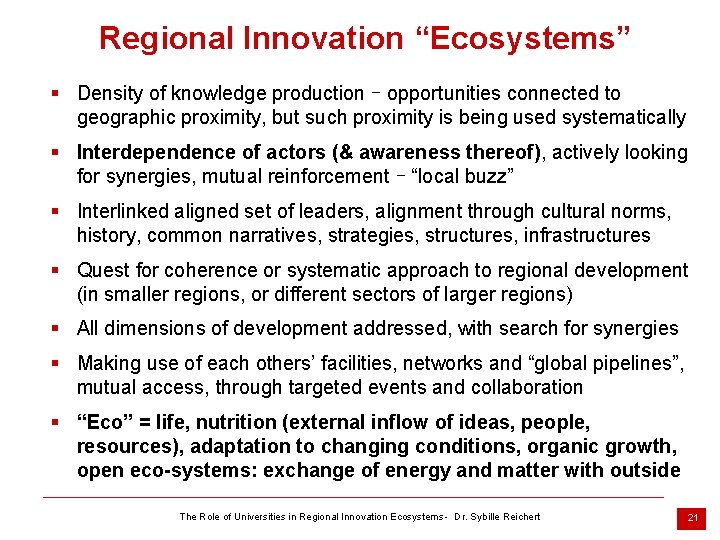
Regional Innovation “Ecosystems” § Density of knowledge production – opportunities connected to geographic proximity, but such proximity is being used systematically § Interdependence of actors (& awareness thereof), actively looking for synergies, mutual reinforcement – “local buzz” § Interlinked aligned set of leaders, alignment through cultural norms, history, common narratives, strategies, structures, infrastructures § Quest for coherence or systematic approach to regional development (in smaller regions, or different sectors of larger regions) § All dimensions of development addressed, with search for synergies § Making use of each others’ facilities, networks and “global pipelines”, mutual access, through targeted events and collaboration § “Eco” = life, nutrition (external inflow of ideas, people, resources), adaptation to changing conditions, organic growth, open eco-systems: exchange of energy and matter with outside _______________________________________________ The Role of Universities in Regional Innovation Ecosystems - Dr. Sybille Reichert 21
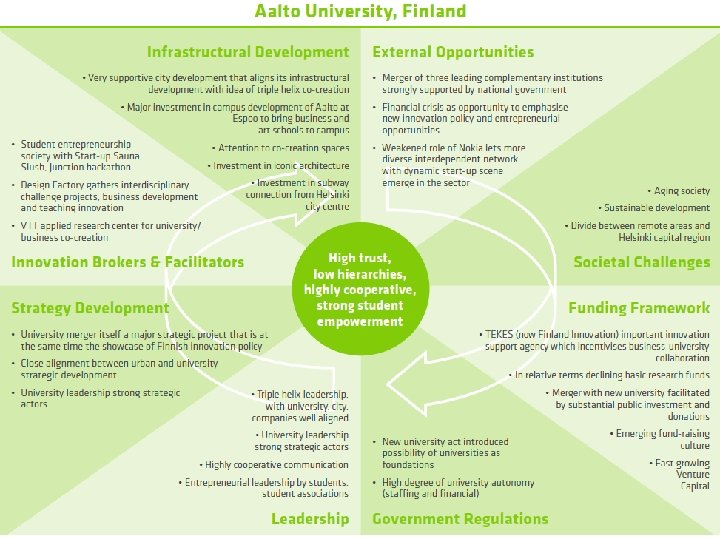
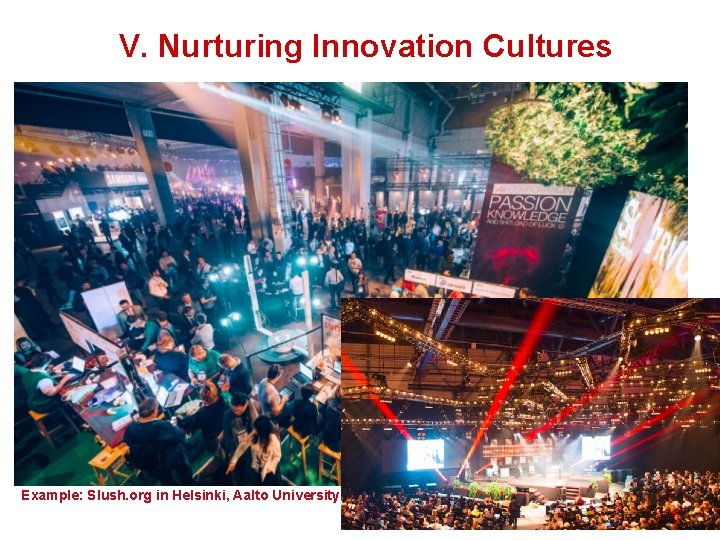
V. Nurturing Innovation Cultures Example: Slush. org in Helsinki, Aalto University 22
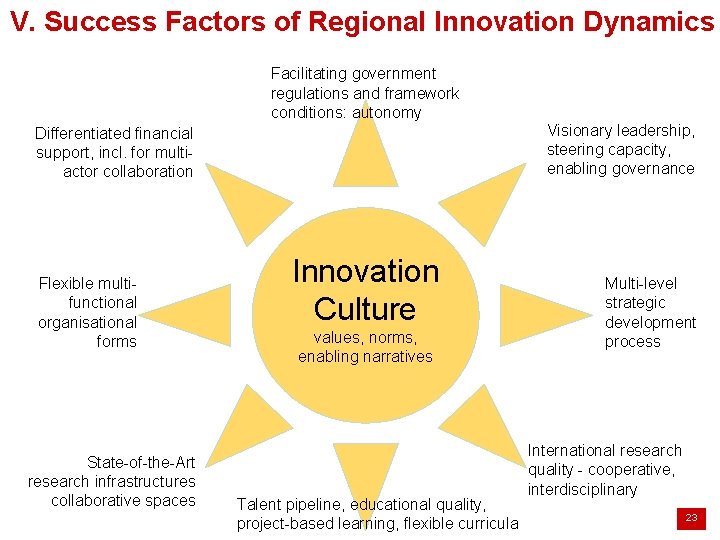
V. Success Factors of Regional Innovation Dynamics Facilitating government regulations and framework conditions: autonomy Visionary leadership, steering capacity, enabling governance Differentiated financial support, incl. for multiactor collaboration Flexible multifunctional organisational forms State-of-the-Art research infrastructures collaborative spaces Innovation Culture values, norms, enabling narratives Talent pipeline, educational quality, project-based learning, flexible curricula Multi-level strategic development process International research quality - cooperative, interdisciplinary 23
Thank you for your attention! Questions are welcome. . . sybille@reichert-consulting. de www. reichert-consulting. de 24