
The Role of the Tact in Language Acquisition



- Slides: 15
The Role of the Tact in Language Acquisition Mark L. Sundberg, Ph. D. , BCBA-D (www. marksundberg. com)
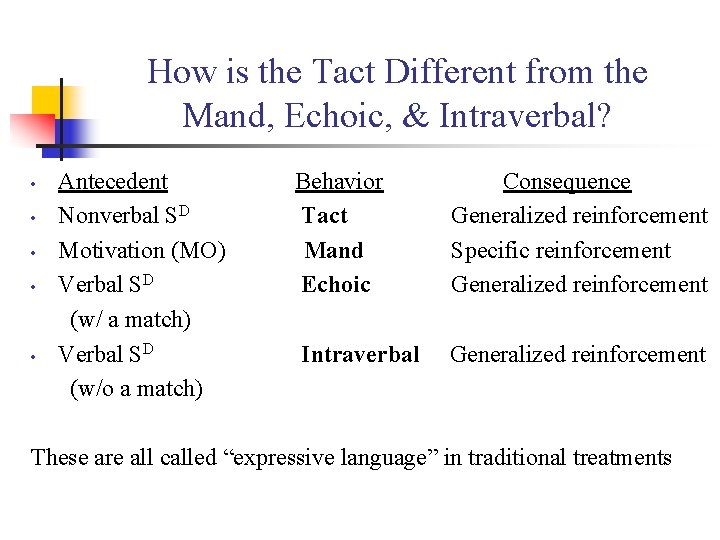
How is the Tact Different from the Mand, Echoic, & Intraverbal? • • • Antecedent Nonverbal SD Motivation (MO) Verbal SD (w/ a match) Verbal SD (w/o a match) Behavior Tact Mand Echoic Consequence Generalized reinforcement Specific reinforcement Generalized reinforcement Intraverbal Generalized reinforcement These are all called “expressive language” in traditional treatments
Skinner (1957) and the Tact • • • “The tact emerges as the most important of verbal operants… because of the unique control exerted by the prior stimulus” (p. 82) “There are two important types of controlling stimuli which are usually nonverbal (1) an audience (which) characteristically controls a large group of responses (2) nothing less than the whole of the physical environment—the world of things and events which a speaker is said to ‘talk about’” (p. 81) “Verbal behavior under the control of such stimuli is so important that it is often dealt with exclusively in the study of language and in theories of meaning” (p. 81)
Skinner (1957) and the Tact • • • “The invented term ‘tact’ will be used here. The term carries a mnemonic suggestion of behavior which ‘makes contact with’ the physical world” (p. 81) “A tact may be defined as a verbal operant in which a response of given form is evoked (or at least strengthened) by a particular object or event or property of an object or event” (p. 81) “We account for the strength by showing that in the presence of the object or event a response of that form is characteristically reinforced in a given verbal community” (pp. 81 -82)
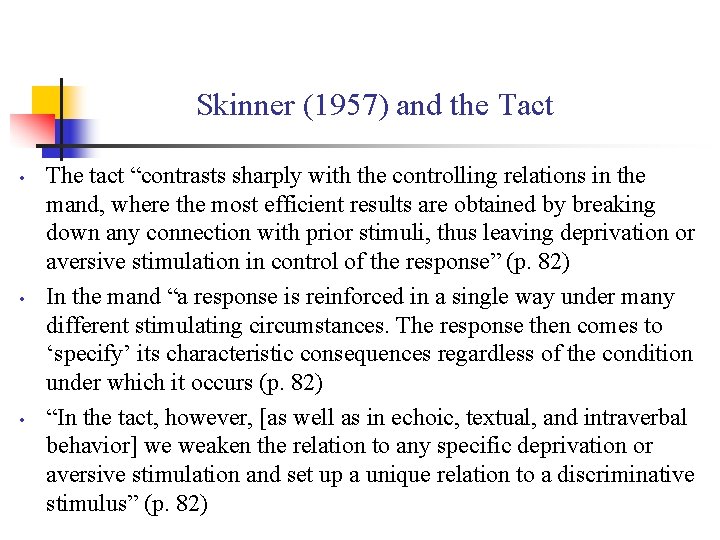
Skinner (1957) and the Tact • • • The tact “contrasts sharply with the controlling relations in the mand, where the most efficient results are obtained by breaking down any connection with prior stimuli, thus leaving deprivation or aversive stimulation in control of the response” (p. 82) In the mand “a response is reinforced in a single way under many different stimulating circumstances. The response then comes to ‘specify’ its characteristic consequences regardless of the condition under which it occurs (p. 82) “In the tact, however, [as well as in echoic, textual, and intraverbal behavior] we weaken the relation to any specific deprivation or aversive stimulation and set up a unique relation to a discriminative stimulus” (p. 82)
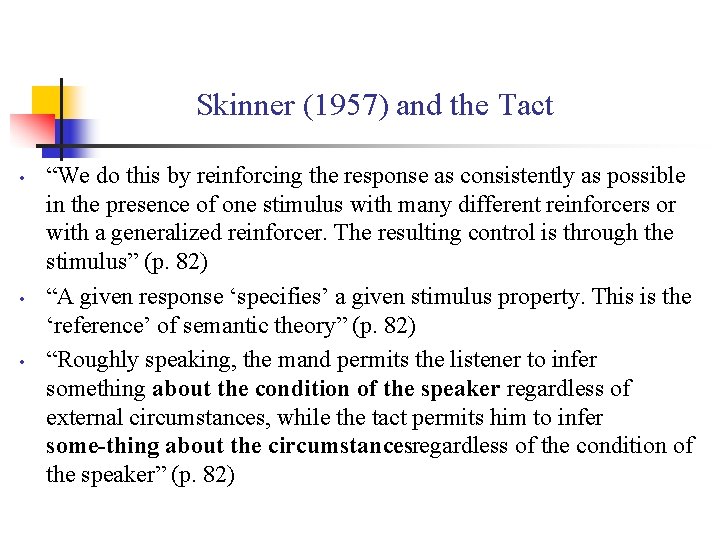
Skinner (1957) and the Tact • • • “We do this by reinforcing the response as consistently as possible in the presence of one stimulus with many different reinforcers or with a generalized reinforcer. The resulting control is through the stimulus” (p. 82) “A given response ‘specifies’ a given stimulus property. This is the ‘reference’ of semantic theory” (p. 82) “Roughly speaking, the mand permits the listener to infer something about the condition of the speaker regardless of external circumstances, while the tact permits him to infer some thing about the circumstancesregardless of the condition of the speaker” (p. 82)
Skinner (1957) and the Tact • • “The tact as a verbal operant is mainly useful to the listener” (p. 82) “We come a little closer to the ultimate explanation of behavior in the form of the tact when we examine a case in which the stimulus which the tact specifies is not directly accessible to the listener” (p. 85) (e. g. , “It’s raining”) “Under these circumstances the behavior of the speaker may be reinforcing to the listener by constituting the occasion for behavior which could otherwise not occur” (p. 85) “In very general terms we may say that behavior in the form of the tact works for the benefit of the listener by extending his contact with the environment, and such behavior is set up in the verbal
Skinner (1957) and the Tact • • • “In educational reinforcement the contingencies between responses and appropriate stimuli are rather sharply maintained (pp. 85 -86) “In general there is an advantage if responses appropriate to a current situation are strong” (p. 86) “There also many automatic reinforcements from the effect of the behavior upon the speaker himself” (p. 86) “An environment to which the speaker has responded in this fashion may exert a more discriminative control over other behavior, verbal or nonverbal” (p. 86) “For example, by correctly classifying an object the speaker may react more appropriately to it” (p. 86)
Skinner (1957) and the Tact: Applications • • • Why teach tacting? What can a tact do for a speaker? Tacting can facilitate useful nonverbal behavior Tacting can make us more valuable to listeners Tacting can facilitate useful manding Tacting can facilitate effective intraverbal behavior Tacting can facilitate textual behavior Tacting can facilitate transcriptive behavior Tacting can elicit emotional (respondent) behavior Tacting can facilitate effective autoclitic behavior
Skinner (1957) and the Tact: Applications • • • We “talk about” the physical world all the time Tacts benefits a listener by bringing listener in contact with the physical environment he can’t access or is unaware of Tacts informs the listener of a speaker’s private events The autoclitic tact also informs the listener of unknown variables (private events) Tacts can participate in joint control Tacts can participate in joint attention Tacts often gets conversations going, and play an ongoing role Tact play an important role in social behavior Excessive manding is a burden to a listener
Skinner (1957) and the Tact: Applications • • • Failure to tact is a big problem in social behavior Incorrect or distorted tacts (lying, exaggerating, cheating) Seeing and tacting are not the same Tact through all the sensory systems Tacting occurs for pain, exhaustion, discomfort, anger, obsession, danger, art, beauty, nature, love, friendship, enjoyment, and so on Respondents occur when we can’t come up with the tact
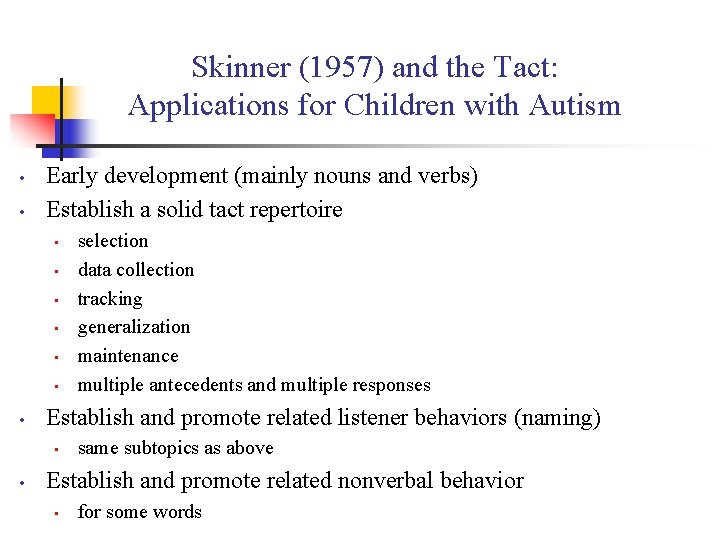
Skinner (1957) and the Tact: Applications for Children with Autism • • Early development (mainly nouns and verbs) Establish a solid tact repertoire • • Establish and promote related listener behaviors (naming) • • selection data collection tracking generalization maintenance multiple antecedents and multiple responses same subtopics as above Establish and promote related nonverbal behavior • for some words
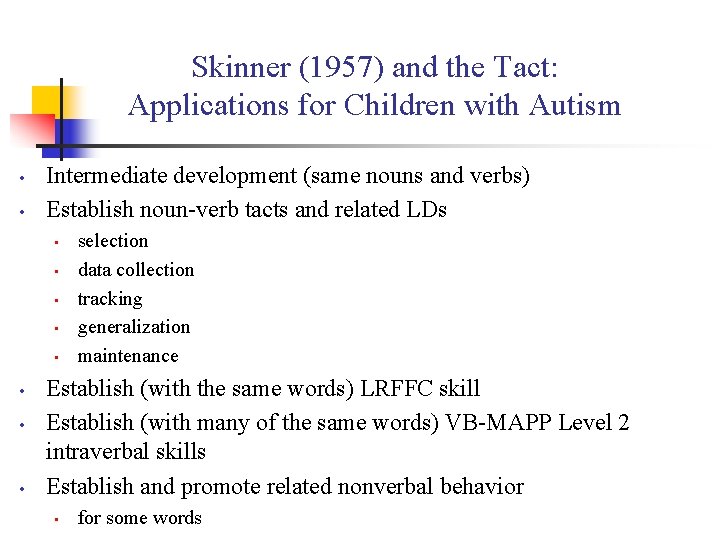
Skinner (1957) and the Tact: Applications for Children with Autism • • Intermediate development (same nouns and verbs) Establish noun-verb tacts and related LDs • • selection data collection tracking generalization maintenance Establish (with the same words) LRFFC skill Establish (with many of the same words) VB-MAPP Level 2 intraverbal skills Establish and promote related nonverbal behavior • for some words
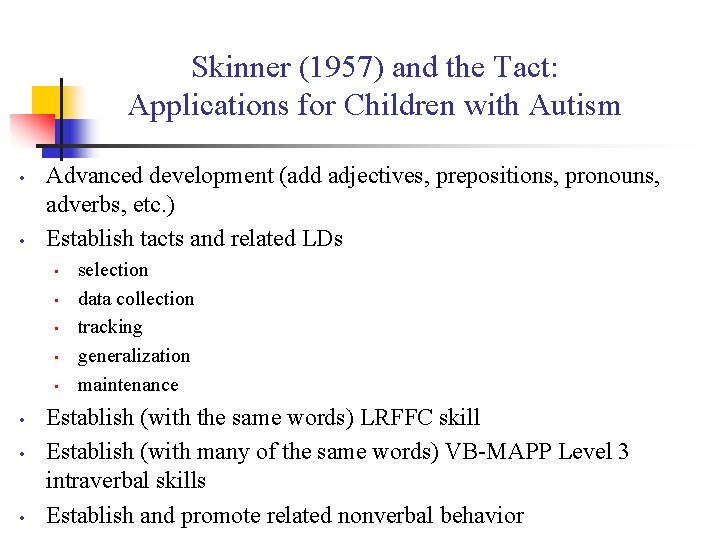
Skinner (1957) and the Tact: Applications for Children with Autism • • Advanced development (add adjectives, prepositions, pronouns, adverbs, etc. ) Establish tacts and related LDs • • selection data collection tracking generalization maintenance Establish (with the same words) LRFFC skill Establish (with many of the same words) VB-MAPP Level 3 intraverbal skills Establish and promote related nonverbal behavior
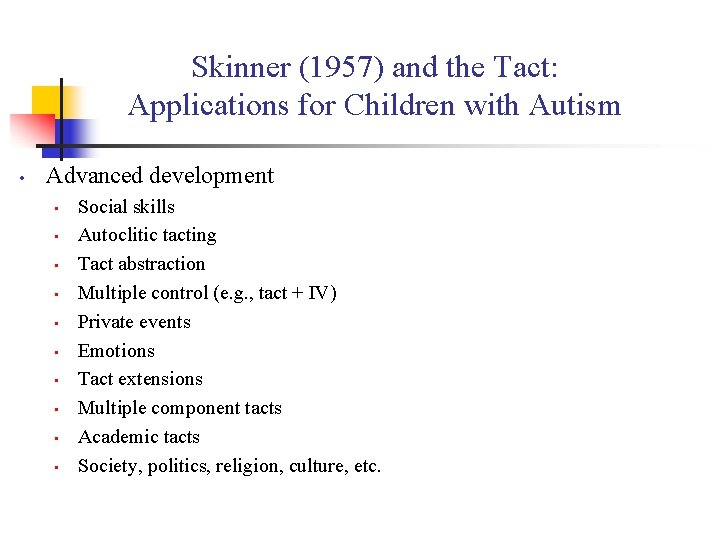
Skinner (1957) and the Tact: Applications for Children with Autism • Advanced development • • • Social skills Autoclitic tacting Tact abstraction Multiple control (e. g. , tact + IV) Private events Emotions Tact extensions Multiple component tacts Academic tacts Society, politics, religion, culture, etc.