
The Role of the Library in Achieving CoCurricular
The Role of the Library in Achieving Co-Curricular Activities in Civic Engagement on College Campuses LOEX Discussion Group Mary Reddick Head of Online Curriculum Library Services California State University Sacramento, CA Susan Metcalf Instructional Services Librarian University of Southern Indiana Evansville, IN
Walk around, introducing yourself to 20 people in the next ten minutes, and chat about the meaning of civic engagement. We’ll call time in 30 second intervals.
The Role of the Library in Achieving Co-Curricular Activities in Civic Engagement on College Campuses LOEX Discussion Group Mary Reddick Head of Online Curriculum Library Services California State University Sacramento, CA Susan Metcalf Instructional Services Librarian University of Southern Indiana Evansville, IN
What did you talk about? “Civic engagement means working to make a difference in the civic life of our communities and developing the combination of knowledge, skills, values, and motivation to make that difference. ” - Thomas Ehrlich, former chair of the Campus Compact board of directors and president emeritus of Indiana University. Ehrlrch drafted the President’s Declaration on the Civic Responsibility of Higher Education, and he is author of Civic Responsibility and Higher Education (2000) Campus Compact offers the Thomas Ehrlich Faculty Award for Service-Learning
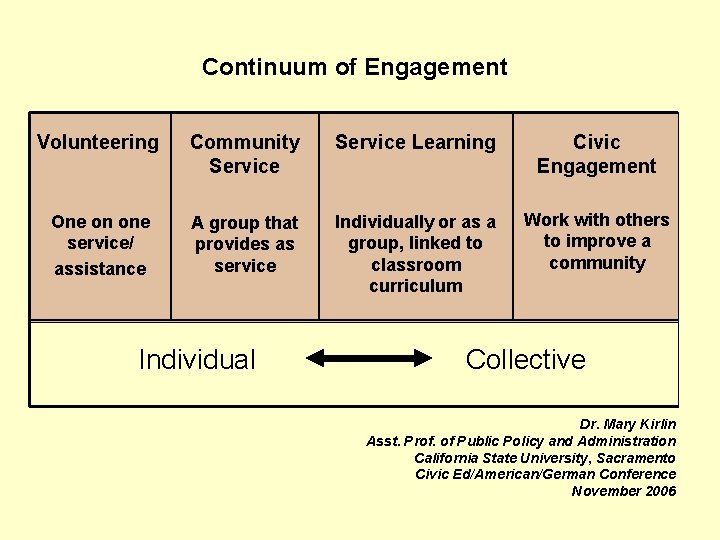
Continuum of Engagement Volunteering Community Service Learning Civic Engagement One on one service/ assistance A group that provides as service Individually or as a group, linked to classroom curriculum Work with others to improve a community Individual Collective Dr. Mary Kirlin Asst. Prof. of Public Policy and Administration California State University, Sacramento Civic Ed/American/German Conference November 2006
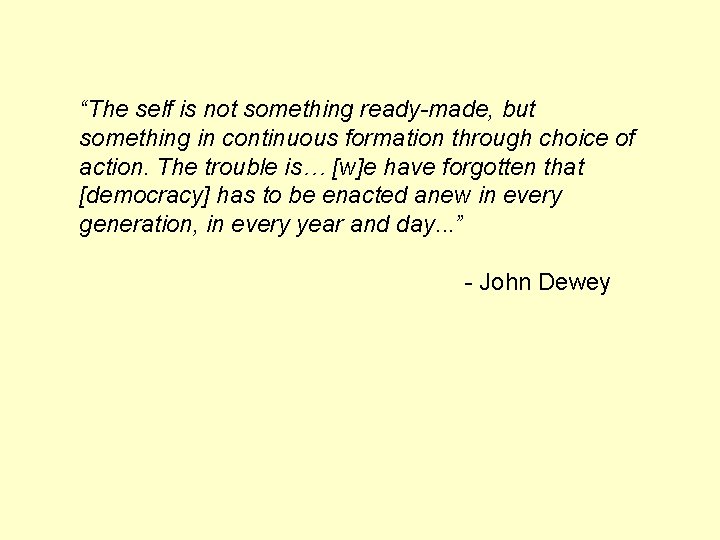
“The self is not something ready-made, but something in continuous formation through choice of action. The trouble is… [w]e have forgotten that [democracy] has to be enacted anew in every generation, in every year and day. . . ” - John Dewey
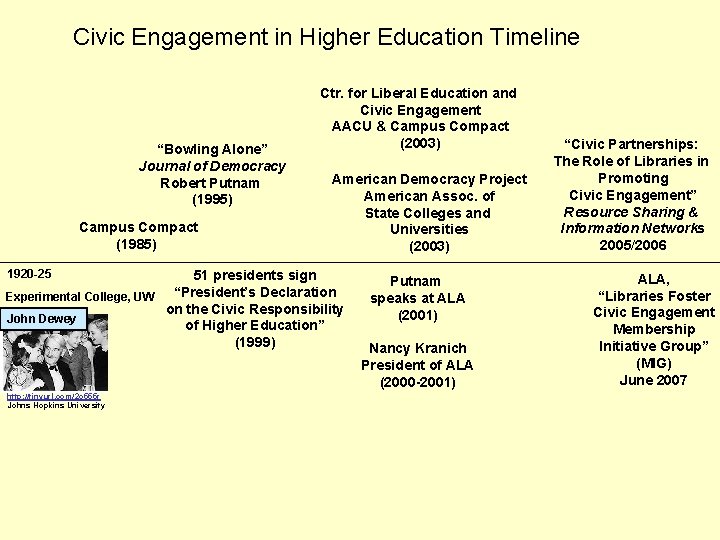
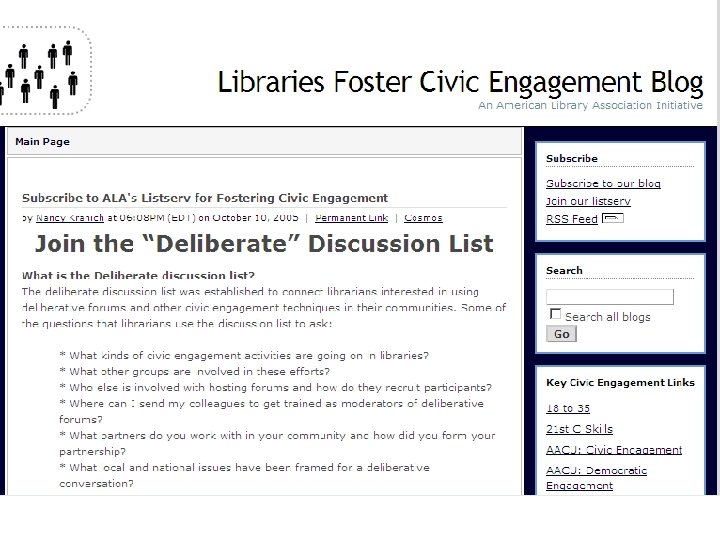
Civic Engagement in Higher Education Timeline “Bowling Alone” Journal of Democracy Robert Putnam (1995) Campus Compact (1985) 1920 -25 Ctr. for Liberal Education and Civic Engagement AACU & Campus Compact (2003) American Democracy Project American Assoc. of State Colleges and Universities (2003) 51 presidents sign “President’s Declaration Experimental College, UW on the Civic Responsibility John Dewey of Higher Education” (1999) http: //tinyurl. com/2 o 555 r Johns Hopkins University Putnam speaks at ALA (2001) Nancy Kranich President of ALA (2000 -2001) “Civic Partnerships: The Role of Libraries in Promoting Civic Engagement” Resource Sharing & Information Networks 2005/2006 ALA, “Libraries Foster Civic Engagement Membership Initiative Group” (MIG) June 2007
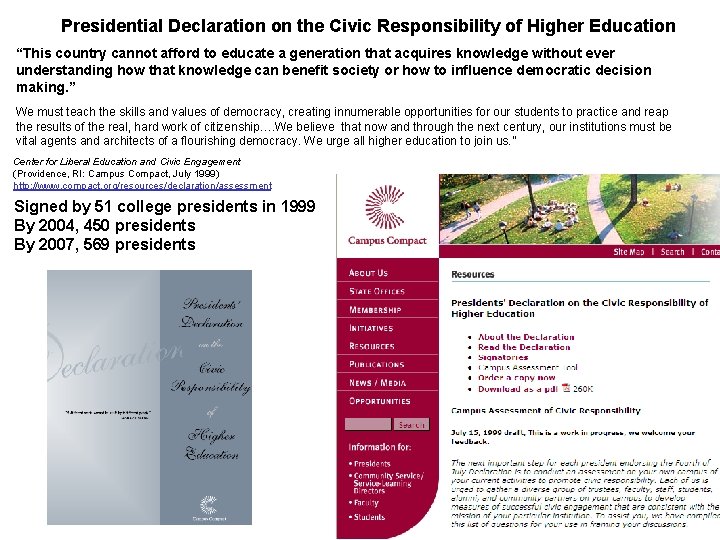
Presidential Declaration on the Civic Responsibility of Higher Education “This country cannot afford to educate a generation that acquires knowledge without ever understanding how that knowledge can benefit society or how to influence democratic decision making. ” We must teach the skills and values of democracy, creating innumerable opportunities for our students to practice and reap the results of the real, hard work of citizenship…. We believe that now and through the next century, our institutions must be vital agents and architects of a flourishing democracy. We urge all higher education to join us. ” Center for Liberal Education and Civic Engagement (Providence, RI: Campus Compact, July 1999) http: //www. compact. org/resources/declaration/assessment Signed by 51 college presidents in 1999 By 2004, 450 presidents By 2007, 569 presidents
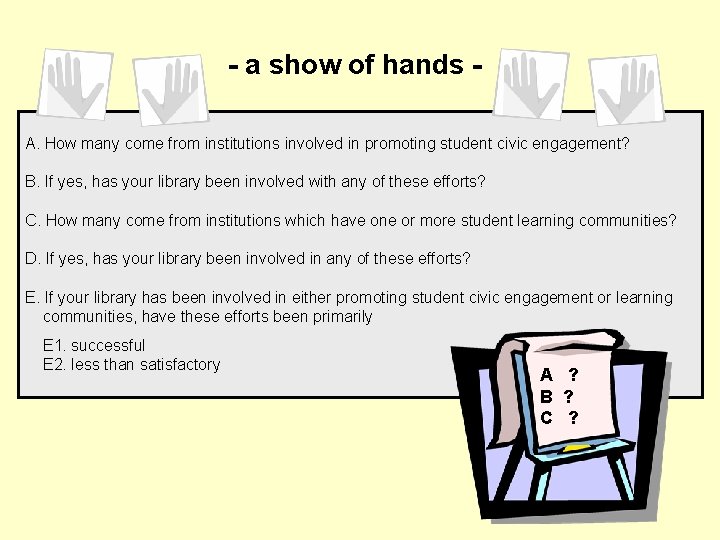
- a show of hands A. How many come from institutions involved in promoting student civic engagement? B. If yes, has your library been involved with any of these efforts? C. How many come from institutions which have one or more student learning communities? D. If yes, has your library been involved in any of these efforts? E. If your library has been involved in either promoting student civic engagement or learning communities, have these efforts been primarily E 1. successful E 2. less than satisfactory A ? B ? C ?
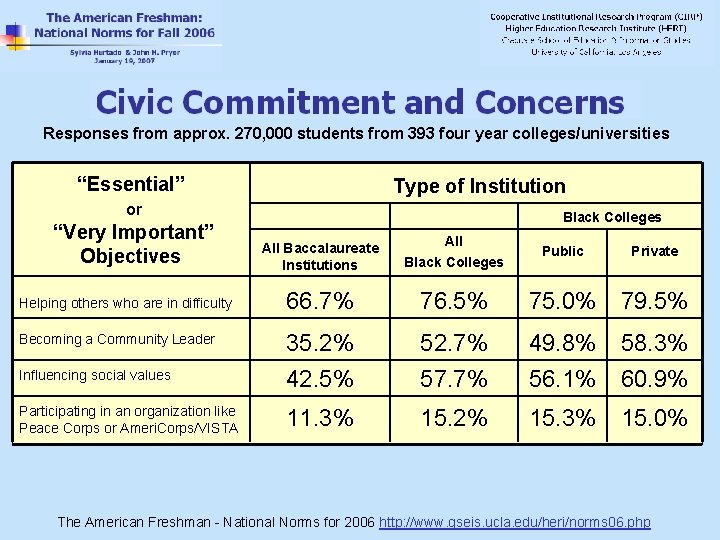
Responses from approx. 270, 000 students from 393 four year colleges/universities “Essential” or “Very Important” Objectives Helping others who are in difficulty Becoming a Community Leader Influencing social values Participating in an organization like Peace Corps or Ameri. Corps/VISTA Type of Institution Black Colleges All Baccalaureate Institutions All Black Colleges 66. 7% 76. 5% 75. 0% 79. 5% 35. 2% 42. 5% 52. 7% 57. 7% 49. 8% 58. 3% 56. 1% 60. 9% 11. 3% 15. 2% 15. 3% 15. 0% Public Private The American Freshman - National Norms for 2006 http: //www. gseis. ucla. edu/heri/norms 06. php
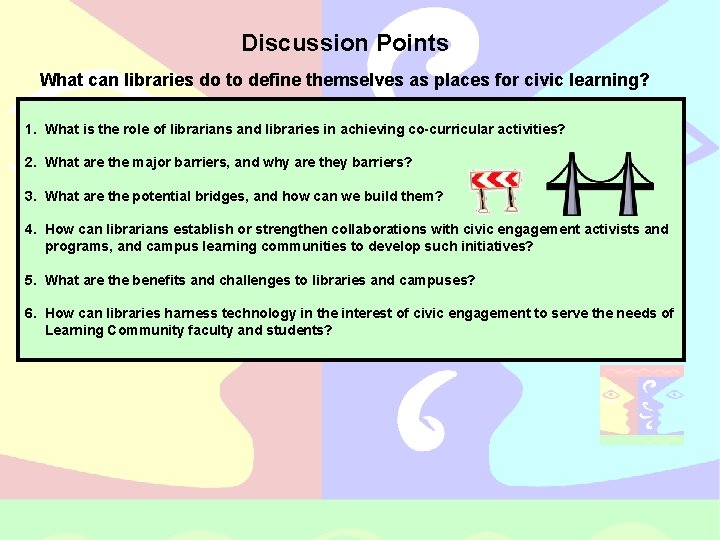
Discussion Points What can libraries do to define themselves as places for civic learning? 1. What is the role of librarians and libraries in achieving co-curricular activities? 2. What are the major barriers, and why are they barriers? 3. What are the potential bridges, and how can we build them? 4. How can librarians establish or strengthen collaborations with civic engagement activists and programs, and campus learning communities to develop such initiatives? 5. What are the benefits and challenges to libraries and campuses? 6. How can libraries harness technology in the interest of civic engagement to serve the needs of Learning Community faculty and students?
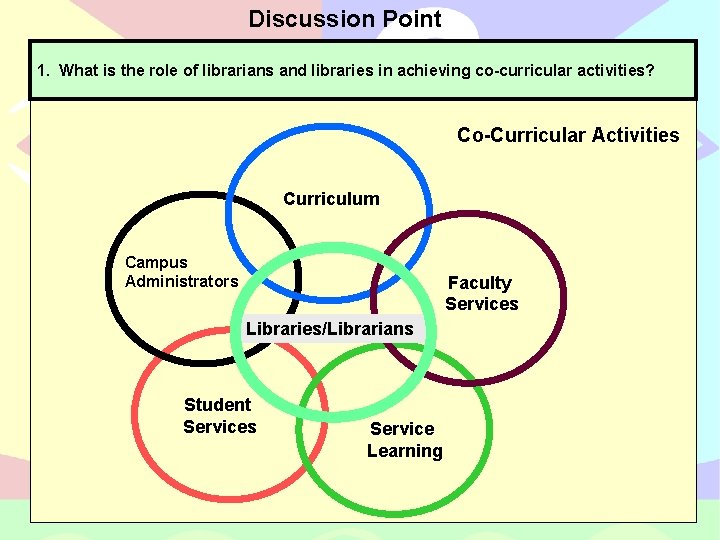
Discussion Point 1. What is the role of librarians and libraries in achieving co-curricular activities? Co-Curricular Activities Curriculum Campus Administrators Faculty Services Libraries/Librarians Student Services Service Learning
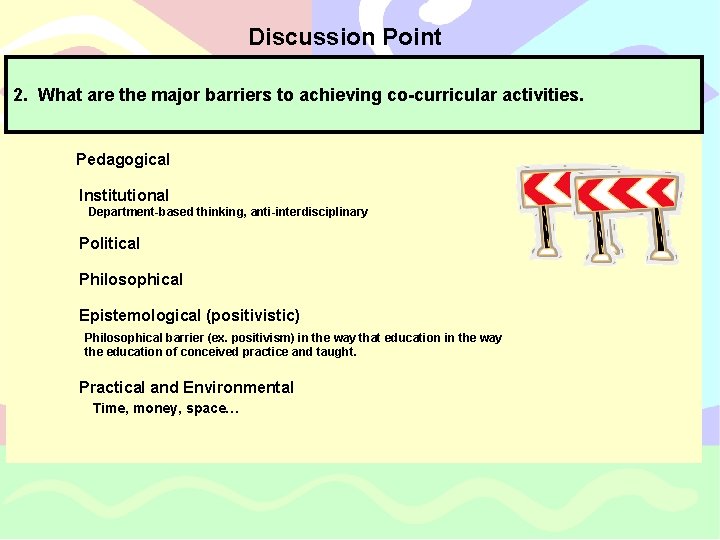
Discussion Point 2. What are the major barriers to achieving co-curricular activities. Pedagogical Institutional Department-based thinking, anti-interdisciplinary Political Philosophical Epistemological (positivistic) Philosophical barrier (ex. positivism) in the way that education in the way the education of conceived practice and taught. Practical and Environmental Time, money, space…
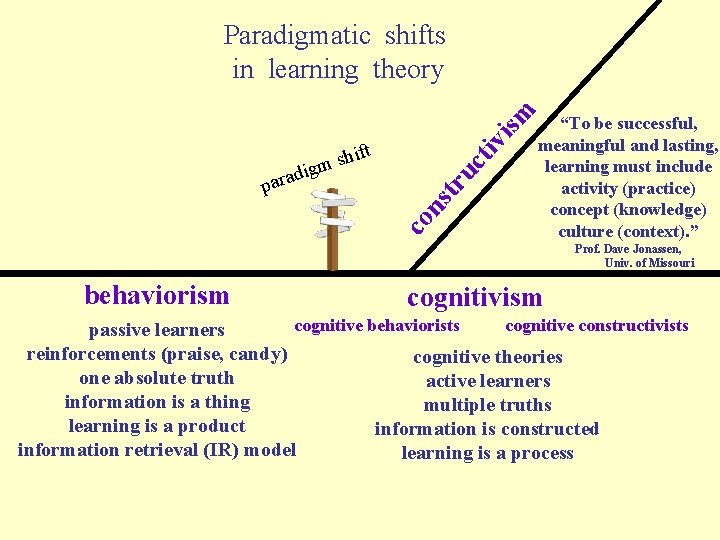
ism Paradigmatic shifts in learning theory ns tr co di a r a p uc tiv ift h s gm “To be successful, meaningful and lasting, learning must include activity (practice) concept (knowledge) culture (context). ” Prof. Dave Jonassen, Univ. of Missouri behaviorism cognitive behaviorists cognitive constructivists passive learners reinforcements (praise, candy) cognitive theories one absolute truth active learners information is a thing multiple truths learning is a product information is constructed information retrieval (IR) model learning is a process
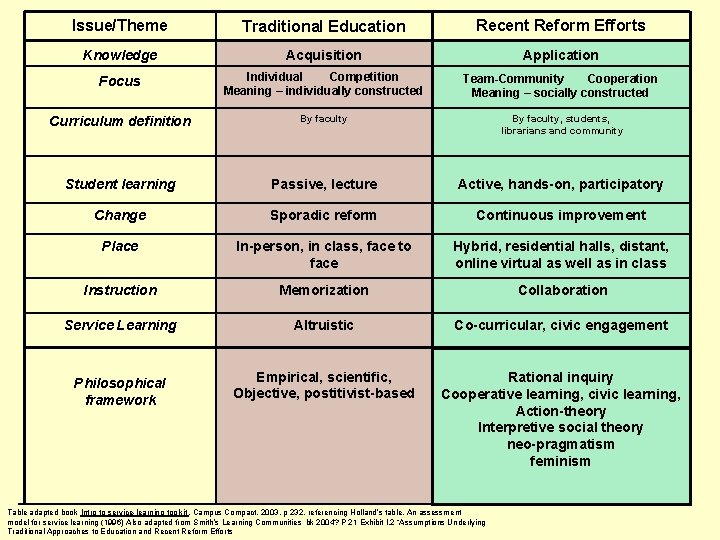
Issue/Theme Traditional Education Recent Reform Efforts Knowledge Acquisition Application Focus Individual Competition Meaning – individually constructed Team-Community Cooperation Meaning – socially constructed Curriculum definition By faculty, students, librarians and community Student learning Passive, lecture Active, hands-on, participatory Change Sporadic reform Continuous improvement Place In-person, in class, face to face Hybrid, residential halls, distant, online virtual as well as in class Instruction Memorization Collaboration Service Learning Altruistic Co-curricular, civic engagement Philosophical framework Empirical, scientific, Objective, postitivist-based Rational inquiry Cooperative learning, civic learning, Action-theory Interpretive social theory neo-pragmatism feminism Table adapted book Intro to service-learning toolkit, Campus Compact, 2003. p 232, referencing Holland’s table, An assessment model for service learning (1996) Also adapted from Smith’s Learning Communities bk 2004? P 21 Exhibit I. 2 “Assumptions Underlying Traditional Approaches to Education and Recent Reform Efforts
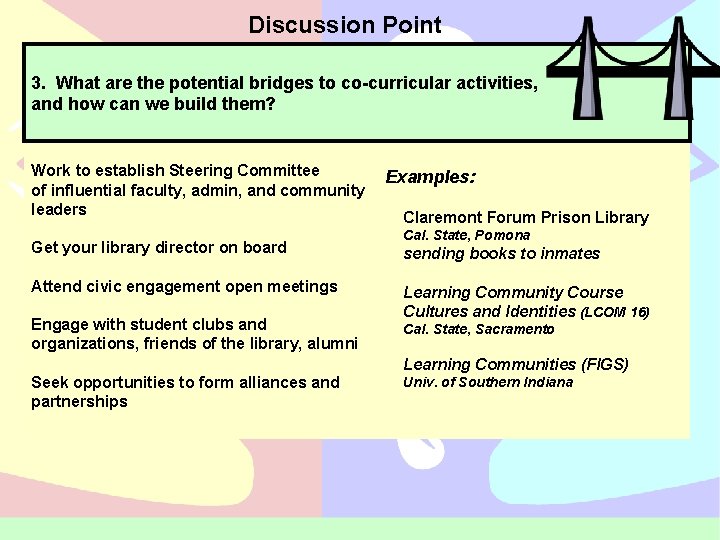
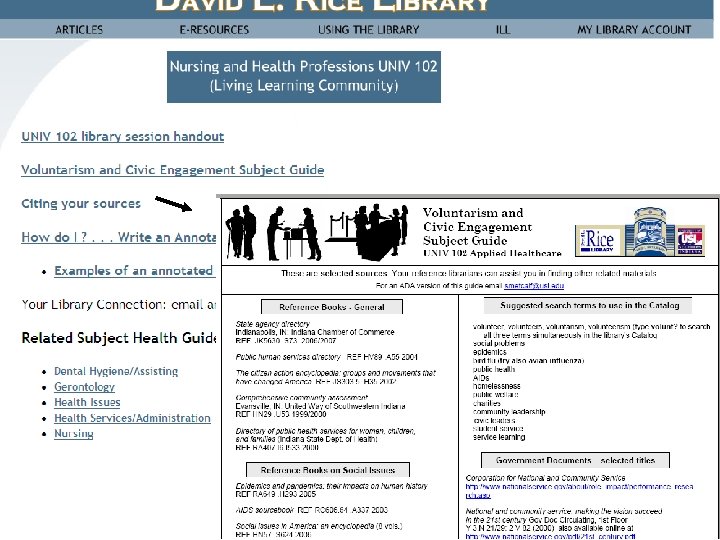
Discussion Point 3. What are the potential bridges to co-curricular activities, and how can we build them? Work to establish Steering Committee Examples: of influential faculty, admin, and community leaders Claremont Forum Prison Library Get your library director on board Attend civic engagement open meetings Engage with student clubs and organizations, friends of the library, alumni Cal. State, Pomona sending books to inmates Learning Community Course Cultures and Identities (LCOM 16) Cal. State, Sacramento Learning Communities (FIGS) Seek opportunities to form alliances and partnerships Univ. of Southern Indiana
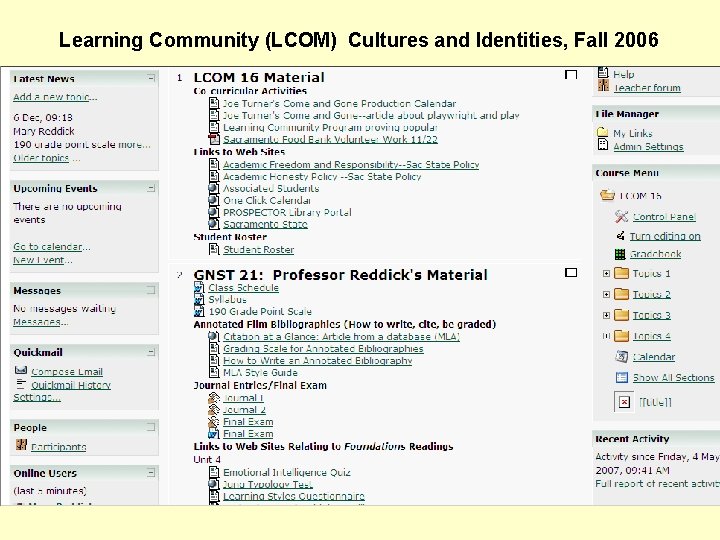
Learning Community (LCOM) Cultures and Identities, Fall 2006
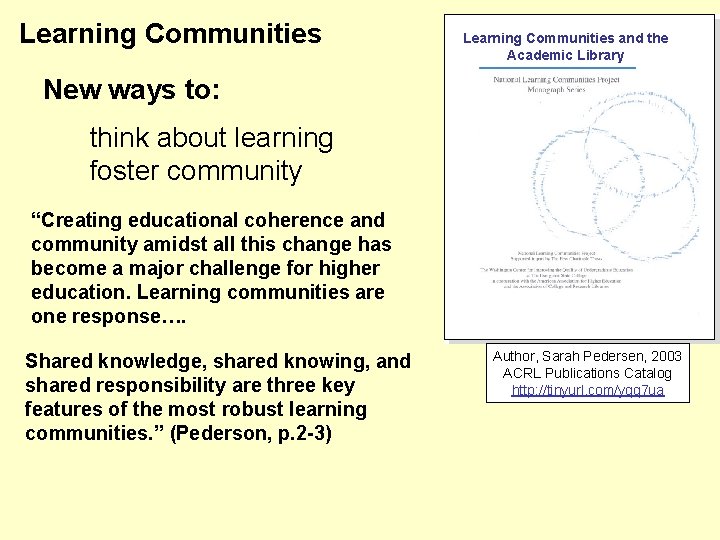
Learning Communities and the Academic Library New ways to: think about learning foster community “Creating educational coherence and community amidst all this change has become a major challenge for higher education. Learning communities are one response…. Shared knowledge, shared knowing, and shared responsibility are three key features of the most robust learning communities. ” (Pederson, p. 2 -3) Author, Sarah Pedersen, 2003 ACRL Publications Catalog http: //tinyurl. com/yqq 7 ua
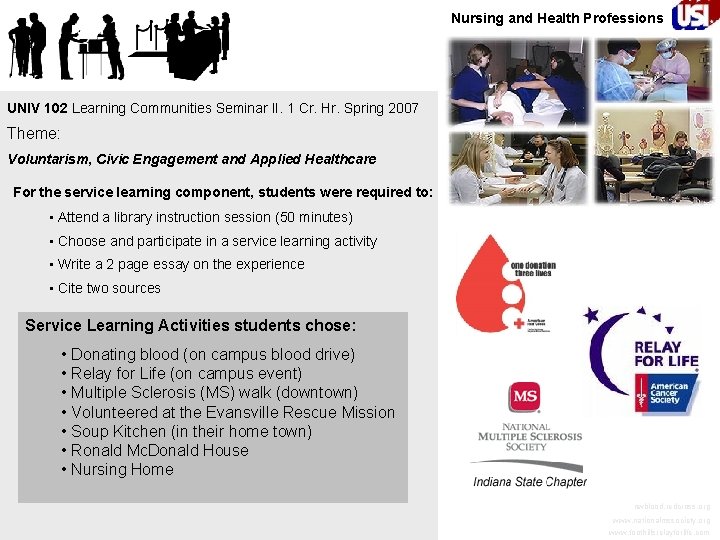
Nursing and Health Professions UNIV 102 Learning Communities Seminar II. 1 Cr. Hr. Spring 2007 Theme: Voluntarism, Civic Engagement and Applied Healthcare For the service learning component, students were required to: • Attend a library instruction session (50 minutes) • Choose and participate in a service learning activity • Write a 2 page essay on the experience • Cite two sources Service Learning Activities students chose: • Donating blood (on campus blood drive) • Relay for Life (on campus event) • Multiple Sclerosis (MS) walk (downtown) • Volunteered at the Evansville Rescue Mission • Soup Kitchen (in their home town) • Ronald Mc. Donald House • Nursing Home nwblood. redcross. org www. nationalmssociety. org www. foothillsrelayforlife. com
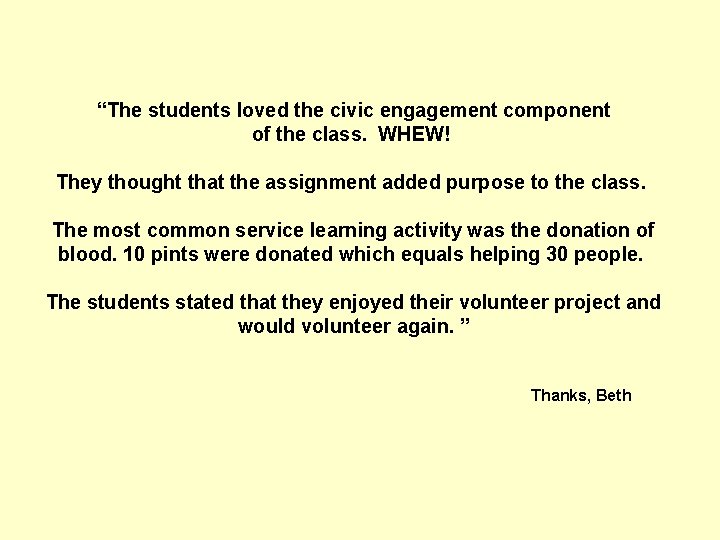
“The students loved the civic engagement component of the class. WHEW! They thought that the assignment added purpose to the class. The most common service learning activity was the donation of blood. 10 pints were donated which equals helping 30 people. The students stated that they enjoyed their volunteer project and would volunteer again. ” Thanks, Beth
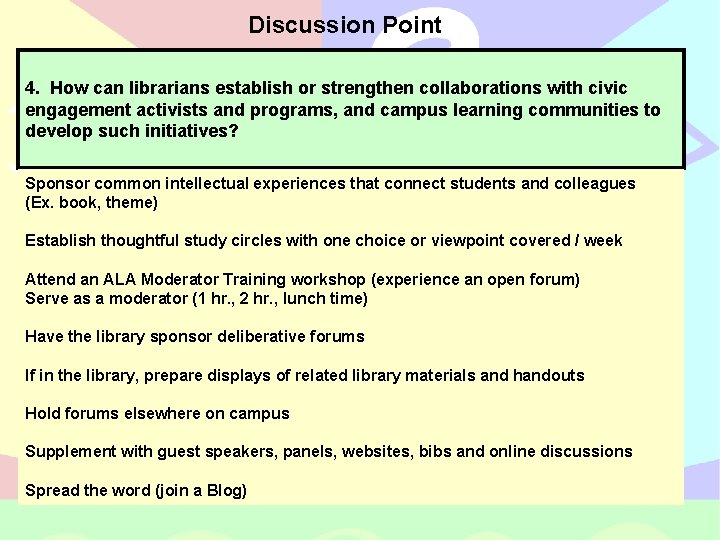
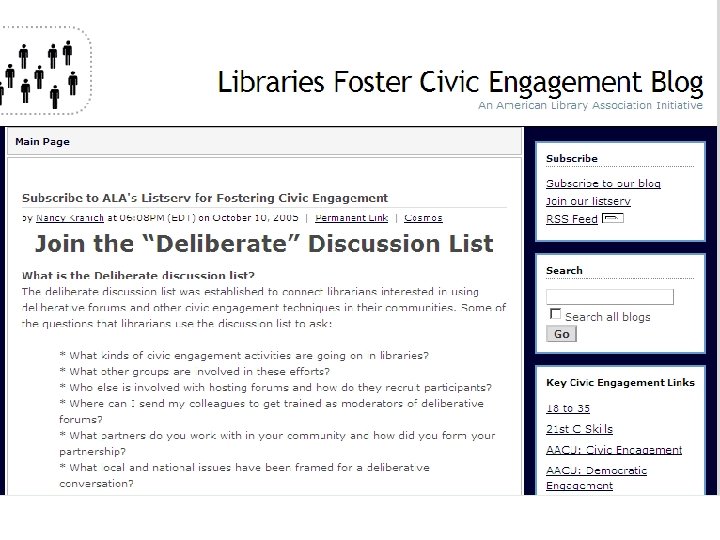
Discussion Point 4. How can librarians establish or strengthen collaborations with civic engagement activists and programs, and campus learning communities to develop such initiatives? Sponsor common intellectual experiences that connect students and colleagues (Ex. book, theme) Establish thoughtful study circles with one choice or viewpoint covered / week Attend an ALA Moderator Training workshop (experience an open forum) Serve as a moderator (1 hr. , 2 hr. , lunch time) Have the library sponsor deliberative forums If in the library, prepare displays of related library materials and handouts Hold forums elsewhere on campus Supplement with guest speakers, panels, websites, bibs and online discussions Spread the word (join a Blog)
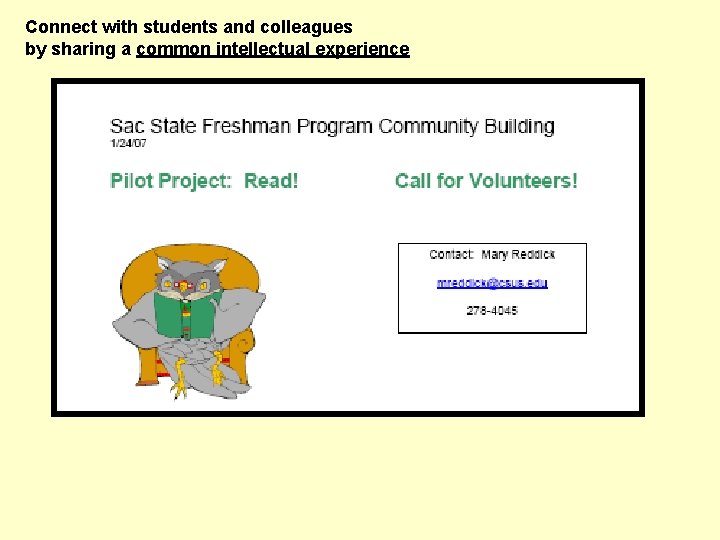
Connect with students and colleagues by sharing a common intellectual experience
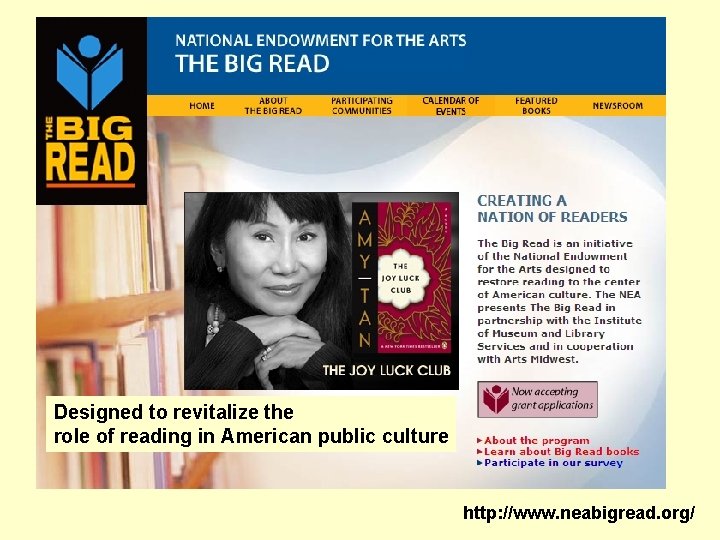
Designed to revitalize the role of reading in American public culture http: //www. neabigread. org/
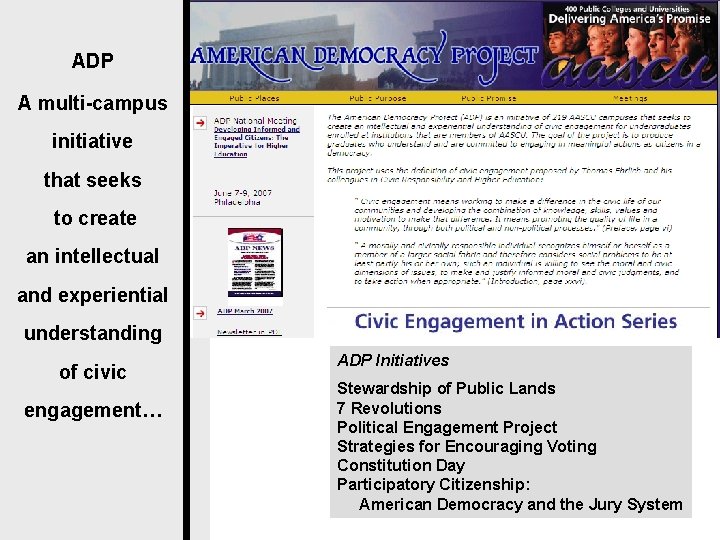
ADP A multi-campus initiative that seeks to create an intellectual and experiential understanding of civic engagement… ADP Initiatives Stewardship of Public Lands 7 Revolutions Political Engagement Project Strategies for Encouraging Voting Constitution Day Participatory Citizenship: American Democracy and the Jury System
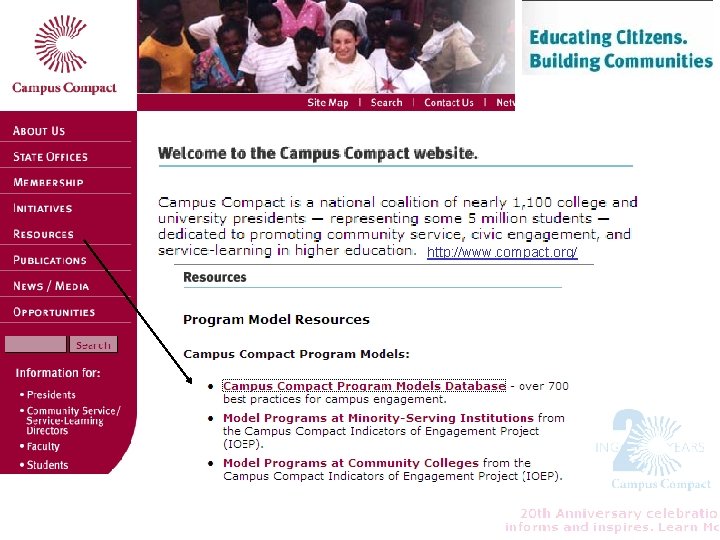
http: //www. compact. org/
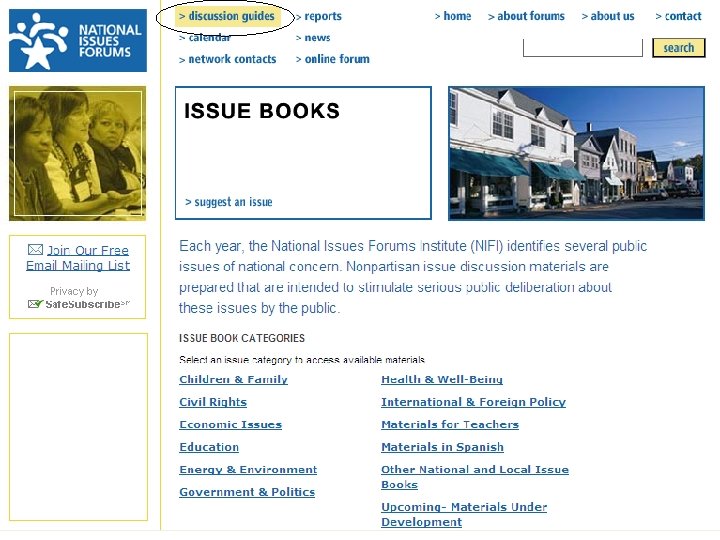
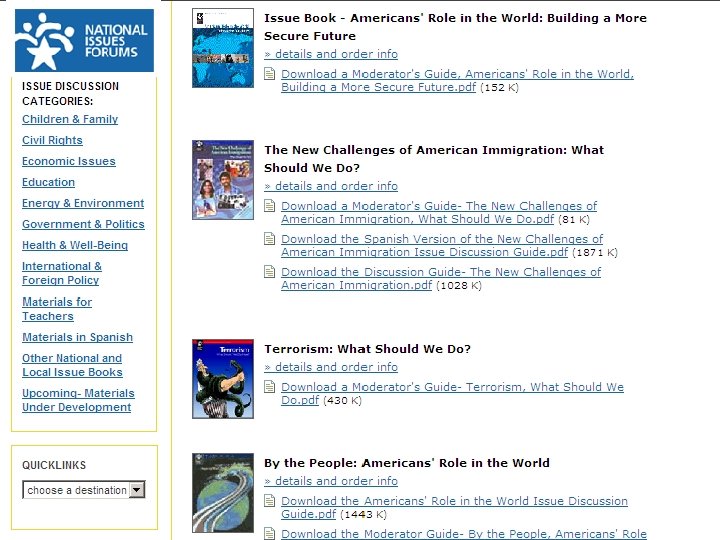
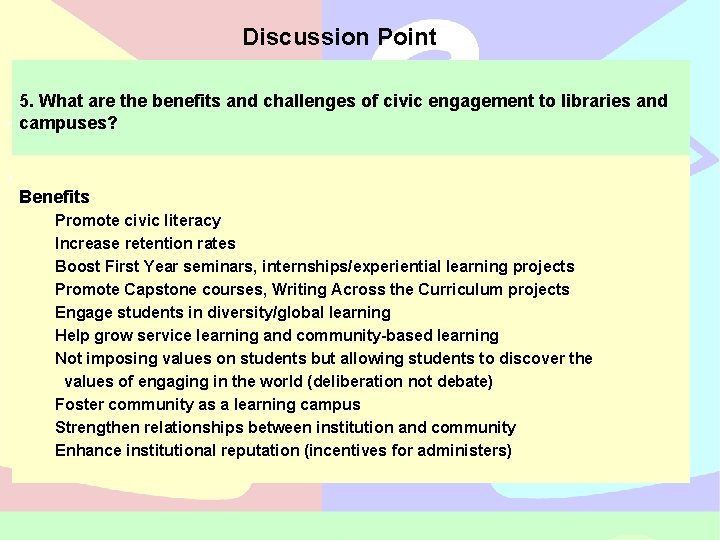
Discussion Point 5. What are the benefits and challenges of civic engagement to libraries and campuses? Benefits Promote civic literacy Increase retention rates Boost First Year seminars, internships/experiential learning projects Promote Capstone courses, Writing Across the Curriculum projects Engage students in diversity/global learning Help grow service learning and community-based learning Not imposing values on students but allowing students to discover the values of engaging in the world (deliberation not debate) Foster community as a learning campus Strengthen relationships between institution and community Enhance institutional reputation (incentives for administers)
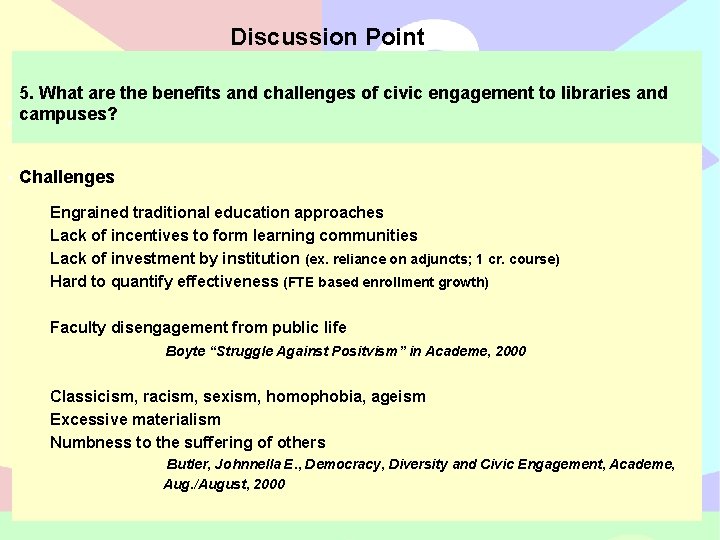
Discussion Point 5. What are the benefits and challenges of civic engagement to libraries and campuses? Challenges Engrained traditional education approaches Lack of incentives to form learning communities Lack of investment by institution (ex. reliance on adjuncts; 1 cr. course) Hard to quantify effectiveness (FTE based enrollment growth) Faculty disengagement from public life Boyte “Struggle Against Positvism” in Academe, 2000 Classicism, racism, sexism, homophobia, ageism Excessive materialism Numbness to the suffering of others Butler, Johnnella E. , Democracy, Diversity and Civic Engagement, Academe, Aug. /August, 2000
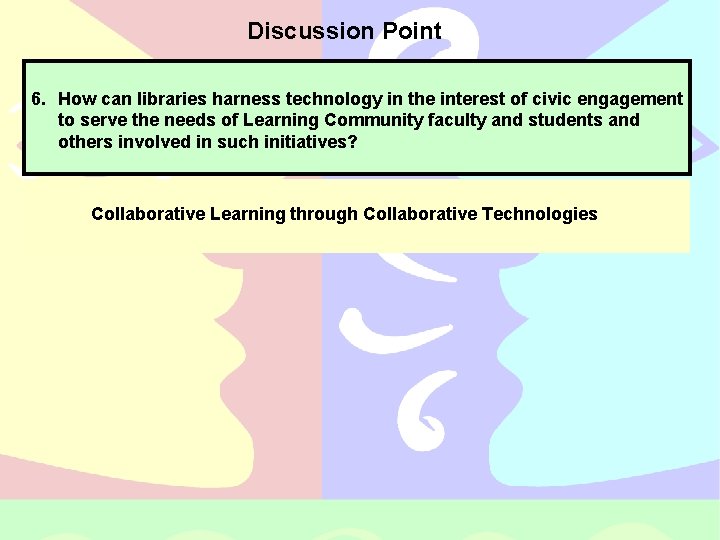
Discussion Point 6. How can libraries harness technology in the interest of civic engagement to serve the needs of Learning Community faculty and students and others involved in such initiatives? Collaborative Learning through Collaborative Technologies
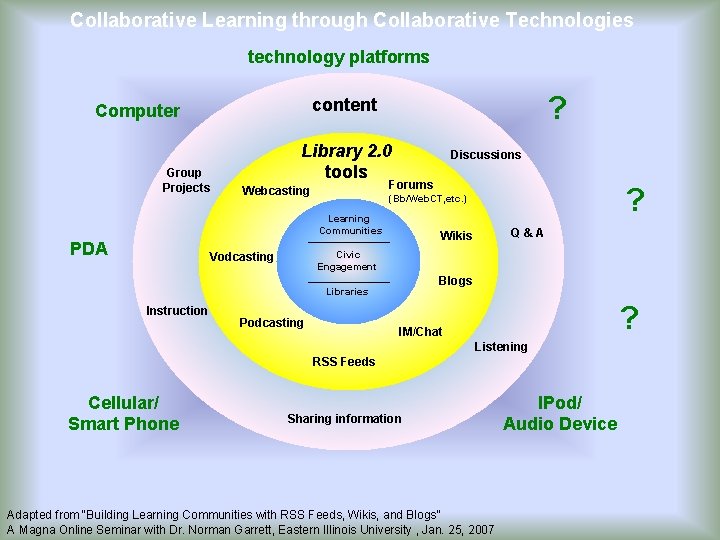
Collaborative Learning through Collaborative Technologies technology platforms ? content Computer Group Projects Library 2. 0 tools Discussions Forums Webcasting Learning Communities PDA Q & A Wikis Civic Engagement Vodcasting Blogs Libraries Instruction ? (Bb/Web. CT, etc. ) Podcasting ? IM/Chat Listening RSS Feeds Cellular/ Smart Phone Sharing information Adapted from “Building Learning Communities with RSS Feeds, Wikis, and Blogs” A Magna Online Seminar with Dr. Norman Garrett, Eastern Illinois University , Jan. 25, 2007 IPod/ Audio Device
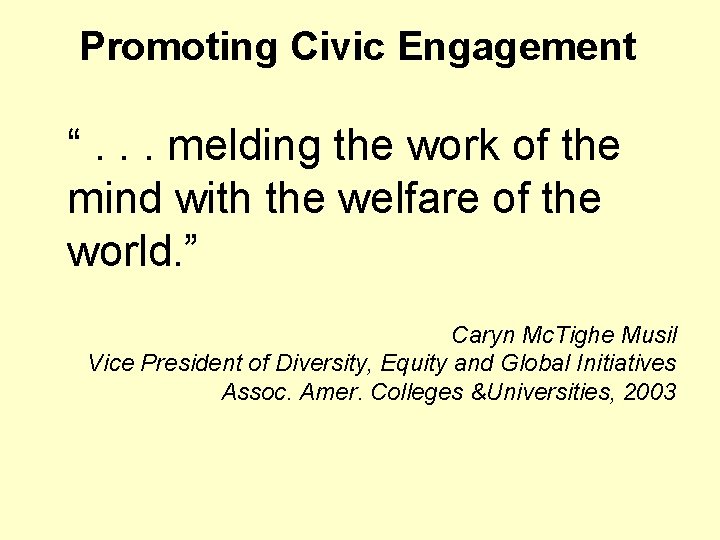
Promoting Civic Engagement “. . . melding the work of the mind with the welfare of the world. ” Caryn Mc. Tighe Musil Vice President of Diversity, Equity and Global Initiatives Assoc. Amer. Colleges &Universities, 2003
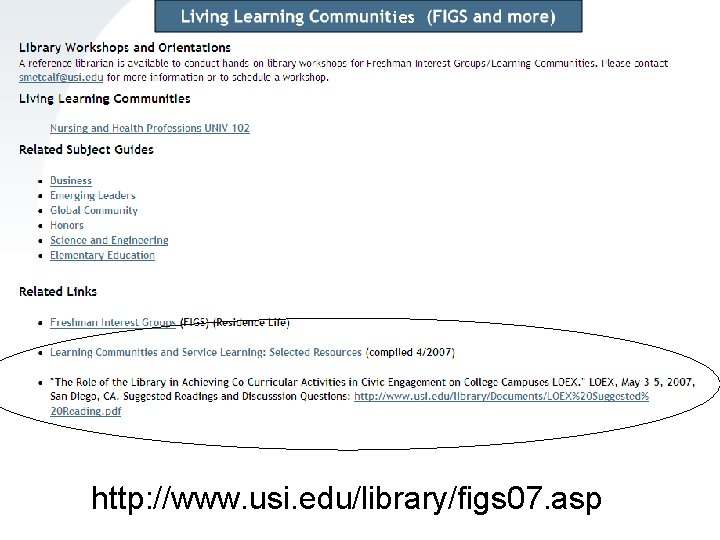
http: //www. usi. edu/library/figs 07. asp
- Slides: 36