
The role of the Glp D cap domain
- Slides: 1
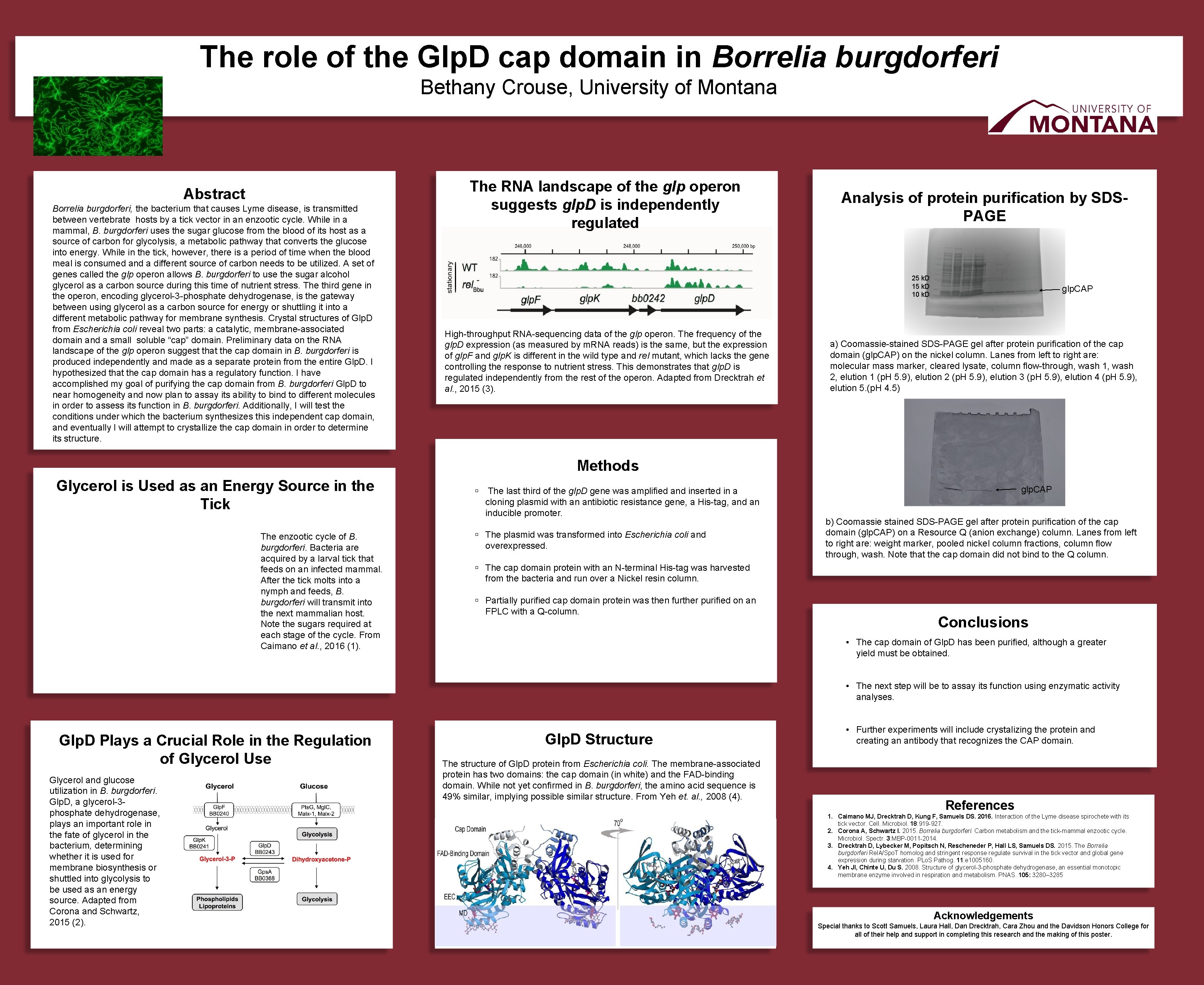
The role of the Glp. D cap domain in Borrelia burgdorferi Bethany Crouse, University of Montana Abstract Borrelia burgdorferi, the bacterium that causes Lyme disease, is transmitted between vertebrate hosts by a tick vector in an enzootic cycle. While in a mammal, B. burgdorferi uses the sugar glucose from the blood of its host as a source of carbon for glycolysis, a metabolic pathway that converts the glucose into energy. While in the tick, however, there is a period of time when the blood meal is consumed and a different source of carbon needs to be utilized. A set of genes called the glp operon allows B. burgdorferi to use the sugar alcohol glycerol as a carbon source during this time of nutrient stress. The third gene in the operon, encoding glycerol-3 -phosphate dehydrogenase, is the gateway between using glycerol as a carbon source for energy or shuttling it into a different metabolic pathway for membrane synthesis. Crystal structures of Glp. D from Escherichia coli reveal two parts: a catalytic, membrane-associated domain and a small soluble “cap” domain. Preliminary data on the RNA landscape of the glp operon suggest that the cap domain in B. burgdorferi is produced independently and made as a separate protein from the entire Glp. D. I hypothesized that the cap domain has a regulatory function. I have accomplished my goal of purifying the cap domain from B. burgdorferi Glp. D to near homogeneity and now plan to assay its ability to bind to different molecules in order to assess its function in B. burgdorferi. Additionally, I will test the conditions under which the bacterium synthesizes this independent cap domain, and eventually I will attempt to crystallize the cap domain in order to determine its structure. The RNA landscape of the glp operon suggests glp. D is independently regulated Analysis of protein purification by SDSPAGE 25 k. D 10 k. D High-throughput RNA-sequencing data of the glp operon. The frequency of the glp. D expression (as measured by m. RNA reads) is the same, but the expression of glp. F and glp. K is different in the wild type and rel mutant, which lacks the gene controlling the response to nutrient stress. This demonstrates that glp. D is regulated independently from the rest of the operon. Adapted from Drecktrah et al. , 2015 (3). glp. CAP a) Coomassie-stained SDS-PAGE gel after protein purification of the cap domain (glp. CAP) on the nickel column. Lanes from left to right are: molecular mass marker, cleared lysate, column flow-through, wash 1, wash 2, elution 1 (p. H 5. 9), elution 2 (p. H 5. 9), elution 3 (p. H 5. 9), elution 4 (p. H 5. 9), elution 5. (p. H 4. 5) Methods Glycerol is Used as an Energy Source in the Tick The enzootic cycle of B. burgdorferi. Bacteria are acquired by a larval tick that feeds on an infected mammal. After the tick molts into a nymph and feeds, B. burgdorferi will transmit into the next mammalian host. Note the sugars required at each stage of the cycle. From Caimano et al. , 2016 (1). The last third of the glp. D gene was amplified and inserted in a cloning plasmid with an antibiotic resistance gene, a His-tag, and an inducible promoter. The plasmid was transformed into Escherichia coli and overexpressed. glp. CAP b) Coomassie stained SDS-PAGE gel after protein purification of the cap domain (glp. CAP) on a Resource Q (anion exchange) column. Lanes from left to right are: weight marker, pooled nickel column fractions, column flow through, wash. Note that the cap domain did not bind to the Q column. The cap domain protein with an N-terminal His-tag was harvested from the bacteria and run over a Nickel resin column. Partially purified cap domain protein was then further purified on an FPLC with a Q-column. Conclusions • The cap domain of Glp. D has been purified, although a greater yield must be obtained. • The next step will be to assay its function using enzymatic activity analyses. Glp. D Plays a Crucial Role in the Regulation of Glycerol Use Glycerol and glucose utilization in B. burgdorferi. Glp. D, a glycerol-3 phosphate dehydrogenase, plays an important role in the fate of glycerol in the bacterium, determining whether it is used for membrane biosynthesis or shuttled into glycolysis to be used as an energy source. Adapted from Corona and Schwartz, 2015 (2). Glp. D Structure The structure of Glp. D protein from Escherichia coli. The membrane-associated protein has two domains: the cap domain (in white) and the FAD-binding domain. While not yet confirmed in B. burgdorferi, the amino acid sequence is 49% similar, implying possible similar structure. From Yeh et. al. , 2008 (4). • Further experiments will include crystalizing the protein and creating an antibody that recognizes the CAP domain. References 1. Caimano MJ, Drecktrah D, Kung F, Samuels DS. 2016. Interaction of the Lyme disease spirochete with its tick vector. Cell. Microbiol. 18: 919 -927. 2. Corona A, Schwartz I. 2015. Borrelia burgdorferi: Carbon metabolism and the tick-mammal enzootic cycle. Microbiol. Spectr. 3: MBP-0011 -2014. 3. Drecktrah D, Lybecker M, Popitsch N, Rescheneder P, Hall LS, Samuels DS. 2015. The Borrelia burgdorferi Rel. A/Spo. T homolog and stringent response regulate survival in the tick vector and global gene expression during starvation. PLo. S Pathog. 11: e 1005160. 4. Yeh JI, Chinte U, Du S. 2008. Structure of glycerol-3 -phosphate dehydrogenase, an essential monotopic membrane enzyme involved in respiration and metabolism. PNAS. 105: 3280– 3285 Acknowledgements Special thanks to Scott Samuels, Laura Hall, Dan Drecktrah, Cara Zhou and the Davidson Honors College for all of their help and support in completing this research and the making of this poster.