
The Role of the Central American Seaway CAS

- Slides: 6
The Role of the Central American Seaway (CAS) Closure on Ocean Circulation Lori Sentman December 5, 2013
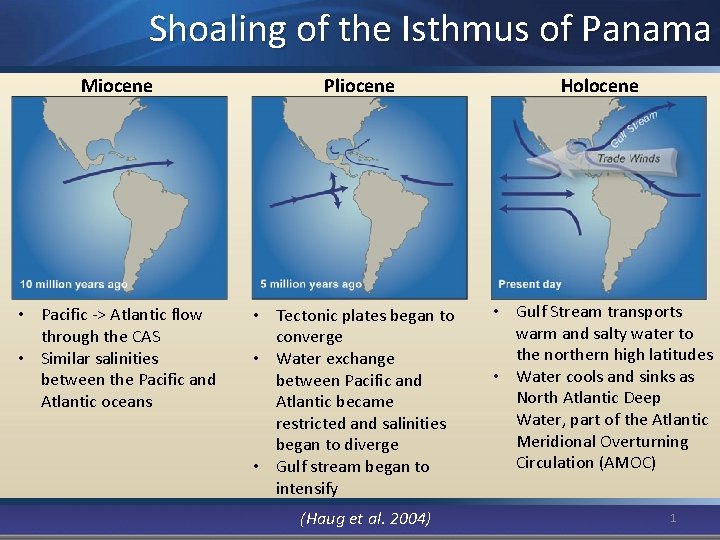
Shoaling of the Isthmus of Panama Miocene • Pacific -> Atlantic flow through the CAS • Similar salinities between the Pacific and Atlantic oceans Pliocene • Tectonic plates began to converge • Water exchange between Pacific and Atlantic became restricted and salinities began to diverge • Gulf stream began to intensify (Haug et al. 2004) Holocene • Gulf Stream transports warm and salty water to the northern high latitudes • Water cools and sinks as North Atlantic Deep Water, part of the Atlantic Meridional Overturning Circulation (AMOC) 1
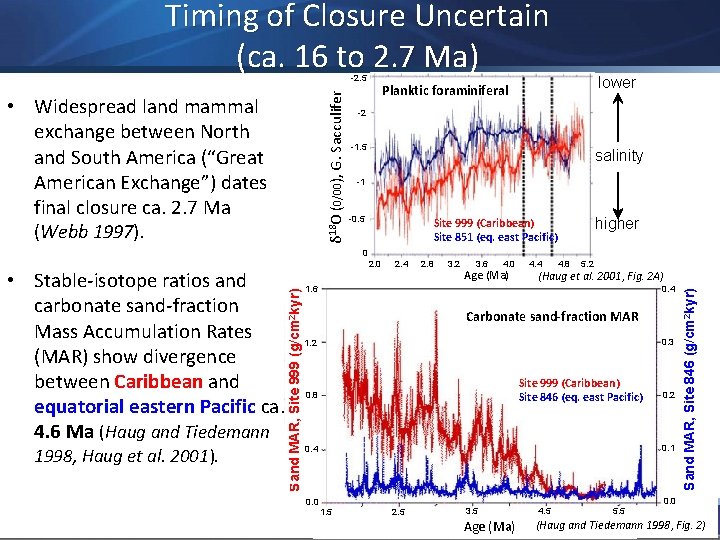
Timing of Closure Uncertain (ca. 16 to 2. 7 Ma) δ 18 O (0/00), G. Sacculifer -2. 5 • Widespread land mammal exchange between North and South America (“Great American Exchange”) dates final closure ca. 2. 7 Ma (Webb 1997). lower Planktic foraminiferal -2 -1. 5 salinity -1 -0. 5 higher Site 999 (Caribbean) Site 851 (eq. east Pacific) 0 2. 4 2. 8 3. 2 3. 6 4. 0 Age (Ma) 4. 4 4. 8 5. 2 (Haug et al. 2001, Fig. 2 A) 0. 4 1. 6 Carbonate sand-fraction MAR 0. 3 1. 2 Site 999 (Caribbean) Site 846 (eq. east Pacific) 0. 8 0. 1 0. 4 0. 0 0. 2 1. 5 2. 5 3. 5 Age (Ma) 4. 5 5. 5 Sand MAR, Site 846 (g/cm 2 kyr) 1998, Haug et al. 2001). Sand MAR, Site 999 (g/cm 2 kyr) • Stable-isotope ratios and carbonate sand-fraction Mass Accumulation Rates (MAR) show divergence between Caribbean and equatorial eastern Pacific ca. 4. 6 Ma (Haug and Tiedemann 2. 0 0. 0 2 (Haug and Tiedemann 1998, Fig. 2)
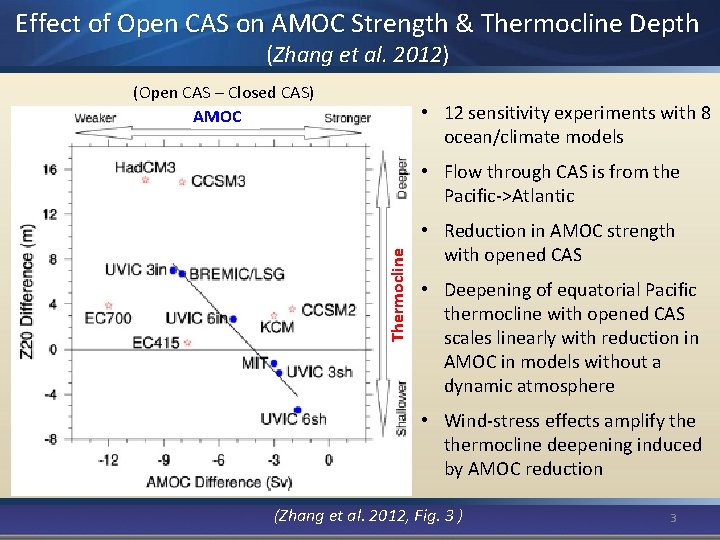
Effect of Open CAS on AMOC Strength & Thermocline Depth (Zhang et al. 2012) (Open CAS – Closed CAS) AMOC • 12 sensitivity experiments with 8 ocean/climate models Thermocline • Flow through CAS is from the Pacific->Atlantic • Reduction in AMOC strength with opened CAS • Deepening of equatorial Pacific thermocline with opened CAS scales linearly with reduction in AMOC in models without a dynamic atmosphere • Wind-stress effects amplify thermocline deepening induced by AMOC reduction (Zhang et al. 2012, Fig. 3 ) 3
Summary • Closure of the CAS was a gradual event occurring from around 16 to 2. 7 Ma. • Ocean sediment proxy data suggests a marked reorganization of the ocean circulation due to the shoaling of the Isthmus of Panama beginning around 4. 6 Ma. • In general, ocean climate models of varying complexity simulate reduced AMOC strength and a deepening of the equatorial eastern Pacific thermocline with an open seaway configuration. • Wind-stress feedbacks in coupled atmosphere-ocean climate models amplify thermocline deepening with an open seaway configuration. • It is important to understand mechanisms of past climate change to make predictions of future climate change. 4