
The Role of the Atmosphere in MagnetosphereIonosphere Coupling
- Slides: 10
The Role of the Atmosphere in Magnetosphere-Ionosphere Coupling (at Saturn) N. Achilleos (Atmospheric Physics Laboratory, UCL) With thanks to colleagues: C. G. A. Smith (Brooksbank School), C. Tao, S. V. Badman (JAXA) and A. D. Aylward (UCL)
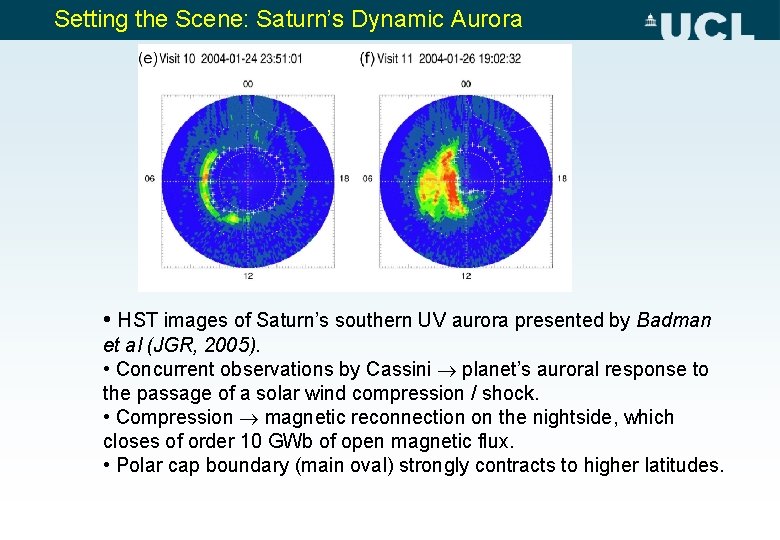
Setting the Scene: Saturn’s Dynamic Aurora • HST images of Saturn’s southern UV aurora presented by Badman et al (JGR, 2005). • Concurrent observations by Cassini planet’s auroral response to the passage of a solar wind compression / shock. • Compression magnetic reconnection on the nightside, which closes of order 10 GWb of open magnetic flux. • Polar cap boundary (main oval) strongly contracts to higher latitudes.
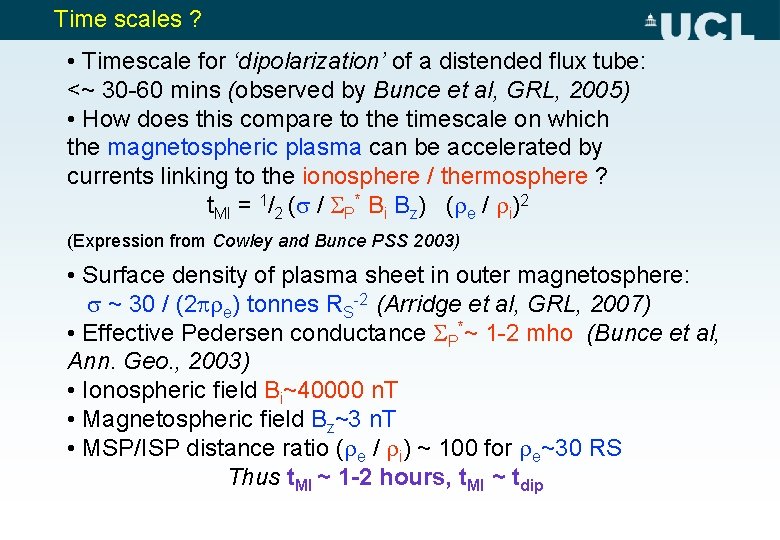
Time scales ? • Timescale for ‘dipolarization’ of a distended flux tube: <~ 30 -60 mins (observed by Bunce et al, GRL, 2005) • How does this compare to the timescale on which the magnetospheric plasma can be accelerated by currents linking to the ionosphere / thermosphere ? t. MI = 1/2 ( / P* Bi Bz) ( e / i)2 (Expression from Cowley and Bunce PSS 2003) • Surface density of plasma sheet in outer magnetosphere: ~ 30 / (2 e) tonnes RS-2 (Arridge et al, GRL, 2007) • Effective Pedersen conductance P*~ 1 -2 mho (Bunce et al, Ann. Geo. , 2003) • Ionospheric field Bi~40000 n. T • Magnetospheric field Bz~3 n. T • MSP/ISP distance ratio ( e / i) ~ 100 for e~30 RS Thus t. MI ~ 1 -2 hours, t. MI ~ tdip
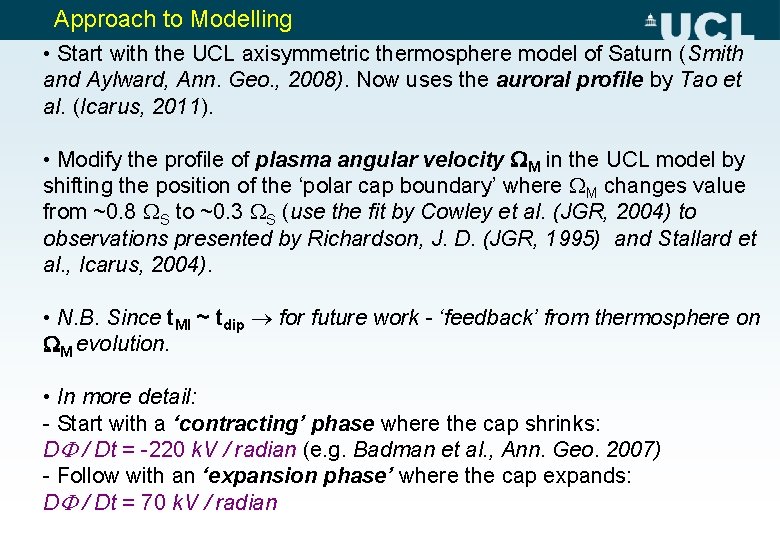
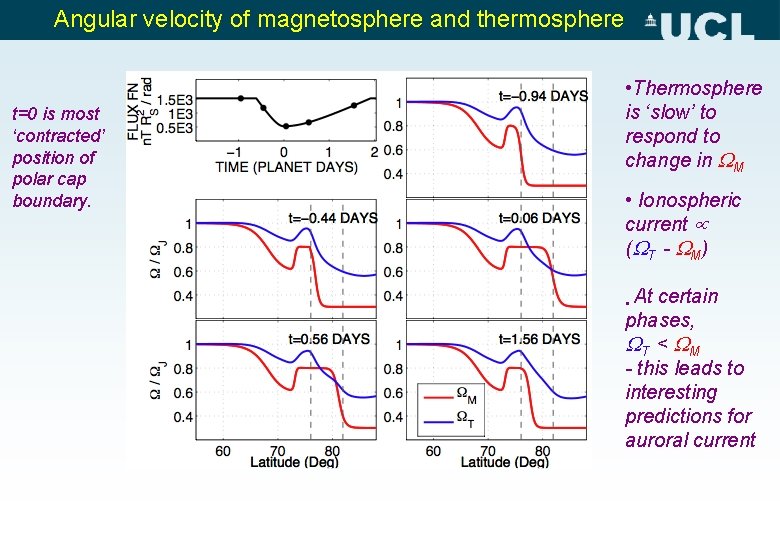
Approach to Modelling • Start with the UCL axisymmetric thermosphere model of Saturn (Smith and Aylward, Ann. Geo. , 2008). Now uses the auroral profile by Tao et al. (Icarus, 2011). • Modify the profile of plasma angular velocity M in the UCL model by shifting the position of the ‘polar cap boundary’ where M changes value from ~0. 8 S to ~0. 3 S (use the fit by Cowley et al. (JGR, 2004) to observations presented by Richardson, J. D. (JGR, 1995) and Stallard et al. , Icarus, 2004). • N. B. Since t. MI ~ tdip for future work - ‘feedback’ from thermosphere on M evolution. • In more detail: - Start with a ‘contracting’ phase where the cap shrinks: D / Dt = -220 k. V / radian (e. g. Badman et al. , Ann. Geo. 2007) - Follow with an ‘expansion phase’ where the cap expands: D / Dt = 70 k. V / radian
Angular velocity of magnetosphere and thermosphere t=0 is most ‘contracted’ position of polar cap boundary. • Thermosphere is ‘slow’ to respond to change in M • Ionospheric current ( T - M ) • At certain phases, T < M - this leads to interesting predictions for auroral current
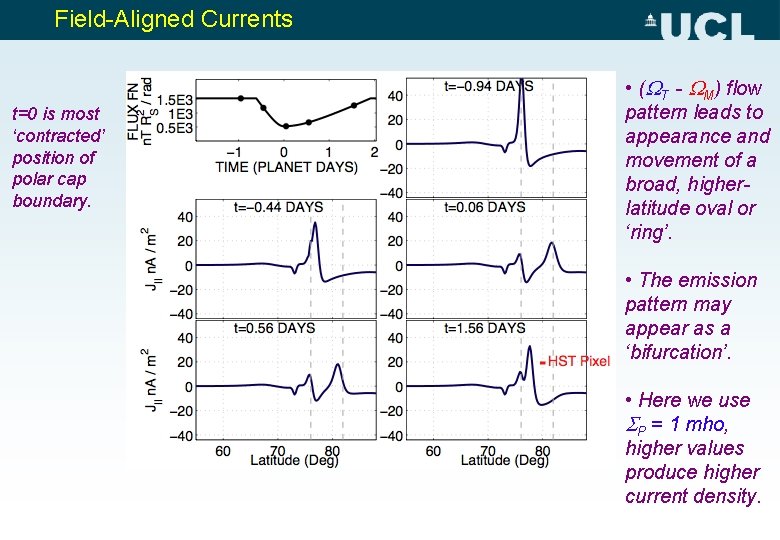
Field-Aligned Currents t=0 is most ‘contracted’ position of polar cap boundary. • ( T - M) flow pattern leads to appearance and movement of a broad, higherlatitude oval or ‘ring’. • The emission pattern may appear as a ‘bifurcation’. • Here we use P = 1 mho, higher values produce higher current density.
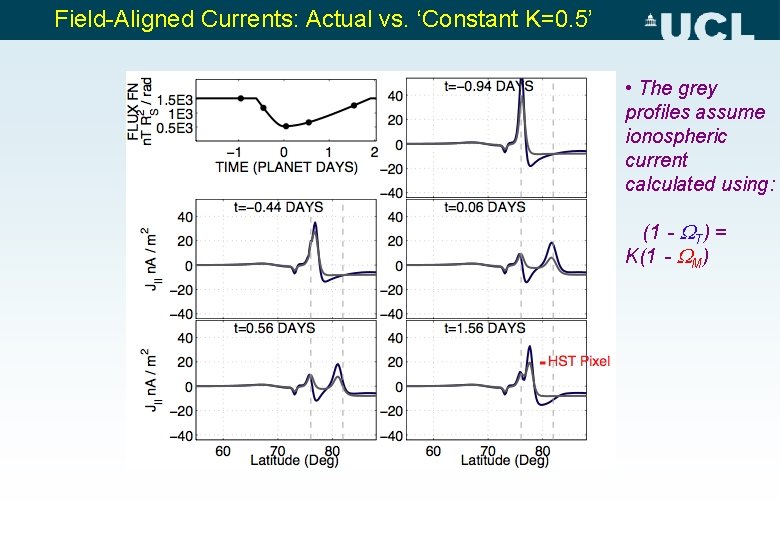
Field-Aligned Currents: Actual vs. ‘Constant K=0. 5’ • The grey profiles assume ionospheric current calculated using: (1 - T) = K(1 - M)
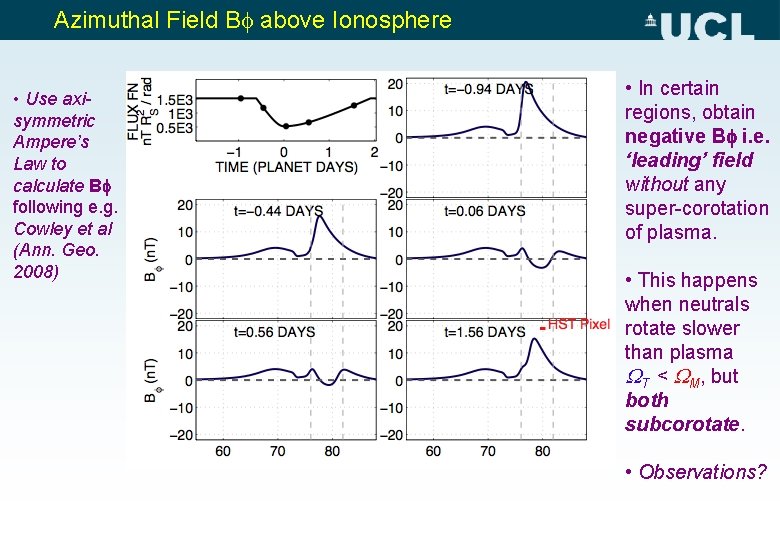
Azimuthal Field B above Ionosphere • Use axisymmetric Ampere’s Law to calculate B following e. g. Cowley et al (Ann. Geo. 2008) • In certain regions, obtain negative B i. e. ‘leading’ field without any super-corotation of plasma. • This happens when neutrals rotate slower than plasma T < M, but both subcorotate. • Observations?
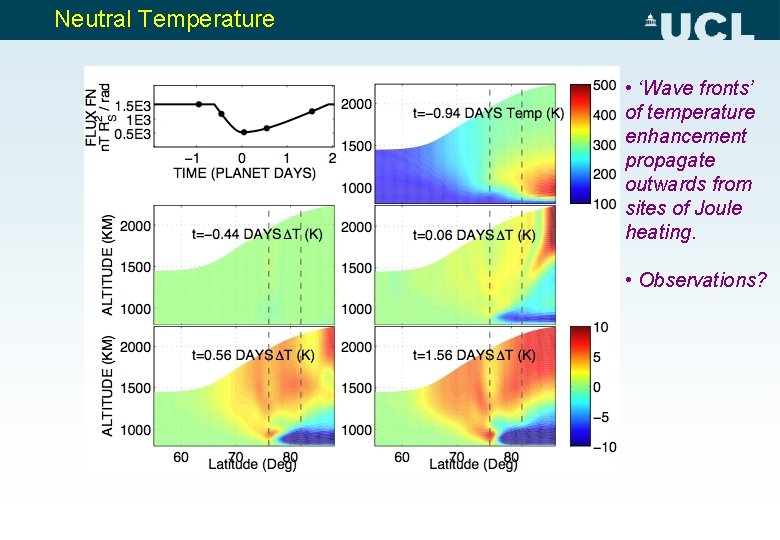
Neutral Temperature • ‘Wave fronts’ of temperature enhancement propagate outwards from sites of Joule heating. • Observations?
• Proposal for UCL to host MOP 2013: (C. Jackman and N. Achilleos) • London is a vibrant city, also convenient for travel access to Europe, US. UCL campus is a 5 min walk from Eurostar terminal and a short train journey from Heathrow. • Many possibilities for excursions near UCL - museums, art galleries, University of London observatory, visits to Royal Astronomical Society, London Eye, Thames riverboats, Tower Bridge, etc. • UCL have planetary science teams at the Gower Street campus (Physics and Astronomy) as well as the Mullard Space Science Laboratory. • We have experience in hosting international meetings, and a dedicated conference support team, to help organize venues, audiovisual needs, catering, etc. • Other experience: UCL organized a small planetary meeting in 2008 at Windsor Great Park, which was successful. • Accommodation: For restricted budgets, student halls of residence are an option during the Summer. Many hotel options, over a variety of budgets, in the Bloomsbury area. UCL have a special rate with the Tavistock hotel.