
The Role of State Government in Public Health
The Role of State Government in Public Health Nutrition Assessment Policy Development Assurance
Assessment » State level assessment of population nutrition assessment » Identify high risk areas of state » Coordinate state and local assessment initiatives l Provide data to local agencies l Provide technical assistance & training

Assurance » Manage/administer/deliver federal nutrition programs: WIC, NSLP, SNAP » Manage/deliver state funded programs: MSS » Build state capacity to address nutrition l Technical assistance/capacity building, networking, communication l Secure and distribute resources for long term goals
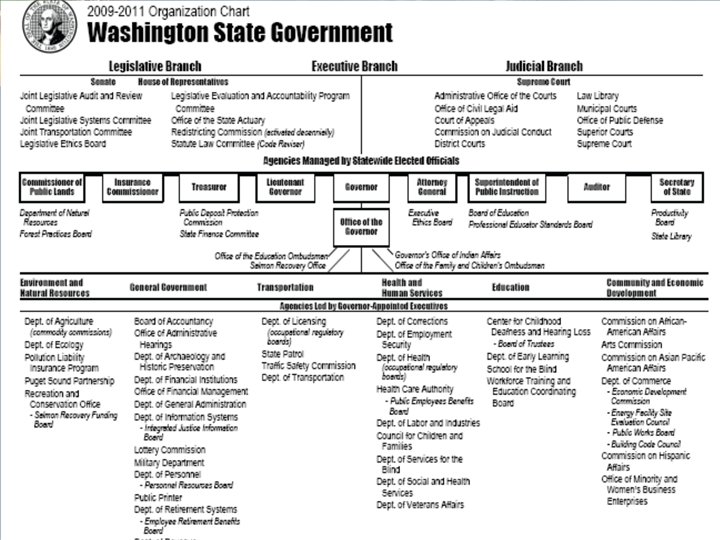
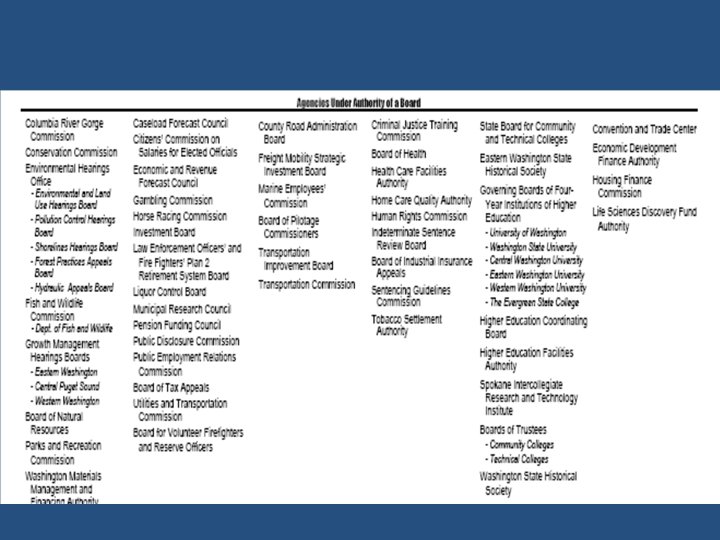
Policy Development » Advise governor and legislature » State-level planning
Infrastructure
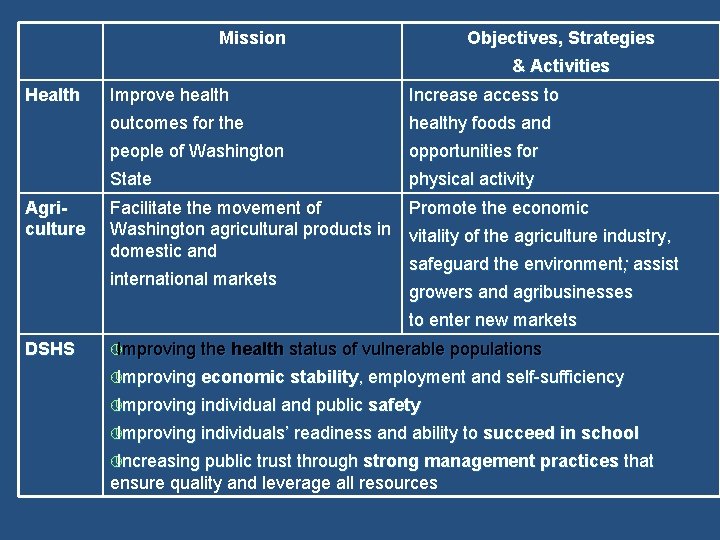
Mission Objectives, Strategies & Activities Health Agriculture Improve health Increase access to outcomes for the healthy foods and people of Washington opportunities for State physical activity Facilitate the movement of Promote the economic Washington agricultural products in vitality of the agriculture industry, domestic and safeguard the environment; assist international markets growers and agribusinesses to enter new markets DSHS » Improving the health status of vulnerable populations » Improving economic stability, employment and self-sufficiency » Improving individual and public safety » Improving individuals’ readiness and ability to succeed in school » Increasing public trust through strong management practices that ensure quality and leverage all resources
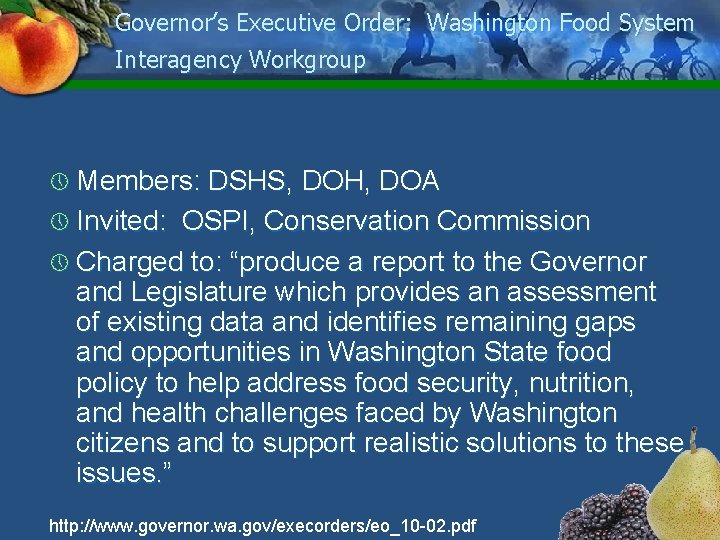
Governor’s Executive Order: Washington Food System Interagency Workgroup » Members: DSHS, DOH, DOA » Invited: OSPI, Conservation Commission » Charged to: “produce a report to the Governor and Legislature which provides an assessment of existing data and identifies remaining gaps and opportunities in Washington State food policy to help address food security, nutrition, and health challenges faced by Washington citizens and to support realistic solutions to these issues. ” http: //www. governor. wa. gov/execorders/eo_10 -02. pdf
The report is intended to help agencies, stakeholders and legislators: » Explore ways to promote nutrition, especially for those who are most in need. » Identify ways to educate the public and policy makers on the status of hunger in Washington State and the role they play in addressing the issue of food security, nutrition, and health. » Educate the public and policy makers on the importance of farmland preservation and the importance of promoting Washington-grown products to farmer’s markets, food banks, and institutions.

Washington State Department of Health Secretary Mary C. Selecky Board of Health Developmental Disabilities Council Deputy Secretary Gregg Grunenfelder State Health Officer Maxine Hayes, MD, MPH Public Health Systems Development Allene Mares Director Policy, Legislative, and Constituent Relations Brian Peyton Director Office of Communications Tim Church Director Public Health Preparedness and Response Program John Erickson Director Community and Family Health Allene Mares Assistant Secretary Environmental Health Maryanne Guichard Assistant Secretary Epidemiology, Health Statistics and Public Health Laboratories Jennifer Tebaldi Assistant Secretary Health Systems Quality Assurance Karen Jensen Assistant Secretary » Financial Services » Office of Infectious Disease » Drinking Water » Communicable Disease » Customer Service » Human Resources and Reproductive Health » Radiation Protection Epidemiology » Community Health Systems » Performance and » Office of Maternal and Child » Shellfish and Water Protection » Non-Infectious Conditions » Health Professions and Accountability Health » Information Resource » Community Wellness and Management » Risk Management » Adjudicative Service Unit » Privacy/Public Disclosure Prevention » Environmental Health, Safety and Toxicology Epidemiology Facilities » Health Statistics » Investigation and Inspection » Public Health Laboratories » Legal services » Informatics
Community Wellness & Prevention » Asthma » Breast & Cervical Health » Cancer Registry » Heart Disease and Stroke Prevention » Tobacco Prevention & Control » WIC » Nutrition, Physical Activity, Obesity Prevention » SNAP-ED » Diabetes Control
Washington State’s Nutrition & Physical Activity Plan
The Six Objectives » Objectives Access to Health Promoting Foods Food Insecurity Proportion of Mothers Who Breastfeed Their Infants & Toddlers Free and Low-Cost Opportunities for Recreation and Physical Activity Opportunities for Children Active Community Environments
Planned Activities » Partner with agencies, coalitions & local communities » Provide technical assistance, training, tools & resources » Support pilot programs and development of local action plans » Encourage development & implementation of policy recommendations by sector
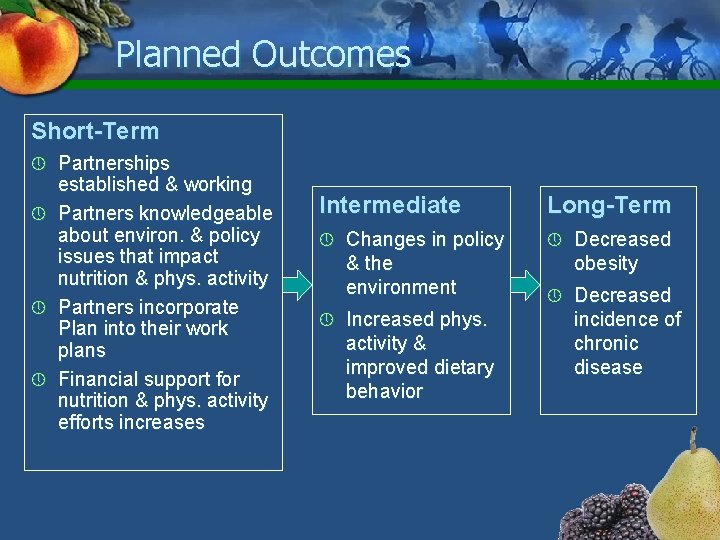
Planned Outcomes Short-Term Partnerships established & working » Partners knowledgeable about environ. & policy issues that impact nutrition & phys. activity » Partners incorporate Plan into their work plans » Financial support for nutrition & phys. activity efforts increases » Intermediate » » Changes in policy & the environment Increased phys. activity & improved dietary behavior Long-Term » Decreased obesity » Decreased incidence of chronic disease
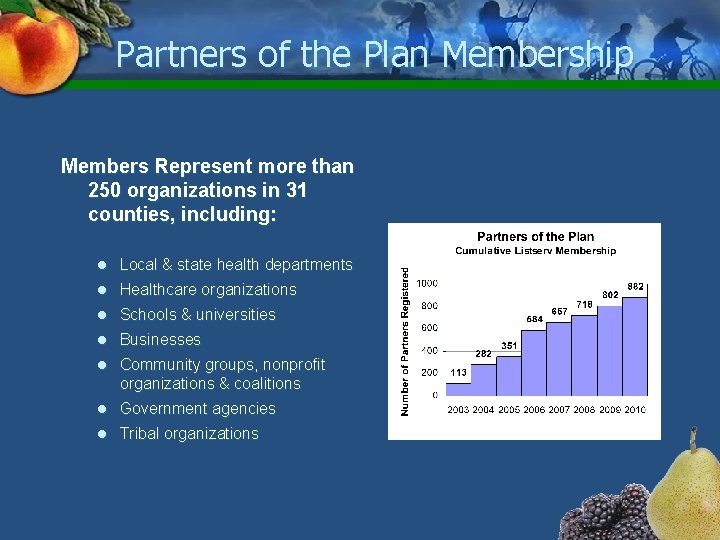
Partners of the Plan Membership Members Represent more than 250 organizations in 31 counties, including: l Local & state health departments l Healthcare organizations l Schools & universities l Businesses l Community groups, nonprofit organizations & coalitions l Government agencies l Tribal organizations
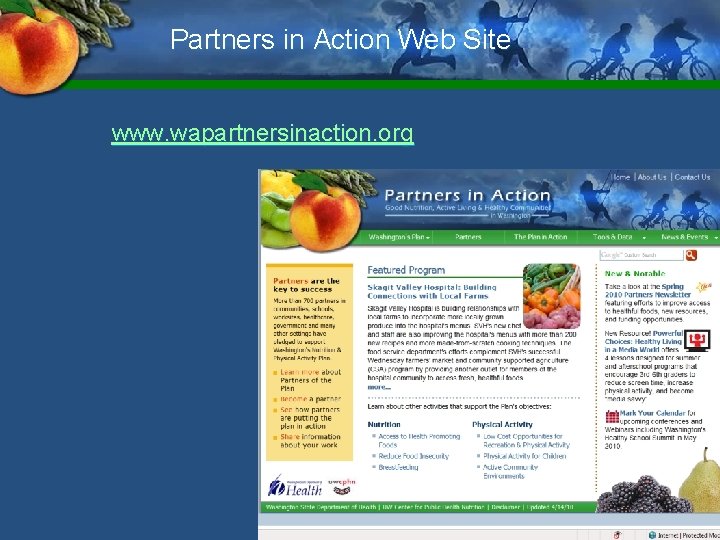
Partners in Action Web Site www. wapartnersinaction. org
Collaboration & Coalition » Networking is exchanging information for mutual benefit. » Cooperation is a shorter term, informal relationship for sharing information only. Goals, resources and structures are separate. » Coordination is a longer term effort around a project or task, with some planning and division of roles. Some resources, rewards, and risks are shared » Collaboration is a mutually beneficial and well-defined relationship entered into by two or more organizations to achieve results they are more likely to achieve together than alone
Why collaborate? » Some problems are too complex for an individual agency to handle alone » Collaboration is an opportunity to gain more financial resources the skills » knowledge, and information gained will strengthen and bring credibility
- Slides: 20