
The Role of Standardization Ronald Cornet Ph D


- Slides: 36
The Role of Standardization Ronald Cornet, Ph. D Dept. of Medical Informatics Academic Medical Center – University of Amsterdam
Standards… “The good thing about standards is that there are so many to choose from”
Outline u Examples (I) u Standards Development u Standards Organizations u Health IT Standards Organizations u Examples (II) u Importance of Standards u Drawbacks of Standards
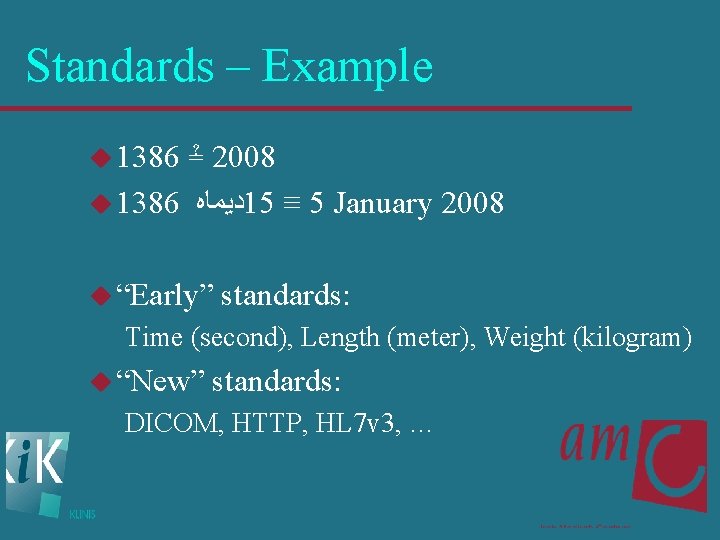
Standards – Example u 1386 ≟ 2008 u 1386 ﺩﻳﻤﺎﻩ 15 ≡ 5 January 2008 u “Early” standards: Time (second), Length (meter), Weight (kilogram) u “New” standards: DICOM, HTTP, HL 7 v 3, …
Standards – Example
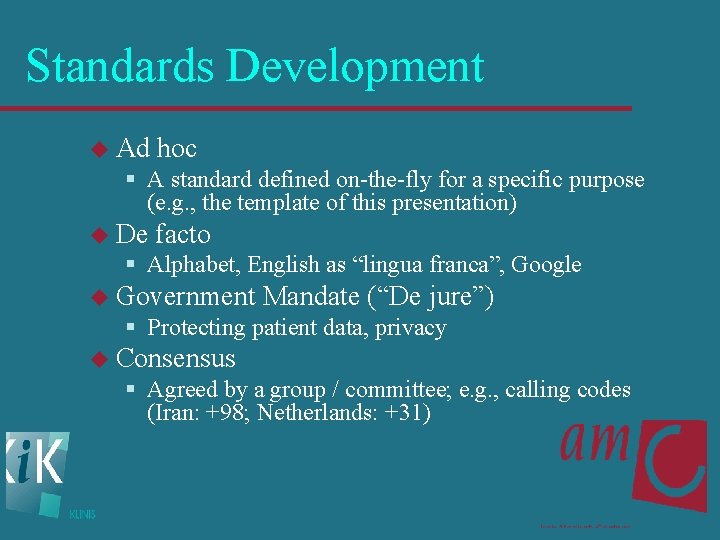
Standards Development u Ad hoc § A standard defined on-the-fly for a specific purpose (e. g. , the template of this presentation) u De facto § Alphabet, English as “lingua franca”, Google u Government Mandate (“De jure”) § Protecting patient data, privacy u Consensus § Agreed by a group / committee; e. g. , calling codes (Iran: +98; Netherlands: +31)
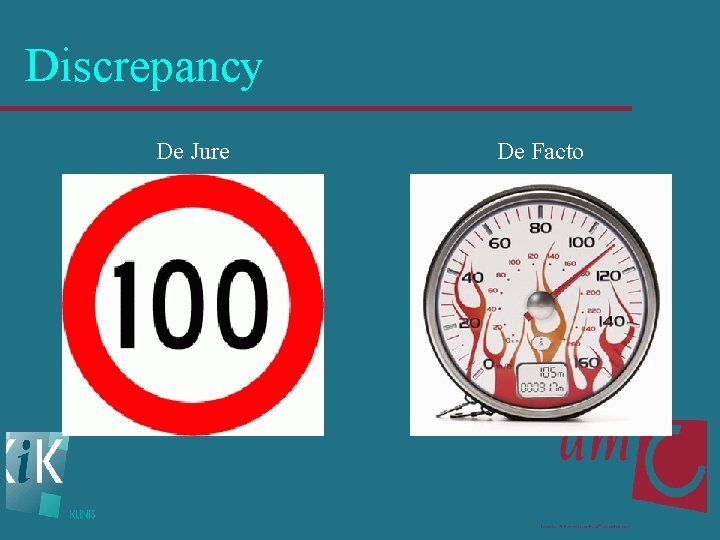
Discrepancy De Jure De Facto
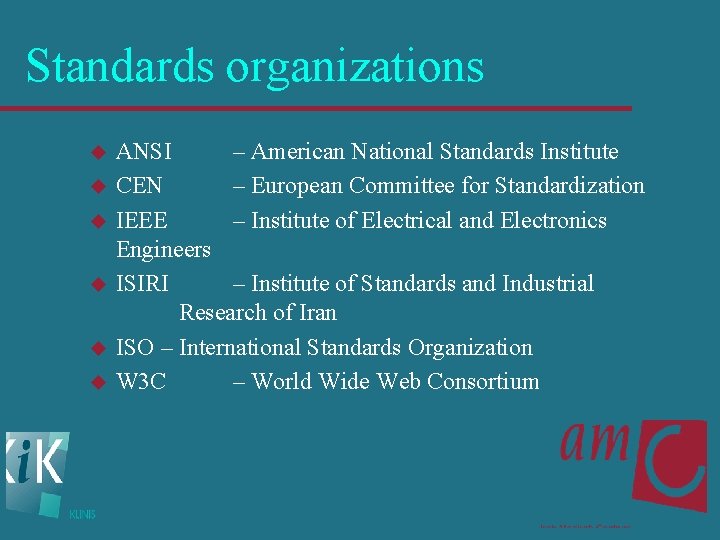
Standards organizations u u u ANSI – American National Standards Institute CEN – European Committee for Standardization IEEE – Institute of Electrical and Electronics Engineers ISIRI – Institute of Standards and Industrial Research of Iran ISO – International Standards Organization W 3 C – World Wide Web Consortium
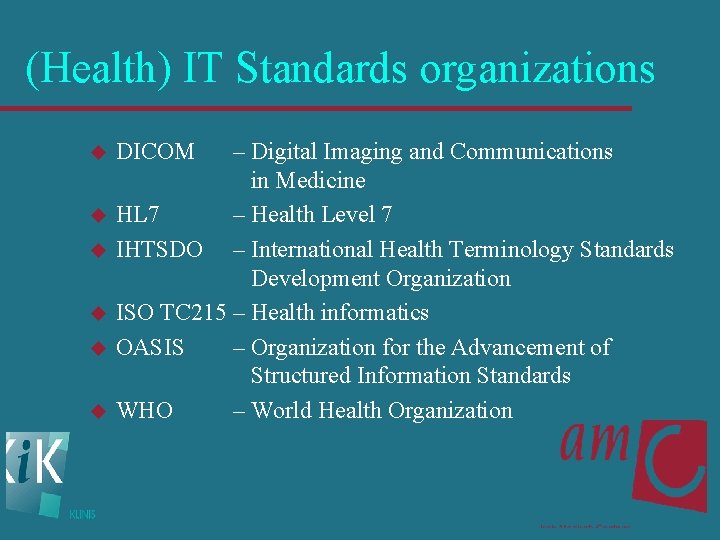
(Health) IT Standards organizations u u u DICOM – Digital Imaging and Communications in Medicine HL 7 – Health Level 7 IHTSDO – International Health Terminology Standards Development Organization ISO TC 215 – Health informatics OASIS – Organization for the Advancement of Structured Information Standards WHO – World Health Organization
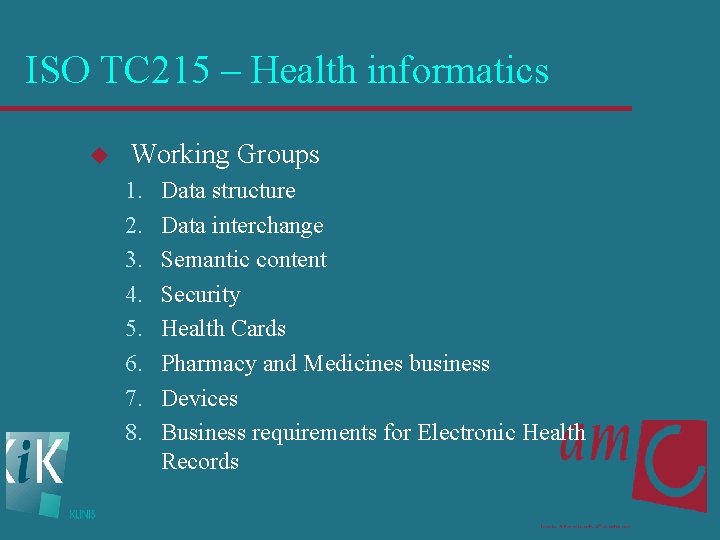
ISO TC 215 – Health informatics u Working Groups 1. 2. 3. 4. 5. 6. 7. 8. Data structure Data interchange Semantic content Security Health Cards Pharmacy and Medicines business Devices Business requirements for Electronic Health Records
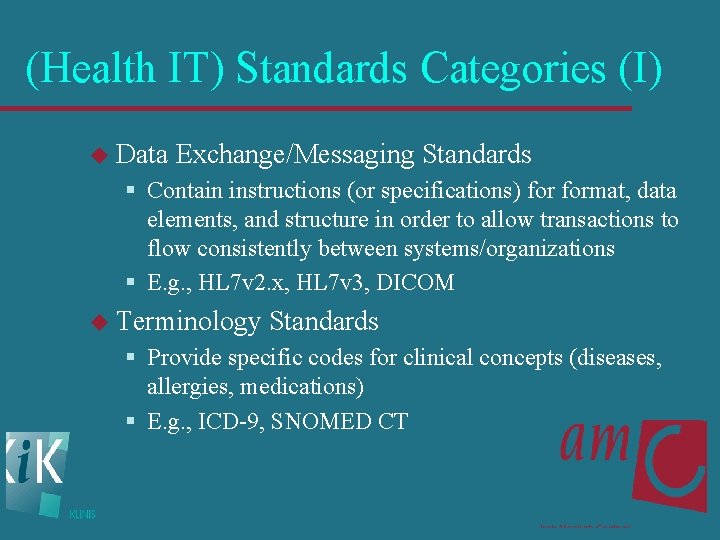
(Health IT) Standards Categories (I) u Data Exchange/Messaging Standards § Contain instructions (or specifications) format, data elements, and structure in order to allow transactions to flow consistently between systems/organizations § E. g. , HL 7 v 2. x, HL 7 v 3, DICOM u Terminology Standards § Provide specific codes for clinical concepts (diseases, allergies, medications) § E. g. , ICD-9, SNOMED CT
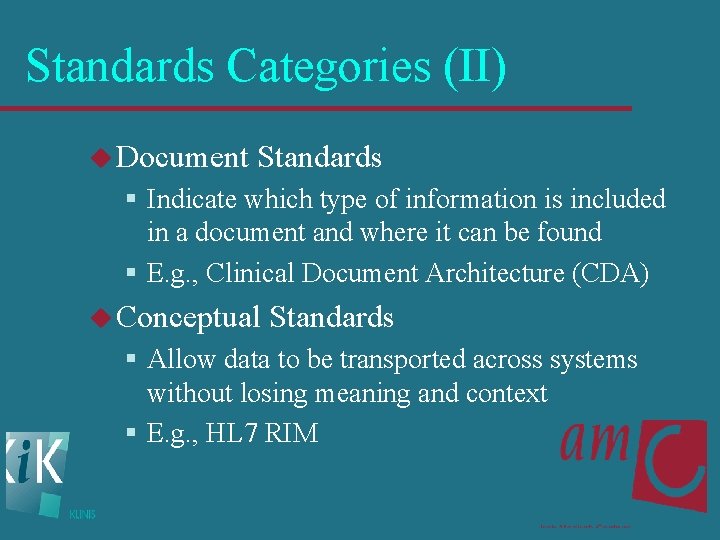
Standards Categories (II) u Document Standards § Indicate which type of information is included in a document and where it can be found § E. g. , Clinical Document Architecture (CDA) u Conceptual Standards § Allow data to be transported across systems without losing meaning and context § E. g. , HL 7 RIM
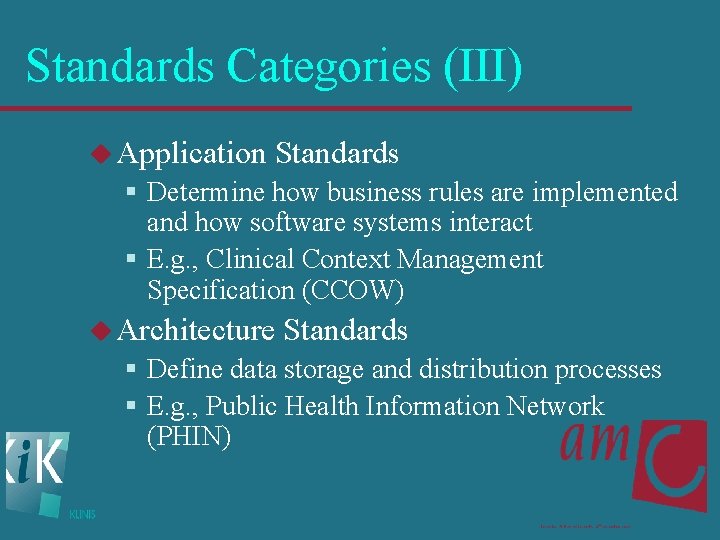
Standards Categories (III) u Application Standards § Determine how business rules are implemented and how software systems interact § E. g. , Clinical Context Management Specification (CCOW) u Architecture Standards § Define data storage and distribution processes § E. g. , Public Health Information Network (PHIN)
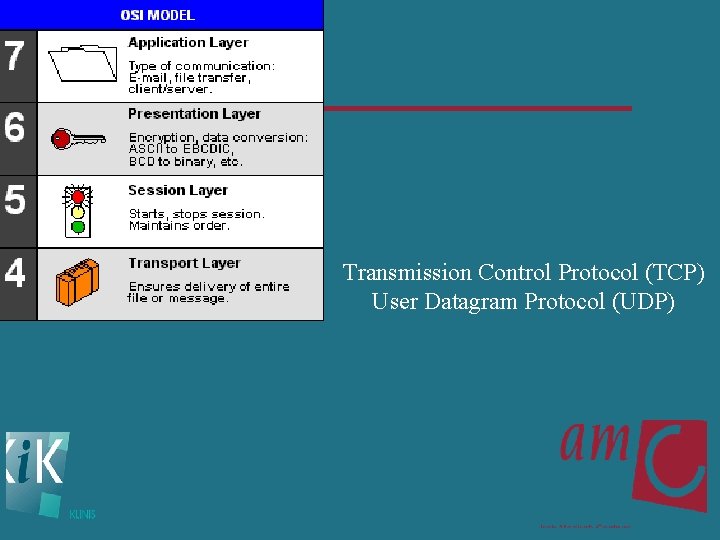
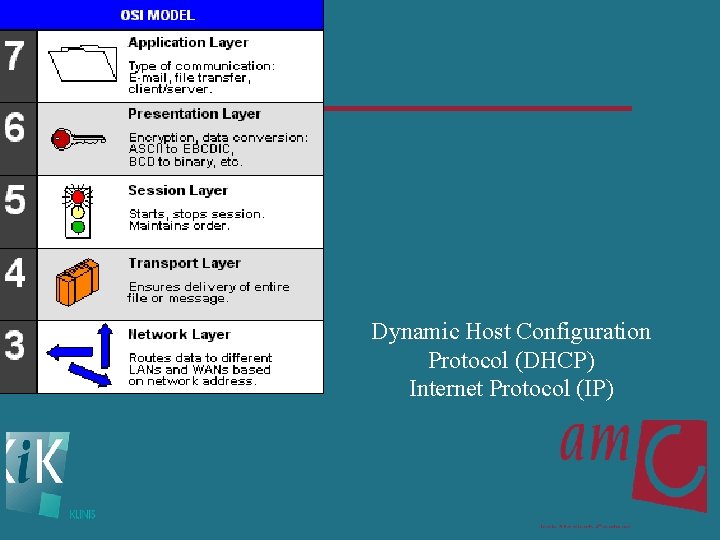
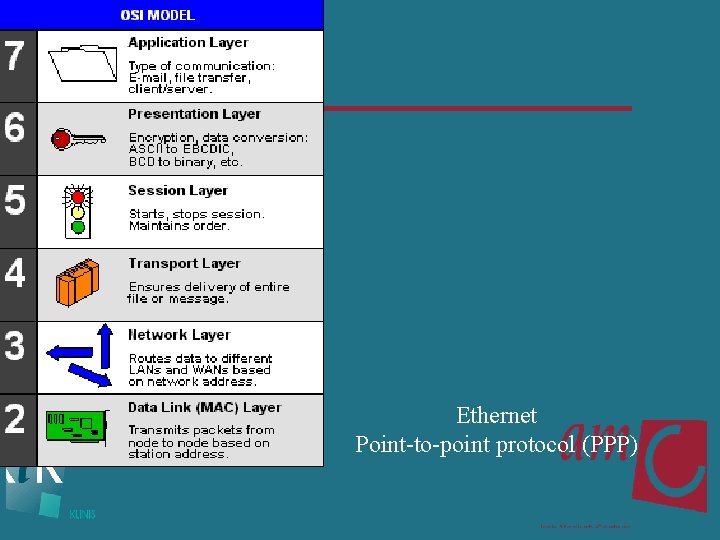
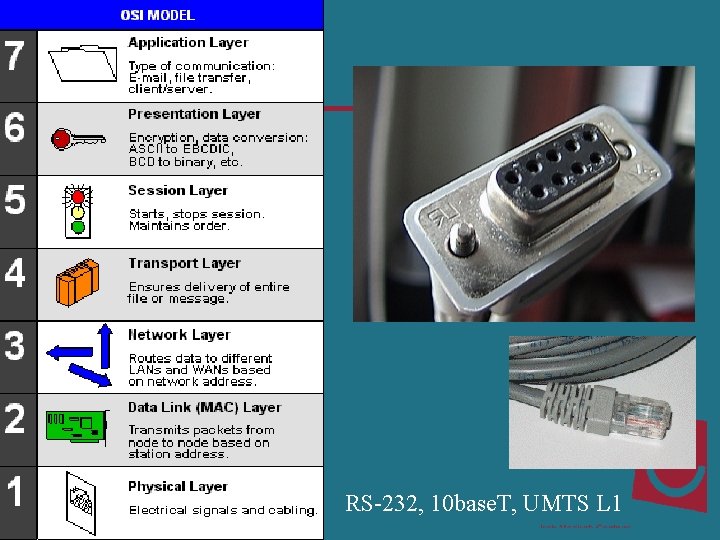
Standards – Examples u ISO/OSI Model u HL 7 u SNOMED CT
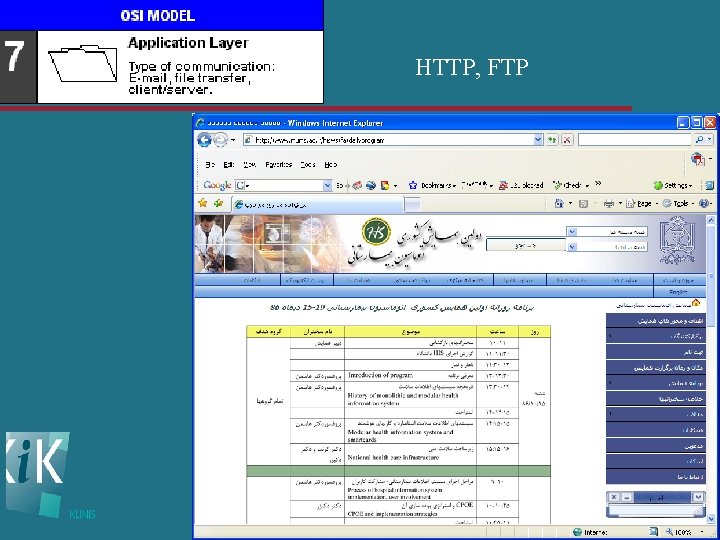
HTTP, FTP
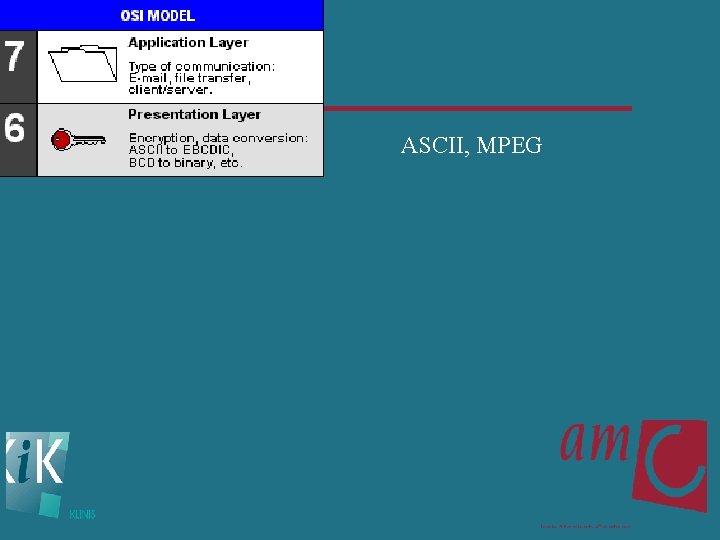
ASCII, MPEG
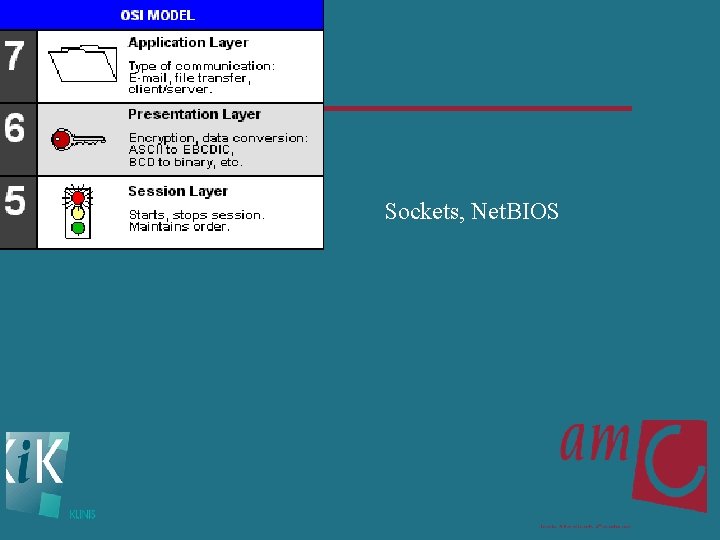
Sockets, Net. BIOS
Transmission Control Protocol (TCP) User Datagram Protocol (UDP)
Dynamic Host Configuration Protocol (DHCP) Internet Protocol (IP)
Ethernet Point-to-point protocol (PPP)
RS-232, 10 base. T, UMTS L 1
HL 7 – Health Level 7 u ANSI-accredited Standards Developing Organization u Focus on clinical and administrative data u Provides standards for interoperability that improve care delivery, optimize workflow, reduce ambiguity, and enhance knowledge transfer
HL 7 - organization u Started as an Ad hoc standards group u Turned into consensus-based process u Specification of data interchange u Originally focused on message syntax
HL 7 standards u Messaging Standard § HL 7 v 2. 4, HL 7 v 3 u Reference Information Model (RIM) u Clinical Document Architecture (CDA) u Clinical Context Management Specification (CCOW) u Arden Syntax for Medical Logic Systems
HL 7 version 3 u Based (RIM) on Reference Information Model § Data exchange § Representation § Terminology u Clinical Document Architecture (CDA) More on Wednesday…
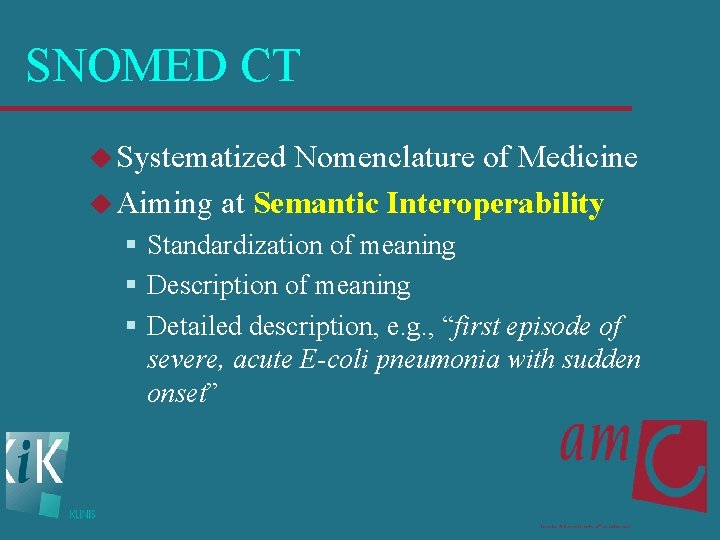
SNOMED CT u Systematized Nomenclature of Medicine u Aiming at Semantic Interoperability § Standardization of meaning § Description of meaning § Detailed description, e. g. , “first episode of severe, acute E-coli pneumonia with sudden onset”
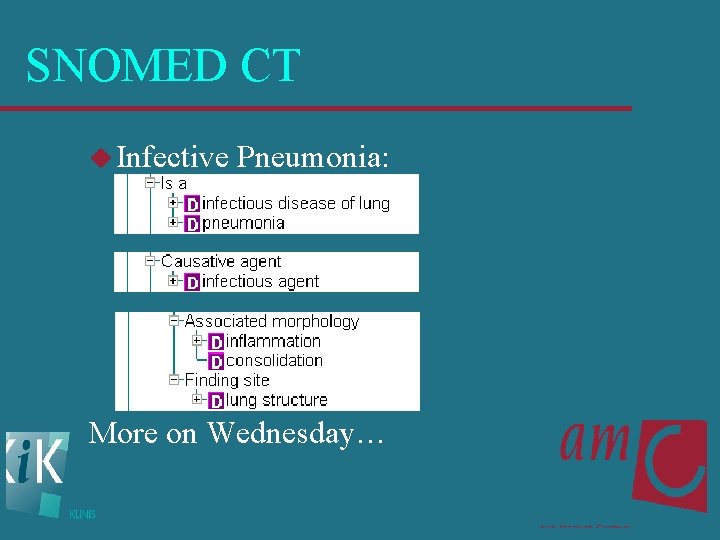
SNOMED CT u Infective Pneumonia: More on Wednesday…
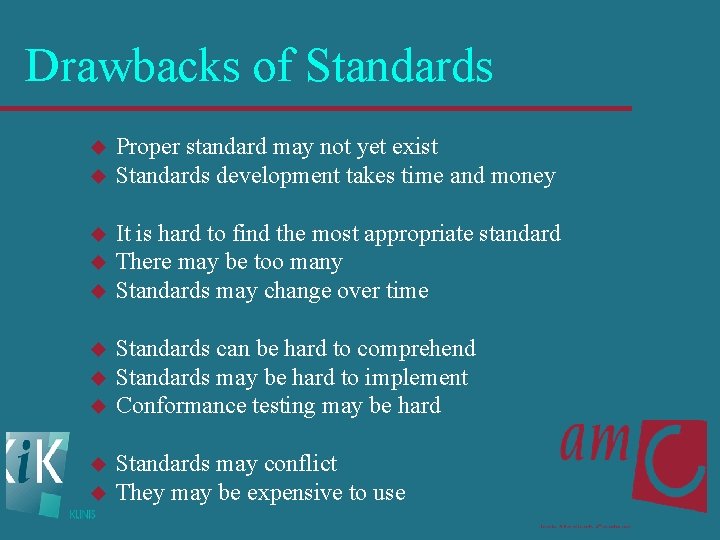
Drawbacks of Standards u u u u u Proper standard may not yet exist Standards development takes time and money It is hard to find the most appropriate standard There may be too many Standards may change over time Standards can be hard to comprehend Standards may be hard to implement Conformance testing may be hard Standards may conflict They may be expensive to use
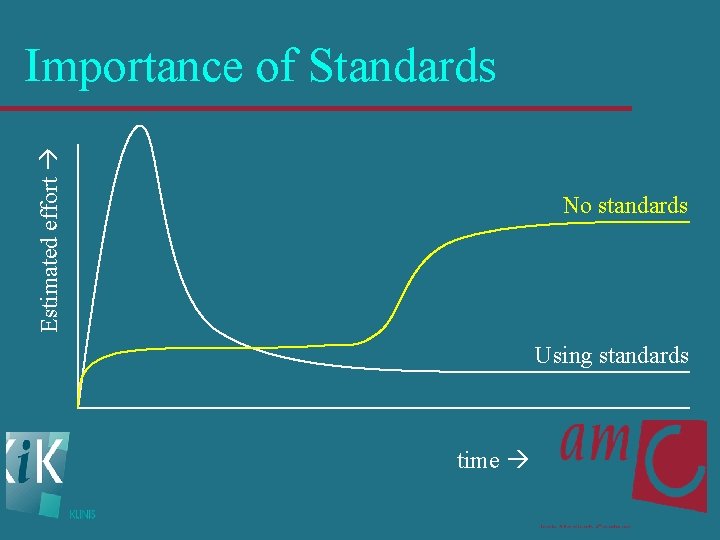
Estimated effort Importance of Standards No standards Using standards time
Importance of Standards u Increase (vendor) acceptance u Reduce (integration) cost u Availability of off-the-shelf tools u Maintenance
Applying standards u Determine context § (future) collaborations, usage u Determine § § § standards in relevant categories Architecture Application Conceptual Document Terminology Data exchange / Messaging
Final example: Units u 2 teams: design & implementation u Specification: metric units u Implementation group: English units (i. e. pounds force instead of Newton) u Conversion factor: 4. 45 u Overlooked…
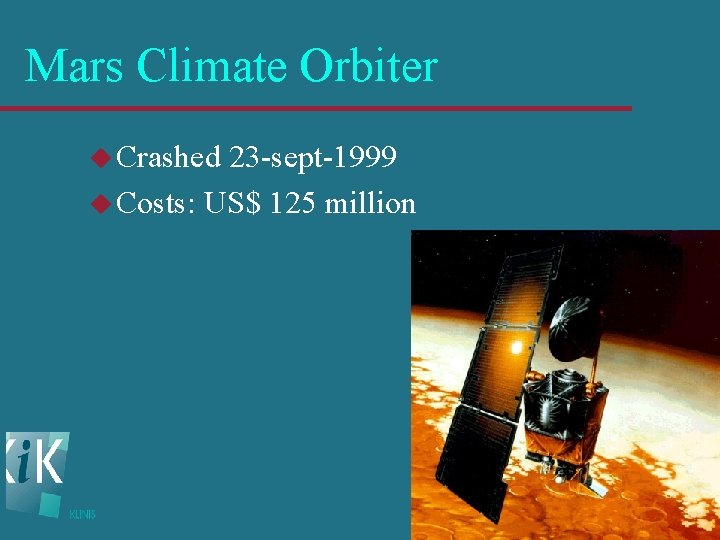
Mars Climate Orbiter u Crashed 23 -sept-1999 u Costs: US$ 125 million
Conclusion 千里之行,始於足下。 A journey of a thousand miles begins with a single step
Round-up u Standards require short-term investment for longer-term profit u Applying standards is standing on the shoulders of moving giants u Focus on standardization of “higher layers” (application, content and semantics)
More information www. hl 7. org www. ihtsdo. org www. iso. org r. cornet@amc. uva. nl