
The Role of Social Identity in Global Cooperation
The Role of Social Identity in Global Cooperation Nancy R. Buchan* University of South Carolina Marilynn B. Brewer University of New South Wales • Acknowledge: Margaret Foddy, Enrique Fatas, Gianluca Grimalda, Rick Wilson Funded by the National Science Foundation: Grants #0652277 & #0652310
Social Identity and Cooperation p Social identity plays a role in social dilemma decisions n In dyadic exchanges such as prisoners’ dilemmas (e. g. Dion, 1973; Miller, Downs & Prentice, 1998) n Or investment games (e. g. Buchan, Croson & n In resource dilemmas (e. g. Brewer & Kramer n In public goods dilemmas (De. Cremer & Dawes, 2002; Tanis & Postmes, 2005) 1986; Wit & Wilke, 1992) van. Vugt, 1999; Wit & Kerr, 2002)
Social Identity and Large-Scale Cooperation p Can social identity enhance cooperation in large, global collectives?
Globalization and Cooperation p Globalization: The increased connectivity (Tomlinson, 2000) and interdependence (Guillen, 2001) among people worldwide, and the intensified consciousness of the ‘world as a whole’ (Robertson, 1992). n p Individuals and nations differ in levels of globalization 6 Nation study of relationship between globalization and cooperation n Argentina, Iran, Italy, Russia, South Africa, Russia, USA

Globalization and Cooperation p Prior Results: Globalization at both the macro (nation) and micro (individual) levels is positively correlated with global cooperation. (Buchan, et. al. PNAS, 2009)
Globalization and Social Identity n Increased globalization should lead to development of global social identity n This would predict increased willingness to contribute to collective at global level n The relationship between globalization and cooperation will be accounted for, at least in part, by strength of individual global social identity
Social Identity and Collective Cooperation: Two Mechanisms p Expectations about others n General expectancy that others will be cooperative within the ingroup (Brewer, 1986; Yamagishi & Kiyonari, 2000) p Goal Transformation n Group identity involves a transformation of goals from the personal to the collective level (De Cremer & Van Vugt, 1999; Kramer & Brewer, 1986) p If both are operating, global social identification will have an effect on global cooperation above and beyond its relationship to expectations
The Method: Description of Sample p 6 Countries representing range of globalization at national level p p Quota Sample of “Real” people n n p Argentina, Iran, Italy, Russia, South Africa, Russia, USA Men and Women: 18 -70 All levels of SES: 4 th grade reading level Recruitment Criteria n n Have lived in given locality for at least 1 year Citizen of country studied p 1145 Subjects ~ 190 Ss per country p Cross-National Controls (Buchan, Croson, Dawes, 2002)
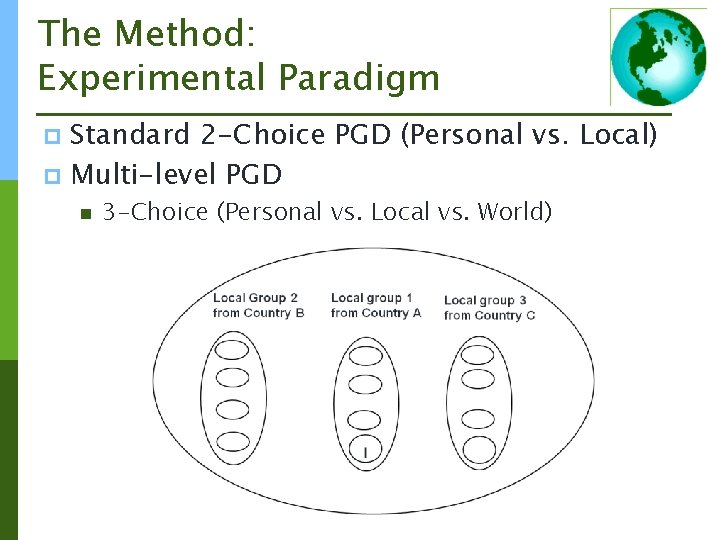
The Method: Experimental Paradigm Standard 2 -Choice PGD (Personal vs. Local) p Multi-level PGD p n 3 -Choice (Personal vs. Local vs. World)
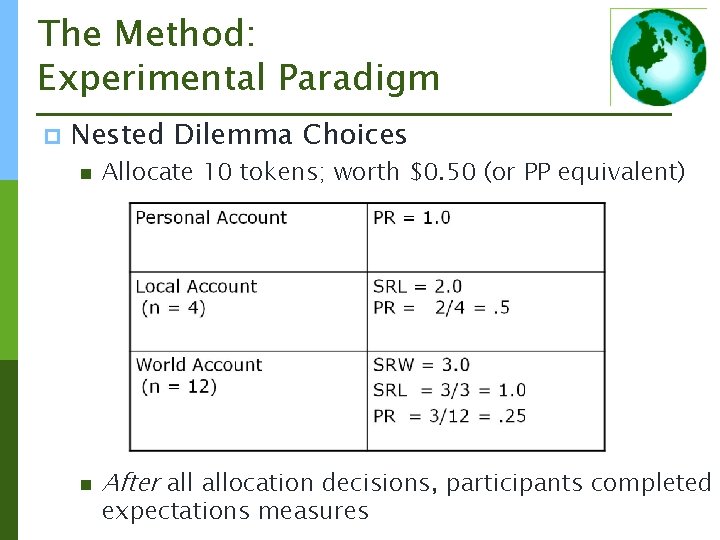
The Method: Experimental Paradigm p Nested Dilemma Choices n Allocate 10 tokens; worth $0. 50 (or PP equivalent) n After allocation decisions, participants completed expectations measures
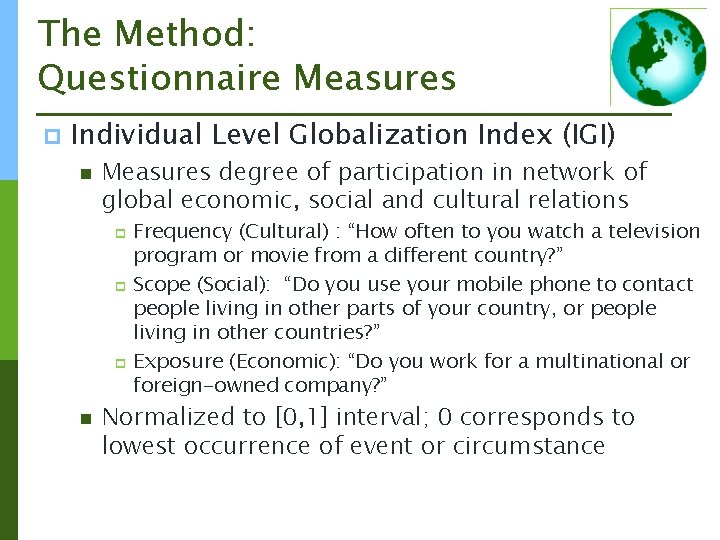
The Method: Questionnaire Measures p Individual Level Globalization Index (IGI) n Measures degree of participation in network of global economic, social and cultural relations Frequency (Cultural) : “How often to you watch a television program or movie from a different country? ” p Scope (Social): “Do you use your mobile phone to contact people living in other parts of your country, or people living in other countries? ” p Exposure (Economic): “Do you work for a multinational or foreign-owned company? ” p n Normalized to [0, 1] interval; 0 corresponds to lowest occurrence of event or circumstance
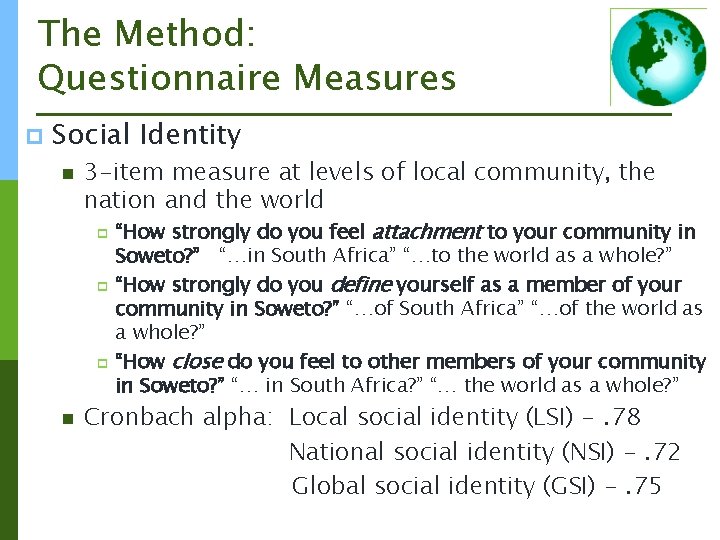
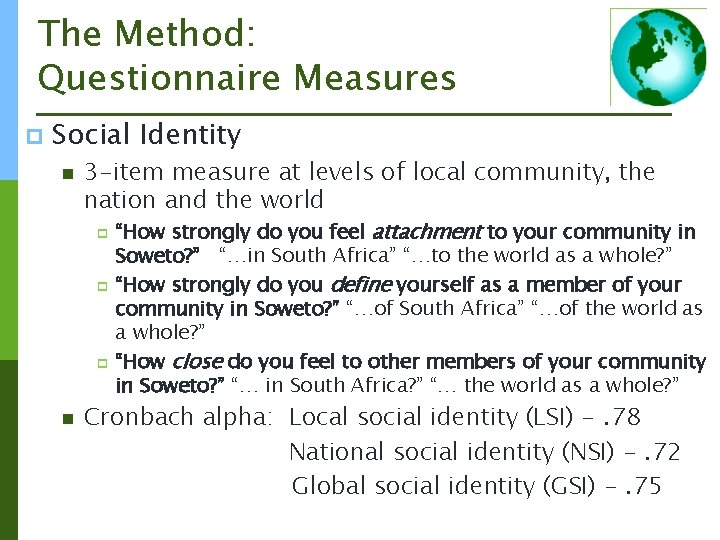
The Method: Questionnaire Measures p Social Identity n 3 -item measure at levels of local community, the nation and the world “How strongly do you feel attachment to your community in Soweto? ” “…in South Africa” “…to the world as a whole? ” p “How strongly do you define yourself as a member of your community in Soweto? ” “…of South Africa” “…of the world as a whole? ” p “How close do you feel to other members of your community in Soweto? ” “… in South Africa? ” “… the world as a whole? ” p n Cronbach alpha: Local social identity (LSI) -. 78 National social identity (NSI) -. 72 Global social identity (GSI) -. 75
The Method: Questionnaire Measures p Social Identity n 3 -item measure at levels of local community, the nation and the world “How strongly do you feel attachment to your community in Soweto? ” “…in South Africa” “…to the world as a whole? ” p “How strongly do you define yourself as a member of your community in Soweto? ” “…of South Africa” “…of the world as a whole? ” p “How close do you feel to other members of your community in Soweto? ” “… in South Africa? ” “… the world as a whole? ” p n Cronbach alpha: Local social identity (LSI) -. 78 National social identity (NSI) -. 72 Global social identity (GSI) -. 75
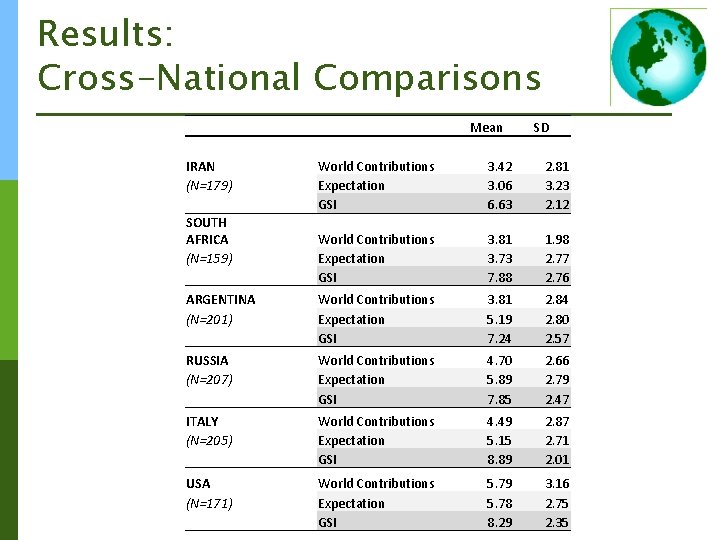
Results: Cross-National Comparisons Mean IRAN (N=179) SD World Contributions Expectation GSI 3. 42 3. 06 6. 63 2. 81 3. 23 2. 12 World Contributions Expectation GSI 3. 81 3. 73 7. 88 1. 98 2. 77 2. 76 ARGENTINA (N=201) World Contributions Expectation GSI 3. 81 5. 19 7. 24 2. 80 2. 57 RUSSIA (N=207) World Contributions Expectation GSI 4. 70 5. 89 7. 85 2. 66 2. 79 2. 47 ITALY (N=205) World Contributions Expectation GSI 4. 49 5. 15 8. 89 2. 87 2. 71 2. 01 USA (N=171) World Contributions Expectation GSI 5. 79 5. 78 8. 29 3. 16 2. 75 2. 35 SOUTH AFRICA (N=159)
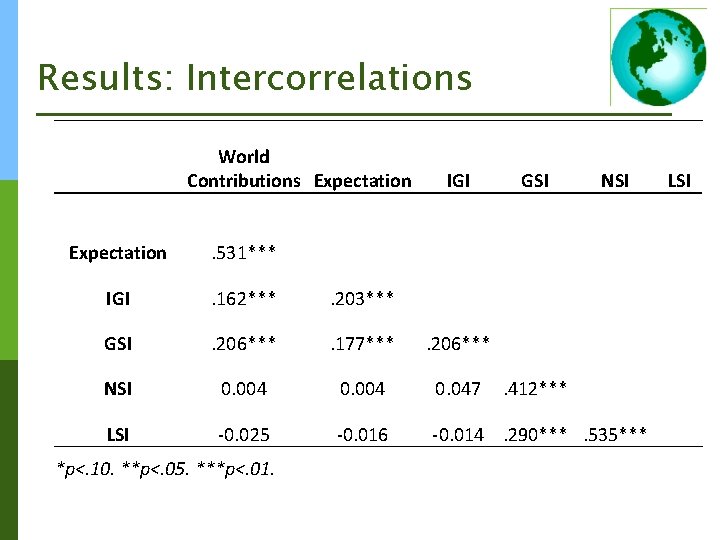
Results: Intercorrelations World Contributions Expectation IGI GSI NSI Expectation . 531*** IGI . 162*** . 203*** GSI . 206*** . 177*** . 206*** NSI 0. 004 0. 047 LSI -0. 025 -0. 016 -0. 014. 290***. 535*** *p<. 10. **p<. 05. ***p<. 01. . 412*** LSI
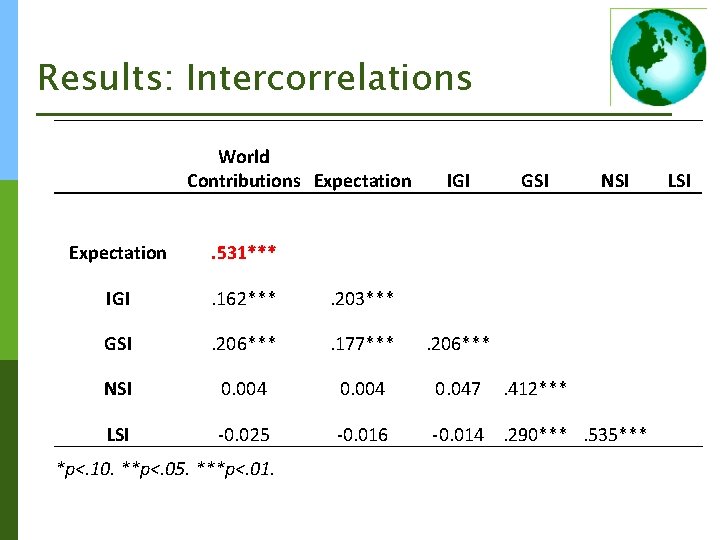
Results: Intercorrelations World Contributions Expectation IGI GSI NSI Expectation . 531*** IGI . 162*** . 203*** GSI . 206*** . 177*** . 206*** NSI 0. 004 0. 047 LSI -0. 025 -0. 016 -0. 014. 290***. 535*** *p<. 10. **p<. 05. ***p<. 01. . 412*** LSI
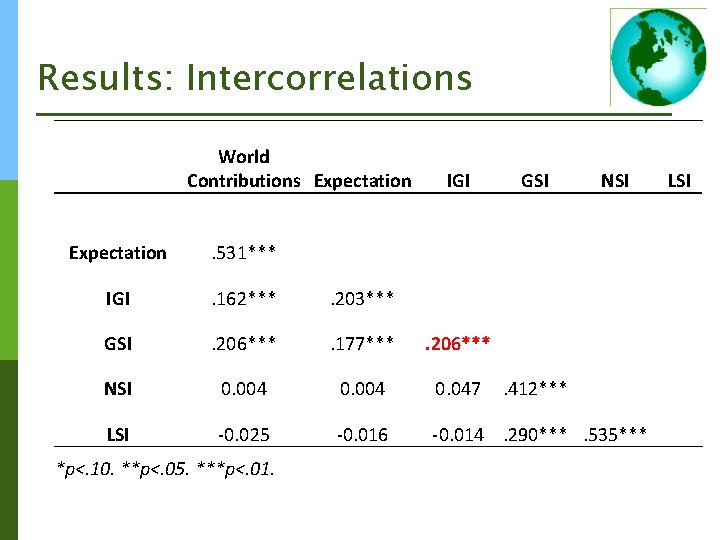
Results: Intercorrelations World Contributions Expectation IGI GSI NSI Expectation . 531*** IGI . 162*** . 203*** GSI . 206*** . 177*** . 206*** NSI 0. 004 0. 047 LSI -0. 025 -0. 016 -0. 014. 290***. 535*** *p<. 10. **p<. 05. ***p<. 01. . 412*** LSI
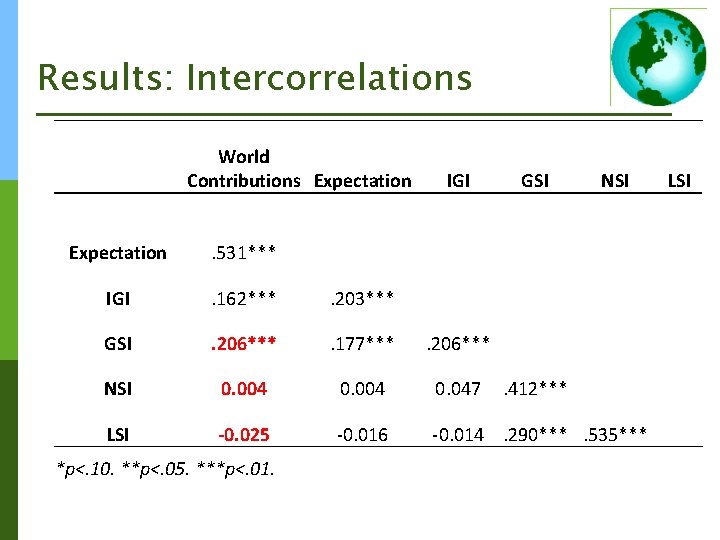
Results: Intercorrelations World Contributions Expectation IGI GSI NSI Expectation . 531*** IGI . 162*** . 203*** GSI . 206*** . 177*** . 206*** NSI 0. 004 0. 047 LSI -0. 025 -0. 016 -0. 014. 290***. 535*** *p<. 10. **p<. 05. ***p<. 01. . 412*** LSI
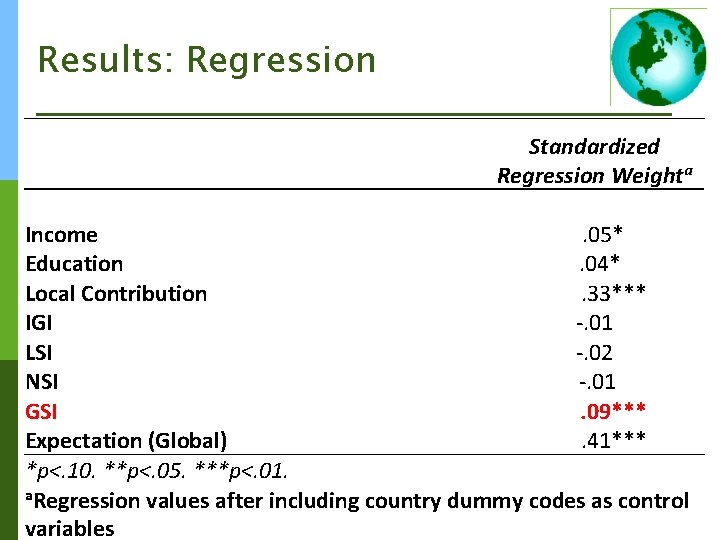
Results: Regression Standardized Regression Weighta Income. 05* Education. 04* Local Contribution. 33*** IGI -. 01 LSI -. 02 NSI -. 01 GSI. 09*** Expectation (Global). 41*** *p<. 10. **p<. 05. ***p<. 01. a. Regression values after including country dummy codes as control variables
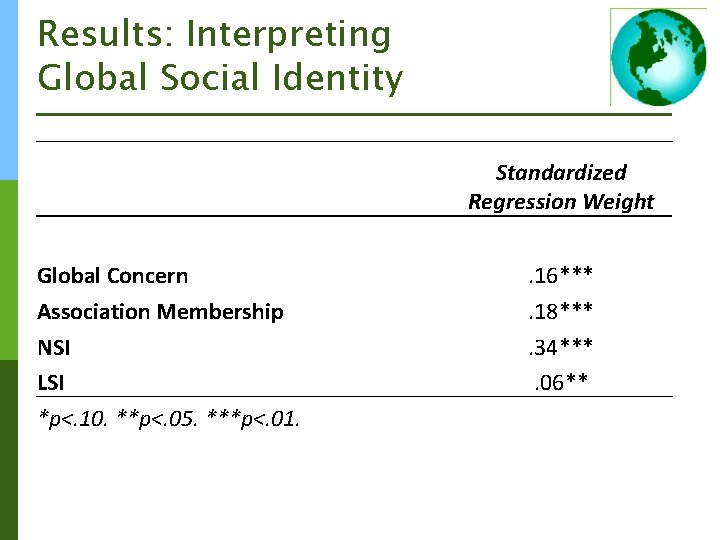
Results: Interpreting Global Social Identity Standardized Regression Weight Global Concern Association Membership NSI LSI *p<. 10. **p<. 05. ***p<. 01. . 16***. 18***. 34***. 06**
Discussion p Implications for Non-Parochial Cooperation and Identity Inclusiveness
- Slides: 21