
The Role of Psychology Within Addiction Services Dr


- Slides: 12
The Role of Psychology Within Addiction Services Dr Mette Kreis, Clinical Psychologist Prison Addiction Clinical Psychology Service, NHS Forth Valley Dr Carin Killips, Counselling Psychologist NHS Lanarkshire Addiction and BBV Psychology Service Alcohol, Drugs and Hepatitis C conference, Edinburgh, 24 th June 2015
Outline of talk Mette: o The consultation model o Case formulation with teams o Developing a consultation-based Clinical Psychology Service within prisons Carin: o The role of psychology in community addiction and BBV services o Current BBV pathways.
What is consultation? o o o A reflective space to think and review what’s going on between client and staff/team Open, enquiring, reflexive and psychologically informed approach Collaborative - not ‘expert’ position Empower consultee by helping to draw out and enhance their skills Not supervision: consultant not responsible or accountable for consultee’s clinical practice or for client’s care. (Lake, 2008)
Why use consultation with staff teams? o o Increases access to psychological therapies in underresourced areas, using stepped care approach Enables skills sharing/building in psychological interventions across work force Helps to develop more psychologically informed teams and organisations Way of supporting and containing staff in remaining open, empathic and compassionate. (BPS, 2007; Lake, 2008; Svanberg & Kreis, 2013)
Case formulation with teams Formulation: o Helps to summarise and make sense of client’s difficulties using psychological theories and principles (why this person came to have this problem at this time) o Non diagnostic - considers multiple factors (biopsychosocial) that may be involved in the development and maintenance of client’s difficulties, and how these may relate to one another o Indicates a plan of intervention o Open to revision and re-formulation (BPS, 2007, 2011)
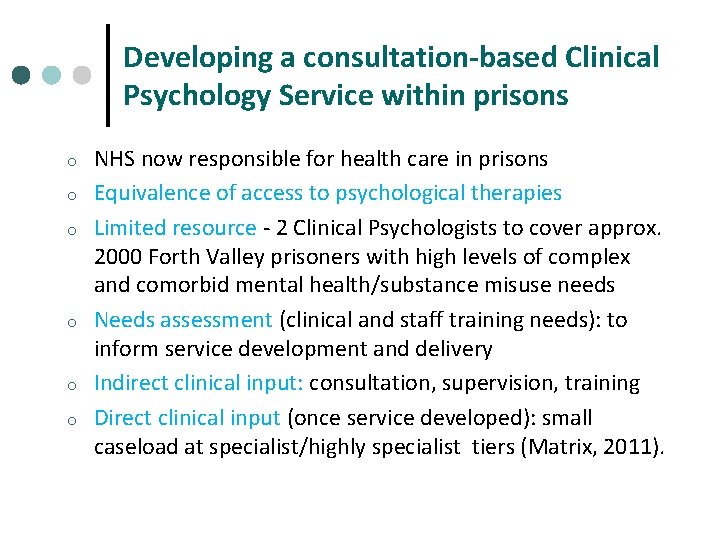
Developing a consultation-based Clinical Psychology Service within prisons o o o NHS now responsible for health care in prisons Equivalence of access to psychological therapies Limited resource - 2 Clinical Psychologists to cover approx. 2000 Forth Valley prisoners with high levels of complex and comorbid mental health/substance misuse needs Needs assessment (clinical and staff training needs): to inform service development and delivery Indirect clinical input: consultation, supervision, training Direct clinical input (once service developed): small caseload at specialist/highly specialist tiers (Matrix, 2011).
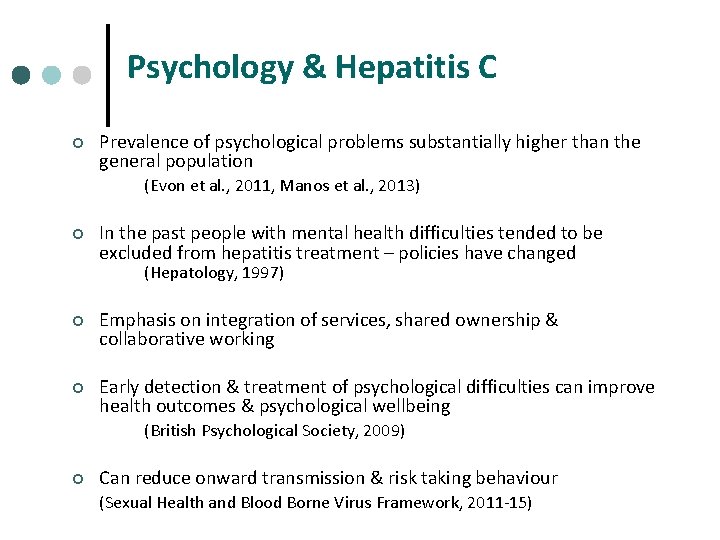
Psychology & Hepatitis C ¢ Prevalence of psychological problems substantially higher than the general population (Evon et al. , 2011, Manos et al. , 2013) ¢ In the past people with mental health difficulties tended to be excluded from hepatitis treatment – policies have changed (Hepatology, 1997) ¢ Emphasis on integration of services, shared ownership & collaborative working ¢ Early detection & treatment of psychological difficulties can improve health outcomes & psychological wellbeing (British Psychological Society, 2009) ¢ Can reduce onward transmission & risk taking behaviour (Sexual Health and Blood Borne Virus Framework, 2011 -15)
Role of Psychology ¢ Locality Integrated Addiction Service & Lanarkshire BBV Networks l Consultation (BPS, 2007; HCPC, 2012) l Multidisciplinary Team working (HCPC, 2012; Matrix, 2008) l Evidence based psychosocial interventions training agenda (NICE, 2007) • Upskilling staff • Supervision & Coaching l l l Audit & research Awareness raising Hepatitis C Pathway
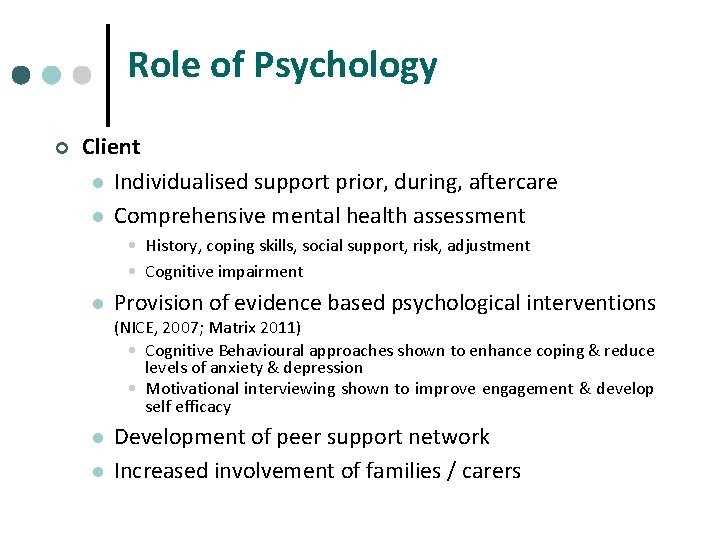
Role of Psychology ¢ Client l Individualised support prior, during, aftercare l Comprehensive mental health assessment • History, coping skills, social support, risk, adjustment • Cognitive impairment l Provision of evidence based psychological interventions (NICE, 2007; Matrix 2011) • Cognitive Behavioural approaches shown to enhance coping & reduce levels of anxiety & depression • Motivational interviewing shown to improve engagement & develop self efficacy l l Development of peer support network Increased involvement of families / carers
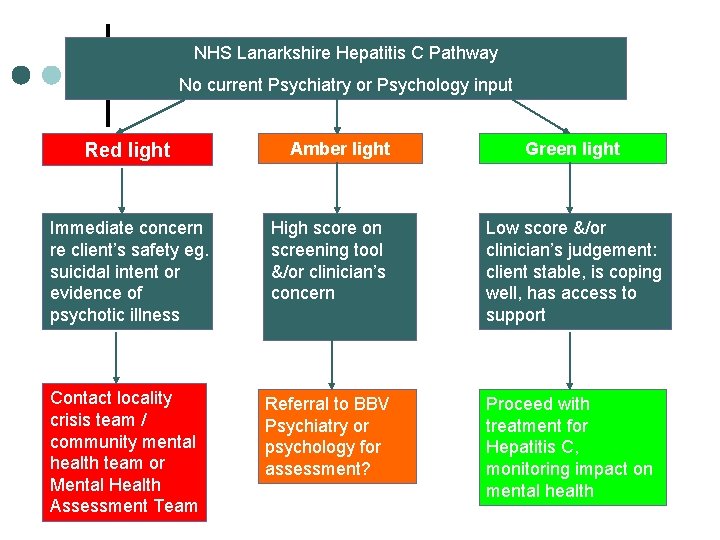
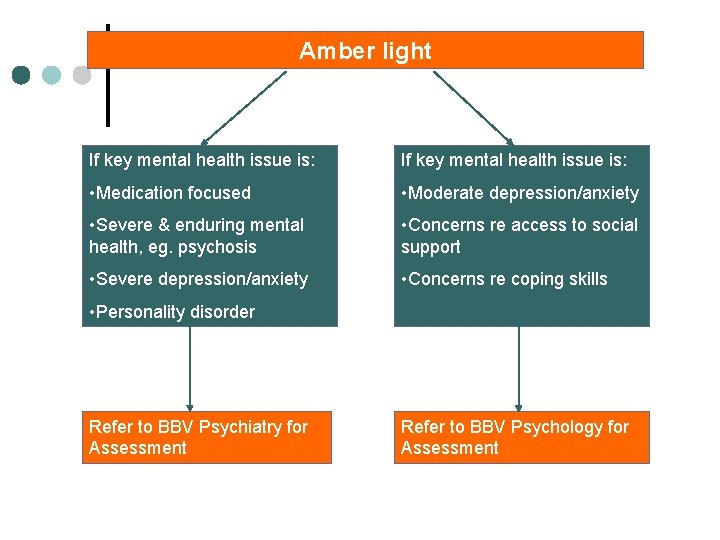
NHS Lanarkshire Hepatitis C Pathway No current Psychiatry or Psychology input Red light Amber light Green light Immediate concern re client’s safety eg. suicidal intent or evidence of psychotic illness High score on screening tool &/or clinician’s concern Low score &/or clinician’s judgement: client stable, is coping well, has access to support Contact locality crisis team / community mental health team or Mental Health Assessment Team Referral to BBV Psychiatry or psychology for assessment? Proceed with treatment for Hepatitis C, monitoring impact on mental health
Amber light If key mental health issue is: • Medication focused • Moderate depression/anxiety • Severe & enduring mental health, eg. psychosis • Concerns re access to social support • Severe depression/anxiety • Concerns re coping skills • Personality disorder Refer to BBV Psychiatry for Assessment Refer to BBV Psychology for Assessment
Thank you! mettekreis@nhs. net Carin. Killips@lanarkshire. scot. nhs. uk