
The role of negative feedback HIGHER ONLY Do
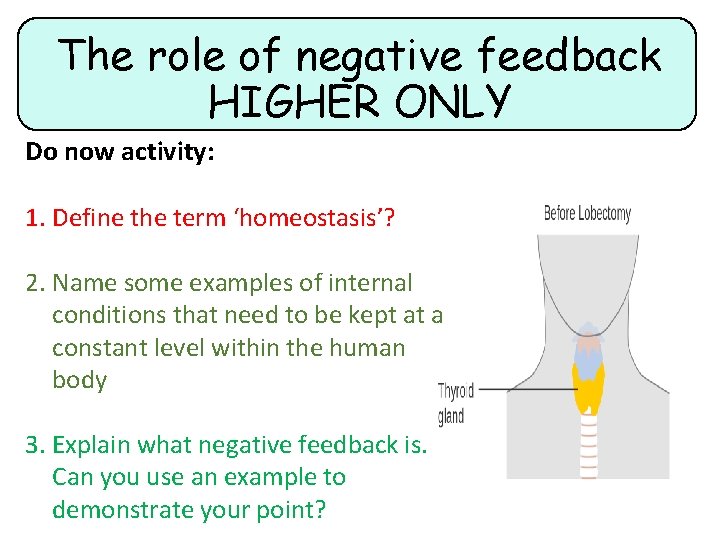
The role of negative feedback HIGHER ONLY Do now activity: 1. Define the term ‘homeostasis’? 2. Name some examples of internal conditions that need to be kept at a constant level within the human body 3. Explain what negative feedback is. Can you use an example to demonstrate your point?
Progress indicators GOOD PROGRESS: Describe the importance of negative feedback systems Identify the glands that secrete adrenaline and thyroxine OUTSTANDING PROGRESS: Explain the role of adrenaline and thyroxine in the body
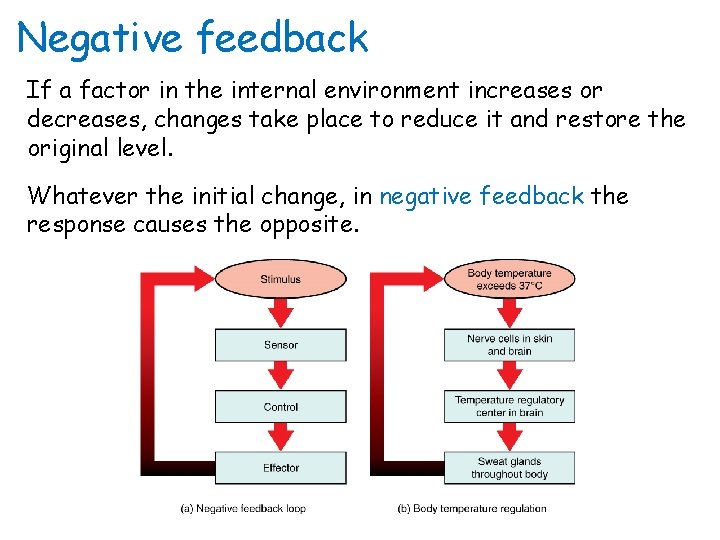
Negative feedback If a factor in the internal environment increases or decreases, changes take place to reduce it and restore the original level. Whatever the initial change, in negative feedback the response causes the opposite.
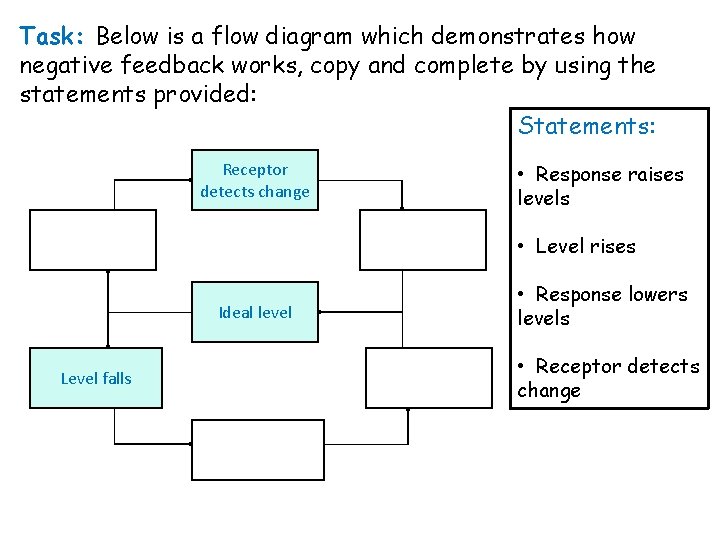
Task: Below is a flow diagram which demonstrates how negative feedback works, copy and complete by using the statements provided: Statements: Receptor detects change • Response raises levels • Level rises Ideal level Level falls • Response lowers levels • Receptor detects change
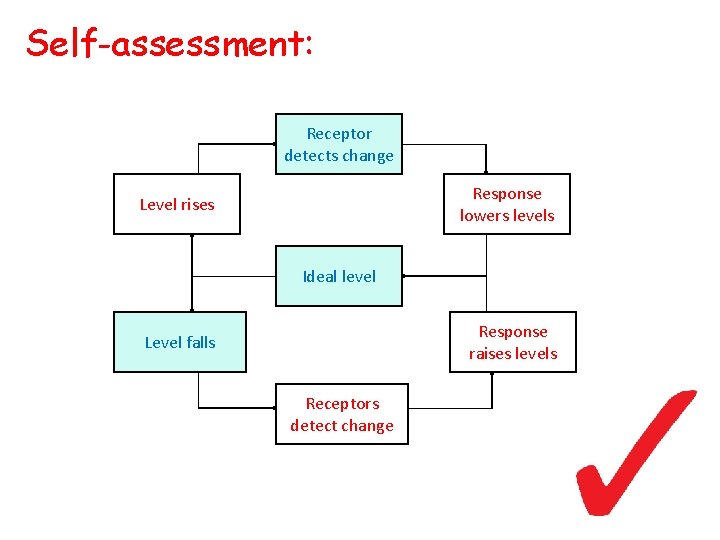
Self-assessment: Receptor detects change Response lowers levels Level rises Ideal level Response raises levels Level falls Receptors detect change
Thyroxine and negative feedback The thyroid gland in your neck uses iodine from your diet to produce the hormone thyroxine. Can you remember the role of thyroxine? Thyroxine controls the basal metabolic rate of the body Why is this important? Determines how quickly substances are broken down and built up, how much oxygen your tissues use and the development of the brain in a growing child. It therefore plays a huge role in growth and development.
Task: Read the information on thyroxine and adrenaline and answer the following questions: 1. Why is adrenaline an important hormone for (2 marks) organisms? 2. What effects can adrenaline cause to happen once it is released from the adrenal glands? (4 marks) 3. Compare the role of thyroxine in the body and the way it is controlled with the role and control system of adrenaline. (4 marks)
Self-assessment: 1. Adrenaline is an important hormone as via various mechanisms it boosts the delivery of oxygen and glucose to your brain in order to prepare your body for action. This enables you to react quickly in situations where you may be at risk of harm. 2. Once adrenaline is released from the adrenal glands it can cause a number of effects including increased heart an breathing rate, glycogen being converted to glucose to be used in respiration, dilation of pupils, heightened mental awareness and blood diverted to muscles in the limbs. 3. Thyroxine is needed to control the metabolic rate of the body, this plays an important role in growth and development. The levels of thyroxine in the blood are monitored by a sensor in the brain, when these levels fall to low the pituitary gland is triggered to released more TSH. The TSH travels to the thyroid gland triggers more thyroxine to be secreted. This is an example of a negative feedback loop. Adrenaline is needed to prepare the body for fight or flight mode, ensuring a quick reaction during an intense and stressful situation. The levels of adrenaline in the blood is not monitored by any sensors, the adrenal glands will only secrete adrenaline in situations where it is required. When this situation is over the adrenal glands will cease to release adrenaline. This control system does not involve a negative feedback loop.
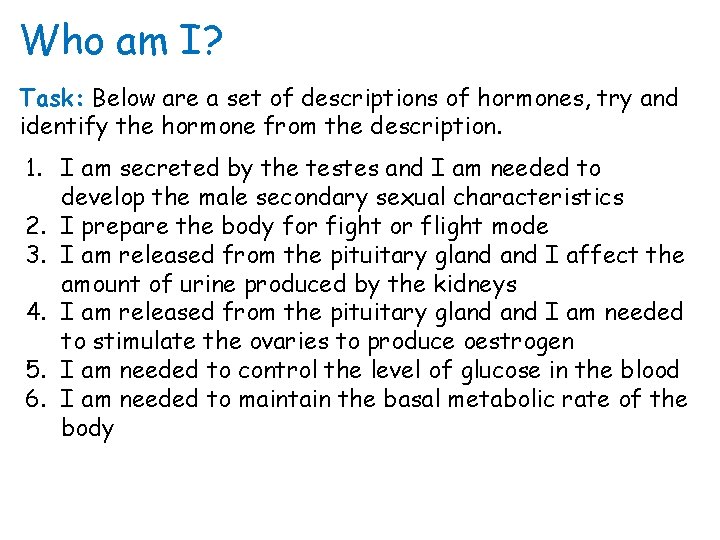
Who am I? Task: Below are a set of descriptions of hormones, try and identify the hormone from the description. 1. I am secreted by the testes and I am needed to develop the male secondary sexual characteristics 2. I prepare the body for fight or flight mode 3. I am released from the pituitary gland I affect the amount of urine produced by the kidneys 4. I am released from the pituitary gland I am needed to stimulate the ovaries to produce oestrogen 5. I am needed to control the level of glucose in the blood 6. I am needed to maintain the basal metabolic rate of the body
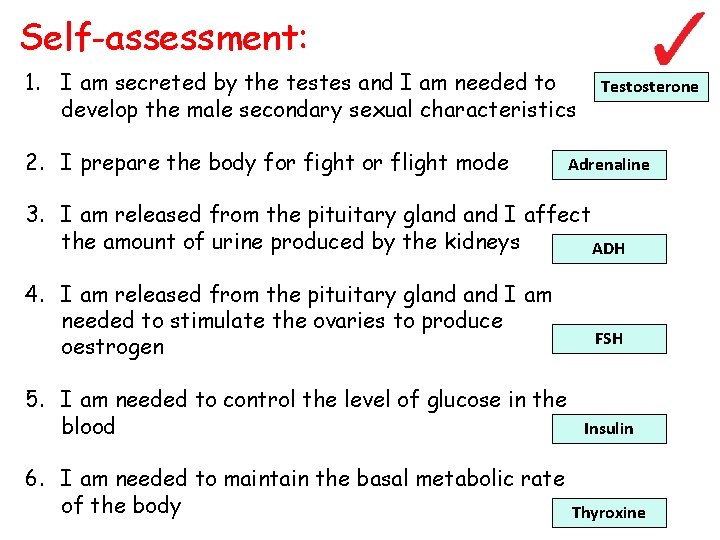
Self-assessment: 1. I am secreted by the testes and I am needed to develop the male secondary sexual characteristics 2. I prepare the body for fight or flight mode Testosterone Adrenaline 3. I am released from the pituitary gland I affect the amount of urine produced by the kidneys ADH 4. I am released from the pituitary gland I am needed to stimulate the ovaries to produce oestrogen FSH 5. I am needed to control the level of glucose in the blood Insulin 6. I am needed to maintain the basal metabolic rate of the body Thyroxine
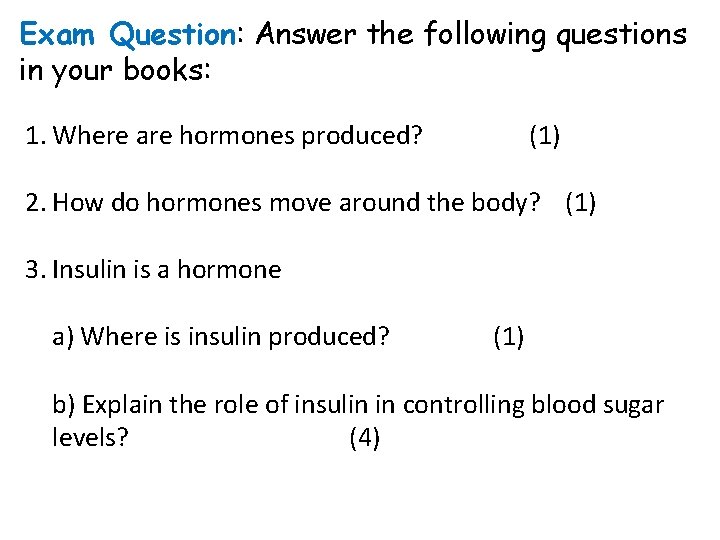
Exam Question: Answer the following questions in your books: 1. Where are hormones produced? (1) 2. How do hormones move around the body? (1) 3. Insulin is a hormone a) Where is insulin produced? (1) b) Explain the role of insulin in controlling blood sugar levels? (4)
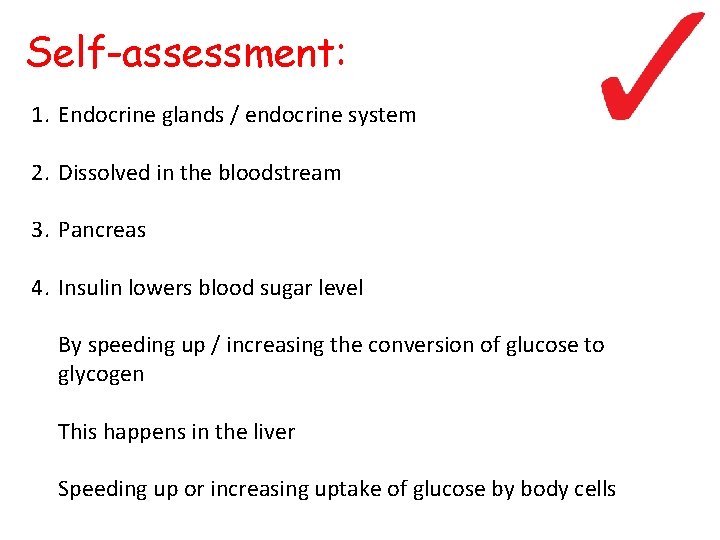
Self-assessment: 1. Endocrine glands / endocrine system 2. Dissolved in the bloodstream 3. Pancreas 4. Insulin lowers blood sugar level By speeding up / increasing the conversion of glucose to glycogen This happens in the liver Speeding up or increasing uptake of glucose by body cells

Plenary: Write a text message to your friend to tell them about what you have learnt today!
Resources
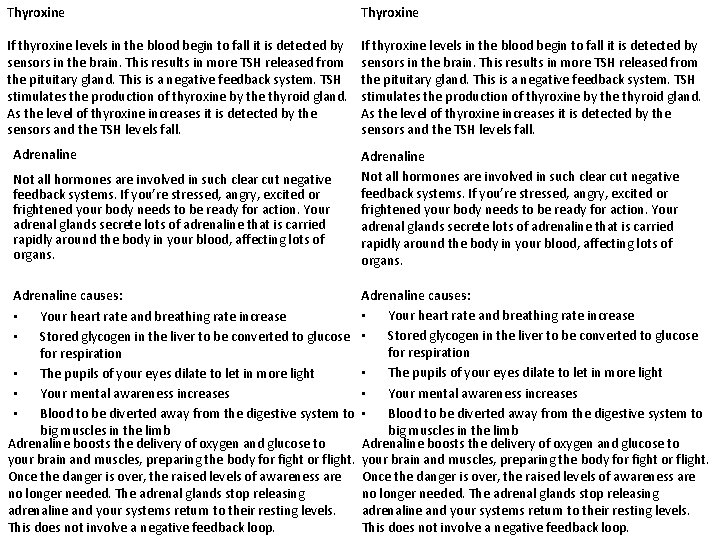
Thyroxine If thyroxine levels in the blood begin to fall it is detected by sensors in the brain. This results in more TSH released from the pituitary gland. This is a negative feedback system. TSH stimulates the production of thyroxine by the thyroid gland. As the level of thyroxine increases it is detected by the sensors and the TSH levels fall. Adrenaline Not all hormones are involved in such clear cut negative feedback systems. If you’re stressed, angry, excited or frightened your body needs to be ready for action. Your adrenal glands secrete lots of adrenaline that is carried rapidly around the body in your blood, affecting lots of organs. Adrenaline causes: • Your heart rate and breathing rate increase • Stored glycogen in the liver to be converted to glucose for respiration • The pupils of your eyes dilate to let in more light • Your mental awareness increases • Blood to be diverted away from the digestive system to big muscles in the limb Adrenaline boosts the delivery of oxygen and glucose to your brain and muscles, preparing the body for fight or flight. Once the danger is over, the raised levels of awareness are no longer needed. The adrenal glands stop releasing adrenaline and your systems return to their resting levels. This does not involve a negative feedback loop.
- Slides: 15